
Understanding audience psychology print magazines is essential. Luxury audiences engage more deeply with print magazines when design and editorial choices signal that the publication was made specifically for them, through restrained typography, deliberate pacing, and imagery that matches the brand’s actual world rather than stock aspiration. Print also carries a psychological weight digital can’t replicate: holding a physical object, returning to it on a coffee table, and associating its weight and paper stock with quality all build brand perception slowly and durably. That combination, considered craft plus physical permanence, is what turns a magazine from a one-off marketing piece into a long-term brand asset.
How Do Design and Editorial Choices Shape Audience Psychology in Print Magazines?
Every design and editorial decision in a magazine tells the reader, before they read a single word, whether the publication was built for them or built to sell to them. This is the core mechanism behind audience psychology print magazines rely on: readers form judgments about quality and relevance almost instantly, based on cues they rarely consciously name. Researchers who study perception and attention have long documented how quickly people form these snap judgments; the American Psychological Association’s Monitor on Psychology covers ongoing research into how visual cues shape trust and credibility, which maps closely onto how readers evaluate a printed page.
What Design Elements Most Influence How Readers Absorb and Retain Brand Messaging?
Layout pacing controls reading speed, and reading speed controls retention. A page with generous white space, a deliberate image-to-text ratio, and clear section breaks forces the eye to slow down, the reader lingers instead of skimming. That slower pace is not wasted time. It gives the brand’s message room to land, rather than compete for attention against six other headlines on a cluttered page.
Typography carries the same weight before any sentence is read. A considered typeface, weight, letter spacing, the choice between serif and sans-serif, signals register the way a tailored suit signals occasion. Luxury readers read restraint as competence. A cramped, default-feeling font reads as an afterthought, no matter how good the writing underneath it is.
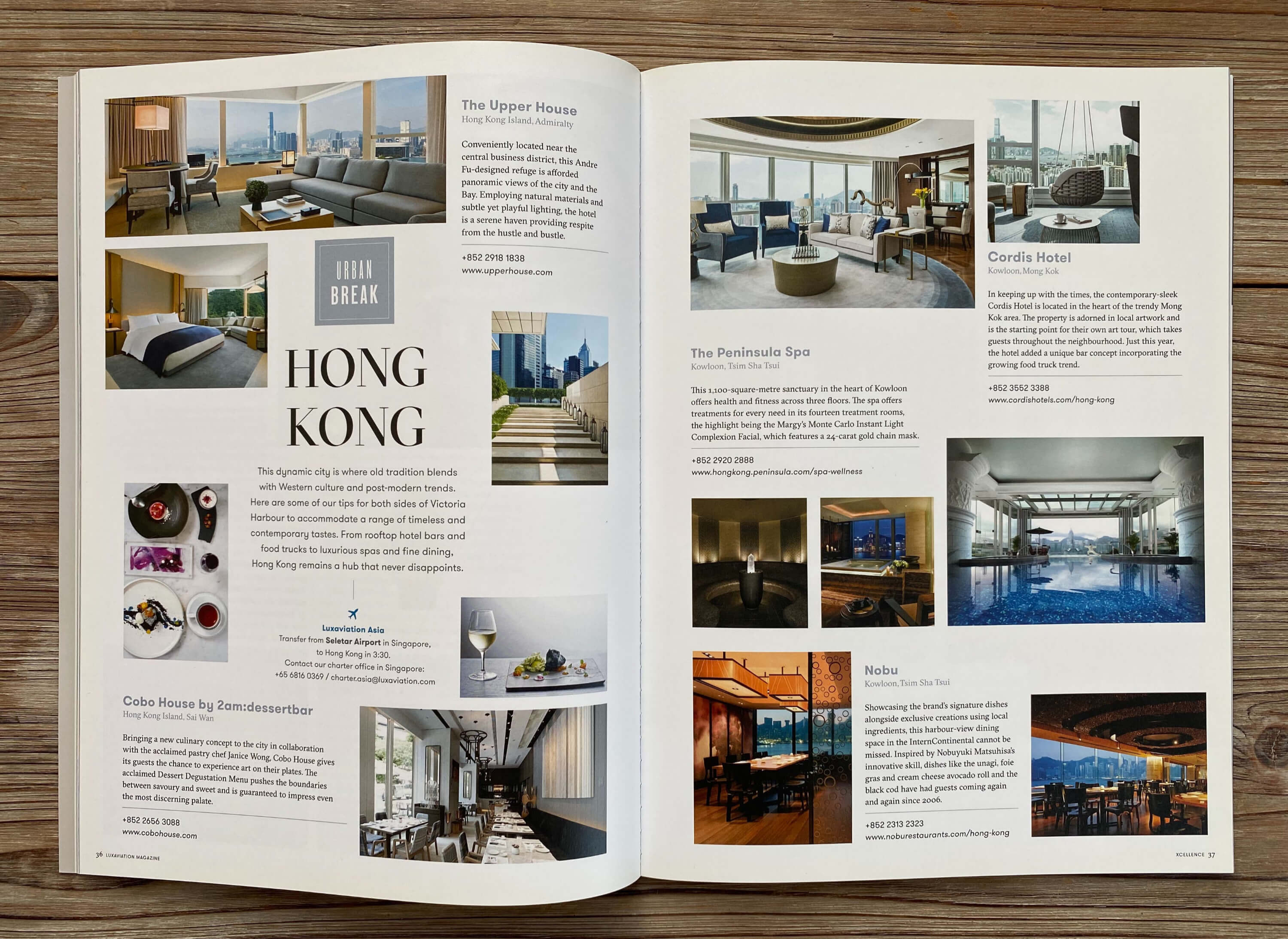
Imagery does the heaviest lifting of all. Photography drawn from the brand’s actual world, its properties, its people, its craft, tells a reader the publication understands their world. Generic aspirational stock photography does the opposite: it tells the reader they’re being targeted, not addressed. That distinction is often the difference between a magazine kept on a coffee table and one left in a waiting room.
How Does Editorial Curation Affect Which Audiences Feel a Publication Was Made for Them?
What a magazine leaves out matters as much as what it includes. Editorial curation, choosing which stories earn a place and rejecting the ones that dilute the publication’s point of view, creates a sense of exclusivity no brochure can fake by adding more content. A brochure tries to cover everything relevant to a sale. An edited magazine has a spine: a point of view that runs through every issue and gives readers a reason to trust the selection.
This is the line Rethink Publishing draws with every client before design work begins, the editorial spine gets defined first, because a magazine with a real point of view reads as authority, while one without it reads as marketing no matter how expensive the paper stock feels. This same principle shows up in how psychology publications curate their own content; the Valant guide to leading psychology magazines and journals highlights how selective editorial standards build reader trust over time, a dynamic that mirrors audience psychology print magazines depend on for credibility.
Why Does the Tactile Print Experience Create Deeper Brand Perception Than Digital?
A physical magazine engages touch, sight, and even smell at once, while a screen only ever engages sight, and that difference in sensory load changes how much value a reader assigns to the content itself.
What Psychological Factors Make Holding a Physical Magazine Different From Scrolling on Screen?
Weight in the hand signals substance before a single word gets read. Paper stock, the resistance of a page turning, the sound of a spine cracking open, none of that exists on a screen, and none of it can be faked by a PDF. This is the starting point for audience psychology print magazines: readers form judgments about quality from the object itself, before they evaluate the writing or design inside it.
Screens are built for interruption. A notification, a new tab, an incoming message, every scroll competes with something else demanding attention within seconds. Print removes all of that. There is no push alert competing with a magazine spread, which is why a reader who opens a physical issue tends to stay with it for a full sitting rather than skimming and switching. That uninterrupted stretch of attention is exactly what a brand pays for and rarely gets from a digital send.
How Does the Permanence of Print Build Brand Loyalty Over Time?
A magazine placed on a coffee table doesn’t disappear after one viewing, it gets picked up again next week, and again the week after, by the client, their spouse, or a guest waiting in the room. Each of those moments compounds the brand impression a little further, while a digital newsletter typically gets one open and one scroll before it’s gone. This repeated, passive exposure in a home, a waiting room, or an office lobby builds familiarity the same way seeing a person regularly builds trust, slowly, without effort, and without a sales pitch attached.
Print also carries an implicit credibility signal that digital struggles to match. There are no banner ads, no algorithmic feed deciding what appears next, no autoplay video interrupting the page. That absence of clutter reads as editorial integrity, and readers extend that same credibility to the brand behind the publication. It’s part of why Rethink Publishing builds every custom magazine and coffee-table book around an editorial spine first, the content has to earn the trust the format already grants it.
What Role Does Magazine Design Play in Creating a Lasting Marketing Asset?
Design decides whether a magazine ends up on a coffee table for years or in a recycling bin within a week, the paper, the binding, and the page count all send a signal before anyone reads a word.
How Should Brands Balance Aesthetic Beauty With Strategic Messaging?
A magazine built only for beauty has no purpose beyond decoration. One built only to sell reads like a brochure with better fonts, and readers spot the difference immediately.
Both have to be planned together, starting at the brief. Before a single layout is sketched, the editorial spine needs to define what the brand is actually saying, who’s reading it, and what story earns their attention. Design then serves that spine rather than dressing it up after the fact. This is where audience psychology print magazines intersect most directly: the visual choices, typography, white space, image scale, shape how credible and how permanent a publication feels, and that perception is inseparable from the words sitting next to it.
What Design Decisions Determine Whether a Magazine Feels Like a Keepsake or Disposable Marketing?
Several concrete choices separate a keepsake from something a reader tosses after one flip-through.
- Paper stock and binding. A heavier, matte or uncoated stock and a proper perfect-bound or stitched spine signal durability. Flimsy paper and saddle-stitching read as disposable, no matter how good the photography is.
- Cover durability. A cover that can survive being picked up repeatedly, carried in a bag, or displayed on a shelf holds up over the years a brand wants it in circulation.
- Page count that earns its size. A publication needs enough substance to justify permanence, too thin and it feels like a pamphlet stretched thinner.
- Design that ages well. Chasing a current trend dates a magazine within a year. Restrained, editorial-grade design holds its relevance the way a well-made book does.
Content placement matters just as much as paper weight. Case studies, thought leadership, and brand story need to live inside the editorial flow, not bolted on as a sidebar that screams “advertisement.” Woven in properly, that content stays relevant on a shelf for years rather than weeks, because it reads as insight rather than pitch.
None of this holds together if strategy, editorial, design, and print are handled by separate vendors. Rethink Publishing manages all of it as one process, editorial direction first, then layout, image sourcing, and production, specifically to prevent the disconnect that shows up when a design team builds around copy it never helped shape. For a broader look at how established psychology publications balance editorial depth with visual presentation, the Mentalyc overview of leading psychology magazines and journals is a useful reference point.
How Should Brands Approach Print Magazine Strategy as a Long-Term Investment?
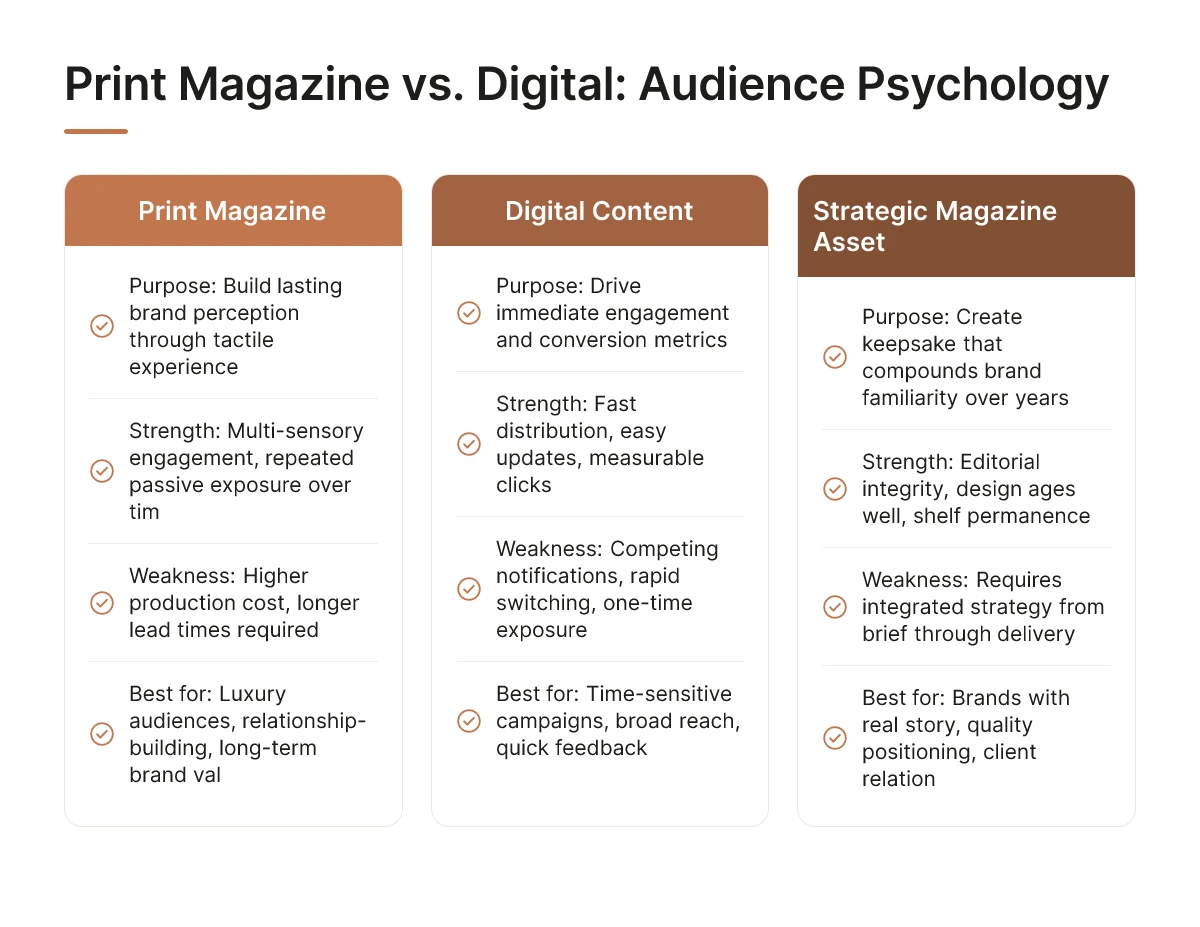
A custom magazine should be judged the way you’d judge a client relationship, over years, not over a quarterly report. If you measure it like a digital ad campaign, you’ll misread the results and probably kill a good asset too early.
What Outcomes Should Brands Expect From Custom Print Magazines?
Digital campaigns are built for speed, click-through rates, open rates, cost per lead. A print magazine works on a different clock. Its job is to shape how a client, partner, or prospect feels about your brand the next time they think of you, which is exactly why audience psychology print magazines and short-term marketing metrics don’t belong in the same spreadsheet.
The realistic outcome is perception compounding: a magazine sits on a coffee table or in a waiting room for months, gets picked up more than once, and each pass reinforces the same impression, this company has taste, depth, and something worth saying. That’s a brand-building outcome, not a lead-generation one. Trying to force it into a conversion funnel misreads what the format is built to do.
How Do You Measure Whether a Print Magazine Investment Is Working?
You won’t find this in an analytics dashboard. You’ll find it in the room.
- Direct feedback, clients or partners mentioning the magazine unprompted, in meetings or emails, months after it landed.
- Requests for extra copies, a strong signal someone wants to hand it to a colleague, a board member, or a friend.
- Longevity, is it still on the coffee table or the reception desk six months later, or did it get recycled in a week?
- Use in sales and client meetings, sales teams reaching for it as a leave-behind, or bringing it into a pitch, tells you it’s earned a functional role, not just a decorative one.
None of this is cheap to produce, and it shouldn’t be. Premium print is a considered investment, closer in weight to a flagship event or a brand redesign than to an ad budget line item. The comparison that matters isn’t “print versus a Google campaign”, it’s “print versus other long-term brand investments,” where the return shows up in retention and reputation, not clicks.
Not every company earns a return here. A brand with no real story, no client relationships worth nurturing, and no quality-driven positioning will produce a beautiful object that says nothing. The format rewards brands that already have depth to show, hospitality groups, law firms, real estate developers, design studios, and simply need it bound in print rather than buried in a PDF. That’s the difference between a magazine and a brochure: one compounds perception over years: the other gets read once and forgotten.
Frequently Asked Questions
Is print worth it when most marketing has moved digital?
Yes, precisely because most marketing has moved digital, print now stands out by contrast. A digital ad competes with dozens of open tabs; a magazine on a coffee table competes with nothing. It sits in a room, gets picked up again, and gets handed to someone else. That physical persistence is the value digital can’t replicate.
How long does a custom print magazine typically stay relevant before it feels dated?
A well-built brand magazine holds up for one to three years, sometimes longer. Relevance depends on editorial choices, not trend-chasing content, a magazine built around timeless brand stories and quality photography ages far better than one built around a product cycle or a seasonal promotion.
Who should be involved from the brand side when creating a custom magazine?
One decision-maker with real authority over brand voice should lead, usually a CEO, CMO, or Head of Brand. Bringing in too many stakeholders slows editorial decisions and dilutes the point of view. Rethink Publishing works best with a single client contact who can approve direction and keep the process moving.
Can a print magazine work alongside a digital content strategy, or does it replace it?
It works alongside digital, it doesn’t replace it. Print handles what digital can’t: slow attention, physical presence, a sense of permanence. Digital still carries reach, speed, and searchability. The two do different jobs, and a brand magazine gives you material to extend into digital, not the reverse.
Why do luxury brands in particular rely so heavily on print magazines?
Luxury buyers are already sensitive to signals of craft, exclusivity, and attention to detail, and print delivers all three in ways a screen can’t. A well-made magazine mirrors the same care a luxury brand puts into its products and spaces. That alignment is central to audience psychology print magazines exploit for luxury brands specifically: the format itself becomes part of the brand’s credibility, not just a vehicle for messages about it.
Conclusion
A print magazine works on your audience because of what it doesn’t do: it doesn’t refresh, doesn’t disappear, doesn’t compete for a split-second glance. It asks for a few unhurried minutes, and it rewards that attention with weight, texture, and a point of view your digital channels can’t hold.
Before commissioning one, get clear on your editorial spine and name the single decision-maker who will own it. If you’re weighing whether your brand has a real story to bind in print, start that conversation at www.rethink-publishing.com.
Recommended Articles
Explore more from our content library: