
Understanding publication personality branding is essential. A custom magazine builds brand identity by giving a company a consistent editorial voice, visual style, and point of view that readers associate with that company alone, the same way a distinctive personality makes a person memorable. Unlike ads or social posts, a printed publication holds that identity across every page, every issue, and every year it sits on a desk or coffee table, reinforcing recognition through repeated, unhurried contact rather than a single impression. Research on personal branding as an interdisciplinary field makes the same point: identity that’s expressed consistently across many touchpoints builds recognition in a way a single message never can.
How Does a Custom Magazine Build Publication Personality Branding?
A magazine builds personality through two combined forces: what it chooses to say and how it chooses to look, repeated until readers recognize both on sight.
Neither force works alone. A company can write with a distinct voice, but without disciplined design, the pages read like a document, not a publication with a point of view. A company can hire the best photographer available, but without editorial judgment about which stories deserve space, the images have nothing to serve. Publication personality branding happens at the intersection, the sum of editorial choices and design choices operating together, issue after issue. It’s not a slogan reprinted on glossy paper, and it isn’t a logo dropped onto a new template. It’s a set of decisions a reader starts to expect.
The building blocks of a strong publication personality typically include:
- A defined editorial voice that stays consistent whether the story is a profile, an interview, or a photo essay
- A visual system, typography, color discipline, and photographic style, applied without deviation issue to issue
- A clear point of view about what the publication covers, and just as importantly, what it deliberately leaves out
- A production standard, paper, binding, print quality, that signals the object is worth keeping
- Repetition across multiple issues, since a single well-made issue is an artifact, not yet a personality
What Role Does Editorial Curation Play in Creating a Distinctive Publication Personality?
Curation is the clearest signal a company sends about what it actually values, because every story included is a story something else was cut to make room for. A law firm that fills its pages with client profiles and regulatory analysis is telling readers it values precision and discretion. A hospitality brand that fills its pages with chef interviews and destination features is telling readers it values experience over efficiency. Neither choice is neutral, both are editorial statements made by omission as much as inclusion.
This is why Rethink Publishing starts every project with an editorial spine before a single layout gets built. Deciding what the magazine is about, and just as important, what it will never cover, gives the rest of the production something to align around.
How Do Design, Photography, and Layout Choices Reinforce Brand Identity in Print?
Design carries personality the way posture and tone of voice carry a person’s character, consistent choices, repeated without deviation, until they become recognizable on their own. Typography that never wavers issue to issue. A color discipline that rules out whatever doesn’t fit. A photographic style applied the same way every time. This overlaps with what marketers describe as brand personality more broadly, human traits and visual signals a brand consistently expresses so audiences recognize it instantly.
Picture a cybersecurity firm using measured, high-contrast photography and restrained white space, the visual grammar of control and precision. Now picture a hospitality brand using warm, natural light and lived-in interiors, the visual grammar of comfort and welcome. Same medium, opposite personality, because the design decisions are doing different jobs.
None of this holds if it only happens once. A single beautifully designed issue is a nice artifact; it isn’t a personality. Recognition builds from repetition, the same editorial judgment and the same design language, issue after issue, until readers know whose magazine they’re holding before they check the cover.
What’s the Difference Between Brand Personality in a Magazine and Other Marketing Channels?
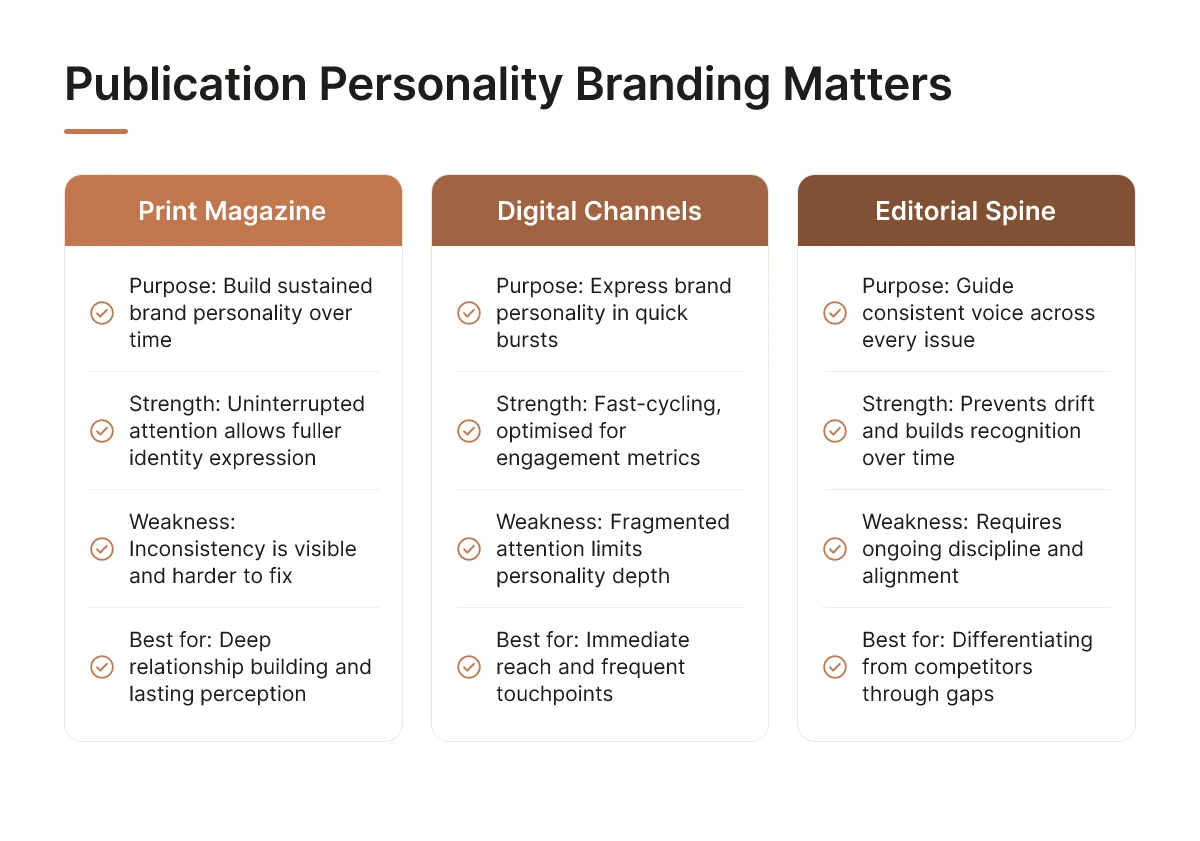
A magazine holds a reader’s attention for a full session with no scroll, no feed, no competing notification, digital brand personality gets seconds; print gets an evening.
Why Does Print Allow for a Deeper, More Cohesive Brand Personality Than Digital or Social Media?
A social post has to make its case in the time it takes a thumb to flick past it. An Instagram caption, a paid ad, a homepage banner, each one is optimized for a metric: click-through, dwell time, engagement rate. That pressure forces brand personality into short, punchy bursts, repeated endlessly, hoping one version lands.
A magazine works differently. There’s no algorithm deciding whether page 14 gets seen. Once someone picks it up, they move through it at their own pace, page by page, with nothing competing for their attention except the next spread. That gives a brand room to show range, wit on one page, gravity on the next, a photo essay that takes its time, instead of compressing everything into a single headline. This is where publication personality branding does something digital channels structurally can’t: it lets a fuller, more textured version of the brand emerge across dozens of pages rather than one image.
How Does a Publication’s Personality Differ From a Company’s Broader Brand Personality?
A magazine’s voice is a curated, editorial expression of the brand, not the entire brand personality itself. A company might be playful on social media, formal in legal contracts, and warm in client meetings. The magazine picks a specific register, the one that suits long-form reading, and holds it with discipline across every article, caption, and layout choice. As Harvard Business School’s overview of personal branding notes, a coherent identity is what lets an audience know what to expect from you, whether that audience is meeting a person or reading a company’s magazine.
That discipline matters more in print than anywhere else. A poorly toned social post gets deleted quietly; a clumsy email gets forgotten by lunchtime. A weak spread in a printed magazine sits there permanently, in a reader’s hands, impossible to edit after the fact. Inconsistency is louder in print because there’s no undo button, which is exactly why editorial direction has to come before design or production begins, not after.
None of this replaces digital marketing. Social and web still carry speed, reach, and real-time conversation. Print carries the parts of the brand story that need room to breathe, the parts worth keeping on a coffee table long after the campaign ends.
How Do You Align a Publication’s Editorial Voice With Your Company’s Values and Market Position?
You align voice with values by writing down an editorial spine first, a point of view and a short list of recurring themes every issue must serve, before anyone touches layout or copy.
This is the part of publication personality branding that most companies skip. They jump to design because design is visible and fast to approve. But a magazine without a spine drifts: issue one is about innovation, issue two is about heritage, issue three is whatever the marketing calendar needed that quarter. Readers notice the inconsistency even when they can’t name it.
What Does It Mean to Build an ‘Editorial Spine’ and How Does It Guide Publication Personality?
An editorial spine is a documented point of view, the two or three ideas your company keeps coming back to, restated so an editor can build stories around them for years, not months. At Rethink Publishing, we build this spine before a single page is designed, because it’s the document that keeps issue five sounding like issue one.
Building an editorial spine typically involves:
- Structured interviews with the people running the company, focused on what they believe is true about their market that competitors won’t say out loud
- A review of existing brand materials to see what’s already been claimed publicly
- A scan of the category to find what every other player in the space consistently avoids covering
- Drafting two or three recurring themes an editor can build stories around for years, not months
That gap between what competitors avoid and what your company actually believes is often where the spine lives, and it’s the same gap that gives publication personality branding something distinctive to hold onto.
How Do You Ensure Your Magazine’s Voice Resonates With Your Audience and Differentiates You in Your Market?
Voice has to match who’s reading, not just how the company sees itself, a magazine written for engineers needs different pacing, references, and proof points than one written for retail buyers, even from the identical company. A cybersecurity firm’s magazine for its technical buyers reads nothing like the version built for its channel partners, and treating them the same flattens both.
Differentiation comes from naming what the category ignores. If every hospitality brand’s content talks about amenities and none talk about the craftspeople behind the property, that absence is your opening. Build the spine around it, and the magazine becomes something competitors can’t easily copy because it reflects a specific point of view, not a template.
The failure we see most often: a company treats the magazine as a rebadged brochure, restating product features in longer paragraphs. That collapses editorial voice into sales messaging, and readers, who can tell the difference within two pages, stop trusting the rest of the publication.
What Makes a Printed Magazine a Lasting Brand Asset Rather Than a Disposable Marketing Piece?
Paper stock, binding, and cover weight tell a reader whether an object is worth keeping before they read a single word inside.
A 250gsm cover with a matte finish and a sewn binding communicates permanence the way a glossy tri-fold brochure never can. That’s not a design opinion, it’s how people physically sort mail and materials. Heavy stock and a considered cover get set aside on a desk or shelf. Thin paper and a flimsy spine get recycled within the week. The mechanics of publication personality branding start here, at the level of what a hand feels before the brain processes any content.
How Does the Tactile, Keepsake Quality of Print Strengthen Client Relationships Over Time?
A pitch deck ends when the meeting ends. A magazine left on a coffee table or a reception desk keeps working long after everyone has gone home.
It sits where a client’s own guests notice it. It gets picked up during a slow afternoon in a waiting room. It gets handed to a colleague with a “you should see this.” None of that happens with a PDF attachment, because a PDF has no presence in a physical room. The publications Rethink Publishing produces for hospitality groups, law firms, and design firms are built with that afterlife in mind, the meeting is one touchpoint, but the object on the table is a hundred more.
What Production and Design Decisions Turn a Magazine Into Something People Keep and Return To?
Long-form stories worth a second read, layouts paced for flipping back through, and a cover strong enough to justify display on its own.
A brochure is built to be scanned once and discarded. A magazine with a real editorial spine is built to reward a second visit, a profile piece someone finishes over coffee, a photo spread they flip back to a week later. Visual pacing matters as much as the writing: enough white space and image variation that the eye wants to keep turning pages rather than close the cover. None of this happens by accident. It’s the product of deliberate editorial direction, image sourcing, and layout choices made before a single page goes to print.
Compare that lifespan to a social post, which typically holds attention for hours before it disappears into a feed. A well-made magazine holds a physical spot on a shelf for years.
None of this holds if the production quality doesn’t match the ambition. Cut corners on paper weight or print quality, and the magazine becomes exactly the disposable object it was meant to replace.
How Do You Measure Whether a Custom Publication Is Strengthening Your Brand Perception?
You measure it by watching what people do with the magazine, not by running it through a conversion dashboard, requests for extra copies, unprompted mentions in meetings, and reprint demand tell the real story.
What Signals Show That a Magazine Is Working as a Brand-Building Tool?
The clearest sign is a client bringing up the magazine before you do. Someone references a specific story or photograph from the issue in a meeting, unprompted, weeks or months after it landed on their desk. That’s a signal no digital metric captures.
Other signals worth tracking include:
- A receptionist reporting that waiting room copies keep disappearing
- A client asking for extra copies to hand to their own board or team
- Sales staff using the magazine as a natural opener in first meetings instead of leading with a pitch deck
- The magazine turning up somewhere you didn’t place it, a client’s office, a competitor’s waiting room, an unsolicited LinkedIn mention
Gather this deliberately rather than hoping it surfaces. Ask account managers directly, in every check-in: has a client mentioned the magazine? Track reprint and additional-copy requests in a simple log, spikes after events or client visits are worth noting.
How Does a Publication’s Impact on Brand Perception Differ From Traditional Marketing ROI Metrics?
A magazine isn’t built to generate a click or close a deal this quarter. It’s built to change how someone feels about your brand the third or fourth time they pick it up, which means the usual campaign metrics (open rate, click-through, cost per lead) simply don’t apply here.
This is where publication personality branding works on a different clock than a paid social campaign. A single issue rarely shifts perception on its own. It’s the cumulative effect of several issues, arriving on schedule, building a consistent editorial identity, that deepens how a client or prospect experiences the brand.
Judge the cost accordingly. A magazine’s value shows up in relationship depth and retention measured over years, not against a single campaign’s return in a single quarter. Treat it the way you’d treat any long-term brand asset, worth revisiting annually, not weekly.
Frequently Asked Questions
Does every company need a custom magazine to build brand personality?
No. Not every company needs one. A magazine makes sense when you have a genuine relationship with clients or partners worth deepening over years, not months. If your brand competes on price or your buying cycle is short and transactional, that budget likely works harder elsewhere.
How is a company magazine different from a corporate brochure?
A brochure sells; a magazine has an editorial spine that informs, entertains, or tells a story readers actually want to finish. A brochure gets skimmed once and discarded. A well-made magazine gets kept on a coffee table and picked up again months later.
How often should a company publish to maintain a consistent publication personality?
Most brands sustain personality well with one or two issues a year rather than quarterly. Consistency of voice, design, and quality matters more than frequency, a rushed annual issue does less for personality than a considered one every 18 months.
Can a digital-only publication build the same kind of brand personality as print?
Digital can carry voice and story, but it can’t replicate the physical presence and permanence print gives a brand. A PDF competes with a full inbox and gets closed in seconds. A printed piece sits in an office or living room and keeps signaling who you are long after the click would have faded.
Who should be responsible for maintaining publication personality branding across issues?
Ideally a single editorial lead, whether in-house or from a publishing partner, who owns the spine and has final say over voice and design decisions across every issue. Splitting that responsibility across departments without one accountable owner is one of the fastest ways consistency erodes from issue to issue.
Conclusion
A distinct publication personality comes from three decisions: committing to an editorial spine before design starts, choosing a format your audience will actually keep, and being honest about whether print fits your business at all. Skip any of the three and you get an expensive brochure, not a brand asset.
If you’re weighing whether this is worth pursuing, start smaller than a full magazine commitment: sketch the editorial spine for a single issue, three story ideas that have nothing to do with selling, and see if they hold together. That exercise alone will tell you more than any pitch deck. When you’re ready to build publication personality branding properly, that’s the conversation to have with Rethink Publishing.
Recommended Articles
Explore more from our content library: