
A custom luxury brand magazine belongs in the client lounge because it does something a digital touchpoint can’t: it gives a high-value relationship a physical, unhurried object to hold. Unlike advertising inside an existing lifestyle publication, a branded magazine is edited entirely around your clients’ interests and your company’s point of view, with no competing ads or unrelated content diluting the message. Printed well, it signals permanence and craft, qualities luxury clients associate with the brands they trust. It also outlasts a digital impression: left on a coffee table, it keeps working long after a scroll ends.
Why Should a Luxury Brand Create a Custom Magazine Instead of Advertising in Existing Publications?
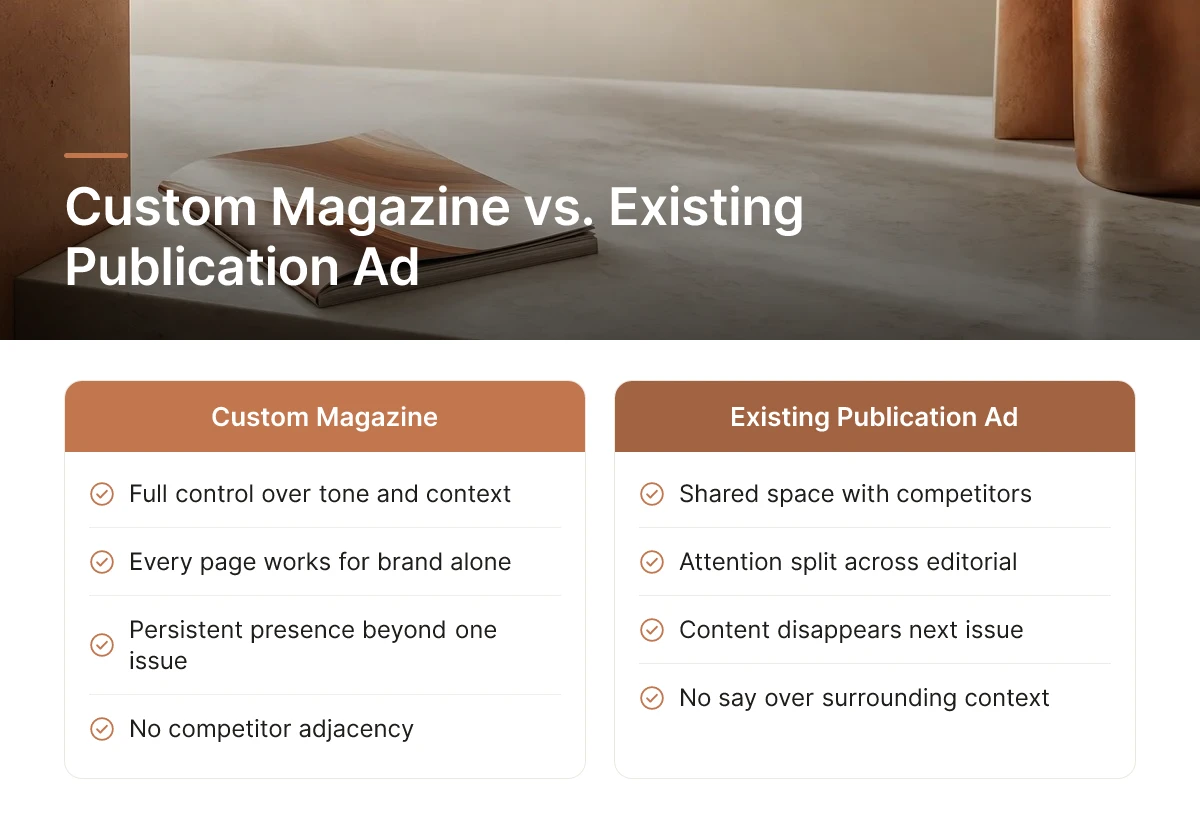
Buying a page in someone else’s magazine rents attention for one issue; owning a title keeps every page working for the brand alone. That difference, shared space versus full control, is the real argument for building a luxury brand magazine rather than placing ads in established lifestyle titles.
An ad inside a glossy lifestyle magazine sits next to competitors, unrelated editorial, and whatever else the publisher sold that month. The reader’s attention is split, the content disappears with the next issue, and the brand has no say over tone or context. A custom publication removes all of that. Every page serves one story, the brand’s, with no competing message diluting it.
There’s also the question of audience. A commercial lifestyle magazine is built around a publisher’s broad subscriber base, most of whom have no relationship with the advertiser at all. A custom magazine is built around the company’s actual clients, their interests, their concerns, their reasons for choosing the brand in the first place. That’s a tighter, more valuable conversation than any shared readership can offer, and it’s the kind of direct relationship-building that luxury CMOs increasingly treat as central to owned media strategy [1].
What’s the Difference Between a Custom Brand Magazine and Traditional Luxury Lifestyle Publications?
A traditional lifestyle title is edited for a commercial subscriber base and sold around advertising inventory; a custom brand magazine is edited entirely around one company’s clients and values. Titles like Architectural Digest or Condé Nast Traveler remain trusted advertising environments precisely because of their editorial independence and broad affluent readership [4]. A branded magazine trades that scale for precision, no shared attention, no unrelated content, just the brand’s own point of view carried from cover to back page.
How Does a Custom Magazine Serve as a Long-Term Brand Investment Compared to Other Marketing Channels?
A well-made issue keeps circulating for months after it’s printed, on coffee tables, in waiting rooms, passed between colleagues, long after a single ad placement would have expired. Premium production is a real commitment, not a discount tactic, and that seriousness is part of what makes it credible to a luxury clientele that notices craft. Print’s physical, sensory quality is exactly what gives luxury marketing its sense of permanence and exclusivity [2], something a one-time media buy can’t replicate. Rethink Publishing builds each title around that same principle: an editorial spine designed first, so the magazine reads as a genuine publication rather than a disguised brochure.
What Makes a Custom Magazine an Effective Tool for Luxury Brand Positioning and Client Relationships?
A custom magazine works by combining physical craft and editorial restraint into a single object that signals quality before, and after, anyone reads a word. The mechanism is tactile, psychological, and cumulative, not decorative.
How Does Print Quality and Design Language Strengthen Luxury Brand Perception?
Paper stock, print finish, and layout communicate quality to a reader’s hands before their eyes process any content. A heavier matte stock, a considered trim size, and a clean grid tell a client something about standards within the first three seconds of contact, long before they read a headline. Print marketing’s advantage here is sensory: it delivers a physical experience that a screen cannot replicate, which is exactly why luxury brands have leaned on it for decades to reinforce sophistication and exclusivity [2].
Design language consistency extends that signal across every page. Typography choices, image treatment, white space, and pacing all accumulate into an impression of discipline. Clients absorb this unconsciously, a magazine with inconsistent fonts or crowded layouts reads as careless, and that carelessness transfers to how they judge the brand behind it. A luxury brand magazine succeeds or fails on this consistency long before anyone evaluates the writing.
What Role Does Editorial Curation Play in Deepening Relationships with High-Value Clients?
Editorial curation builds trust by showing restraint, what a publication leaves out says as much as what it includes. Luxury clients recognize discernment because they expect it from the brands they choose, and a magazine that covers everything indiscriminately reads as a brochure wearing a magazine’s clothes. A tightly edited issue, built around a clear editorial spine rather than a list of products or services, demonstrates the same selectivity a client expects in a boardroom or a property portfolio.
That discipline is what separates an effective client publication from sales material. The best client-facing magazines read like independent editorial products, something a reader would pick up even without a brand relationship, which is precisely why people keep them rather than recycling them. At Rethink Publishing, that editorial-first approach means defining the spine and the content strategy before a single layout decision gets made, because a magazine that feels like marketing collateral gets discarded, and one that feels like a magazine gets kept.
That retention is the real mechanism. A magazine left on a desk or given as a gift creates repeated, low-pressure exposure every time someone walks past it, a form of contact no sales email or display ad can replicate, since both are deleted or scrolled past within seconds. Owned print media, done with real editorial ambition, deepens a relationship by being present in a client’s physical space over months, not seconds [1].
How Do You Develop the Editorial Strategy and Design That Defines a Luxury Brand Magazine?
The strategy comes before a single photo is chosen or a single word is drafted, you define a point of view, then build every page to serve it. Skip this step and you get something expensive that reads like a brochure with better paper.
What Is an Editorial Spine and Why Does It Matter for a Luxury Brand Magazine?
An editorial spine is the recurring theme or point of view that holds every issue together, the thread a reader can feel even if they can’t name it. It’s the difference between “this issue is about craftsmanship in hospitality” and a loose stack of unrelated features that happen to share a cover.
At Rethink Publishing, this is the first decision made on any project, before layout, before writer assignments, before image research begins. Nathalie Grolimund built the studio’s process around this sequencing over 20+ years of producing custom print magazines, because an issue assembled in any other order tends to feel assembled rather than written.
Without a spine, a magazine collapses into a catalogue no matter how good the paper stock or how sharp the photography. Readers sense the difference between a publication with a point of view and one that’s just well-printed marketing copy, and premium production values can’t compensate for that gap.
How Do You Pair Words and Images with Intention to Reflect Brand Values?
Word-and-image pairing is a deliberate craft decision made spread by spread, not a template applied uniformly across the issue. Some pages need an image-led spread, a double-page photograph that lets a property, a product, or a room create atmosphere with almost no text competing for attention. Other pages need to be text-led, where a long-form interview or essay carries the authority a brand is trying to establish, and imagery steps back to support rather than dominate.
That pairing decision starts with the reader, not the brand’s product sheet. Content built around what the target reader actually cares about, their interests, their world, the problems and curiosities that occupy their attention, gets read. Content built around product features gets flipped past, which is why luxury print strategy increasingly treats the reader experience as the starting point rather than an afterthought [1].
Tone and pacing follow the same logic. A reader who keeps a magazine on a bedside table for a week moves through it differently than one who flips through it once in a lounge, so an issue mixes short, visual features with a few longer reads that reward sitting still, matched to how the object actually gets used, not to a fixed page-count formula.
What Does the End-to-End Process Look Like for Producing a Luxury Brand Magazine?
A luxury brand magazine moves through five stages in sequence, strategy, editorial planning, design and art direction, print production, and distribution, each one built on the last.
Skip a stage, or hand it to a different vendor, and it shows. The tone set in the strategy phase drifts by the time a freelance designer lays out the pages. The editorial voice that worked in the planning deck disappears once a print shop that’s never worked in publishing takes over production.
Who Handles Strategy, Design, Printing, and Delivery for a Custom Luxury Magazine?
The work starts with defining the audience and what the publication needs to achieve, existing clients, prospective buyers, members, or referral partners each call for a different tone and structure [3]. From there, editorial planning sets the content plan and the spine that holds every issue together. Design and art direction pair copy with imagery with intent, not as an afterthought bolted onto finished text.
Print production follows: stock selection, binding method, and finish are decided here, not improvised later. Distribution and delivery close the loop, getting finished copies into the hands of the people meant to keep them.
Rethink Publishing runs all five stages inside one team, strategy, writing, layout, image rights, printing, and delivery, specifically because handoffs between separate vendors are where tone and quality erode. A brand strategist who never sees the final print run can’t catch a color mismatch. A designer who wasn’t in the strategy conversation can’t protect the editorial intent. One team, accountable start to finish, is what keeps a magazine from feeling like three different projects stapled together.
What Industries and Sectors Have Successfully Used Custom Magazines as Brand Assets?
Fashion and hospitality are the obvious users, but they’re not the only ones. Private banks hand clients a magazine instead of a statement insert. Real estate developers use one to sell a lifestyle alongside a property. Architecture and design firms use them to document a portfolio with the same craft they apply to a building. Even cybersecurity firms, an industry with no obvious aesthetic hook, have commissioned custom magazines to build trust with technical buyers who respond better to depth than to another slide deck.
The common thread isn’t the sector. It’s a client relationship worth deepening beyond a quarterly email.
Realistic timelines matter here. Editorial lock, print runs, and delivery windows each take real time, and rushing one stage to hit an arbitrary launch date is usually where quality breaks down.
How Do Luxury Brands Measure the Impact of a Custom Magazine on Brand Perception and Client Loyalty?
They track what happens after the magazine leaves the mailroom: who keeps it, who asks for more copies, and who brings it up unprompted months later. Those signals don’t show up in a dashboard, but they’re more reliable than a click-through rate, because a click costs nothing and a kept object costs a decision.
An ad gets scrolled past in under a second. A luxury brand magazine that survives on a coffee table for a year is making a quieter, stronger claim: someone chose to keep it in a space they control. That’s the measurement most CEOs actually care about, even if it resists a tidy percentage.
Why Do Luxury Magazines Become Keepsakes That Stay in Homes and Offices?
Objects earn a place in a home or office because they carry editorial and tactile value that disposable marketing collateral never had to begin with. A brochure is built to be discarded once its information is extracted; a well-made magazine is built to be re-read, which is a different design problem entirely.
Print marketing works on luxury audiences precisely because it delivers a sensory, tangible experience that digital formats can’t replicate, the weight of the paper, the quality of the binding, the sense that someone made deliberate choices on every page [2]. That physical credibility is what separates a keepsake from clutter.
What Makes a Custom Magazine Function as a Real Marketing Asset Rather Than Just a Vanity Project?
A magazine functions as a real asset when it shows up inside the business, referenced by a sales team mid-pitch, placed deliberately in a reception area or boardroom, handed to a prospective client as a conversation starter. A vanity project gets printed, boxed, and stacked in a storeroom, admired once at launch and never touched again.
The difference is visible in ordinary moments: a client asking for three extra copies to share with partners, an account manager noting that a renewal conversation opened with a comment about last issue’s feature, a relationship that reactivates because the magazine arrived at the right time. Owned print media earns its place in the marketing mix only when it deepens a relationship that was already forming, print has to justify the investment the same way any other channel does, measured by whether it actually changes how a client engages [1].
None of this resolves into a single campaign metric, and that’s the point. A magazine is a long-term brand investment, and its payoff shows up in relationship depth and retention conversations over quarters and years, not in an open rate measured the Monday after send.
Rethink Publishing builds each issue with that outcome in mind: an editorial spine strong enough to earn a second read, and production quality precise enough that clients don’t just receive it, they keep it.
Frequently Asked Questions
Does a luxury brand magazine replace digital marketing entirely?
No, a print magazine works alongside digital, not instead of it. Digital handles reach, speed, and daily visibility; print handles depth, permanence, and the kind of attention a social post never earns [5]. The strongest luxury marketing mixes both, with print reserved for the relationships that matter most.
How often should a luxury brand publish a custom magazine?
Most luxury brands publish one to two issues a year, sometimes tied to a season, a property launch, or an anniversary. Frequency matters less than consistency and quality, a single well-made annual issue carries more weight than four rushed ones. The right cadence depends on your sales cycle and how often you have something worth saying.
Can a smaller luxury brand justify a custom print magazine?
Yes, if the brand has a genuinely affluent, relationship-driven audience, size matters less than the depth of the client relationships being nurtured. A boutique hotel group or a single luxury development can justify one issue a year if it’s replacing scattered brochures and newsletters with one artifact clients actually keep. If the audience is broad and price-sensitive, it’s harder to justify.
What’s the difference between a brand magazine and a coffee table book?
A brand magazine is periodical, it publishes on a cadence and carries an editorial spine that evolves issue to issue. A coffee-table book is a single, often evergreen object, built to mark a milestone, a property, or a design philosophy rather than a publishing schedule. Rethink Publishing produces both, choosing the format based on whether a client needs ongoing engagement or a lasting centerpiece.
Conclusion
A luxury brand magazine earns its place on a coffee table because it respects the reader, real editorial, real craft, no pitch. The brands getting this right treat print as a long-term asset tied to specific moments: a property launch, an anniversary, a client relationship worth deepening. The ones getting it wrong treat it as a brochure with better paper.
If you’re weighing whether this fits your brand, start by naming the one client relationship or milestone you’d want a magazine to serve first. That answer tells you more about readiness than any budget conversation. From there, visit rethink-publishing.com and bring that answer with you.
Sources & References
- The commercial print strategy luxury brands often overlook
- How Luxury Brands Market Themselves Using Print
- Launching Your First Custom Magazine | Tulip Media Group
- 9 Luxury Magazines to Showcase Your Brand | MediaMax
- 5 luxury print magazine strategies
Recommended Articles
Explore more from our content library: