
Understanding what makes a magazine successful is essential. A magazine becomes successful when editorial strategy, design, and production quality work together so the finished piece earns a place on someone’s coffee table instead of in the recycling bin. Beautiful design alone doesn’t do that, a magazine needs a clear editorial point of view, a reason to exist beyond promotion, and print quality that signals the brand behind it is worth paying attention to. When those elements align, the magazine stops being a marketing collateral item and starts functioning as a brand asset people keep, reread, and associate with quality.
What Makes a Magazine Successful as a Brand Asset Instead of a Shelf Filler
The decision gets made before a single page is laid out: is this magazine built to be glanced at once, or built to be kept? That choice, not a design flourish added at the end, is what makes a magazine successful months after it leaves the printer.
Most branded print pieces fail the same way. Someone commissions a glossy booklet, fills it with product shots and a company timeline, and hopes the paper stock does the convincing. It won’t. A reader can tell within thirty seconds whether a magazine exists to inform them or to sell them something, and that instinct decides whether it lands on a side table or in recycling.
Why Do Some Custom Magazines Feel Like Keepsakes While Others Get Discarded?
Keepsake magazines give the reader something; discarded ones only tell the reader something. A story about a chef’s first restaurant, a photo essay on a city neighborhood, an interview with an architect who broke from convention, these hand the reader a world to step into. A page listing service offerings hands them a reminder of a transaction.
This is the same distinction that separates brand magazines from traditional advertising: editorial storytelling builds a connection that direct sales messaging can’t, because it offers value to the reader first and lets the brand appear in a lifestyle context rather than a pitch [1]. Rethink Publishing builds every issue around that premise, developing the editorial spine, the narrative reason the magazine exists, before any layout decision gets made.
How Does a Magazine Function Differently When It’s Designed as a Brand Tool Rather Than a Publication?
A magazine built as a brand tool works by staying present, sitting on a reception desk, a waiting-room table, or a client’s coffee table for months, doing quiet reputational work no brochure or digital ad can replicate. A brochure gets skimmed once and filed. A LinkedIn post disappears in a day. A well-made magazine gets picked up again during a slow afternoon, left out for a visitor to notice, passed to a colleague.
That duration is the point. Design quality and editorial craft matter because they’re what earns the magazine a second look weeks after the first one, not because a beautiful spread alone justifies the investment.
There’s one practical test that cuts through all of it: would someone pick this magazine up a second time if there were no sales pitch attached? If the honest answer is no, the publication is a marketing collateral item wearing a magazine’s cover. If the answer is yes, it’s doing the job a magazine is supposed to do.
How Do Editorial Strategy and Design Work Together to Create a Magazine People Keep?
Editorial strategy decides what the magazine is about and why each story belongs; design decides how that story gets read. Neither works without the other, and the order matters, strategy comes first.
What Is an Editorial Spine and Why Does It Matter Before You Design Anything?
An editorial spine is the throughline of ideas running through an issue, the reason a profile piece, a photo essay, and a Q&A all belong in the same publication rather than reading as unrelated content dropped into a template. It gets decided before anyone opens a design file. A hospitality brand’s spine might be “the people behind the property,” which then dictates which stories get commissioned, which get cut, and how much space each one earns.
Skip this step and the design team is handed a pile of marketing copy to format rather than a magazine to build. The result looks like a stapled set of brochure pages, no matter how much polish goes into the typography or the photo treatment. Readers feel this even when they can’t name it, the issue has no center of gravity, so nothing invites them past the first spread. This is a large part of what makes a magazine successful or forgettable: the spine decides what earns a page before layout ever starts.
How Do You Pair Words and Images With Intention So Readers Stay Engaged?
Words and images get paired deliberately, with design serving the story instead of competing with it. A long-form feature might slow down into a photo essay with minimal text, letting the images carry the pacing for two or three spreads before copy returns. White space isn’t empty, it’s a pause built into the reading experience, the same way a writer uses a short sentence after a long one.
Sequencing across the whole issue works the same way a well-edited playlist works. A strong opening feature earns attention early, shorter pieces create breathing room, and a second longer feature gives the issue a second peak rather than a slow fade. Design trade publications describe this same principle at the spread level, hierarchy, contrast, and white space all exist to help a reader absorb a spread in one glance rather than parse it line by line [5]. Applied across 80-plus pages instead of one spread, that same discipline is what keeps a reader moving from the first page to the last rather than stopping at page twelve.
What Role Does Print Quality and Production Play in How a Magazine Is Perceived?
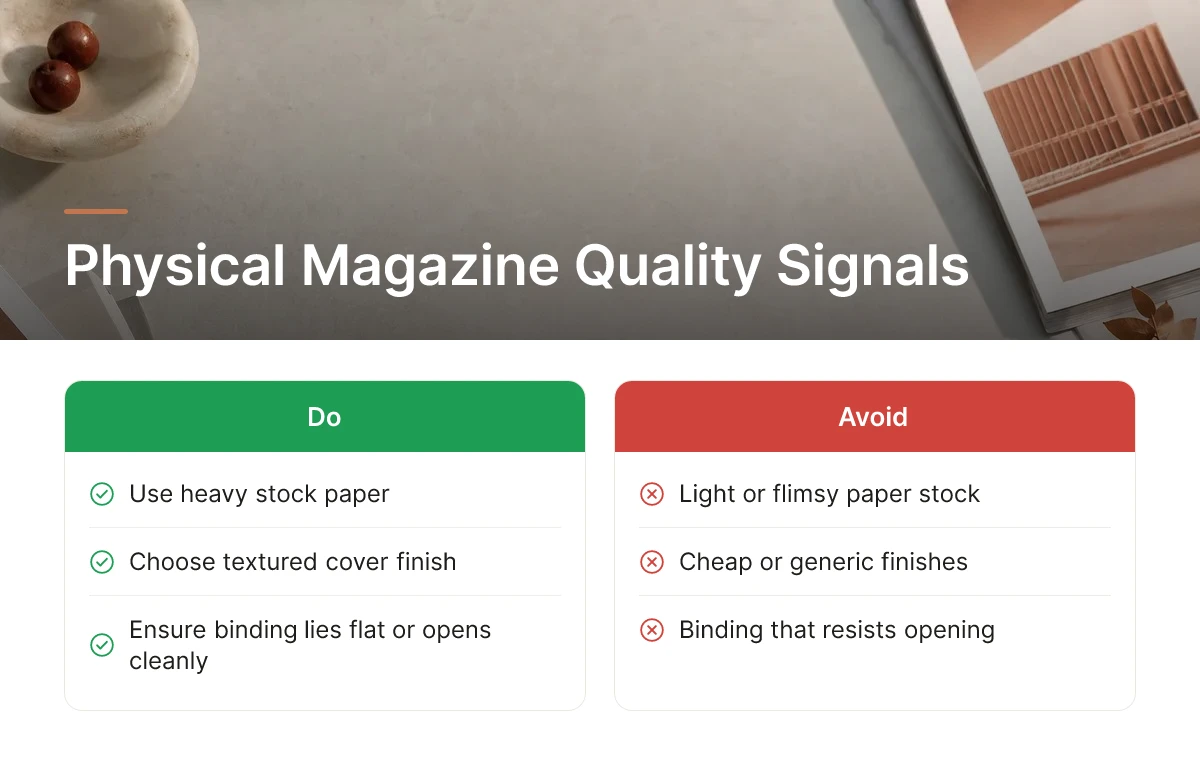
Production quality is part of what makes a magazine successful because readers judge a publication physically before they read a single sentence. Paper weight, cover finish, and binding register in the first three seconds of contact, long before editorial content has a chance to prove itself.
Why Does the Physical Feel of a Magazine Matter as Much as Its Content?
A reader’s hands make a judgment about the brand before their eyes do. Heavy stock, a cover with the right texture, and a binding that lies flat or opens cleanly all signal that the company behind the piece takes its own image seriously, the same way a firm handshake signals confidence before anyone speaks.
The reverse is just as immediate. Thin, flimsy paper or a cover that curls at the corners reads as cheapness, and that impression attaches to the brand, not just the object. A reader doesn’t separate “the magazine felt cheap” from “the company felt cheap”, the two fuse in the first few seconds of handling it.
This is why strong editorial work can still fail commercially. Well-researched articles and sharp photography lose their impact if printed on stock that feels like a supermarket flyer [5]. The design and content pairing that readers “digest” in a single glance depends on production values supporting that first impression, not undercutting it [5].
How Does Precise Production Affect Whether People View Your Brand as Premium?
Precise production means color accuracy and consistency across every copy in the run, plus finishing choices, matte versus gloss, saddle-stitch versus perfect binding, paper stock, matched to how the piece will actually be used. A coffee-table book meant to sit out for years calls for different binding and cover weight than a quarterly handed out at a trade show.
These decisions compound. One section with inconsistent color or a binding defect undoes the credibility built by every other page, because readers notice inconsistency more than they notice quality done right.
Print is not a disposable marketing line item, it’s a brand asset meant to last years on a shelf or coffee table, and production choices should be made with that lifespan in mind rather than the lowest short-term cost. Rethink Publishing manages print production end-to-end, color accuracy, stock selection, finishing, and quality control, precisely because these decisions are inseparable from the editorial strategy that precedes them, not an afterthought bolted on once the pages are designed.
How Do You Measure Whether a Custom Magazine Is Working as a Marketing Tool?
A magazine succeeds when it changes how people talk about and act toward your brand, not when it generates clicks, because it was never built to generate clicks.
This is where most CEOs trip up. They’re used to dashboards: open rates, click-through, cost per lead. A print publication doesn’t give you that data, and trying to force digital benchmarks onto a physical object is part of what makes a magazine successful or not land with the right expectations. The honest answer is that you measure a magazine the way you’d measure a strong client relationship, slowly, and mostly by what people do and say, not by what a report tells you.
What Metrics Matter for a Magazine That’s Meant to Stay in Someone’s Home or Office?
Track physical behavior: how long the issue stays visible on a coffee table or reception desk, and whether people ask for extra copies to hand to someone else.
Requests for additional copies are a stronger signal than almost anything digital analytics can offer, because nobody asks for five more copies of something they consider disposable. The same logic applies to shelf life, a brochure gets tossed within a week; a well-made magazine tends to sit out for months [5]. Sales teams are a good source of this data too. Ask them directly whether the magazine comes up unprompted in client meetings, and whether prospects reference specific articles or photo spreads weeks after receiving it.
How Do You Know if Your Magazine Is Actually Shifting Brand Perception?
Listen for unprompted references, clients mentioning the magazine without being asked, and your own team using it as a conversation opener or culture tool.
Watch three groups. Clients who bring it up on their own, in a call or email, without a sales rep steering them there. Sales staff who start pulling the magazine out before pitching rather than after. And internal teams, HR using it in recruiting packets, leadership handing it to new hires as a way to explain company culture faster than an onboarding deck ever could.
None of this shows up in week one. Set expectations before production starts: define what “working” means for your specific audience and purpose, rather than borrowing a benchmark from email marketing or social media. A magazine aimed at retaining high-value clients should be judged on renewal conversations six months out, not on how many people flipped through it the week it arrived. Rethink Publishing builds that conversation into the strategy phase, before a single page is designed, precisely because a magazine is a slower asset than a campaign, and judged on the wrong clock, it will always look like it underperformed.
What Does It Take to Produce a Premium, Intentional Magazine From Start to Finish?
One team owning every stage, from strategy to the finished printed piece in a client’s hands, is what makes a magazine successful rather than merely good-looking. Split that process across vendors and something gets lost at every handoff.
Why Does Handling Everything End-to-End Change the Outcome?
When one team owns strategy through delivery, editorial decisions and production decisions inform each other instead of being made in isolation. A writer who knows the paper stock and print run can pace a story differently than one working blind. A designer who sat in on the strategy conversation understands why a certain client story leads the issue instead of hiding on page 40.
The common failure mode looks different. A company hires a freelance designer, then a separate printer, and the strategy set at the start gets diluted somewhere in the handoffs between them. Nobody owns the outcome. The designer delivers files; the printer delivers boxes; the original intent, why this magazine exists and what it’s supposed to do for the brand, rarely survives intact. Rethink Publishing runs strategy, writing, layout, image sourcing, print production, and delivery as one accountable process specifically to close that gap.
What’s Involved in the Process Before a Single Page Gets Designed?
Before any layout work starts, the real decisions get made: who the audience is, what the piece is for, what the editorial spine is, and how it will be distributed and used. Is this handed to clients at a property launch? Mailed to a firm’s top accounts twice a year? Left on a boardroom table? Each answer changes the page count, the tone, the cover, even the paper weight.
Skipping this step is how magazines end up as glorified brochures, handsome, but without a reason to be read. An editorial spine gives every issue a backbone worth following.
Honestly, not every company needs a custom magazine. A firm without a client base worth cultivating over years, or without stories worth telling beyond its own promotion, should save the investment. The businesses that benefit are the ones with real relationships to deepen, hospitality groups, real estate developers, law firms, design studios, where a physical object left behind says more than another email ever could.
Frequently Asked Questions
Does a magazine need to be published on a schedule to be successful?
No. A brand magazine succeeds on editorial quality and timing relevance, not calendar discipline. Consumer magazines depend on subscriber habit, so a missed issue costs them readers. A brand magazine works differently: one well-made annual or biennial issue, tied to a launch, anniversary, or client milestone, can outperform a quarterly publication nobody looks forward to.
Can a small company benefit from a custom magazine, or is it only for large brands?
Size matters less than relationship depth, a magazine works best for companies with a defined, high-value audience, regardless of revenue. A boutique law firm with 50 key clients can get more mileage from a well-crafted magazine than a large company sending generic newsletters. The question isn’t company size; it’s whether you have relationships worth deepening in print.
How long should a custom brand magazine be to feel substantial without feeling padded?
Most effective brand magazines run between 40 and 80 pages, long enough to feel like a real publication, short enough to avoid filler. The right length follows the editorial spine, not a page-count target. If you’re stretching content to hit a number, the issue is too long.
Should a company’s magazine include advertising from other brands?
Generally, no, a brand magazine works because it feels like an editorial product, not a sales vehicle, and outside ads undercut that credibility. The entire publication should read as one coherent voice. Diluting it with unrelated advertisers makes it look like a commercial product instead of a brand asset.
Conclusion
A successful brand magazine comes down to three decisions: a clear editorial spine before any design work starts, a page count and cadence that match your actual audience relationship rather than a publishing convention, and a willingness to keep it ad-free so it reads as a brand artifact, not a sales tool. Get those right and the physical object does the work digital channels can’t, it sits on a desk, gets handed to a colleague, and keeps the brand present weeks after a meeting ends. Start by drafting the editorial spine for your next issue before you think about layout or print specs.
Sources & References
- How a brand magazine can be the missing link in your content marketing
- The art of magazine design, Handle Branding®
Recommended Articles
Explore more from our content library: