
A magazine editorial calendar is the master plan that sequences themes, stories, visuals, and production deadlines across every issue of a custom publication, so the magazine reads as one continuous narrative rather than a string of disconnected issues. Unlike a content calendar for blog posts or social media, it works backward from print deadlines and forward from a long-term editorial spine, the throughline that ties each issue to your brand’s bigger story. The templates below show different ways to structure that plan, depending on how often you publish and how many moving parts (design, print, sponsorship) you’re coordinating.

1. The Editorial Spine Calendar
An editorial spine calendar builds every issue theme off a single long-term narrative throughline instead of a list of disconnected topics. It is the foundation of a magazine editorial calendar built for cohesion, not just output.
What does it mean to start with an editorial spine, and how does that shape your calendar?
The spine is the throughline connecting each issue’s theme to the brand’s larger story, the thread a reader would notice if they read every issue back to back. Before a single story idea gets assigned, this template maps the issue’s theme against that spine, so the question isn’t “what do we have to say this quarter” but “how does this issue move the larger story forward.”
This format suits brands publishing fewer, higher-stakes issues, an annual report, a flagship coffee-table book, a once-a-year client publication, where cohesion matters more than frequency. A quarterly newsletter can afford a loose topic list. A single annual flagship piece cannot.
The differentiator is a dedicated “spine check” column, where every proposed story gets tested against the throughline before it earns a greenlight. Stories that don’t pass get cut before they cost design or writing hours. That one column is what keeps filler content out of a publication meant to last on a coffee table for years, not a news cycle.
2. The Multi-Issue Production Timeline Calendar
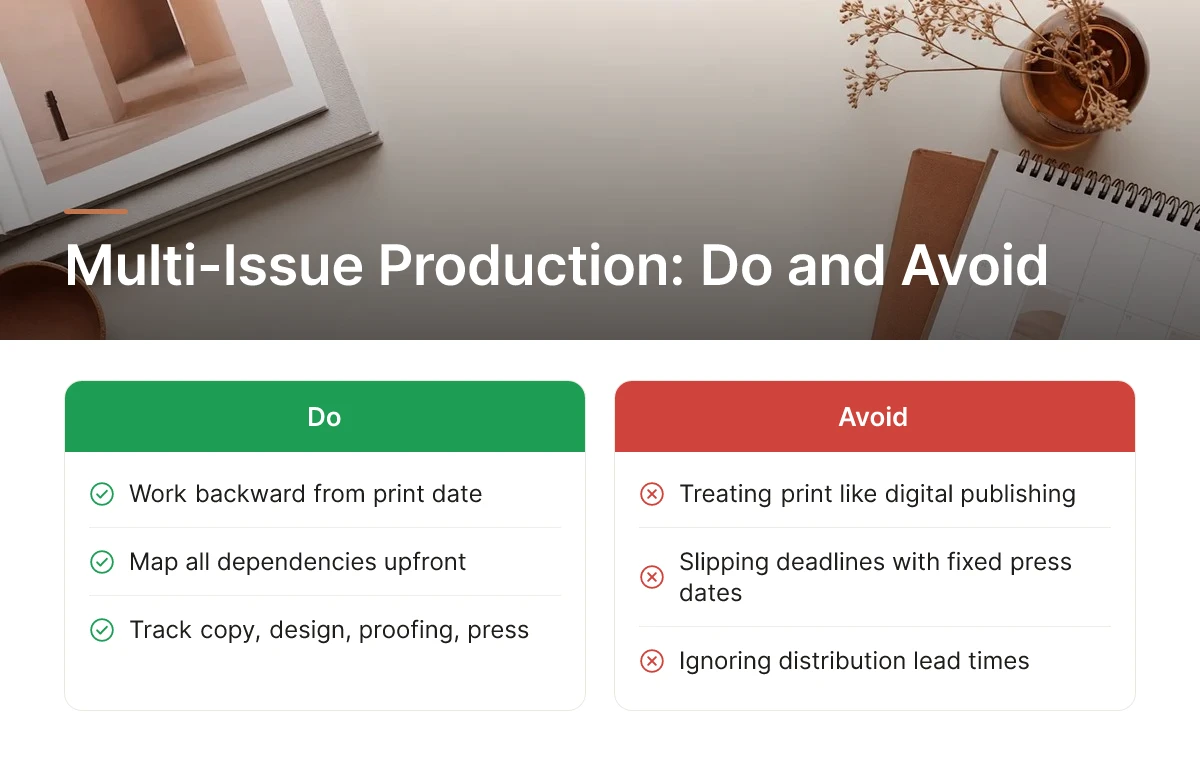
This template works backward from the print date, mapping every dependency between writing, design, proofing, and delivery across several issues at once.
What lead times and dependencies should your calendar account for?
Print doesn’t forgive the way digital publishing does. A blog post can slip a day with no visible cost; a magazine with a fixed press date and a physical distribution run cannot. That difference forces backward planning, you set the delivery date first, then work in reverse to fix every earlier deadline.
The dependencies this template tracks typically include:
- Copy deadlines for every section and feature
- Design handoff dates between editorial and the art team
- One or more proofing rounds with built-in review time
- Press time, locked once files are approved
- Delivery or distribution windows, including shipping lead times
Each item on that list has a hard date, and each depends on the one before it closing on schedule.
This structure is built for publishers running quarterly or biannual magazines with multiple contributors and an actual print run, not a single one-off project. The differentiator is a buffer week built in specifically between design handoff and press time, reserved for late client approvals. Generic content calendars, built for digital publishing where a delay just means a later timestamp, rarely plan for that gap, but in print, a late sign-off without a buffer means a blown press date [1].
3. The Theme-and-Story Grid Calendar
This grid-style template lays out each issue’s theme, feature stories, recurring columns, and visual direction side by side, in one view.
How do you structure themes, stories, and visual narratives across issues?
The layout runs issues as rows and themes, lead features, recurring sections, and photography or art-direction notes as columns. Scanning a single row tells you everything about that issue at a glance, what it’s about, what’s new, what repeats, and what it looks like.
Visual narrative gets planned in the same grid as the copy, not bolted on after the writing is finished. That matters because a layout designed around images chosen late tends to look like decoration rather than storytelling.
This format fits lifestyle and B2B brand magazines that mix evergreen columns with timely features, a recurring “founder’s note” column alongside a one-off feature on a new property launch, for example. The differentiator is a column dedicated purely to visual narrative continuity: recurring photographic style, a seasonal color palette, recurring framing choices. Most editorial calendar templates treat that as a design team’s private concern rather than a planning input, this one puts it on the same page as the words [1].
4. The Advertising and Sponsorship Integration Calendar
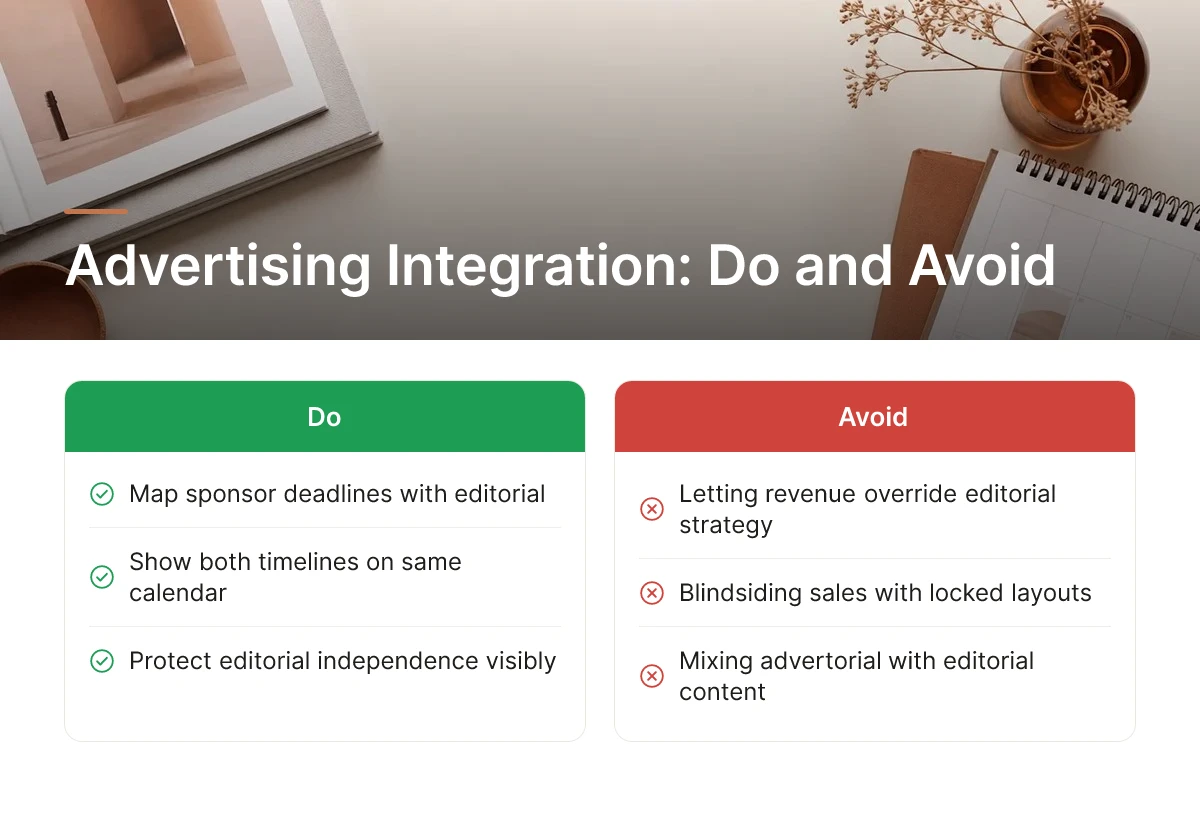
This template layers sponsor commitments onto the editorial plan so revenue deadlines and editorial deadlines are visible to each other, without letting one override the other.
How should revenue planning and editorial strategy inform each other?
Sponsor deadlines, artwork due dates, placement confirmations, renewal windows, get mapped directly against editorial deadlines on the same calendar. That way sales isn’t blindsided by a locked layout, and editorial isn’t blindsided by a sponsor asking for space after the feature well is already set.
Editorial independence gets protected through a clear, visible separation between advertorial space and the core feature well, marked explicitly on the calendar rather than negotiated informally issue by issue. Readers of a premium publication can tell the difference between a sponsored page and an editorial feature, and that distinction has to be planned, not improvised.
This approach is built for publishers monetizing custom magazines through sponsorship or advertiser partnerships. The differentiator: specific issues get flagged with “flexible well” space reserved for sponsor-adjacent content, so sales conversations happen before design lockdown instead of after, a sequencing problem that causes most of the friction between sales and editorial teams in sponsored publishing.
5. The Full Publication Cycle Calendar
This is the master document, a single magazine editorial calendar tracking strategy, editorial, design, print, and delivery across an entire year or multi-issue run.
What does the end-to-end process look like from strategy through delivery?
The phases run in sequence: strategy and spine confirmation, content assignment, writing and editing, design, proofing, print production, and distribution. Each phase feeds the next, and the calendar shows all of them on one timeline rather than scattered across separate tools per department.
A single master calendar reduces miscommunication between departments in a way that separate calendars per function cannot, when editorial, design, and production each keep their own schedule, the gaps between those schedules are exactly where deadlines get missed and handoffs get dropped [4].
This template suits brands running an ongoing custom magazine program, the kind of multi-issue relationship Rethink Publishing manages end-to-end for clients, from editorial spine through print and delivery, who need one document leadership can review without chasing three teams for status updates. The differentiator is a retrospective column, logged issue to issue, noting what worked and what didn’t. Over several issues, that column turns the calendar from a disposable schedule into an institutional record the next editor or production lead can actually learn from.
How to Choose the Right Magazine Editorial Calendar Template
Match the template to three variables: how often you publish, how many people touch the issue, and whether advertising revenue needs its own tracking lane.
A quarterly magazine with one editor and no ad sales can run on a simple spine document and a timeline. A monthly title with five department heads, a photo desk, and a sponsorship team needs a structured grid that assigns owners, deadlines, and page allocations per section. Skip this match and the calendar either collapses under its own complexity or fails to catch the handoffs that cause missed press dates.
A practical way to test fit is to ask a few questions before committing to a format:
- How many issues do you produce per year, and how much lead time does each one realistically need?
- How many departments or outside contributors need visibility into the same calendar?
- Does revenue depend on advertiser or sponsor placements that need their own deadlines?
- Is there a single owner accountable for the editorial spine, or does that responsibility shift issue to issue?
The answers usually point clearly toward a simple spine-and-timeline setup or a more layered grid with sponsorship tracking built in. Building a broader content strategy around the publication, rather than treating each issue as a standalone project, also makes it easier to decide which template will still make sense a year from now.
Why do magazines need a different planning approach than multi-channel content workflows?
Print works backward from a fixed page count and a hard production deadline, not forward from a rolling publish date like blogs or social posts [4]. A magazine editorial calendar has to account for image rights clearance, proofing rounds, printer lead times, and binding, steps that don’t exist in digital workflows built around statuses like “drafting” or “scheduled” [4]. Generic content calendar templates, built for channels where a missed date just means tomorrow’s post, don’t carry fields for signatures, prepress checks, or physical delivery windows [5]. Treating a 68-page issue like a blog queue is where most self-managed magazine projects start to slip.
How do you balance planned content with flexibility for timely, relevant stories?
Lock the spine early, the recurring sections, the editorial theme, the departments that appear in every issue, then leave two or three slots open for timely material closer to print. Consistency is what makes a magazine feel like a keepsake instead of a one-off: the same front-of-book columns, a style guide covering voice and image treatment, and a spine check before each issue closes. Rethink Publishing builds this editorial spine first, before layout or production begins, specifically so later issues don’t drift from the brand’s original intent.
Start with the basics, spine plus timeline, and add a grid or sponsorship-tracking column only once the publication program proves it needs one.
Frequently Asked Questions
How is an editorial calendar different from a content calendar or publishing schedule?
A content calendar schedules posts across channels; a magazine editorial calendar maps a single publication’s narrative arc from spine to final page. Content calendars track dates and platforms [3]. A magazine calendar tracks themes, feature sequencing, image needs, and how one issue connects to the next, closer to a flatplan than a social posting grid [1].
What should you include in a magazine editorial calendar?
Include the editorial spine, feature themes per issue, writer and photographer assignments, image sourcing deadlines, design and layout milestones, proofing rounds, and print production dates. A content calendar template typically tracks publish date, status, title, and target keyword [4], a magazine version needs those production stages layered on top, since a finished issue moves through writing, design, and print before anything “publishes.”
How do you maintain editorial consistency and quality across multiple issues?
Consistency comes from a documented editorial spine applied the same way every issue, not from improvising each time. Define recurring sections, a consistent design language, and a single point of editorial accountability before issue one ships. Rethink Publishing builds this spine first, then applies it across every subsequent publication, which is part of why a 20-plus-year production history matters more than any single issue looking good.
What practices ensure your magazine stays a keepsake and marketing asset over time?
Treat the magazine as an editorial product, not a brochure, that distinction is what makes someone keep it on a coffee table instead of recycling it. Prioritize image quality, print stock, and genuine storytelling over sales copy. When a magazine is done properly, people don’t throw it away. They keep it, and that’s the entire point of the investment.
Who should own and maintain the magazine editorial calendar day to day?
Ownership usually sits with a managing editor or editorial director, since that role is positioned to weigh spine fit, writer capacity, and production timing together. Design leads and, where relevant, a sponsorship or revenue lead should have visibility into the same document, but a single accountable owner keeps the spine from drifting as new contributors rotate in across issues.

Conclusion
A magazine editorial calendar only works if it starts with a spine, not a spreadsheet of dates. Sequence your themes before you assign a single writer, lock image and design milestones alongside editorial deadlines, and hold every issue to the same standard so the publication builds credibility over time rather than resetting it each cycle. The brands that get this right stop treating print as a one-off project and start treating it as a recurring brand asset.
If you’re weighing whether your company is ready for one, start by sketching the editorial spine for a single issue, three features, one theme, one point of view, before you worry about frequency.
Sources & References
- How to plan a magazine (using a flatplan)
- What is an Editorial Calendar? [12 Free Templates for 2025]
- Content Calendar Template: The Columns That Matter, and 10 Free Ones to Copy | Distribb
- 10 Best Editorial Calendar Templates for 2026 | WaveGen Blog
Recommended Articles
Explore more from our content library: