
Understanding how to write a magazine is essential. Writing a magazine that readers finish cover to cover means treating it as a brand asset with an editorial spine, not a stack of marketing pages. Start with a clear editorial thesis, one idea every story serves, then structure content so pacing, sequencing, and design work together to pull readers forward. The magazines people keep on their coffee table share three traits: a real point of view, deliberate rhythm between long and short reads, and design that respects the writing instead of decorating it.
What You’ll Need Before You Write a Magazine for Your Brand
Before anyone opens a document, a company needs a point of view, a defined reader, and an honest answer to whether print earns its place in the marketing budget at all.
Most companies get this backward. They gather marketing messages, hire a designer, and call the result a magazine, then wonder why nobody reads past page three. The real work of how to write a magazine happens before a single word is drafted, in three decisions: what the publication believes, who it’s actually for, and whether it deserves to exist as a physical object in the first place.
Why an editorial spine is the foundation of a cohesive magazine
An editorial spine is the single idea every article in the issue has to serve, not a list of things the company wants to say about itself. A law firm’s spine might be “judgment under pressure shapes outcomes”; a hospitality brand’s might be “hospitality is a discipline, not a nicety.” Every feature, profile, and photo essay tests against that one line. Drop the spine and you get a folder of unrelated marketing messages bound together, which readers recognize immediately and stop trusting.
This is also where audience comes before content. Clients, prospects, employees, and industry peers each want something different from the same publication, clients want to feel understood, peers want to see authority, employees want to see the culture reflected honestly. Define who gets the most value from reading, then build the spine around what they gain, not what the company wants to broadcast.
How a custom magazine differs from other marketing materials
A magazine has editorial independence and pacing; a brochure has a sales agenda wearing an editorial costume. A brochure exists to close a transaction on this page, this quarter. A magazine exists to be read, kept, and reopened, which means it needs long features next to short ones, quotes next to data, and design that gives the writing room instead of decorating it [1]. That rhythm is precisely what a sales sheet can’t fake.
Before committing, name the signals that a magazine isn’t the right move: no real story to tell beyond “we’re great at what we do,” or no appetite for a recurring, long-term production commitment. A single issue with no follow-through rarely justifies the investment. This is the qualifying conversation Rethink Publishing has with every prospective client before any strategy or design work begins, because a magazine built on a weak spine costs the same to print as one built on a strong one, and only one of them gets kept on a coffee table.
Structure the Magazine So Readers Finish Cover to Cover
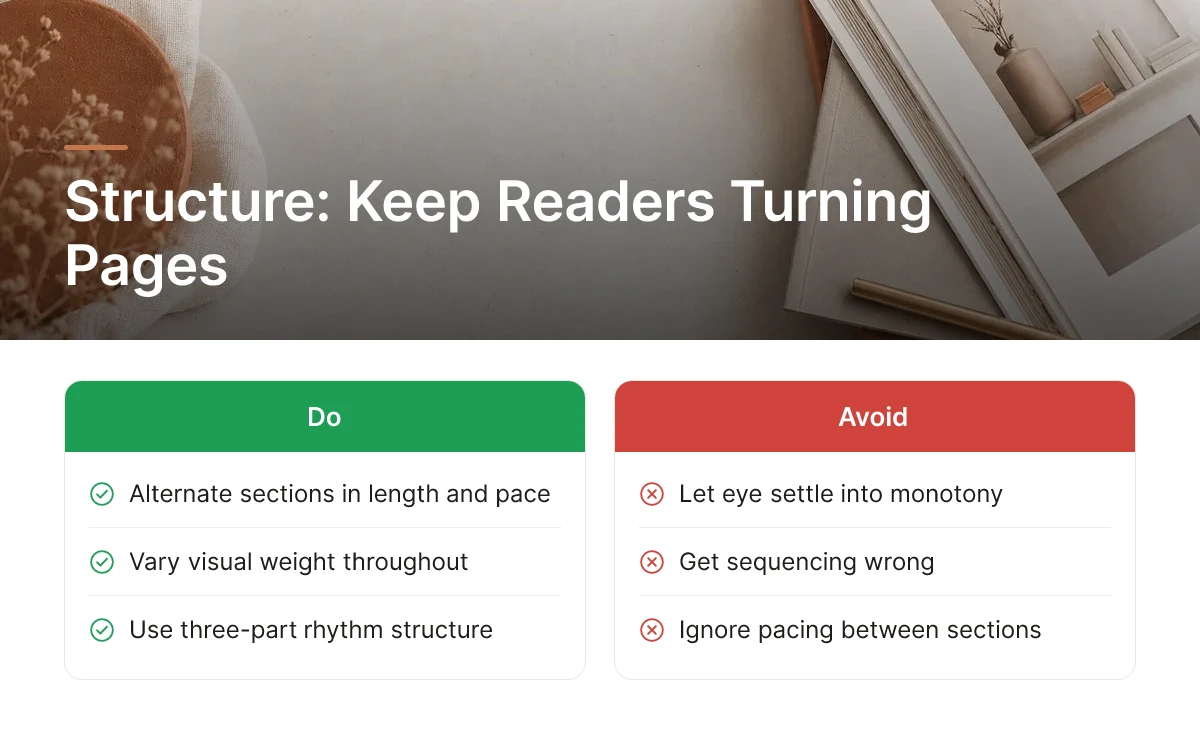
A magazine keeps readers turning pages when its sections alternate in length, pace, and visual weight so the eye and attention never settle into monotony. Get the sequencing wrong and even strong writing goes unread past page 12. Get it right, and a 96-page issue feels shorter than a 20-page brochure.
Key structural elements that keep readers turning pages
Consumer magazines solved this problem decades ago, and the underlying logic still applies to a branded publication. Most issues run on a three-part rhythm: front-of-book (short items, news, quick reads that build momentum), features (the long-form core), and back-of-book (lighter, often personality-driven closers) [1]. That rhythm exists because no reader wants 80 consecutive pages at the same intensity.
- Alternate long and short. A 2,000-word profile should sit next to a one-page Q&A or a photo essay with minimal text, not another dense feature.
- Vary the content type, not just the length. Mix interviews, data visuals, short lists, and full-bleed photography so consecutive spreads never look or read the same.
- Use a table of contents as a promise, not a formality. It signals pacing to the reader before they’ve turned a single page, a well-labeled contents page tells them where the quick reads are and where to slow down.
This is the part of learning how to write a magazine that gets skipped most often. Writers focus on individual articles and forget that sequence is itself a form of storytelling.
How to sequence content and design into one reading experience
Every issue needs two anchors: an opening feature strong enough to justify the cover, and a closing page memorable enough to reward finishing. The opening sets the editorial spine, the theme or angle that everything else supports. The closer doesn’t need to be long; it needs to be distinct, often a single striking image, a short personal note, or a recurring column readers start to expect issue after issue.
Design carries as much structural weight as the writing. White space signals a pause before a new section. A full-page photograph slows the reader down; a dense three-column layout speeds them up. Typographic hierarchy, headline size, deck weight, pull quotes, tells the reader which pages are worth lingering on before they’ve read a word [1]. None of this is decoration; it’s pacing made visible.
At Rethink Publishing, this is exactly where editorial direction earns its place before layout begins, sequencing decisions get made against the spine, not after design is already underway. Our team has worked through this pacing exercise across 80-plus magazines, and the pattern holds regardless of industry: hospitality, law, real estate, or architecture. Structure a magazine like this and it reads less like a marketing deliverable and more like a publication your audience chooses to pick back up.
Align Editorial Vision With Design Execution
Writing to a layout beats writing first and hoping design fixes it later, because word count, image pairing, and pacing are editorial decisions, not cosmetic ones. Anyone figuring out how to write a magazine needs to accept this early: the page is the unit of thought, not the document.
Most companies get this backward. A marketing team drafts a 1,200-word article, sends it to a designer, and asks them to “make it fit” a six-page spread with three photos. The designer shrinks the type, crops the images awkwardly, or cuts the writer’s best paragraph to make room. Nobody planned the page as a whole, they assembled two separate deliverables and forced a merger. The result reads like exactly what it is: two teams working in sequence instead of one team working together.
How words and images work together intentionally in a well-made magazine
A pull quote sized at 36 points across a third of the page isn’t decoration, it’s a deliberate pause, forcing the reader to slow down before the next section. A photo essay spanning four pages can replace 800 words of description the writing never needed to carry in the first place. Every page in a well-made magazine is a decision about which medium, text or image, does the work, made before either is finished. That’s the difference between a magazine and a brochure with an article stapled to it: a brochure hands you information; a magazine paces you through it.
What role a calm, precise process plays in bringing editorial vision to life
Quality holds up under a process with clear stages, editorial spine defined first, then copy and image sourcing developed against that spine, then layout, then review, with no rushed rewrites forced in during production. Rushed last-minute copy changes after layout is locked are where quality erodes fastest: a paragraph gets trimmed to fit, a caption gets rewritten in five minutes to match a cropped photo, and the seams show on the printed page. At Rethink Publishing, editorial direction happens before design begins, precisely so writers and designers aren’t negotiating against a deadline. That sequencing, call it Swiss precision, is what lets 80-plus magazines ship as finished, coherent objects rather than patched-together drafts.
Start the Magazine Project From Strategy Through Delivery
Starting a magazine project means answering four questions before you brief anyone, then moving through six stages that turn a concept into a printed object clients keep. Skip the questions and the stages will cost you time, revisions, and money.
Questions to ask before committing to a custom magazine
Before you write a single line, your leadership team needs to agree on the answers to these questions. Anyone learning how to write a magazine that actually gets read starts here, not with a layout template.
- What’s the story? Not “what do we sell,” but what does the company believe, and what does it want to be known for in five years.
- Who reads it? Existing clients, prospects, referral partners, or all three, each answer changes tone, length, and distribution.
- How often does it publish? An annual flagship piece behaves differently than a quarterly relationship-builder, and the editorial calendar has to match the resources you’re willing to commit.
- What happens after someone finishes reading it? A magazine without a next step, a renewed conversation, a referral, a meeting booked, is just a well-made object sitting on a shelf.
What the end-to-end process looks like from strategy through delivery
Once those questions are settled, the work moves through six stages: strategy and concept, editorial planning, writing, design, print production, and distribution. Strategy sets the editorial spine, the throughline that keeps forty pages from feeling like forty unrelated brochures. Editorial planning turns that spine into a table of contents, assigns stories, and sources imagery. Writing and design happen in tandem, not sequence, because words and layout are meant to work together, not get stitched together after the fact. Print production covers paper stock, binding, and quality control. Distribution, mailed, hand-delivered, or placed in a lobby, is where the investment starts paying off.
Print earns its keep differently than a digital campaign does. A magazine sitting on a coffee table gets picked up more than once; a well-made piece gets passed to a colleague, sits in a waiting room for months, and gets reread in a way a social post never will. That’s a durability argument, not a cost argument, you’re paying for repeated exposure over a long shelf life, not a single impression. Treat it as a long-term brand line item, not a campaign expense, and budget accordingly across a mid-range to premium tier depending on scope.
The other decision that matters as much as any editorial choice: who runs the process. Assembling a writer, a designer, an image licensor, and a printer as separate vendors means you’re the one managing handoffs and catching what falls through the cracks. Rethink Publishing runs strategy, writing, layout, image rights, print, and delivery under one roof, so the editorial spine survives all the way to the finished, bound copy, instead of getting diluted at every handoff.
Common Mistakes to Avoid When Writing a Brand Magazine
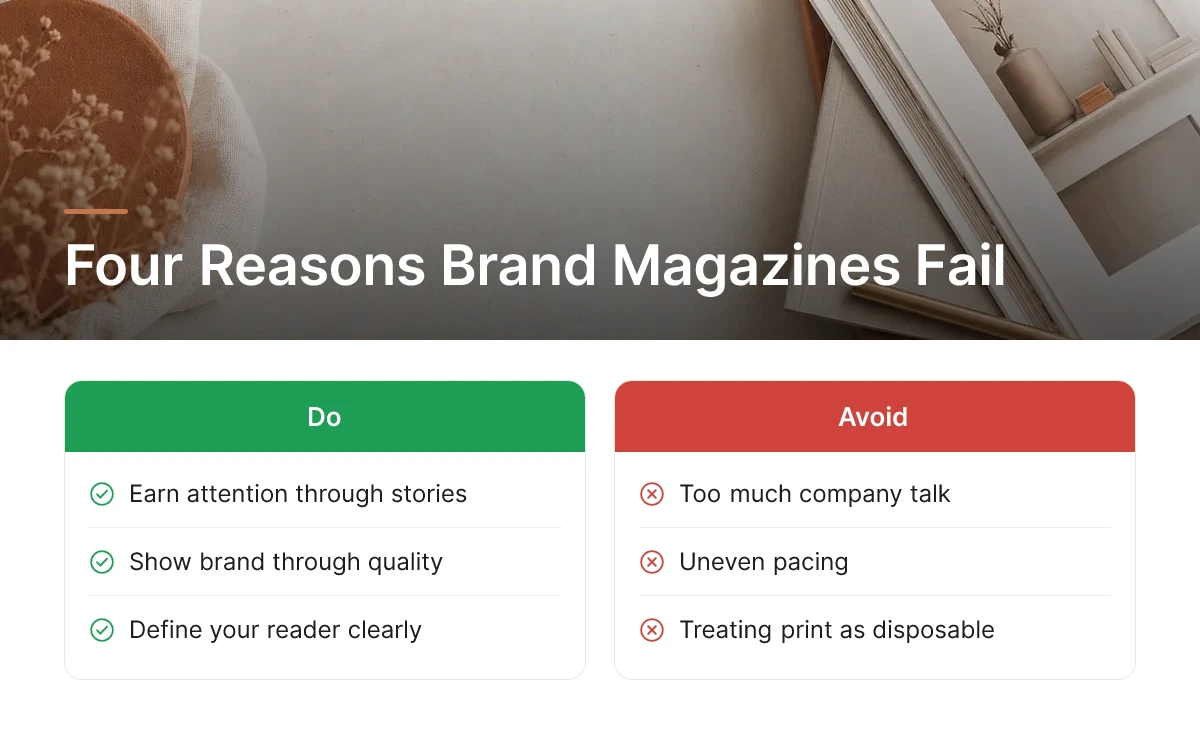
Most brand magazines fail for one of four reasons: too much company talk, uneven pacing, no defined reader, or a print run treated as disposable marketing rather than a keepsake. Every one of these is fixable before layout begins, which is exactly why they’re worth naming plainly.
The most common mistake is building a brochure with more pages. A CEO reviewing drafts wants to see the brand represented well, so every section starts to carry a product mention, a client testimonial, a subtle pitch. Readers notice immediately. A real magazine earns attention through stories, expertise, and perspective, the brand shows up through quality and tone, not through repeated self-promotion. If every page pushes a message, the reader stops trusting the next one.
Pacing is the second failure point, and it’s the one that kills momentum fastest. A magazine built entirely from long-form features, with no photo essays, short profiles, or visual breaks, reads like a report rather than a publication. Readers set it down midway not because the content is bad, but because there’s no rhythm pulling them forward. Editorial teams that understand how to write a magazine plan the contents page like a piece of music, long, short, visual, long again, so attention resets instead of fatiguing.
Skipping audience definition causes the third failure. Without a clear reader in mind, content tries to address existing clients, prospects, and industry peers all at once, and ends up connecting with none of them. A sharp editorial spine only works when it’s aimed at someone specific.
Why print is a long-term brand investment worth the commitment
A printed magazine costs more to produce than a PDF, and that’s the point, not the drawback. Print signals that a brand invested real effort into something meant to last, which is why it gets a place on a coffee table instead of a folder in an inbox. Digital assets compete for seconds of attention; a physical object competes for none, it simply waits to be picked up again.
How to ensure a magazine becomes a keepsake rather than disposable marketing
Keepsake status comes from editorial discipline: a defined audience, varied pacing, and content readers value independent of the brand behind it. Rethink Publishing builds that spine before a single layout is designed, then manages writing, imagery, and print production so the finished piece holds up on rereading, not just on first glance.
Frequently Asked Questions
Does every company need a custom magazine?
No. Not every company needs one. A custom magazine makes sense when a brand has real depth of story, an affluent or relationship-driven client base, and a reason to keep the brand physically present in someone’s home or office, a hospitality group, a law firm, a real estate developer. If the goal is quick lead generation rather than lasting brand perception, a magazine is the wrong tool and the budget is better spent elsewhere.
How long should a brand magazine be?
Most brand magazines run between 48 and 100 pages, though the right length depends on the editorial spine, not a page-count target. A thin issue padded with filler reads as a brochure. The better approach: build the content plan first, then let the page count follow the story rather than forcing the story to fill a predetermined size.
Who should write the content in a company magazine, internal staff or outside editors?
Outside editors, in most cases, because internal staff rarely have the editorial distance or magazine-writing craft to produce something readers keep. Internal teams know the brand deeply but often default to marketing language rather than narrative. Rethink Publishing pairs a client’s institutional knowledge with an outside editorial team, so the voice stays credible and the brand’s expertise still comes through accurately.
How often should a brand publish a custom magazine?
Once or twice a year is typical for a brand magazine, since quality print production takes months, not weeks. Annual publishing also fits how these assets get used, handed out at flagship events, mailed to top clients, placed in offices, where frequency matters less than the piece feeling worth keeping.
Can a digital-only version replace the printed magazine?
No, not for the same purpose, a PDF disappears into an inbox, while a printed magazine sits on a coffee table for months. Digital versions work well as a companion, extending reach online, but the physical object is what creates the lasting impression print is commissioned for in the first place.
Conclusion
A brand magazine earns its place on a coffee table when the editorial spine comes first, the design pairs words and images with intent, and the production quality holds up to scrutiny months after the first read. Skip any of those, and the result reads as a brochure with better paper. Before commissioning anything, get honest about whether your brand has the story and the audience to justify the investment, not every company does. If it does, start by drafting a one-page editorial concept: the audience, the theme, and the story only your brand can tell. Rethink Publishing can take it from there.
Sources & References
Recommended Articles
Explore more from our content library: