
Understanding magazine print run size is essential. The right print run size for your brand magazine comes down to matching quantity to purpose, not chasing the biggest number you can afford. A tightly targeted run of a few hundred copies sent to key clients and prospects often builds more perceived value than a mass-printed run that gets stacked in a lobby. Start with who actually needs to hold the magazine, decision-makers, top accounts, event attendees, then size the print run to that list, plus a modest buffer for new relationships and internal use.

Define Your Magazine Print Run Size Before You Print
Work backward from your distribution list, not forward from a generic industry number, because your magazine print run size only makes sense in relation to who will actually hold a copy. Ask “how many is normal” and you’ll get an answer built for someone else’s business. Ask “who needs this in their hands” and the number writes itself.
What Factors Should Influence Your Print Run Decision
Five inputs should shape the count, and none of them involve a printer’s price sheet:
- Your confirmed recipient list, the named clients, prospects, and partners who will receive a copy directly
- Planned events or mailings scheduled for the next two to three quarters, since a magazine tied to a launch or gala needs enough copies for that specific room
- Sales team needs, how many reps carry copies into meetings, and how often they’ll need to restock
- Internal stakeholder copies for leadership, the board, and departments who use the magazine to reinforce brand standards internally
- A small reserve, typically a modest percentage above your core list, held for new contacts that emerge after distribution begins
Add those together and you have a number grounded in actual use, not aspiration.
How Audience Size and Distribution Channels Shape Your Quantity Choice
A direct-mail campaign to 300 named accounts calls for a different print run than a magazine handed out at a single flagship event. Distribution channel dictates timing and packaging as much as it dictates quantity, a mailed piece needs an exact count plus reserve, while an in-room handout can flex slightly based on expected attendance. Trade sources note that print quantity is one of the biggest levers on per-unit cost, with short runs costing more per copy and larger runs bringing that figure down [2]. That’s a production economics fact worth knowing, but it should never be the reason you print more than your audience justifies.
Overordering “to be safe” is the most common misstep among brand leaders sizing their first run. The instinct feels responsible, but leftover boxes stacked in a storage closet quietly work against the exclusivity the magazine was meant to project, a publication that’s scarce enough to matter shouldn’t also be sitting unclaimed six months later. This is why Rethink Publishing pushes clients to define the list before any conversation about paper stock or press time.
Sizing the run is a strategic call, not a line item to delegate to whoever manages print vendors. It belongs with marketing leadership or the executive sponsoring the publication, because it encodes a judgment about who the brand considers worth reaching, the same judgment that shapes the editorial spine itself.
Weigh How Print Quantity Shapes Perceived Quality
A smaller print run can read as more premium than a large one, but only when the reduction is deliberate targeting, not a cut-rate compromise on materials.
Magazine print run size sends a message before anyone reads a single page. A publication printed in the hundreds, hand-numbered or mailed to a named list, tells the recipient this object was made with them in mind. A publication printed in the tens of thousands and left in a lobby rack tells a different story, even if the content inside is identical. Scarcity is not a marketing trick here, it’s a signal about intent. When a CEO receives a magazine that clearly wasn’t blasted to a mailing list of 50,000, the object itself communicates exclusivity before a single headline lands.
Does Printing Fewer Copies Actually Enhance Brand Perception
Yes, but only when the smaller run is a targeting decision, not a budget shortfall dressed up as strategy. Cutting quantity while keeping paper stock, binding, and finish intact sharpens perceived value. Cutting quantity to afford a project at all, and then compensating by dropping to lighter stock or a cheaper cover finish, does the opposite, readers notice thin paper and a flimsy spine faster than they notice a small print number. The rule of thumb: reduce the run to increase precision of distribution, never to rescue an underfunded production.
How Print Run Size Affects the Tactile and Design Impact of Your Magazine
Print run size and tactile quality compete for the same budget, and a smaller run usually wins that trade-off. Paper weight, coating, trim size, and binding method all move cost per copy, and spending more per copy on a run of 500 well-placed magazines tends to outperform stretching the same budget across 5,000 thinner ones [2]. A heavier stock and a sewn or perfect-bound spine make the object feel like it belongs on a coffee table rather than in a recycling bin. This is the same logic Rethink Publishing applies when scoping a project: the print specification and the print run size get decided together, not in sequence, because one determines what the other can afford.
The opposite failure matters just as much. A run too small to reach enough of the right people never builds brand presence at all, it becomes a beautiful object nobody outside the office ever sees. A magazine exists to be read, shared, and left on a table where a peer picks it up. Quantity has to clear that threshold before quality can do any work.
Match Print Quantities to Your Distribution Strategy
Your magazine print run size only makes sense once you know exactly where every copy is going before it’s printed, not after.
A stack of magazines sitting in a storage closet isn’t a brand asset, it’s a write-off. Before you commit to a number, you need a named destination for each copy: a mailing list, an event handout table, a sales meeting leave-behind, a reception desk. If you can’t point to where a copy lands, that copy shouldn’t exist.
What Print Quantities Allow You to Reach Your Intended Audience Effectively
The right quantity is whatever number lets you place a copy in the hands of everyone on your actual list, plus a modest allowance for the unplanned moments that always come up. A CEO mailing to 400 top-tier clients needs 400 addressed copies and maybe 50 extra for new hires, referrals, or a client who mentions they’d love one. A brand preparing for a flagship property launch or an anniversary event needs enough copies to fill the room and survive people asking for a second one to take home. The audience defines the number, not the other way around.
How Different Print Runs Support Different Distribution Strategies
A direct-mail-led strategy behaves differently from an event-led one, and the print run has to reflect that. Mail campaigns run on precision: you know the list size, you know the address count, and printing significantly beyond that figure just creates inventory with no destination. Event- and meeting-led strategies work the opposite way, they need a rolling buffer, because a managing partner handing out magazines at a conference can’t predict exactly how many conversations turn into “can I take one of those.” Building in that buffer, typically a modest percentage above the confirmed headcount, protects against running out mid-event without inflating the order into wasted stock.
Digital distribution changes this math further. When the same editorial content also lives as a PDF or web version, the print run can afford to stay small and deliberate, the physical copies become the ones reserved for people worth the weight of a printed piece, while digital covers the wider reach [1]. That’s part of why a marketing magazine works as what one industry source calls a physical touchpoint rather than a mass broadcast [1].
For evergreen brand magazines, reprinting in smaller batches over time usually beats one large upfront run. It keeps content current, avoids warehousing costs, and lets you adjust quantity as you learn which channels actually move copies. Rethink Publishing builds this staged approach into its production planning, so clients aren’t locked into a number decided months before the first copy ships.
Adjust Print Run Size for Your Audience and Business Goals
The right magazine print run size depends less on printing economics and more on who receives the magazine and what you need it to do for the business.
What’s a Viable Print Run for a Niche, High-End Audience Versus a Broader Market
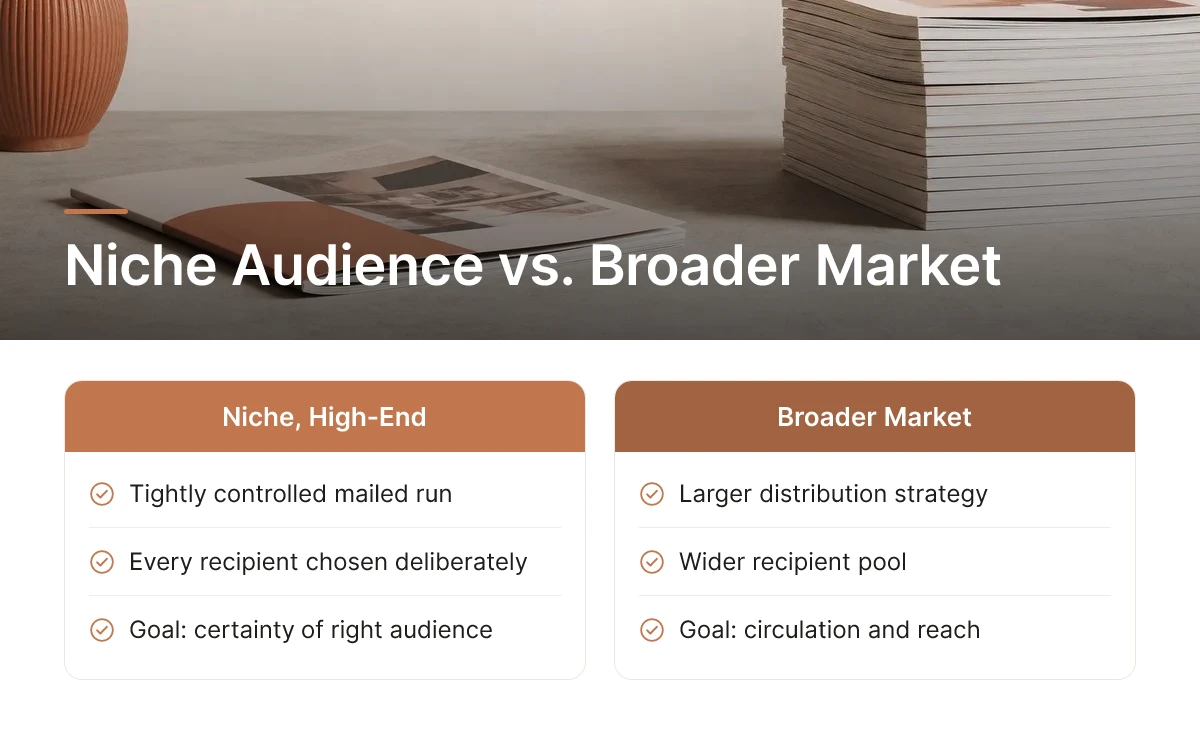
A magazine built for a short list of named clients, prospects, or partners works best as a tightly controlled, mailed run, every copy tracked, every recipient chosen deliberately. This is the model for a law firm targeting general counsels at 300 target accounts, or a private club mailing to its existing membership plus a warm prospect list. The goal isn’t circulation, it’s certainty that the right 300 or 800 people opened it, read it, and put it on a shelf.
Broader-market distribution works on different math. A hospitality brand placing copies in every guest room across a portfolio of properties, or a real estate developer stocking sales offices and show homes, needs enough volume to support constant restocking without babysitting individual copies. Here, reach and repeat exposure matter more than knowing exactly who touched each issue. The quantity conversation shifts from “who’s on the list” to “how many touchpoints do we need live at once.”
How Trade Publications, Corporate Magazines, and Brand Publications Differ in Print Quantity Needs
Trade publications aimed at an industry’s decision-makers tend to run smaller and more targeted, the value is precision, not volume, since the audience is often a few thousand specialists at most. Internal corporate magazines, built to reinforce culture and keep distributed teams aligned, size to headcount plus a reasonable buffer for new hires and reception areas, not a marketing forecast. Brand or client magazines, the category Rethink Publishing produces most often, sit between the two: large enough to support gifting, events, and referral pass-along, but curated enough that quality per copy still matters more than raw count.
None of these categories has an inherently right print run. What separates them is the job the magazine is hired to do. A magazine built for lead generation needs different math than one built for client retention, internal culture, or industry authority, which is why the goal has to be locked down before anyone discusses quantity, not used to justify a number chosen for other reasons.
Common Mistakes to Avoid When Choosing a Print Run Size
Most companies get magazine print run size wrong in one of two directions: they print too many copies out of nervousness, or too few out of budget anxiety, and both mistakes are avoidable.
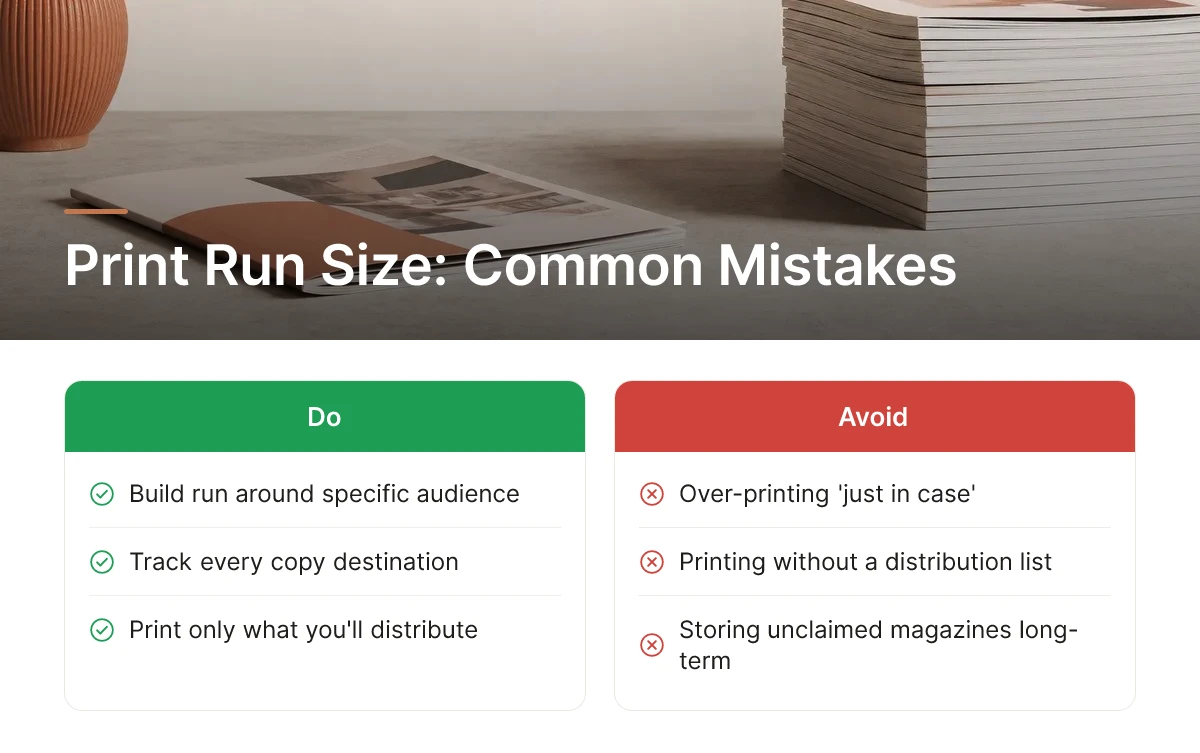
The most common error is over-printing “just in case.” A CEO looks at a distribution list of 500 and asks for 2,000, reasoning that extra copies can’t hurt. They can. Boxes of unclaimed magazines sitting in a storage closet six months later are not a safety net, they are a quiet signal that the print run was never built around a specific audience in the first place. A magazine with a real editorial spine is targeted: it goes to the clients, prospects, and partners who matter to a specific goal. When half the run never leaves the box, that’s evidence the targeting step got skipped.
The opposite mistake is under-printing purely to save money upfront. A firm trims the run to cut cost, only to discover mid-distribution that the general counsel they wanted to impress, or the referral partner who drives repeat business, never received a copy. At that point, the campaign has already undercut its own purpose, the people the magazine existed to reach are the ones left out [1].
Why Is Print Run Size a Strategic Decision, Not Just a Production Decision
Print run size should be revisited with every issue, not locked in once and forgotten. Audiences change: a real estate group’s buyer list after a flagship launch looks nothing like it did two years earlier, and a law firm’s referral network shifts as partners come and go. Treating quantity as a fixed number set at the start of the relationship, rather than a question asked fresh each cycle, is how magazines quietly drift out of alignment with the goals they were built to serve.
How Does Committing to Print Quantity Reflect Your Brand’s Values and Positioning
The discipline behind sizing a run correctly is the same discipline behind the editorial content itself. A brand that thinks carefully about who receives a copy, rather than defaulting to “more is safer”, sends the same signal of precision and intent that shows up in the writing, the layout, and the paper stock [4]. A magazine is a brand artifact. The quantity printed should say something considered about who that brand is for.
Frequently Asked Questions
Should you print extra copies beyond your confirmed distribution list?
Yes, a buffer of roughly 10-15% above your confirmed list is standard practice, not waste. Copies get damaged in shipping, new client relationships appear after the print run ships, and executives always want a few extra for their own office or a last-minute meeting. Running out looks worse than a small overage.
Is it better to print one large run or several smaller reprints over time?
Smaller, more frequent runs usually serve brand magazines better than one large print run you hope to distribute over years. A single large batch often means half the copies are outdated or sitting in storage by the time you use them. Reprinting every 6 to 12 months keeps content current and cost per copy manageable at mid-sized quantities [2].
How does print run size differ for an internal company magazine versus a client-facing one?
Internal magazines run smaller because the audience is fixed and known, usually just employee headcount plus a small buffer. Client-facing magazines need a larger, more flexible run because they’re handed out at events, left in lobbies, mailed to prospects, and shared with referral partners. A client-facing publication also carries more brand weight, so quality and finish matter more than sheer volume [1].
What happens if you print too many copies of a brand magazine?
Excess copies sit in storage, go stale as content ages, and quietly undercut the exclusivity that makes a print magazine feel special in the first place. Money that could fund your next issue gets tied up in boxes nobody opens. It’s a bigger risk to brand perception than most executives expect.

Conclusion
Print run size isn’t a production detail, it’s a decision about how your brand shows up in the room. Start from your real, named audience, add a modest buffer, and resist the urge to print for scale you don’t yet have. A smaller run that reaches the right hands beats a large one gathering dust in a storage closet.
If you’re still unsure what number makes sense for your audience and goals, bring the question to a team that handles this end-to-end. Visit www.rethink-publishing.com and ask Nathalie Grolimund’s team to walk through your distribution list before you commit to a print quantity.
Sources & References
- Marketing Magazines: Why They’re a Secret Weapon – Smartpress Blog
- How much does it cost to print a magazine? – Greenerprinter
- Tips For Magazine Printing – Greenerprinter
Recommended Articles
Explore more from our content library: