
Understanding coffee table book publisher is essential. Before commissioning a high-end coffee table book, ask a publishing studio seven things: how they’d define your editorial spine, who handles strategy through print under one roof, what materials and finishes they recommend and why, what the realistic timeline looks like, how they measure a book’s long-term value, what industries they’ve worked in, and how they balance visual storytelling with substance. A custom coffee table book only works as a brand asset when editorial strategy, design, and production are handled as one continuous process, not outsourced in pieces. The answers to these questions reveal whether a studio can actually deliver that, or just print pretty pages.
1. An Editorial Strategy Session Before Any Design Work Begins
Ask any coffee table book publisher for a strategy conversation first, if they respond with layout mockups instead, that’s the warning sign to note.
Every strong coffee table book has an editorial spine: a throughline that decides which stories, images, and pages actually earn a place in the finished object. Without it, a book becomes a pile of good photographs with no reason for their order. The spine is what a reader feels even if they can’t name it, a sense that the book was arguing for something, not just displaying it.
A studio that jumps straight to design software and template options before asking about narrative hasn’t done the harder work first. Layout is a downstream decision. Editorial direction is the decision that makes layout choices obvious rather than arbitrary.
This step matters most for brands with a genuine story worth documenting, a hospitality group with decades of design history, a law firm’s founding partners, an architecture practice’s body of work. If there’s no real story, no amount of design polish fixes that.
What questions reveal whether a publishing studio understands your brand’s editorial vision?
Ask whether the studio interviews your team or simply requests a folder of assets. Interviews surface the details, the language your clients actually use, the moments your team remembers, that make a book sound like your brand instead of a generic template with your logo on the cover.
2. Proof of End-to-End Capability From Strategy Through Delivery
A coffee table book publisher should manage strategy, writing, design, and print in-house, ask directly, because fragmented teams create visible gaps.
When one agency handles editorial and a separate vendor handles print, brand consistency tends to break down somewhere in the handoff, a color that doesn’t translate, a layout decision the printer wasn’t briefed on, a paper stock nobody vetted against the final trim size. Each handoff is a place where the original vision gets diluted.
How do you evaluate a studio’s end-to-end capability—from strategy through delivery?
Ask specifically who writes the copy, who designs the layout, who sources the paper, and who manages the print run. Vague answers about “our network of partners” usually mean no single team is accountable for the finished object. Rethink Publishing, for example, runs writing, layout, image rights, printing, and quality control under one roof so no phase gets orphaned between vendors.
This matters most for companies without in-house editorial or design bandwidth, most CEOs and brand executives don’t have a spare art director sitting around to coordinate five vendors on a six-month project.
The sharpest test: ask what happens if a chosen paper stock gets discontinued mid-project. A studio that answers with a specific substitute and a clear cost-and-timeline impact has actually run a full production cycle before. A studio that hesitates hasn’t.
3. A Clear Point of View on Design and Visual Storytelling
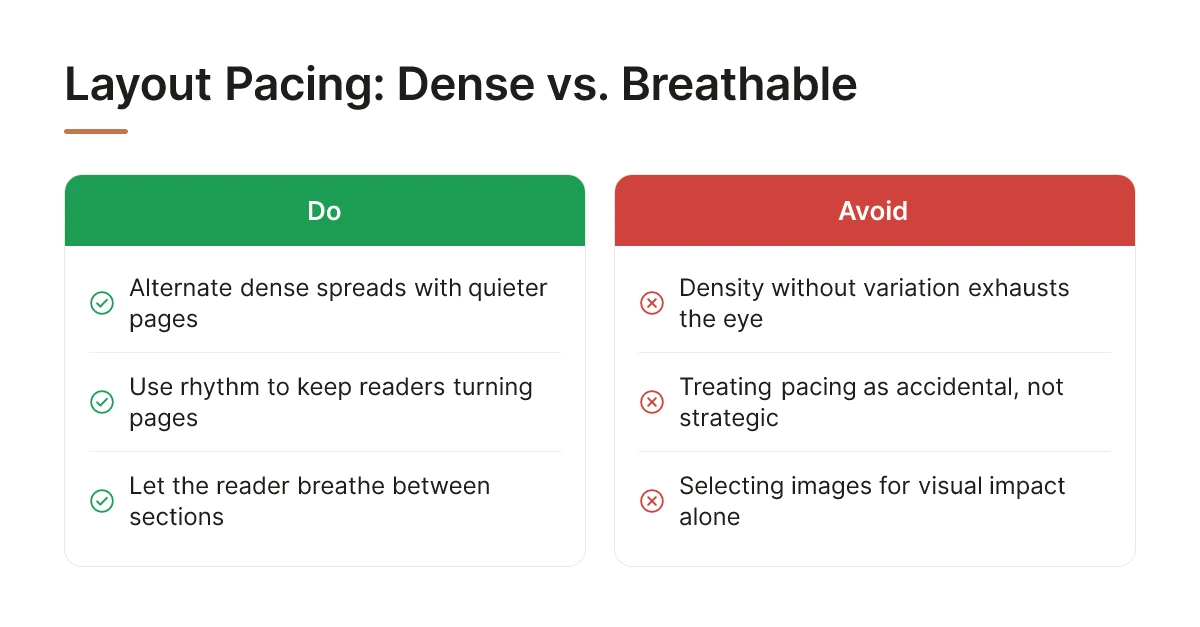
Ask how a studio paces a book, layout rhythm, not decoration, is what keeps a reader turning pages instead of skimming them.
Good design alternates dense, image-heavy spreads with quieter pages that let the reader breathe. That rhythm is what separates a book someone reads cover to cover from one they flip through once and shelve. Density without variation exhausts the eye; the pacing is a design decision, not an accident.
How should layout, typography, and image selection work together in a premium coffee table book?
Ask how the studio selects images, for visual impact alone, or because each one carries the narrative forward. A photograph chosen purely for polish can still be the wrong photograph if it doesn’t serve the story on that page.
This question matters most for brands that already have strong photography or archival material but no framework for sequencing it into something coherent. Raw assets aren’t a book; sequencing is what makes them one.
The sharper differentiator: ask to see how a studio handles white space. Restraint in a spread, the willingness to leave a page uncluttered, signals design maturity more reliably than density ever does.
4. Honest Recommendations on Paper, Binding, and Finish
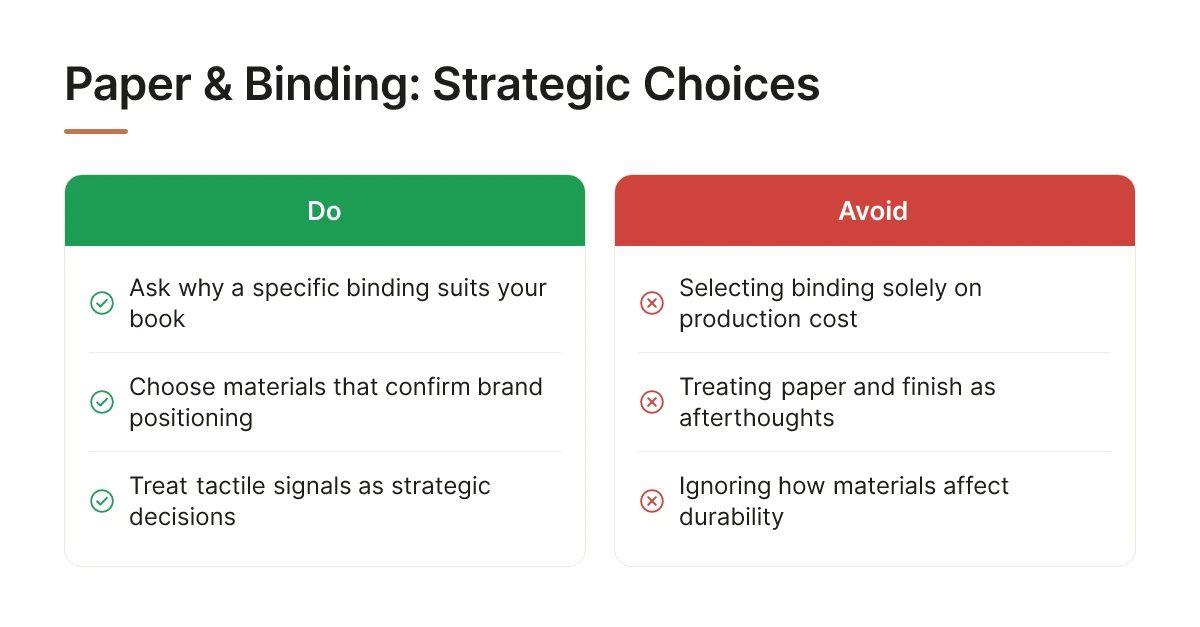
Paper weight, binding, and finish are strategic decisions that determine whether a book survives years of handling, not final-stage afterthoughts.
A reader forms an impression of quality before reading a single word, the weight of the page, the texture of the cover, how the book sits open on a table. Those tactile signals either confirm the brand’s positioning or quietly undercut it.
What paper stocks, binding techniques, and finishes signal quality and justify a coffee table book’s presence?
Ask why a studio recommends a specific binding method for your book’s size and intended use, not simply which option is cheapest to produce. A large-format book that lives on a coffee table needs a binding that lies flat and holds up to repeated opening; a smaller giveaway edition has different demands entirely.
How do tactile choices influence how long a coffee table book stays in circulation?
A book too fragile to be picked up repeatedly won’t build the brand impression it’s meant to, it gets shelved once and forgotten. This matters most for brands producing an object meant to sit on a table or shelf for years, not a one-time leave-behind. Ask how the studio’s material choices hold up under exactly that kind of daily handling.
5. A Realistic Timeline Broken Into Named Phases
A dependable coffee table book publisher can name every phase of the process, strategy, editorial, design, production, print, delivery, and estimate each one specifically.
What are the key phases from concept to finished printed book, and how long does each take?
Strategy and discovery come first, followed by editorial development, then design, then production, then the print run itself, then delivery. A studio that collapses these into a single vague “a few months” estimate hasn’t actually mapped the work, or hasn’t done it enough times to know where it gets tight.
Rushing the early strategy phase is the most common source of expensive rework later. Skip the editorial groundwork and a studio ends up redesigning spreads mid-project because the narrative structure wasn’t settled before layout began.
Why does a thoughtful, transparent process matter more than rushing to print?
Brands planning around a flagship launch, an anniversary, or a fundraising event need a schedule they can build other commitments around, not an optimistic guess that slips by six weeks. A transparent, phase-by-phase process is what makes that possible.
The sharpest question to ask: what typically causes delays in their timeline. A studio that answers with specifics, paper lead times, image rights clearance, a client approval bottleneck, has shipped enough books to know where the friction actually lives.
6. A Storytelling Approach That Balances Substance and Spectacle
What makes a coffee table book worth displaying versus something that gets shelved and forgotten?
A book earns its spot on the table when it rewards a second look, a reader flips back to it months later because there’s still something in it worth reading, not just admiring.
A purely visual book gets flipped through once, complimented, and shelved. Ask any coffee table book publisher how they build in that second read. If the answer is only about photography and paper stock, the substance question hasn’t been asked yet.
How do you balance visual impact with substantive storytelling in a branded coffee table book?
Balance comes from restraint, deciding what not to include matters as much as what makes the final cut. A studio with editorial judgment will cut a client’s favorite anecdote if it doesn’t serve the book’s spine.
This approach suits brands wary of producing something that looks impressive but says nothing specific about them. Ask the studio for an example of a story angle a client wanted in and they talked them out of. That answer separates a keepsake from a catalogue, and shows editorial judgment, not just production skill.
7. Relevant Experience Across Industries, Not Just Aesthetics
Beyond hospitality and design, what other sectors use coffee table books as strategic brand assets?
Private clubs, real estate and architecture firms, law firms, family offices, and manufacturers with a craft story all commission coffee table books as long-term brand assets, not just hotels and design studios.
A law firm marking a fiftieth anniversary, a manufacturer with a multi-generational production process, a family office documenting a legacy, none of these look like obvious “visual” industries, yet each has a story that photographs and print can carry further than a brochure ever could.
How do private clubs, real estate, architecture, and law firms use custom coffee table books?
These organizations use the book as a physical artifact placed in front of the people who matter most, members, prospective clients, referral partners, where it sits and gets picked up repeatedly.
A studio’s range across unlikely sectors signals adaptability rather than a single house look applied to every client. This suits brands outside obvious visual industries who worry a coffee table book won’t suit them. Ask how the studio adapted its process for a client with far less visual material to start with, commissioned photography, archival digitization, illustration. That answer shows resourcefulness, not just aesthetic talent.
8. A Framework for Measuring Long-Term Brand Value
Why is a coffee table book a long-term brand investment rather than a short-term marketing tactic?
A coffee table book pays off over years of quiet exposure in offices, homes, and meetings, not in the days immediately following its print run.
Unlike a campaign with a launch date and an end date, a well-made book keeps working as long as it stays on a desk or a table. That’s a different return profile than a digital ad, and it needs a different way of measuring whether it worked.
What does success look like for a custom coffee table book in a brand’s ecosystem?
Success looks like the book still being displayed, still being handed to key clients, still coming up in meetings a year or two after delivery, not impressions or click-through rates.
This matters most for decision-makers who need to justify the investment internally beyond a single launch moment. Ask whether the studio checks in with past clients months or years later. A studio that follows up on how the book is actually being used is thinking about longevity, not just delivery.
How to Choose the Right Coffee Table Book Publisher
Pull the seven questions into one checklist: editorial vision, end-to-end capability, design point of view, materials rationale, timeline clarity, storytelling balance, and relevant experience.
Run through each one in conversation, not just on paper. A portfolio shows what a studio has made before; how they answer these questions live shows how they’ll think through your project specifically, where the editorial spine comes from, what gets left out, why a paper stock or binding was chosen. A strong portfolio paired with vague answers to direct questions is a warning sign, not a wash.
- Do they define an editorial point of view before design starts?
- Do they manage writing, image rights, printing, and delivery without handing pieces back to you?
- Can they explain a material choice in terms of durability and feel, not just cost?
- Do they give a realistic production timeline with named milestones?
- Can they describe a story they cut, and why?
- Have they worked in sectors adjacent to yours, or adapted to thin visual material before?
If a coffee table book publisher can’t answer these clearly, walk away, a mismatch here compounds through months of production, not just the final result. And it’s worth saying plainly: a coffee table book is not the right asset for every company. For the right brand, though, it’s one of the few marketing investments that still sits on a table years later.

Frequently Asked Questions
How is a coffee table book designed to function as both a physical object and a brand statement?
A well-made coffee table book pairs archival-quality materials with an editorial structure so it holds up physically and communicates a point of view. The paper stock, binding, and cover finish signal permanence, while the content, imagery, sequencing, narrative arc, carries the brand’s values. Without a clear point of view, even beautiful pages read as decoration rather than a statement worth keeping [1].
What distinguishes a coffee table book from a magazine or annual report?
A coffee table book is built around a single, lasting narrative rather than a periodic update cycle. Magazines and annual reports report on a period of time and get replaced by the next issue; a coffee table book is designed as a permanent artifact, a brand history, a property showcase, a founder’s legacy, meant to sit on a table for years, not a quarter.
What makes a coffee table book stay in someone’s home and hands longer than digital content?
Physical scarcity and tactile weight give it staying power digital content can’t match, no scroll, no expiration, no algorithm burying it. When the editorial and design work is done properly, people don’t throw it away. They keep it, display it, and hand it to guests.
How does a custom coffee table book build brand perception differently than advertising or PR?
It builds perception through sustained physical presence rather than a single impression or news cycle. Advertising interrupts attention for seconds; PR earns a mention that fades. A coffee table book sits in a client’s living room or boardroom for years, quietly reinforcing taste and authority every time someone picks it up.
What is an editorial spine and why does it matter for a branded coffee table book?
An editorial spine is the central narrative thread that decides what belongs in the book and what gets cut. Without one, even strong photography becomes a loose collection of images with no argument. The spine is what turns a pile of assets into a book someone reads cover to cover.
Conclusion
A coffee table book earns its place on a table only when three things hold: a defined editorial spine, production discipline that respects the materials, and a publisher who manages the whole process instead of handing you half-finished files. Skip any one of those and you get an expensive object nobody picks up twice.
Before commissioning one, ask a prospective partner how they’d define your book’s editorial spine in a single sentence. If they can’t answer clearly, they’re not ready to bind your brand in print. Rethink Publishing has answered that question 30+ times for hospitality and design brands, start the conversation at www.rethink-publishing.com.
Sources & References
Recommended Articles
Explore more from our content library: