
Understanding commission editorial photography is essential. Commissioning editorial photography means hiring a professional photographer to create original images built around your brand magazine’s editorial vision, rather than licensing stock or booking a generic corporate shoot. The photographer works from a brief tied to your magazine’s story, tone and layout needs, producing images that feel like they belong on the page rather than dropped into it. Done well, this turns photography into a marketing asset with a longer shelf life than a single campaign, images that hold up in print, on a coffee table, and across your brand’s other channels.

Prerequisites: What to Sort Out Before You Commission Editorial Photography
Before you contact a photographer, your magazine needs a finished editorial spine, the throughline that tells everyone what each story is actually about. Without it, a photography brief is just a wish list.
An editorial spine defines the arc of the issue: which stories run, in what order, and why they belong together. A photographer working from a clear spine knows whether a piece needs quiet, intimate portraiture or wide environmental shots that carry a sense of place. A photographer working without one is guessing, and guesswork shows up on the page as imagery that feels generic rather than built for the story it accompanies.
How Commissioning Differs From Licensing Stock or Booking a One-Off Shoot
Commissioning means creating original images designed for a specific editorial narrative, with usage rights negotiated up front, not assuming you can reuse whatever comes out of a single session.
Stock photography solves a generic problem: you need “a photo of a boardroom” and any boardroom will do. A one-off corporate headshot session solves a different generic problem: you need staff portraits for a directory. Neither approach starts from a story. When you commission editorial photography, the photographer is briefed on a specific narrative, a founder’s history, a property’s design philosophy, a client relationship worth telling, and shoots to serve that narrative specifically. Rights, usage terms, and how long you can run the images across other channels get settled in the contract before the shoot, not negotiated after the fact when you want to reuse a shot on your website. This guide to hiring and working with a professional photographer walks through many of the same groundwork questions worth resolving early.
Four things need to be locked before the brief goes out:
- Confirmed story angles, not “something about our history,” but the specific angle each feature takes
- Locations scouted or at least identified, with access confirmed
- Subjects and interviewees committed, with availability windows agreed
- A rough layout sense, how many spreads, where full-bleed images will run versus smaller inset shots
Skip this groundwork and photography becomes an afterthought, booked only once the writing is finished. Images shot without knowing the page they’ll sit on tend to fight the layout instead of supporting it, the wrong orientation, the wrong crop, no room left for the headline. Sorting the spine and the specifics first is what lets the photography and the words work as one piece rather than two mismatched halves stitched together in the final layout, and it’s exactly why teams commission editorial photography only once the story is locked.
Brief the Photographer to Commission Editorial Photography That Fits Your Brand Magazine
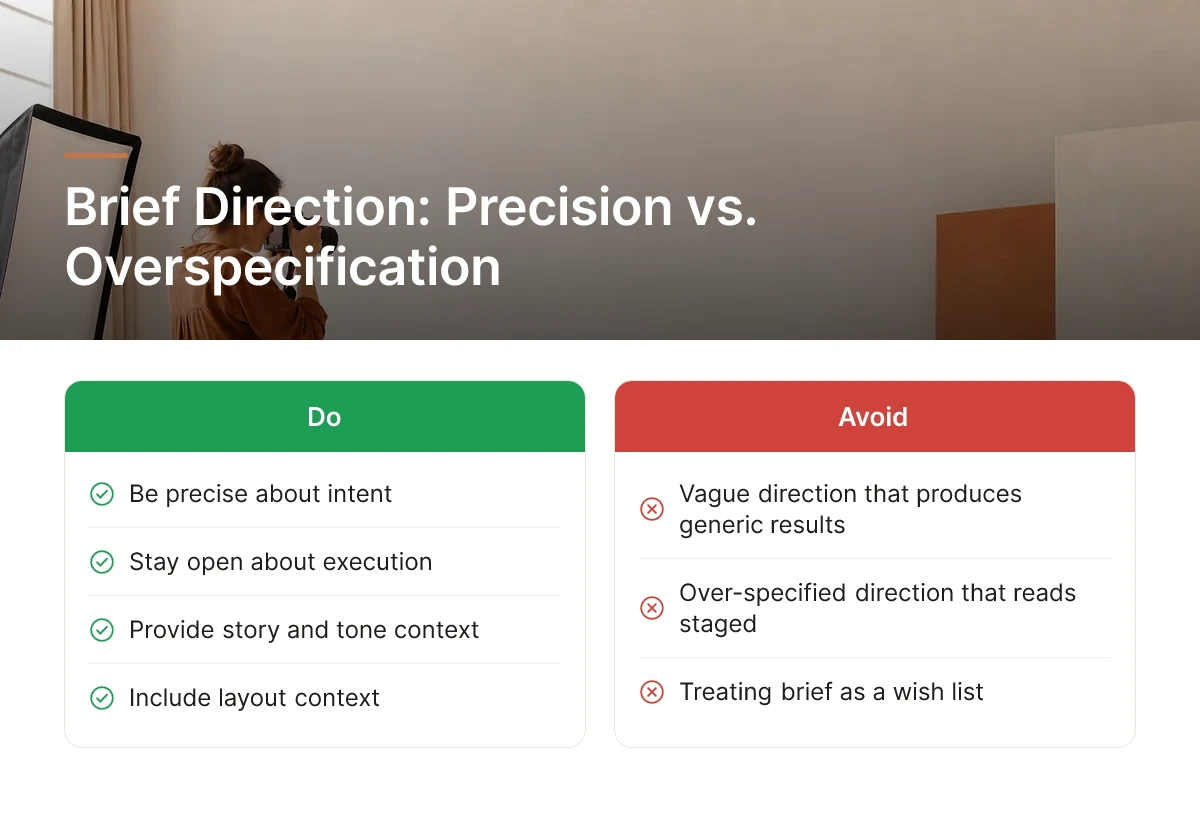
A strong brief gives the photographer the story, the tone, and the layout context, then gets out of the way and lets them shoot.
When you commission editorial photography for a brand magazine, the brief is the single document that determines whether the shoot produces usable spreads or a folder of technically fine images that don’t fit anywhere. Vague direction produces generic results. Over-specified direction produces stiff, catalog-style images that read as staged rather than editorial. The brief needs to sit in the middle: precise about intent, open about execution. This overview on working with a professional photographer offers a useful sense of how much structure a brief should carry before a shoot day is locked in.
What a Photography Brief Should Include
Write down five things before you contact a photographer. First, the story’s angle, what narrative point this shoot serves, not just “photos of the founder.” Second, the subject or subjects, including who needs to be available and for how long. Third, location logistics, address, access windows, permissions, and any restrictions on equipment or lighting setups. Fourth, mood and tone words that describe the feeling you want: warm and unguarded, or formal and architectural, for example. Fifth, and often skipped, how the images will actually sit in the layout, full-bleed openers, a portrait sequence across a spread, or tight detail shots that break up a longer feature. A photographer who knows an image needs to bleed off the page shoots differently than one framing for a small inset.
How to Share Visual References Without Micromanaging
Pull three or four reference images or past spreads that capture the aesthetic, lighting quality, color palette, composition style, and hand them over as a destination, not a shot list. Say “this is the mood we’re after” rather than “recreate this exact frame.” Photographers trained in editorial work read references quickly; they’ve built careers translating a mood board into original images that still feel authentic to the subject in front of them. Handing over ten reference shots is useful. Handing over a numbered list of required poses turns a working photographer into a technician executing someone else’s vision.
Book a short call before the shoot date, even fifteen minutes. This is where you catch the problems the written brief hides: a subject who’s only free for twenty minutes, a location with harsh midday light on the one side that photographs well, or building access that requires a permit filed a week in advance. A brief on paper can’t surface these, a conversation usually does.
Choose a Photographer Whose Style Matches Your Publication’s Visual Voice
Match photographers by consistency across their full body of work, aesthetic reaction to your existing spreads, and prior experience with editorial (not just commercial) direction.
A strong Instagram grid or a five-image website hero section tells you almost nothing. When you commission editorial photography for a brand magazine, you’re not hiring someone to take ten great shots, you’re hiring someone to sustain a visual voice across sixty or eighty pages, spread after spread, without the reader noticing the seams. This piece on how professional photography can boost brand identity makes a similar case for why visual consistency matters more than any single standout image.
What to Look for in a Photographer’s Portfolio
Ask for a full shoot, not a highlight reel. Request the complete set from three separate assignments and look at how light, color grading, and composition hold up across the entire sequence, not just the two or three images a photographer chose to lead with.
- Check whether their exposure and white balance stay consistent from the first frame to the last, especially across a full day of shooting in changing light.
- Look for compositional habits, how they frame a room, a face, a product, that would repeat comfortably across dozens of magazine pages.
- Notice whether their retouching style matches the level of polish your publication needs, since over-processed or under-finished images will fight your layout.
How to Judge Whether Their Process Fits Your Editorial Approach
Before booking, send the photographer two or three spreads from your reference magazines or your own brand guidelines and ask them to react honestly. A photographer who engages with specifics, light direction, mood, how they’d approach a particular subject, is signaling they think editorially. One who responds only with generic enthusiasm probably hasn’t worked this way before.
Ask directly how they’ve collaborated with editorial teams versus commercial clients. Commercial shoots often run on a rigid shot list; editorial work requires reacting to a story on set, adjusting to a space or a subject’s personality, and communicating with a creative director in real time. Photographers who’ve only shot product catalogs may struggle with that flexibility.
Range matters more than niche specialization here. A magazine mixes portraits, interiors, product detail, and location work within a single issue, so a photographer who has shot people, places, and objects across varied industries brings adaptability that a single-genre specialist can’t. At Rethink Publishing, image sourcing and photographer coordination sit inside the same editorial direction process that shapes the writing and layout, so visual voice stays consistent from the first page to the last, which is ultimately the point of choosing to commission editorial photography rather than assembling images ad hoc.
Confirm Deliverables and Usage Rights Before the Shoot Begins
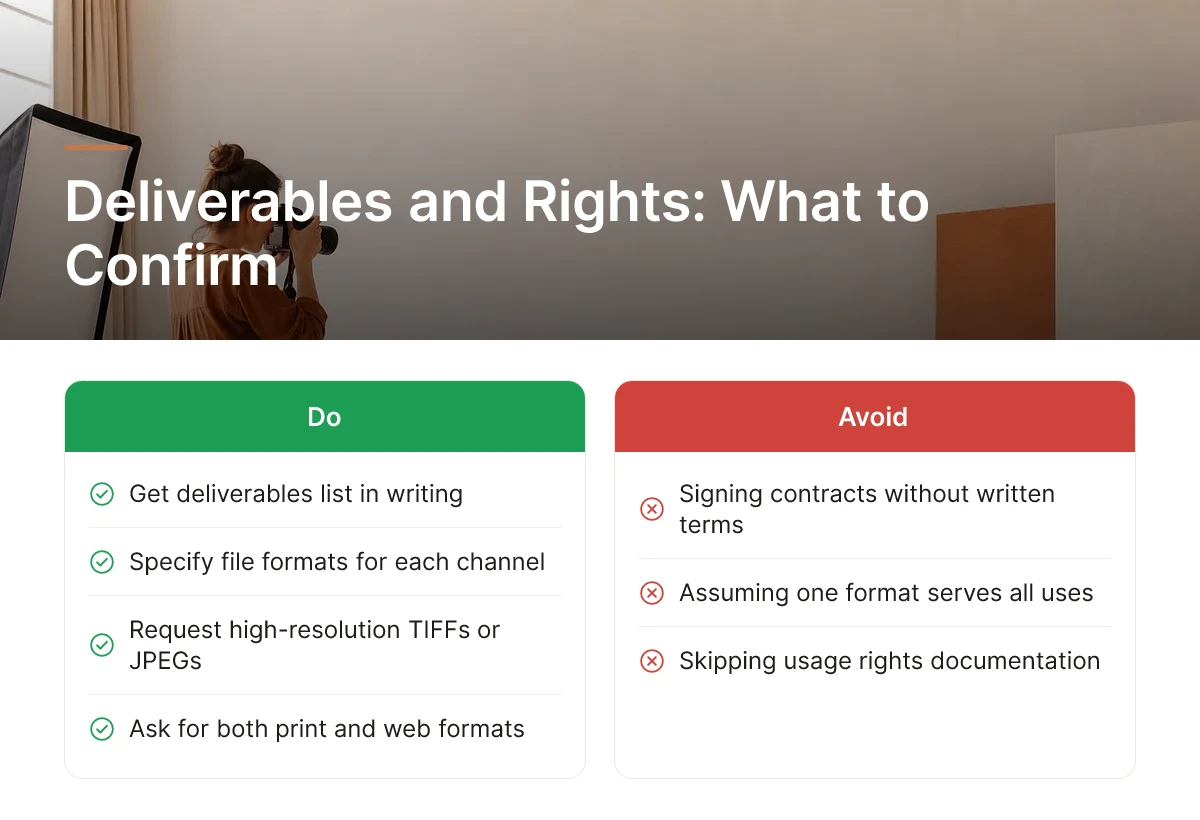
Sign nothing until the deliverables list and usage rights are in writing, this single step prevents most of the disputes that surface after a shoot wraps.
A photographer’s deliverables list should state the number of final edited images, the turnaround time for both a first-pass selection and finished files, and the file formats you’ll receive. Print needs high-resolution TIFFs or uncompressed JPEGs built for CMYK color profiles; digital channels need compressed, web-optimized versions in RGB. If a shoot is meant to serve a magazine and a website at the same time, ask for both formats explicitly, most contracts don’t include one by default [4].
Contract Terms and Usage Rights That Matter Most
Usage rights determine where and how long you can use an image, and they vary more than most first-time clients expect. A contract might grant rights limited to a single magazine issue, ongoing use across the publication and other brand channels, or full exclusivity that prevents the photographer from licensing the same images elsewhere. These terms need to be settled before the shoot, not after, a photographer who quoted a single-issue license has no obligation to extend that rate once you decide you want the same images on your website or in a client mailer [4].
Confirm four things in the contract itself: credit requirements (does the photographer need a byline wherever the image runs), who owns the raw files versus the edited exports, what reuse is permitted beyond the original brief, and what happens, cost and timeline, if a shoot needs to be extended or reshot. Vague answers to any of these tend to surface as disputes months later, usually right when you need the image most.
How to Protect the Investment Across Print and Digital
When you commission editorial photography for a brand magazine, the whole point is a set of images that work as hard in a client’s hands as they did in the boardroom pitch. That only holds if the rights match the ambition. A company that plans to repurpose magazine photography for its website, sales decks, or a future anniversary book should negotiate multi-channel rights from the start, not renegotiate after falling for a shot that’s contractually locked to one use. This guide on visual storytelling and business growth touches on why that longer-term reuse is worth planning for from day one.
At Rethink Publishing, image rights and usage terms are settled as part of the production process before a single frame is shot, so the photography a client falls in love with is the photography they’re free to use.
Common Mistakes to Avoid When Commissioning Editorial Photography
Most problems trace back to sequencing, brief quality, rights, and hiring criteria, get those four wrong and no amount of retouching saves the pages.
The most common error: booking the photographer before the editorial content is far enough along. A shoot scheduled around a production calendar rather than a finished story outline has no narrative to serve, the photographer arrives with no sense of what the images need to prove, so the team defaults to generic wide shots and posed handshakes. By the time the editorial team writes around what was captured, the mismatch is obvious on the page.
A second mistake is treating the brief as a shot list rather than context. “Exterior at dusk, three interior details, one portrait” tells a photographer what to point the camera at, not why. Vsco’s guide to hiring photographers argues that a photography brief should set goals and visual references before it sets shots, because the photographer’s job is translating an idea into a visual narrative, not filling a checklist [4]. Skip that translation step and the results are technically fine and forgettable, sharp focus, flat story.
Third: skipping the usage rights conversation before the shoot. Rights and licensing terms determine whether images can run on the website, in social content, or in a future reprint, and that conversation needs to happen in the contract stage, not after the invoice is paid [4]. Teams that assume “we paid for it, we own it” are often wrong, and find out at the worst possible moment.
Fourth, choosing a photographer on price alone. Aesthetic fit and editorial judgment show up the moment pages are laid out, a photographer skilled at product shots isn’t necessarily right for a hospitality narrative or a founder profile. These tips on using professional photography to elevate a brand make the same point about prioritizing fit over cost.
Finally, teams underestimate how photography meant for print, sitting on a coffee table, in someone’s home, needs more intention than a fast social asset built for a 48-hour scroll. This is precisely why Rethink Publishing pairs image sourcing with editorial direction from the start, rather than bolting photography on after the copy is done, an approach that only works when a team commits early to commission editorial photography rather than treating it as a last-minute checkbox.
Frequently Asked Questions
Why does commissioned photography matter more for a magazine that stays in people’s homes than for a social post?
A social post disappears in a scroll; a magazine on a coffee table gets picked up again and again, so every image has to earn a second and third look. Stock photography or dated brand shots read as filler the moment someone lingers on the page. Commissioned images, built around your editorial spine, hold up under that repeated attention.
How does pairing photography with editorial strategy from the start improve the final result?
Shooting after the story is planned means every image has a job to do, rather than being fitted to a layout after the fact. When the photographer knows the narrative arc before the shoot, framing, lighting, and subject choices support the copy instead of competing with it. That alignment is why Rethink Publishing builds the editorial spine first, then commissions photography against it.
What results can a company reasonably expect from investing in commissioned editorial photography?
Expect a magazine that looks and feels like a genuine editorial product, not a branded pamphlet, the kind of thing people keep rather than recycle. That translates into longer engagement with your brand story, stronger recall in client and prospect meetings, and a physical asset you can hand over at a launch, anniversary, or pitch. It won’t replace digital marketing, but it does something digital can’t: it stays in the room.
Can existing brand photography be reused instead of commissioning new images for a magazine?
Occasionally, but most existing brand libraries were shot for websites or ads, not for the pacing and scale of a print spread. Resolution, cropping, and mood rarely match what a full-bleed magazine page demands, so some new commissioned photography is almost always needed.
How much lead time should a team budget when planning to commission editorial photography for an upcoming issue?
Most teams underestimate the runway needed once the editorial spine is set. Between confirming subjects, scouting locations, and locking a photographer’s calendar, several weeks of lead time is typical before a shoot day can even be scheduled. Building that buffer into the production timeline, rather than compressing it, is what keeps the photography from feeling rushed or generic on the page.
Conclusion
Commissioned photography only pays off when it’s planned alongside the editorial story, not bolted on after the layout is finished. Brief the photographer with the narrative in hand, insist on a shot list tied to specific spreads, and budget for image rights the same way you budget for print stock and binding. A magazine with mismatched or recycled images undercuts the very brand perception it’s meant to build.
If you’re weighing whether your next brand publication needs a dedicated photography plan, start by mapping your editorial spine before you call a single photographer, Rethink Publishing builds that sequence into every project it manages end to end.
Sources & References
Recommended Articles
Explore more from our content library: