
Understanding how to make a coffee table book is essential. A branded coffee table book turns a company’s archive, campaign photography, project documentation, people, products, milestones, into a physical object clients and partners keep on their own tables. The process runs from editorial strategy (what story does the archive tell?) through curation, design, and premium print production. Done well, it works as a long-term brand asset precisely because it isn’t disposable marketing collateral: it’s an object people choose to display, which is what makes it valuable.
Gather What You’ll Need: Your Brand Archive and Editorial Direction
Before anyone touches layout software, two things need to exist: usable source material and a reason for the book to exist. Most companies that ask us how to make a coffee table book already have the first and haven’t thought hard about the second.
Start the audit with an honest inventory. Usable archive material includes campaign photography, product shots, event documentation, employee and client portraits, press coverage, and founder interviews. Few companies have all of this in one place, it’s usually scattered across agency drives, a marketing manager’s laptop, and a decade of PR clippings nobody filed properly. That’s normal. The job at this stage is simply to find out what’s real and what’s missing, not to make it perfect.
How a Branded Coffee Table Book Differs From a Personal Photo Book
A personal photo book organizes memories chronologically for people who already love the subject. A branded coffee table book has to work on a stranger, a prospective client, an investor, a partner who’s never set foot in your office. That means it needs an editorial spine: a point of view about why the company matters, built for a defined audience rather than a scrapbook of “everything that happened this year” [3]. Brand-published books succeed when they dive into the history, philosophy, and milestones behind the work rather than simply documenting it [1].
Which Industries Benefit Most From Commissioning One
Hospitality groups, architecture firms, manufacturers, professional services firms, and, yes, cybersecurity companies get outsized value from this format. The common thread isn’t industry glamour. It’s that the actual work is hard to explain in a sales deck or a 90-second pitch video. A hotel’s craft lives in details a brochure flattens. A cybersecurity firm’s value lives in trust and process, not a product shot. These are exactly the companies where a well-made book earns its place on a table rather than a shelf.
Not every company should make one. If there’s no real archive and no defensible story, just a logo and some stock photography, say so and stop there. The one true prerequisite, before a single photo gets shortlisted, is a point of view on what the book is for.
How to Make a Coffee Table Book: Build the Editorial Strategy First
The real answer to how to make a coffee table book that works as a brand asset starts before a single photo gets chosen, it starts with deciding what story the book is telling.
Most companies skip this step. They collect their best product shots, their best property photos, their best headshots of leadership, and hand the file to a designer with instructions to “make it look premium.” The result is a glossy object with no spine, pretty pages that don’t add up to anything a reader remembers. A coffee table book without a defined narrative is a highlight reel bound in hardcover, and readers can tell the difference within the first ten pages.
How Editorial Strategy and Visual Curation Reinforce Brand Identity
Selection and sequence are the same decision, not two separate ones. A striking photograph of a hotel lobby means something different depending on what comes before it, if the preceding spread shows the architect’s hand-drawn sketches, the lobby photo reads as the realization of a vision; placed next to a staff portrait instead, it reads as a setting for hospitality. Neither sequence is wrong, but only one matches the brand’s actual positioning.
This is why the first real task is defining the editorial spine: the single through-line, craft, history, people, or process, that every spread has to serve. Pavan Java Studio frames this directly, treating a corporate coffee table book as a strategic communication initiative rather than a design project [3], and Izzard Ink makes the same point by naming the failure mode: a book with no clear point of view becomes a costly object with no authority, no matter how good the materials are [5]. Once the spine is set, every photo gets judged against it, not against how good it looks alone.
Why Design and Layout Decide Whether the Book Gets Kept
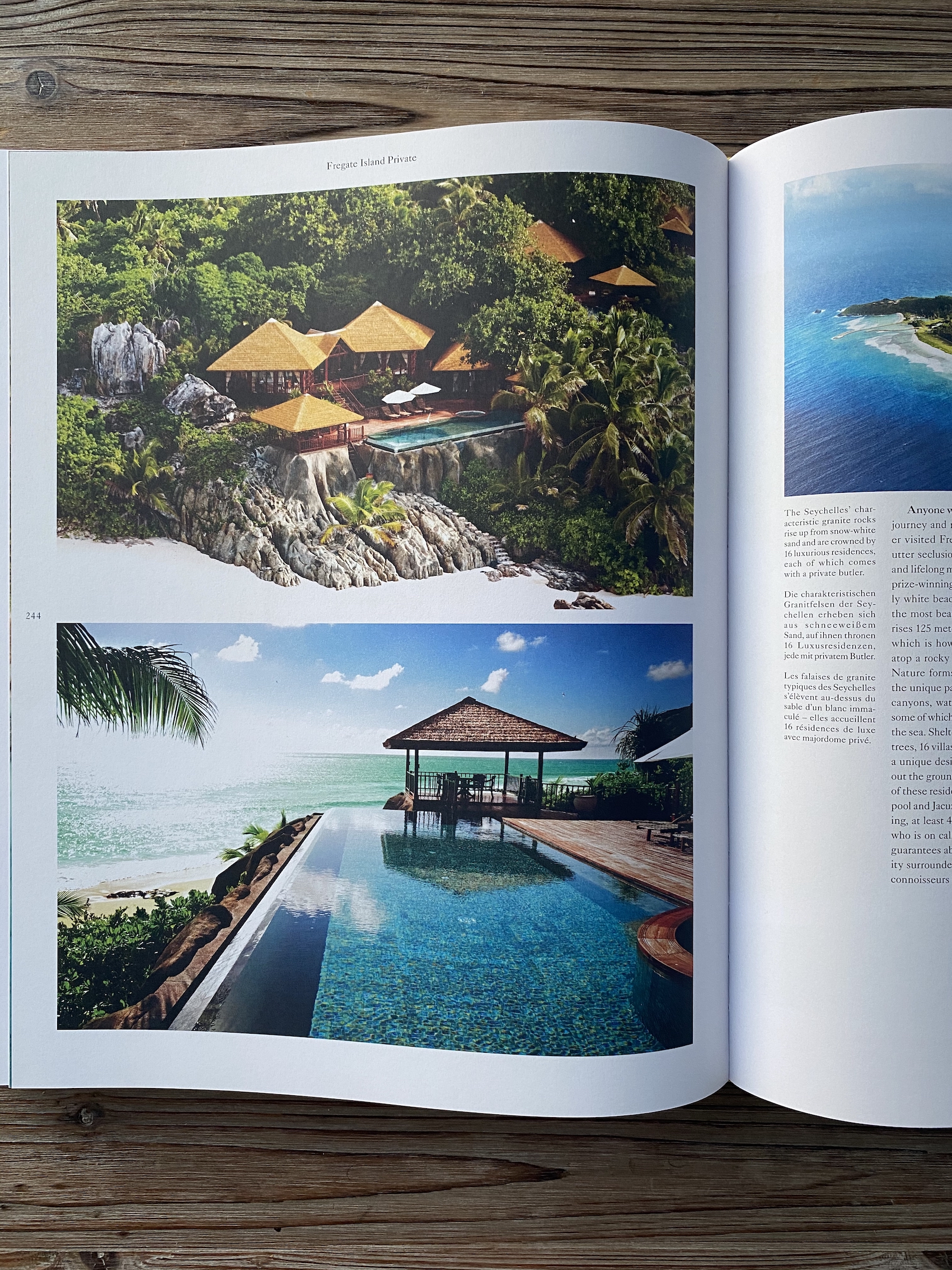
A book earns its spot on the table through pacing, white space that lets a strong image breathe, paper stock that signals the company invested real care, and a rhythm of quiet pages next to dense ones. A marketing brochure crams a logo, three bullet points, and a call to action onto every spread; a magazine-style structure lets one image run full-bleed across two pages with no text at all, trusting the reader to sit with it. That restraint is what separates an artifact from a flyer, luxury brands from Louis Vuitton to Hermès have built entire books around this same editorial discipline [1]. At Rethink Publishing, this sequencing work, the editorial spine, the pacing, the pairing of copy and image, happens before layout design even begins, which is why the finished books end up kept rather than recycled.
Design the Layout: From Concept to Final Print Files
Good layout design moves through six fixed stages, spine, curation, grid, text, review, print prep, and skipping any one shows up on the printed page.
Most people asking how to make a coffee table book picture the photography first. In practice, the editorial spine comes before a single image is placed, it is the argument the book is making, and every later decision gets measured against it.
What the Process Looks Like From Editorial Spine to Design Execution
The sequence runs in order, and each stage depends on the one before it:
- Concept and spine: define the narrative arc, what story the book tells and in what order.
- Content curation: select which images and stories actually serve the spine, and cut the ones that don’t.
- Layout grids: establish the structural system, margins, column widths, image placement rules, that holds the book together visually.
- Caption and text drafting: write the words that accompany each spread, matched to the book’s voice.
- Review cycles: circulate proofs for editorial and brand sign-off before anything is locked.
- Final print preparation: convert approved files to print-ready specifications, color profiles, bleed, resolution.
Flow is engineered, not accidental. A well-paced book alternates dense, information-rich spreads with quiet, single-image pages that let the reader breathe. Full-bleed images are used deliberately to mark transitions between sections, a visual breath before the next chapter starts. Without that rhythm, a book reads as a uniform wall of content, and readers stop turning pages.
Common Design Mistakes That Undercut the Brand Narrative
Four mistakes show up repeatedly in branded books that don’t land. Overcrowded spreads that try to fit too much on one page. Caption voice that shifts tone from section to section, as if written by different people, because it often was. No breathing room between sections, so the reader never gets a pause. And treating every photograph as equally important, which flattens the hierarchy a reader needs to know where to look first.
Captions deserve more attention than they usually get. A caption that only describes what’s in the photo wastes the page, generic stock-caption language is the fastest way to make a premium book feel like a brochure. Captions should carry the same brand voice as the rest of the publication, reinforcing the story rather than narrating the obvious.
Review should sit with someone outside the internal team. An editor who didn’t shoot the photos or write the first draft catches inconsistency the people closest to the project stop seeing, tonal drift, repeated phrases, a caption that contradicts the page before it. At Rethink Publishing, that review sits inside the end-to-end production process, so the client signs off on a finished, print-ready file rather than managing proofing rounds themselves.
Choose Production Format, Materials, and Distribution
Trim size, paper stock, binding, and print timeline are physical decisions that either reinforce brand positioning or quietly undercut it, and they deserve as much rigor as the editorial plan.
A book that photographs well on Instagram but feels thin in the hand fails the one test that matters: does it make someone pause. These are the choices most people skip when they first think about how to make a coffee table book, assuming design software and a print vendor will sort it out. They won’t, the vendor executes a spec, but someone has to set that spec with the brand’s positioning and the book’s actual use case in mind.
How to Choose Trim Size, Paper, and Binding for Your Audience
Start with how the book will be used, not how it will look on a shelf. A book handed to a client at the end of a meeting needs a size that doesn’t feel awkward to carry out the door, oversized formats work for a lobby display table but overwhelm a one-on-one handover. A mailed gift to a top client can justify a slightly heavier trim because unboxing is part of the experience; a sales leave-behind needs enough structural weight to survive a conference bag.
- Match paper stock to image density, heavier, uncoated stocks suit text-forward or heritage narratives, while coated stocks hold color saturation for photography-led brand stories [1].
- Choose binding for lifespan: casebound (hardcover, sewn) signals permanence and holds up to repeated handling in a lobby or boardroom; softcover with a strong spine works for higher-volume gifting where cost per copy matters more.
- Treat print quality as a tier decision, not a single number, budget-friendly stock and binding suit a wide internal distribution, mid-range suits general client gifting, and premium materials suit flagship launches, investor packages, or anniversary editions where the book itself is the gift.
Managing Timeline and Logistics From Concept to Delivery
Production runs in phases, strategy, editorial, design, print, delivery, and each phase has a natural duration that doesn’t compress well without cost to the final object. Rushed proofing leads to color mismatches at press; rushed editorial leads to a book that reads like a brochure, which is exactly the outcome brand leaders are trying to avoid.
Coordination gaps are the real timeline risk, not any single phase. Pavan Java Studio frames a corporate coffee table book as a strategic communication initiative rather than a design project precisely because the handoffs between writer, designer, and printer are where delays and quality drift happen [3]. Rethink Publishing manages strategy, editorial, design, print, and delivery under one process, which removes the vendor-to-vendor handoff points that typically cause slippage.
Distribution, for this audience, means client gifting, executive handovers, trade show and lobby display, and sales team leave-behinds, not bookstore or retail placement, which isn’t the point of a brand-commissioned book. Plan copy counts and shipping logistics against real moments: a product launch, an annual client event, a new office opening. A book that arrives after the moment it was meant for loses most of its value, regardless of how well it was made.
Common Mistakes to Avoid When Commissioning a Brand Coffee Table Book
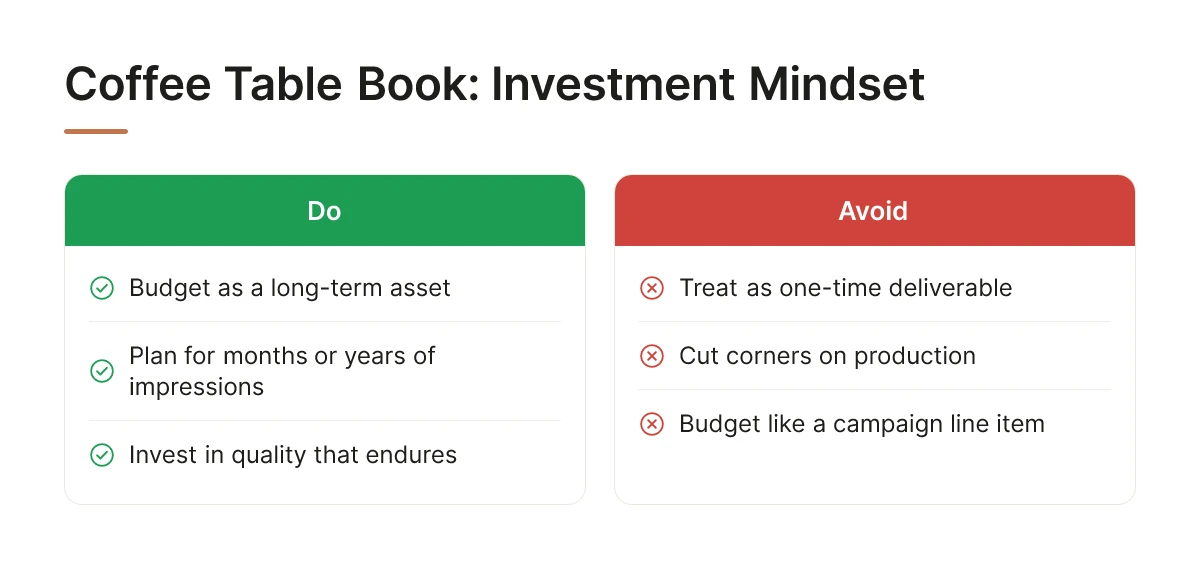
Most failed projects share one root cause: the team treated the book as a deliverable instead of an asset, and cut corners somewhere that showed up later on every coffee table it sat on.
Why a Coffee Table Book Is a Long-Term Investment, Not a One-Time Expense
Budget for a coffee table book like a campaign line item and it will underperform, because the mechanism that makes it work depends on time, not a launch window. A paid ad campaign ends when the budget runs out. A book sitting in a client’s office or a lobby keeps delivering impressions for months or years without another dollar spent, that’s the entire economic case for the format [3]. Companies that understand this fund the book out of brand or retention budgets, not the quarterly marketing spend that gets measured in clicks.
The second mistake is sequencing: starting with layout and photography before anyone has defined what the book is actually arguing. Skip the editorial strategy step and you get a brochure with better paper, chapters that repeat each other, no throughline, no reason for a reader to turn the next page. Anyone researching how to make a coffee table book that holds a reader’s attention needs to settle the narrative spine before a single image is chosen [3][5]. That sequencing discipline is exactly what separates an editorially directed publication from a glorified catalog.
Third, buyers choosing a print partner on cost alone undercut the one thing the book is supposed to signal. A brand book is meant to project quality and permanence; low-grade paper stock, weak binding, or color that shifts off-press tells the client the opposite story, no matter how strong the writing is. The materials are the message here, cheap production is visible the moment someone picks the book up.
On measurement, resist the urge to force the book into a digital dashboard. The honest signals are qualitative: does it come up unprompted in client retention conversations, is it still sitting visibly in an office six months later, does the sales team reach for it in new business meetings instead of a PDF deck. None of that shows up in a click-through rate. It shows up in whether the book got kept, which is precisely why this format isn’t right for every company chasing a quarterly metric, only the ones willing to measure brand perception on a longer clock.
Frequently Asked Questions
How is a branded coffee table book different from a personal photo book?
A branded coffee table book is built on an editorial spine and strategic intent, not a chronological photo dump. It’s commissioned to shape perception of a company or property, pairing professional writing, curated imagery, and design direction toward a specific audience, a client, investor, or peer, rather than preserving a family memory.
What industries get the most value from commissioning a coffee table book?
Hospitality, real estate, architecture and design, law firms, and private clubs see the strongest returns, because their business depends on relationship depth and visual trust. Rethink Publishing has produced 30+ coffee table books across hospitality and design sectors, where a tangible, well-crafted object reinforces the taste and authority these brands sell.
How long does it take to produce a brand coffee table book from concept to delivery?
Most projects run several months from the first strategy conversation to printed delivery, depending on content availability and image rights. Timelines stretch if original photography is needed or existing brand archives require sorting, and shrink when a company already has strong visual assets ready to hand over to an editorial team.
Who should be involved internally when planning one of these projects?
The decision-maker who owns brand perception, a CEO, Managing Partner, or Head of Brand, needs to sign off early and stay involved. Marketing or design leads can support, but final editorial and visual calls work best with one accountable owner, not a committee.
Is print worth it as a brand investment in a digital-first world?
Print earns its place precisely because digital content is disposable, a social post vanishes in 48 hours, a printed book sits on a coffee table for years. Luxury brands are reinvesting in print as digital saturation erodes attention [1], making physical scarcity a strategic advantage rather than a nostalgic one.
Conclusion
A brand coffee table book earns its place on a client’s table through the same discipline that built the brand itself: a clear editorial spine, deliberate image curation, and production quality with no shortcuts. Treat it as a strategic asset with one accountable owner, not a side project for whoever has spare time in marketing. Budget for several months, not weeks, and audit your visual archive before you start writing.
If you’re weighing whether this is the right year for it, start by reviewing your existing brand photography and identifying the one story worth telling in 120 pages. Then talk to Rethink Publishing at www.rethink-publishing.com about what that story could become.
Sources & References
- Elevating Brand Stories: the power of Coffee Table Books
- How to Plan a Corporate Coffee Table Book: A Strategic Guide for Brand, Marketing & Corporate Communications Leaders
- Custom Coffee Table Book Publishing For Brands & Legacy Projects | Izzard Ink
Recommended Articles
Explore more from our content library: