
A printed magazine becomes a keepsake when the editorial content is good enough to reread and the physical object is well-made enough to survive years on a coffee table. Luxury brands build long-term loyalty through keepsake brand publishing by treating print as an asset with a shelf life measured in years, not a campaign measured in weeks, pairing real storytelling with paper stock, binding and design that signal the brand cared enough to make something worth keeping.
What Makes Keepsake Brand Publishing Different From a Marketing Magazine?
The difference shows up in behavior, not budget: a marketing magazine gets flipped through once and recycled, while a keepsake gets displayed, reread, and handed to someone else. This is particularly relevant for keepsake brand publishing.
Run the keepsake test on any publication sitting in a client’s office right now. Does it live on the coffee table months after it arrived, or did it go straight into a recycling bin the week after the campaign ended? Does someone pick it back up to reread a feature, or pass it to a colleague because it says something true about the brand? Page count and production budget don’t answer that question, reader behavior does. A 40-page publication with a clear editorial spine can outlast a glossy 120-page campaign piece if the shorter one earns a second read.
Why Do Luxury Audiences Respond Differently to Print Than Digital Marketing?
Print asks for attention the reader chooses to give, while digital interrupts attention the reader didn’t offer, and that difference changes how a brand message lands.
A social post competes with a notification, a text message, and eleven other tabs. A printed magazine on a coffee table competes with nothing until someone deliberately picks it up. Luxury audiences in particular treat that deliberateness as a signal: slower media suggests a slower, more considered relationship with the brand behind it. Physical media’s scarcity has become a strategic asset precisely because digital saturation has eroded how much attention any single message earns [3]. Premium brands are reinvesting in print for that reason, it forces a pause that digital rarely can [2].
How Does Tangible, Well-Designed Print Create Emotional Connection and Lasting Brand Memory?
Paper weight, binding quality, print finish, and cover material are sensory cues that trigger emotional recall, and no screen can reproduce them. When considering keepsake brand publishing, this point stands out.
The weight of a page between two fingers, the way a spine holds up after repeated handling, a matte finish versus a gloss cover, these register below conscious notice but shape whether someone associates a brand with craft or with cost-cutting. High-end publications work because they align with what a luxury audience already expects from the brands it trusts: attention to material, not just message [3]. This is the mechanism at the center of keepsake brand publishing, an editorial magazine built around a reader’s ongoing relationship with a brand, not around a single campaign or launch date. Rethink Publishing designs every issue with that distinction in mind, pairing an editorial spine with paper stock and binding chosen to survive years of handling, not one news cycle.
How Does a Luxury Brand Create a Custom Publication That Deepens Loyalty and Perception?
A luxury brand creates a keepsake through editorial discipline, not volume: choosing a clear point of view, cutting anything off-brand, and pairing every page with design that signals quality before a word is read.
This is where most in-house attempts fail. A marketing team assembles a PDF, adds a few articles, drops in the logo, and calls it a magazine. What’s missing isn’t polish, it’s a spine. Rethink Publishing builds that spine first, before a single layout is drawn, because the editorial direction determines everything that follows: which stories earn a page, which images support the argument, and which topics get left out entirely.
What Role Does Editorial Curation and Intentional Design Play in Building Brand Perception?
Curation is the discipline of saying no. A brochure includes everything the marketing department wants to say about itself; a magazine with an editorial spine only includes what the reader actually wants to know. That distinction is what separates keepsake brand publishing from a glossy corporate handout, the former earns a place on a coffee table, the latter ends up in a recycling bin.
Design carries the same weight as the writing. Typography choices, white space, photography direction, and pacing all communicate values before the reader processes a single sentence. A dense, cluttered layout reads as rushed. A restrained one, built around considered photography and generous margins, reads as confident, the visual equivalent of a brand that doesn’t need to shout. Luxury houses have understood this for decades; print’s sensory weight, paper stock, binding, image quality, creates a felt sense of exclusivity that a screen cannot replicate [3].
How Can a Magazine Serve as Both a Storytelling Platform and a Credibility Asset?
A well-built magazine reads less like an ad and more like a third-party publication, which is exactly what makes it persuasive. Long-form features, expert interviews, and industry context carry more credibility than direct advertising because they ask nothing of the reader in the moment, no click, no offer, no close. That’s the mechanism behind print’s resurgence among premium brands: it can create a “world people want to spend time in,” which is a harder thing to build in a scrollable feed [2]. For those exploring keepsake brand publishing, this matters.
Consistency compounds this effect. A recognizable editorial voice, the same tone, the same visual grammar, issue after issue, builds brand presence the way a signature does, familiar enough to trust before the content is even read.
What Separates a Lasting Brand Asset From a Publication That Gets Discarded?
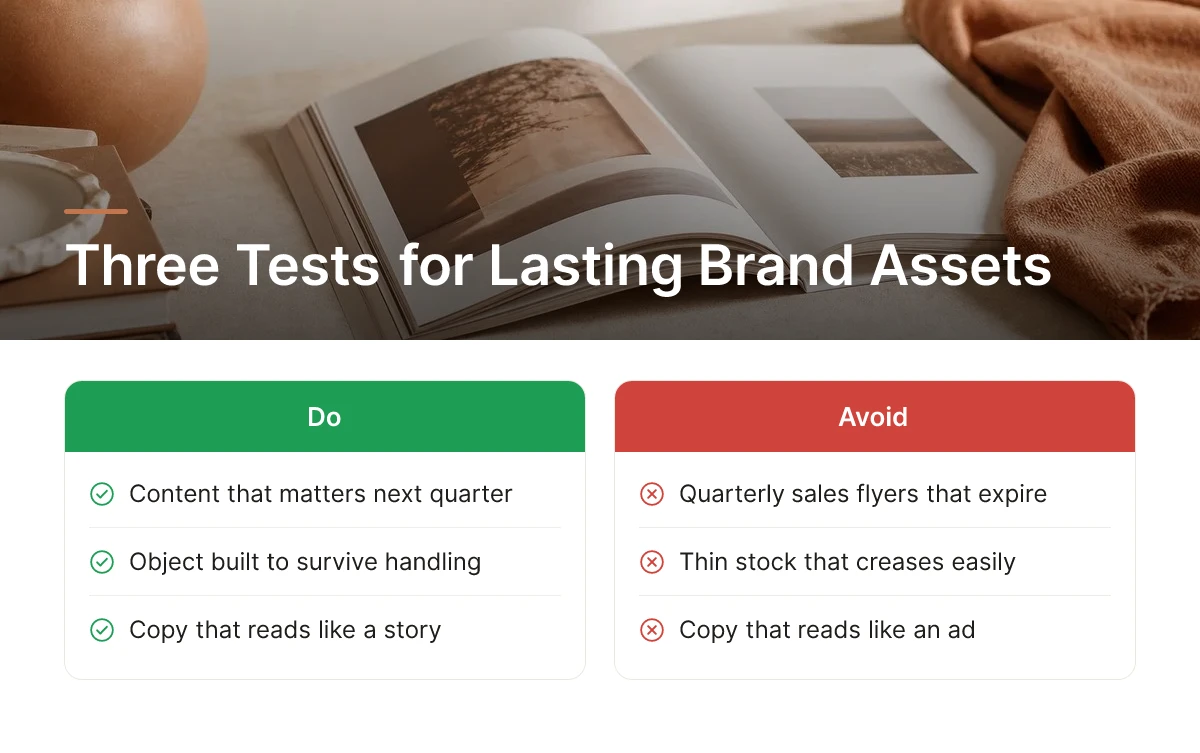
Three tests decide it: does the content still matter next quarter, does the object survive being handled, and would the recipient feel a flicker of guilt tossing it in the recycling bin.
Most branded print fails at least one of these tests before a reader even opens the cover. A quarterly sales flyer fails the first test by design, it’s built to expire. A magazine printed on stock thin enough to crease after one read fails the second. And copy that reads like an ad campaign rather than a story fails the third, because nobody feels bad discarding an advertisement.
How Do You Evaluate Whether Your Current Print Experience Actually Strengthens Brand Loyalty?
Pull your last three printed pieces and ask what happened to them a week later. If the honest answer is “recycled” or “still in the mailroom,” the piece was marketing collateral, not a keepsake brand publishing asset, and that distinction shows up in specific, fixable details.
Generic stock photography is the first tell. A reader can sense, even without articulating it, when the images could belong to any company in the category. Sales-forward copy is the second, paragraphs built around a call to action rather than a story signal “this exists to sell me something,” and objects built to sell get discarded the moment the sale is decided one way or the other. Flimsy print stock is the third, and it’s the most physical: cheap paper communicates a cheap brand before a single word is read, regardless of how good that word is. This directly impacts keepsake brand publishing outcomes.
There’s also a structural difference worth naming. A one-off print run tied to a single campaign, a product launch, an event program, a conference giveaway, has a built-in expiration date because its content is tied to a moment. An ongoing publication that clients receive issue after issue behaves differently. Readers start to anticipate the next one, which is the actual mechanism behind long-term brand loyalty that a single mailer can never produce.
If this audit reveals that current print materials look dated, generic, or purely transactional, that’s not a neutral finding. Print done poorly actively undermines brand perception, it tells clients the company either doesn’t understand its own positioning or didn’t think the relationship was worth the investment.
How Should Luxury Brands Approach Print as a Long-Term Investment, Not a One-Off Tactic?
Treat print the way you treat account management or client retention: an ongoing budget line tied to brand equity, not a single project with a start and end date. A magazine mailed once and forgotten does little. A magazine that arrives on a predictable schedule, issue after issue, becomes something clients expect and notice when it’s missing.
How Can Print and Digital Marketing Work Together to Reinforce Brand Consistency?
Print and digital aren’t competing for the same job, print builds depth and retention, digital delivers reach and frequency, and the two work best when they’re built from the same editorial material. A well-built publication isn’t a dead end. The features, interviews, and photography inside a coffee-table book or magazine can extend into email, social, and web content, giving the digital side something substantial to draw from instead of manufacturing fresh content every week. This is particularly relevant for keepsake brand publishing.
Industry commentary on luxury print strategy makes a similar point: print and digital should reinforce each other across touchpoints rather than operate as separate channels competing for the same budget [1]. The physical piece anchors the brand story; the digital layer keeps it circulating between mailings.
Consistency across those touchpoints is operational, not aspirational. It requires a shared editorial calendar so the magazine, the website, and the client communications are drawing from the same themes at the same time. It requires a consistent visual language, typography, photography style, tone, so a reader recognizes the brand whether they’re holding the book or scrolling a landing page. And it requires a real publishing cadence, not sporadic one-off issues that leave months of silence in between.
What Measurable Outcomes Should Luxury Brands Expect From a Keepsake Publishing Strategy?
Expect the payoff to build across several issues, not one mailing. Perception shifts, referral conversations, and renewed client relationships tend to surface after a brand has shown up consistently, the third or fourth issue, not the first. That’s consistent with the broader case for tangible marketing and long-term brand loyalty, where physical media works by accumulation rather than a single impression [1].
This is precisely why keepsake brand publishing works better as a program than a project: the CEOs who see the clearest results are the ones who budget for it annually, in qualitative tiers tied to brand ambition, rather than commissioning a single premium issue and waiting to see what happens.
What Does It Take to Produce a High-End Custom Publication From Strategy Through Delivery?
Five stages, in order: strategy and audience definition, editorial planning, design and art direction, print production, and delivery. Skip or rush any one of them and the finished piece reads like a brochure, not a magazine.
Strategy comes first because a magazine without a defined reader is just paper with your logo on it. Before a single word is written, the real questions get answered: who is this for, what do they already believe about your brand, and what should they feel by the last page. That groundwork shapes everything downstream, the editorial voice, the photography style, even the paper stock. When considering keepsake brand publishing, this point stands out.
How Does the Editorial Process Differ When Creating a Magazine Designed to Be Kept and Treasured?
Keepsake brand publishing runs on longer lead times and real subjects, not stock photography and rewritten web copy. A standard marketing piece can pull language from an existing brochure and hit deadline in weeks. A publication meant to sit on a coffee table for years can’t work that way, it needs original interviews, a real photo shoot, and a narrative arc that holds together across 60 or 80 pages.
That means scheduling time with the founder, the architect, the head chef, or the client whose story anchors the issue, then giving a writer room to shape those conversations into something with a beginning, middle, and end. Rushed editorial reads rushed. Readers who keep a magazine tend to notice the difference between a story that was reported and one that was assembled from existing marketing collateral.
What Does End-to-End Publishing Production Look Like for a Luxury Brand Magazine?
End-to-end means one accountable team carries the project from concept to the printed object landing in a client’s hands, not a writer here, a designer there, and a printer found separately at the end. Rethink Publishing runs this way deliberately: the same team that develops the editorial spine also manages image rights, layout, and print production, so nothing gets lost in handoffs between vendors who’ve never spoken to each other.
The operational details matter more than most executives expect. Paper weight and finish affect how a page feels in the hand, not just how it looks on a screen. Proofing rounds catch color shifts before a print run locks in thousands of copies. And if the publication runs on a recurring schedule, keeping the same team on issue after issue is what keeps the tone, layout grid, and print quality consistent, rather than starting from scratch, and drifting, every time.
Frequently Asked Questions
Does every company need a keepsake publication?
No. Honestly, not every company needs one. A keepsake magazine only makes sense if a brand has a real story, an affluent or relationship-driven audience, and a reason to deepen loyalty beyond a transaction. If a brand’s marketing is purely performance-driven and short-cycle, that budget is usually better spent elsewhere. For those exploring keepsake brand publishing, this matters.
How often should a luxury brand publish a keepsake magazine to maintain the effect?
Most brands see the strongest results from an annual or biannual publication rather than a single one-off issue. A single beautiful magazine makes an impression, but a recurring publication builds anticipation and gives clients a reason to expect the next issue, which is what turns a printed piece into an ongoing brand ritual.
Can a keepsake publication work for a company outside traditional luxury categories?
Yes, the format has worked well outside categories like hospitality and real estate, including in fields as unexpected as cybersecurity. What matters is not the industry but whether the company has a clientele that values depth, trust, and a physical relationship with the brand rather than another inbox notification.
What’s the risk of treating a keepsake magazine as a one-time project instead of an ongoing asset?
A one-off magazine gets admired once and then forgotten, which wastes most of its long-term brand value. The compounding effect, clients associating the brand with culture and authority over years, only builds when a publication becomes a recognizable, recurring artifact people watch for, not a single project that never repeats.
Conclusion
A keepsake publication earns its place on a coffee table by being honest about what it is: an editorial product, not a brochure with better paper. That means a real editorial spine before design starts, a publishing cadence instead of a single issue, and a willingness to say no when a brand isn’t ready for the investment.
If you’re weighing whether this fits your brand, start by asking what a competitor’s magazine in a client’s home would cost you in perception alone. Then talk to Rethink Publishing at rethink-publishing.com about what an editorial spine for your brand could look like.
Sources & References
- How Can Print Support Luxury Marketing Strategy?
- The commercial print strategy luxury brands often overlook
- Antares Media Holding – Why Luxury Brands Still Invest Heavily in Print
Recommended Articles
Explore more from our content library: