
A company anniversary book turns a milestone date into a lasting brand asset by pairing real editorial storytelling with premium print production, something a digital campaign or a standard corporate brochure can’t replicate. Done well, it becomes a physical object clients and staff keep on their desks or coffee tables, reinforcing brand perception long after the anniversary year ends. The strongest ones combine honest company history, forward-looking narrative, and design quality that signals the company takes its own story seriously.

Decide If a Company Anniversary Book Is the Right Format for Your Milestone
Not every milestone needs a book, and not every company culture will justify the investment, the honest answer depends on whether you have a story worth binding.
A 10th anniversary at a fast-growing tech startup with little institutional memory rarely calls for the same treatment as a family-owned hospitality group marking 50 years. Before commissioning anything, ask what you’re actually celebrating and who will still care about it in five years.
How Is a Company Anniversary Book Different From a Standard Corporate Publication?
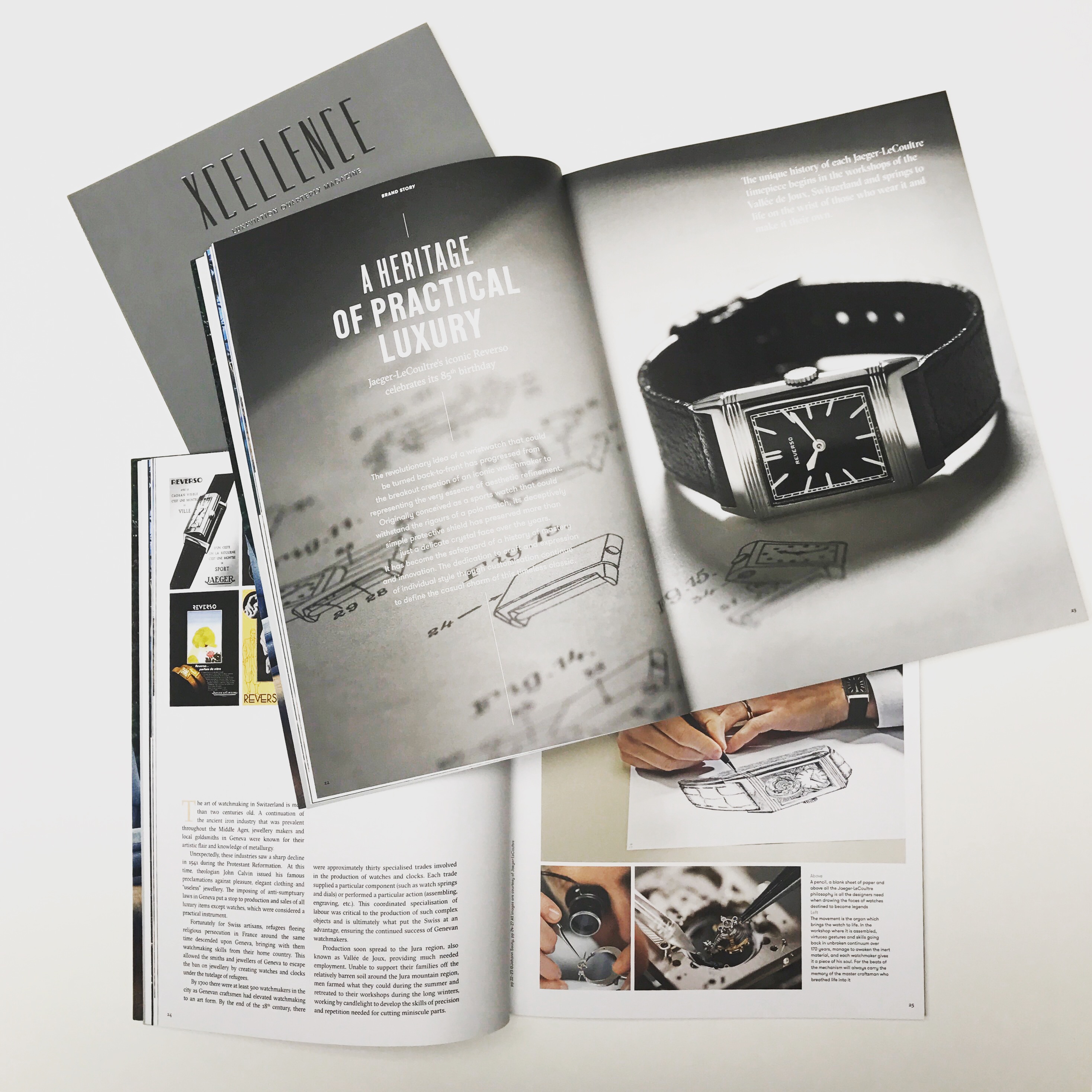
A corporate brochure sells; a company anniversary book tells a story with a beginning, a turning point, and a direction forward. The brochure is marketing copy dressed up with photography, product features, mission statements, a few client logos. An anniversary book needs an editorial spine: a narrative arc that moves through founding struggles, defining decisions, and the people who made them, structured the way a magazine feature is structured, not the way a sales deck is structured.
That distinction matters more than it sounds. Readers can tell within a few pages whether they’re looking at genuine storytelling or repackaged marketing language. One earns a place on a shelf; the other ends up in a recycling bin.
Why Do Premium Brands Choose Printed Books Over Digital Alternatives?
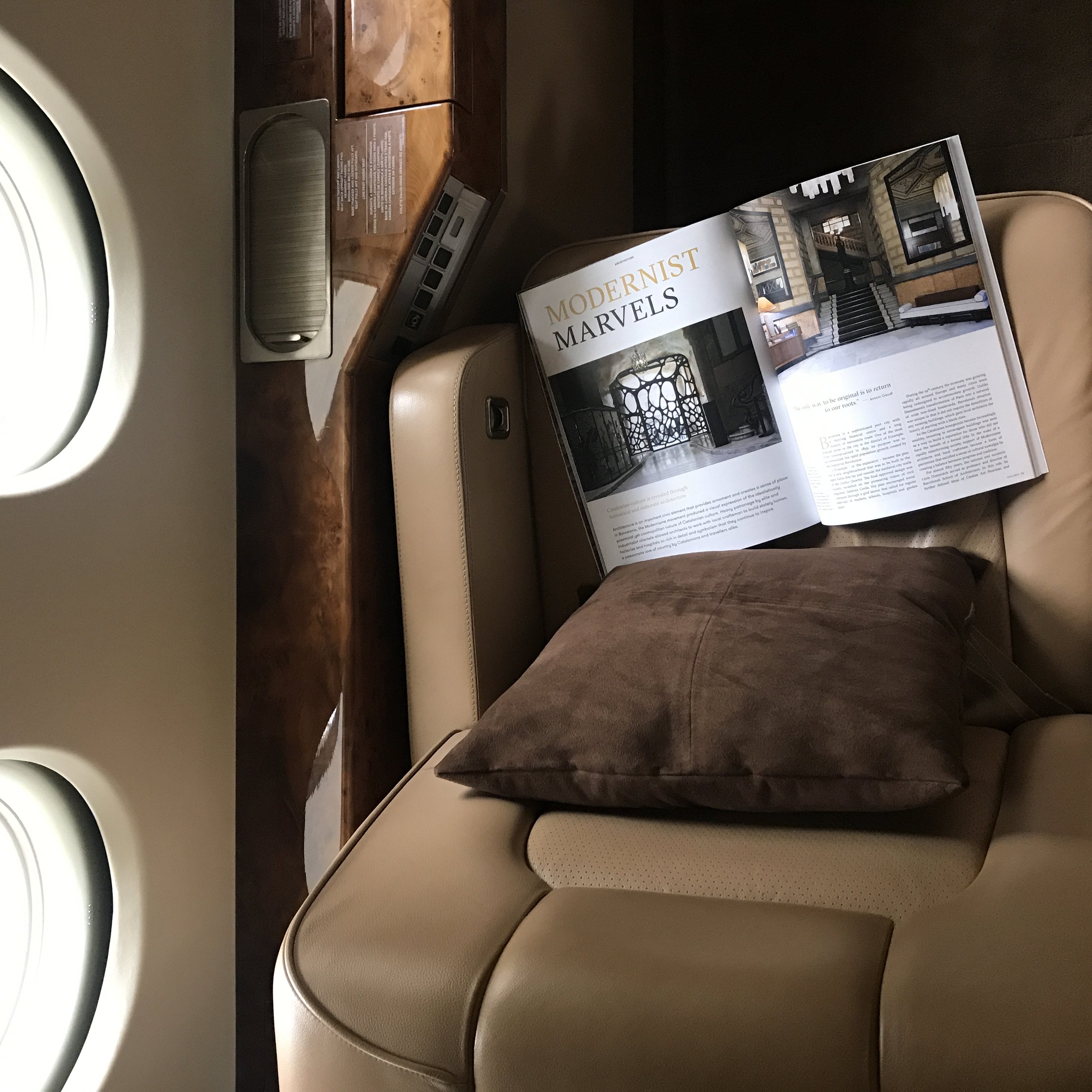
Printed books stay physically present on a desk or coffee table, generating repeated exposure to the brand long after a digital campaign has been closed and forgotten. A microsite or anniversary recap video gets watched once, maybe shared once, then disappears into a browser history nobody revisits. A well-made book sits in a client’s office for years, getting picked up during meetings, handed to visitors, referenced by employees onboarding new hires.
This is the same logic driving the broader print resurgence among luxury and premium brands, physical scarcity now works as a differentiator precisely because digital content has become disposable by default. Print’s advantage isn’t nostalgia; it’s persistence.
This format fits best for companies with real history to draw on, a distinct culture worth documenting, or a client relationship that benefits from a physical touchpoint, a law firm celebrating 25 years of client trust, a hospitality brand marking a flagship property’s anniversary, a design firm with a body of work worth showing in print. If your company is young, your story thin, or your budget better spent elsewhere, say so and skip it. That honesty saves everyone money.
Define the Editorial Strategy Before You Design a Single Page
Editorial strategy has to come first because layout decisions made before the story is shaped just organize a photo dump more attractively. A designer can make forty milestones look elegant on a page, but forty milestones without a narrative spine is still a scrapbook, just a well-typeset one.
A company anniversary book earns its place on a coffee table when it reads like a story someone chose to tell, not a record someone chose to keep. That choice happens on paper, in outline form, before a single spread is designed. This is the step Jenkins Group and Bookhouse Group both flag as foundational to a strong commemorative book [1] [3], and it’s the step most in-house teams skip because they’re eager to see pages.
What Role Do Editorial Strategy and Design Play in Making the Book Feel Like a Keepsake?
Editorial strategy decides what the book is about; design decides how that story looks, and skipping the first step is why most anniversary books get flipped through once and shelved.
Pure nostalgia, year-by-year achievement lists, award photos, retired executives smiling at ribbon-cuttings, tells clients the company’s best days are archived, not ahead. The stronger approach balances history with a forward-looking thread: where the founder started, what changed the trajectory, and what that history means for where the company is headed. A chronological timeline documents; a narrative interprets. The second is what makes a reader keep the book.
Finding that thread means asking different questions than “what happened and when.” It means identifying the real turning points, a founder’s original bet, a culture shift after a hard year, a client relationship that redefined the business, and building the book around those, with achievements as supporting evidence rather than the main event.
These editorial choices are also brand choices. Whose voice leads the story, the founder, the current CEO, longtime clients? What gets left out of a 20-year history matters as much as what gets included, because every omission and inclusion tells the reader what the company actually values. A design-only vendor can format those decisions once they’re made. An experienced editorial team is the one making them, which is where firms with real publishing history, not just production capacity, earn the fee.

Structure the Content So the Story Feels Authentic, Not Promotional
A company anniversary book earns trust when it reads like a documented history, not a highlight reel, that means mixing founding stories, hard lessons, and unscripted voices from people who aren’t in the executive suite.
How Do You Structure an Anniversary Book for Different Company Sizes and Industries?
A 200-person firm can tell one continuous story with a clear beginning, a handful of turning points, and a founder or small leadership group carrying the narrative throughout. An enterprise with regional divisions or a string of acquisitions needs a different architecture entirely, usually a braided structure that lets each division or acquired brand hold its own chapter before the book pulls the threads together into a single company identity. Trying to force 40 years and six acquisitions into one linear timeline flattens the story and confuses the reader about what the company actually is today.
Industry shapes structure just as much as size does. A professional services firm, a law practice, an architecture studio, a financial advisory, should anchor its book on client relationships and the specific expertise that built them, often told through case narratives rather than abstract mission statements. A manufacturer does better anchoring on craft and process: the factory floor, the material sourcing, the engineering problems solved along the way. A hospitality brand should center people and place, the staff who’ve worked there for decades, the physical spaces, the regulars who became part of the story. Each of these calls for different pacing, different photography direction, and a different balance of text to image, which is why the editorial spine has to be set before any layout work begins.
What Content Elements Resonate Most With Readers?
Five elements come up again and again in books that actually get read rather than shelved: the founding story, a timeline of real milestones, core values shown in action through specific decisions rather than listed as slogans, leadership perspectives written in a personal voice, and, critically, lessons learned, including the failures. A book that only celebrates wins reads like a press release, and readers, especially clients and employees who lived through the harder years, notice the omission immediately. Naming a failed product launch or a near-miss on cash flow, and explaining what changed afterward, does more for credibility than another page of awards.
The strongest anniversary books also avoid letting leadership narrate the whole thing. Weaving in short, direct quotes from longtime employees, early clients, or even a supplier who’s been there since year one breaks up the executive voice and signals that the story isn’t self-authored marketing copy, it’s corroborated.
Plan the Production Timeline From Strategy to Delivery
A high-end company anniversary book takes months, not weeks, the milestone date should be set before the first interview is booked, not after.
What Does the Production Timeline Look Like From Strategy Through Delivery?
Six stages carry the project from idea to finished object, and each one depends on the one before it. Skipping ahead, starting layout before the story is confirmed, for instance, is the most common reason projects stall.
- Editorial strategy and content gathering. Define the narrative spine: which decades, which people, which milestones actually deserve a page.
- Interviews and archive research. Sit down with founders, long-tenured staff, and retired executives; dig through old photo archives, press clippings, and internal records.
- Design and layout. Pair the confirmed copy and images with a design system, typography, grid, paper texture cues, built around the brand.
- Proofing rounds. Multiple passes for factual accuracy, color correction, and typographic consistency, with stakeholders signing off at each stage.
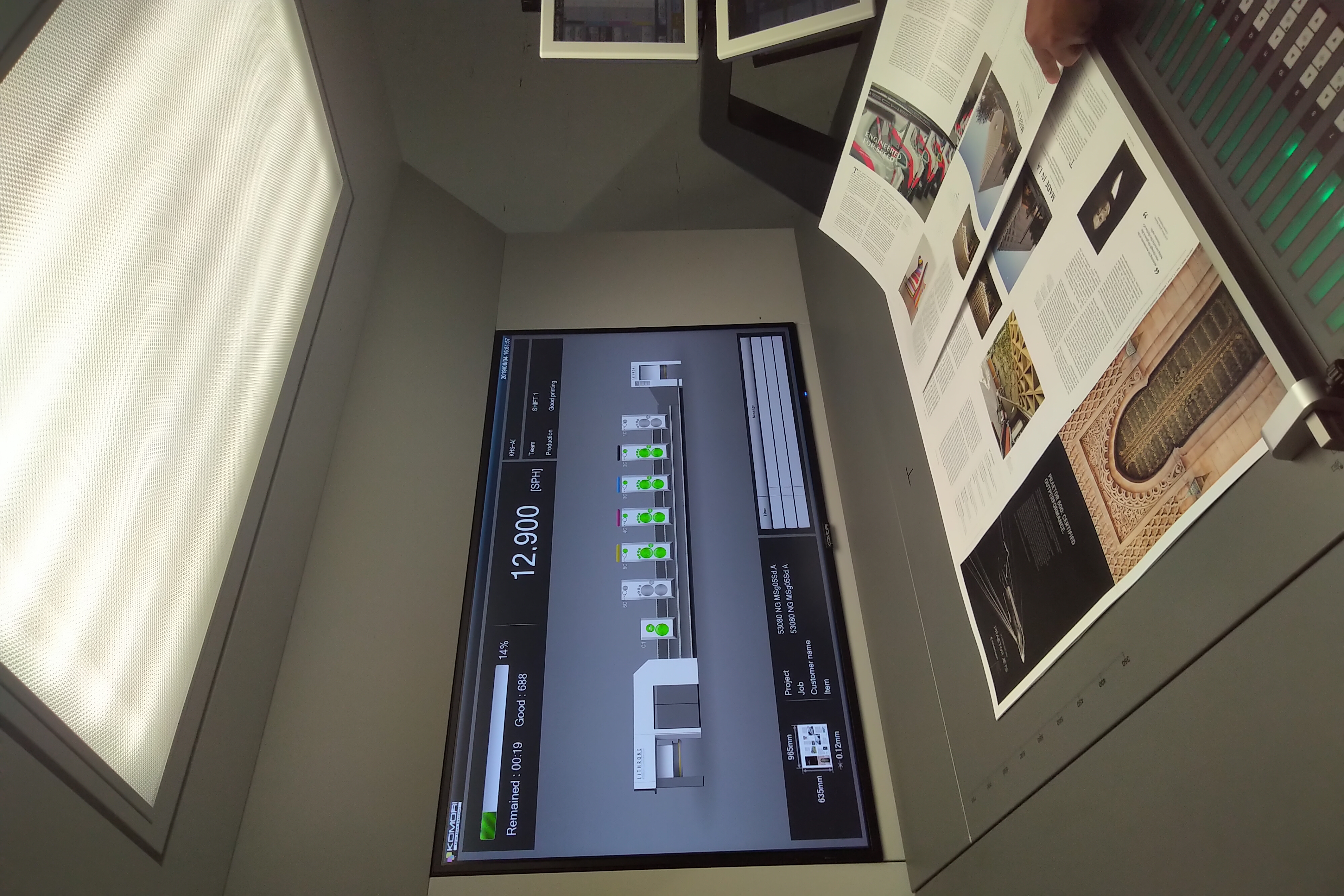
- Print production. Paper selection, binding, press runs, and quality control on physical proofs before the full print run.
- Delivery and distribution. Packaging, shipping, and, for many clients, a launch event or staggered rollout to key accounts and staff.
Content gathering is almost always the longest stage, and the one companies underestimate most. Interviews get rescheduled, archives turn out to be incomplete or poorly labeled, and image rights sometimes need chasing down from photographers who shot events decades ago. A design team can only move as fast as the material handed to it, no layout artist can invent a founder’s account of the company’s first year.
When Should You Start Planning to Hit a Milestone Date?
Start the conversation the moment the anniversary date is confirmed, ideally a year or more out for a large or multi-location company. That buffer covers the inevitable delays in scheduling interviews, tracking down archival material, and running proper proofing rounds without compressing them.
Print production is the stage most vulnerable to a rushed schedule, and the damage shows. Premium paper stocks and specific binding methods, the kind that make a book feel like a keepsake rather than a printout, often carry longer lead times and limited availability. Compress that window and a company either settles for a lesser stock or risks proofing errors that only surface once thousands of copies are bound. Rethink Publishing manages every stage of this timeline end to end, strategy, interviews, design, print, and delivery, precisely so a milestone date doesn’t force a shortcut on quality.
Common Mistakes to Avoid When Creating a Company Anniversary Book
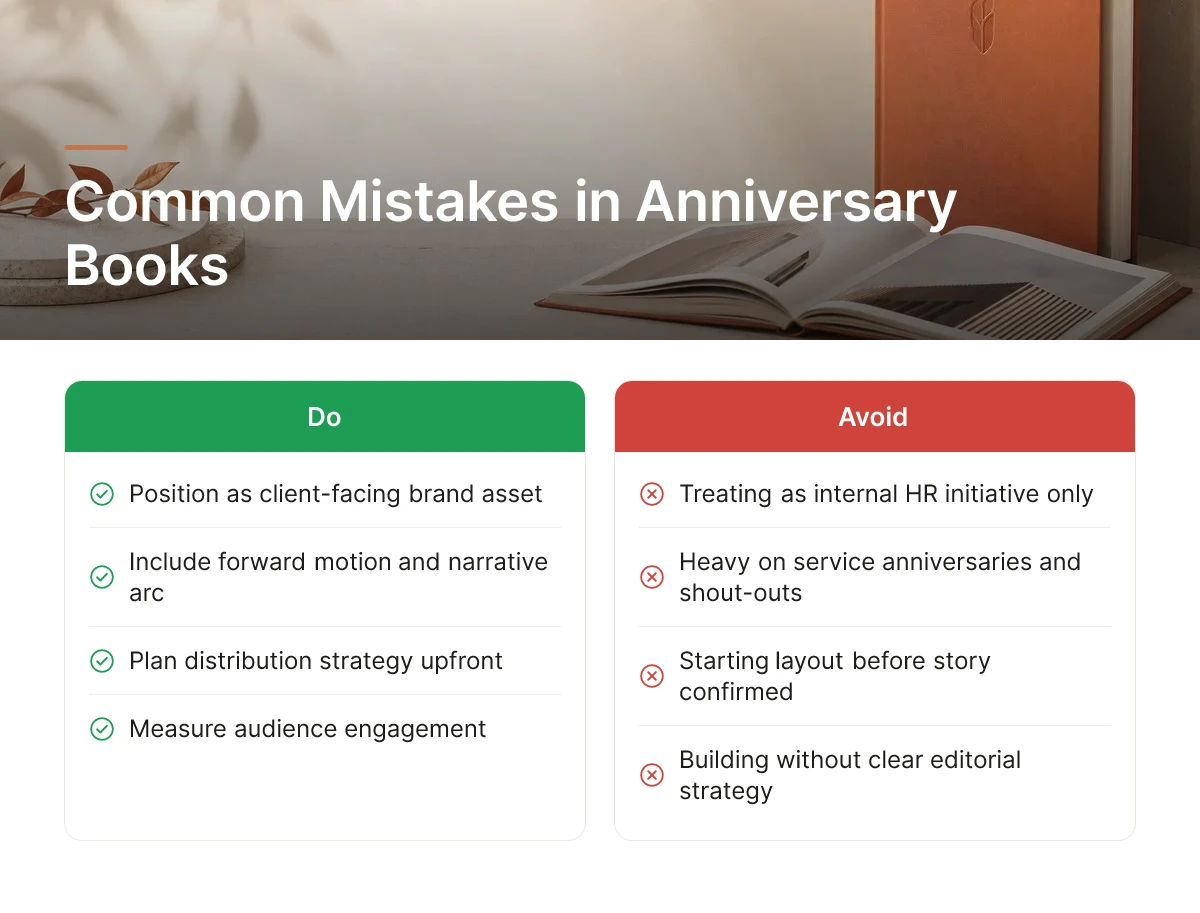
Most anniversary books fail for the same five reasons: wrong audience, no editorial strategy, no forward motion, no distribution plan, and no way to measure whether anyone actually cared.
The most common misstep is treating the project as an internal HR initiative rather than a client-facing brand asset. A book built by the internal communications team, for the internal communications team, ends up reading like an employee newsletter with a hardcover, heavy on service anniversaries and department shout-outs, light on anything a client or prospect would want to keep. If the people signing off on content are thinking “what will our staff enjoy” instead of “what will our best client show a peer,” the tone drifts wrong before a single page is designed.
A second mistake: skipping editorial strategy and jumping straight to layout. Design teams are good at making pages look finished, but a good-looking page with no editorial spine reads flat, a sequence of nice photos and captions with no argument, no throughline, nothing that earns a second read. Rethink Publishing builds the editorial direction first, before any design decision, precisely because a beautiful spread can’t rescue a book that has nothing to say.
Third, many books are purely retrospective, 20 or 50 years of history and nothing else. That’s a museum piece, not a relationship tool. Without a forward-looking section, where the company is headed, what clients can expect next, the book has no reason to come back out after the anniversary party ends.
What Makes an Anniversary Book a Real Marketing Asset, Not a Vanity Project?
Judge it the way you’d judge any relationship-building asset: does it get used, or does it get filed?
Track whether clients mention it unprompted in meetings, whether sales teams reach for it when pitching, and whether it sits on a coffee table or a shelf versus a drawer. A book that gets handed to a prospect six months after launch is working. One that nobody remembers exists by the following quarter was a printing exercise, not a brand investment.
How Do Anniversary Books Fit Into a Broader Brand and Client Relationship Strategy?
They only work as part of a plan for who receives them and when, not as a one-time print run with no distribution strategy. Producing hundreds of copies of a premium company anniversary book with no list, no sequencing, and no follow-up is the fifth mistake, and it’s the one that wastes the most money. Decide the recipient list, top clients, referral partners, prospects in active conversations, before the first page is written, so the book has somewhere to land the day it arrives from the printer.
Frequently Asked Questions
Can a company anniversary book include digital elements alongside the printed edition?
Yes, but the print edition should carry the weight, digital add-ons work best as a companion, not a replacement. Some clients create a PDF version for email distribution or a short video documenting the milestone, but the physical book is what stays on a desk or coffee table. Thumbprint Books, for example, offers both print and digital formats for corporate story projects [4].
Who should be interviewed for a company anniversary book?
Interview founders, long-tenured employees, retired executives, and loyal clients, the people who lived the company’s history firsthand. Jenkins Group notes that legacy books often center on preserving one individual’s story within a larger company narrative [3]. A mix of internal and external voices gives the book credibility beyond a self-congratulatory tone.
Does a company anniversary book work for a young company without decades of history?
It can, but the editorial angle has to shift from “decades of history” to a sharper story, a founding moment, a turning point, or a specific achievement worth commemorating. Bookhouse Group frames commemorative books around significant achievements as much as long tenure [1], so a five-year milestone tied to a real inflection point can carry a book just as well as a centennial.
How is an anniversary book distributed once it’s printed?
Most companies hand-deliver copies to top clients, place them in offices and lobbies, and gift them at anniversary events or executive meetings. Thumbprint Books notes anniversary books also help orient new employees to company culture and history [4], making internal distribution worth planning alongside client-facing copies.
Conclusion
A company anniversary book earns its place on a coffee table when it reads like a real editorial product, not a brochure with a milestone stamped on the cover. That means starting with a defined editorial spine, choosing interview subjects who add credibility rather than flattery, and treating print production, paper stock, binding, image sourcing, as part of the brand statement, not an afterthought.
If your milestone is on the calendar within the next 12 months, start the editorial planning now; a book built with real production discipline takes months, not weeks. Rethink Publishing, founded by Nathalie Grolimund with 20+ years in high-end print publishing, manages that entire process end-to-end. Visit www.rethink-publishing.com to start the conversation.
Sources & References
- Commemorative and Company Anniversary Books produced by Bookhouse Group of Atlanta, Georgia
- Corporate Anniversary Books | Jenkins Group | Powerful Stories
- Corporate Story, Corporate Anniversary, Legacy Book – Thumbprint Books
Recommended Articles
Explore more from our content library: