
Understanding magazine publishing for companies is essential. A custom company magazine works because print does something digital channels can’t: it earns a physical place in someone’s home or office, gets picked up again, and signals that a brand values craft over clicks. Digital content is scanned and forgotten within seconds; a well-made printed magazine sits on a coffee table for months, quietly reinforcing brand perception every time someone walks past it. For companies trying to deepen client relationships rather than just generate impressions, that staying power is the whole point.
Why Should a Company Consider Magazine Publishing Instead of Relying on Digital Channels?
A printed magazine works on the senses in a way a screen never will, weight, paper stock, and finish signal investment before a reader reads a single word. That signal is the real argument for magazine publishing for companies that have outgrown the PDF-and-newsletter routine.
How does a printed magazine change the way clients perceive your brand?
A heavy page stock and a well-bound spine tell the reader, before they’ve absorbed any content, that someone spent real money and real care producing this object. An email newsletter costs nothing to send and reads like it. A client who receives a 96-page custom publication with considered typography and commissioned photography is forming a judgment about the company’s standards, not just its message. That judgment happens below the level of conscious analysis, which is exactly why it’s hard to fake with a digital asset.
What makes a magazine a keepsake that stays in someone’s home or office?
Printed objects get kept because they occupy physical space someone has to choose to maintain, and that choice is itself a form of endorsement. A PDF gets archived or deleted with no friction at all; a magazine left on a reception table or a coffee table requires a small, repeated decision not to throw it away. Dialogue Agency’s research into luxury print strategy describes this as pairing a tactile, beautiful product with storytelling that encourages exploration rather than a quick scroll [3]. That’s the keepsake effect: the object earns its place by being worth returning to.
Attention spans make the contrast sharper. A social post competes with dozens of other notifications and disappears from a feed within seconds. A printed magazine, by comparison, gets read in one sitting, with no competing browser tabs and no algorithm deciding whether it resurfaces. Yankee Custom Marketing frames the goal of a branded magazine as building a connection that captivates an audience and strengthens relationships over time, not a single scroll-past impression [1]. That single sitting, repeated every time the magazine is picked back up, is worth more than a hundred fleeting impressions.
None of this means every company needs one. Honestly? If there’s no real story, no relationship worth deepening, and no audience who’d actually want to sit with it, a magazine is an expensive vanity project. It only earns its cost when a brand has something worth saying and clients worth staying in front of for months, not minutes.
What Does It Take to Create a Magazine That Actually Works as a Brand Asset?
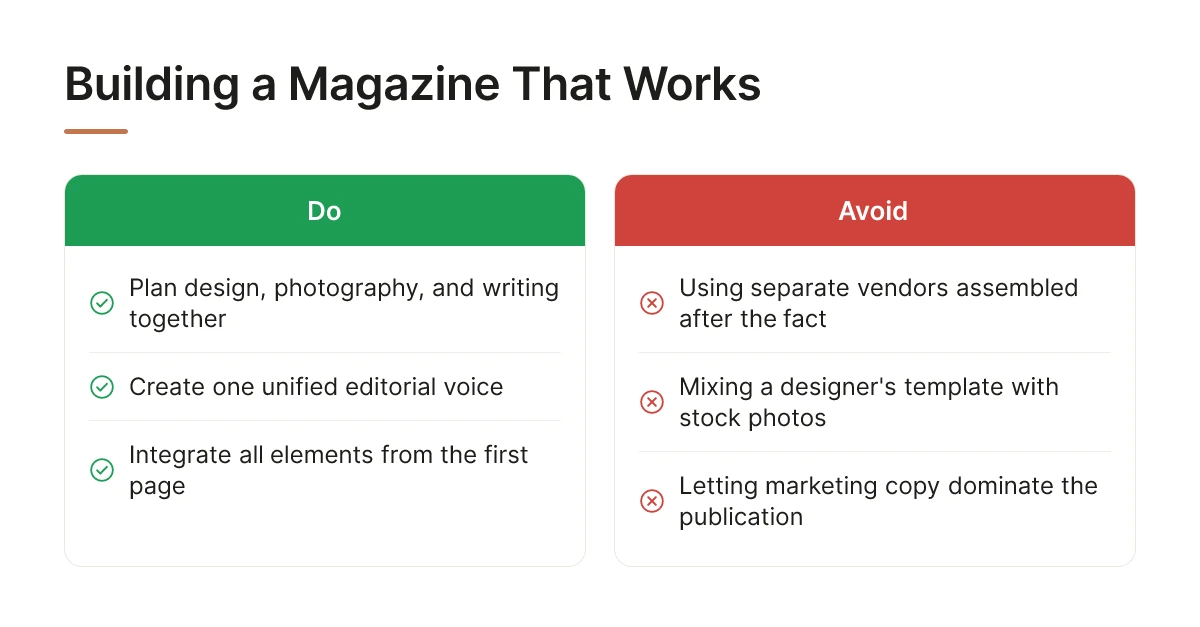
It takes one editorial system, not three separate vendors, design, photography, and writing have to be planned together from the first page, not assembled after the fact.
Most companies that attempt magazine publishing for companies in-house end up with a document that looks like three different projects stapled together: a designer’s template, a photographer’s stock library, and a marketing team’s sales copy. The reader feels the seams immediately. A publication that works as a brand asset reads like it came from one voice, because it did.
How do design, photography, and editorial voice work together to create a premium publication?
Design, photography, and editorial voice have to be planned as a single system where each decision depends on the other two, not bolted on at separate stages. The editorial spine, the narrative thread that gives the issue a reason to exist, comes first. Layout and image selection follow it, rather than the other way around.
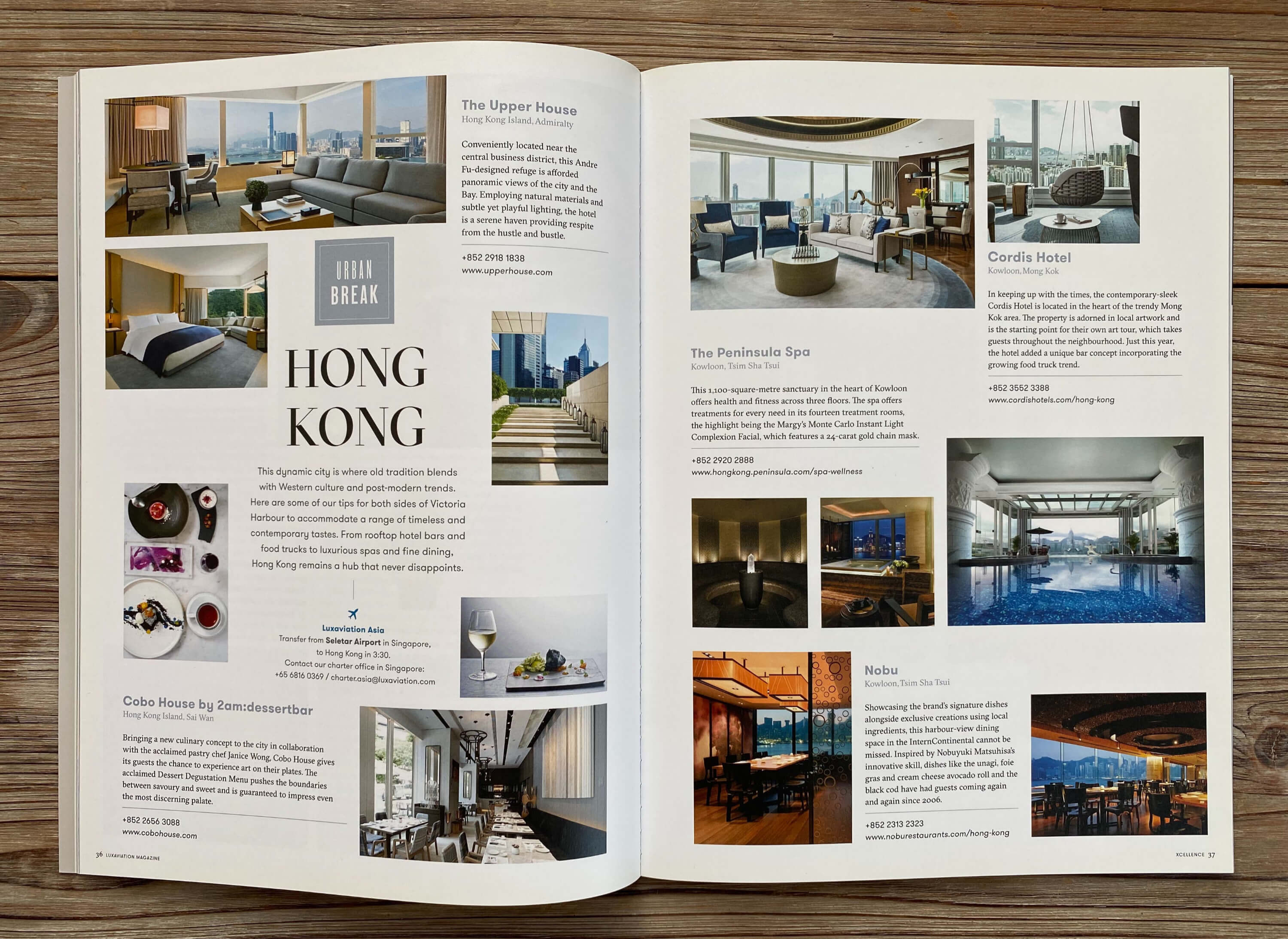
The visible difference between a brochure and a magazine shows up in the details most companies don’t think to specify. Paper stock has weight and texture instead of the thin gloss of a sell sheet. Layout rhythm varies, full-bleed photography next to dense text, breathing room next to density, instead of repeating the same grid on every page. Typographic discipline holds a consistent hierarchy across 80 pages instead of drifting template to template. Image quality is licensed or commissioned, not pulled from a generic stock folder.
What’s the real cost and timeline for producing a high-end custom magazine?
A realistic production arc moves through four phases: concept and editorial strategy, content gathering (writing, photography, interviews), design and layout, then print production and delivery. Each phase depends on the one before it, rushing content gathering to hit a design deadline is where most in-house attempts start to look like a brochure again.
Cost scales with ambition, not a fixed formula. A budget-friendly approach might mean a slimmer page count and a tighter photography budget; a premium or enterprise-tier publication means custom photography, hard-bound production, and a longer editorial runway. Either way, the right frame is long-term brand investment, a publication clients keep for years functions differently than a campaign that expires in a news cycle [3]. Tulip Media Group frames this as a step-by-step process starting with audience and goals before content, design, and distribution get decided [2], which is the right order regardless of who produces it.
The distinction that matters most: a magazine has an editorial spine, a reason someone would read page 40 even if they never bought anything. A brochure has a sales pitch dressed in nicer paper. Rethink Publishing builds the editorial spine before a single layout decision gets made, which is the difference clients notice when the finished piece lands on a coffee table instead of in a recycling bin.
How Do You Build an Editorial Strategy That Serves Your Company’s Relationship Goals?
Start every editorial decision with the relationship you want to deepen, not the achievement you want to announce, the subject matter follows from who you’re trying to reach, not from what’s sitting on your desk. That ordering is the difference between a magazine people keep and one they recycle.
How do you choose what to write about and who should be featured in your magazine?
Work backward from the relationship goal. If the point is to keep a key client relationship warm after a sale closes, the content should speak to what that client cares about professionally and personally, not to a recap of your company’s quarter. If the goal is to position leadership among industry peers, the content needs to earn a place in that conversation, not just assert one.
Most companies default to featuring their own leadership and their own products, issue after issue. That’s the fastest way to turn a magazine into a brochure with better paper stock. The stronger approach features clients, partners, and people working across the industry, a hotel group profiling the architects and craftspeople behind its properties, a law firm featuring the founders of client companies rather than its own partners. The people in your magazine should be the people your relationships depend on.
How does a clear editorial spine guide every decision from concept to print?
An editorial spine is the consistent angle every issue returns to, a through-line that tells the reader, and the team producing the magazine, what belongs and what doesn’t. Without it, magazine publishing for companies tends to drift into a loose stack of unrelated articles that reads like a newsletter stretched to 80 pages.
Consider a hospitality brand whose spine is “the people who make a place feel like somewhere”, every issue profiles staff, longtime guests, and local craftspeople rather than listing property amenities. A cybersecurity firm might build its spine around the human cost of digital trust, running stories about security teams and the businesses they protect rather than product features. Dialogue Agency’s research on luxury print strategy makes a similar point: storytelling and design that engages the audience, sitting alongside digital marketing, is what builds brand loyalty over time [3].
Consistency issue-to-issue is what builds anticipation. A reader who recognizes the spine looks forward to the next installment the way they would a column or a series, a one-off article collection never earns that.
In-House vs. a Publishing Partner for Magazine Publishing for Companies: What’s the Difference?
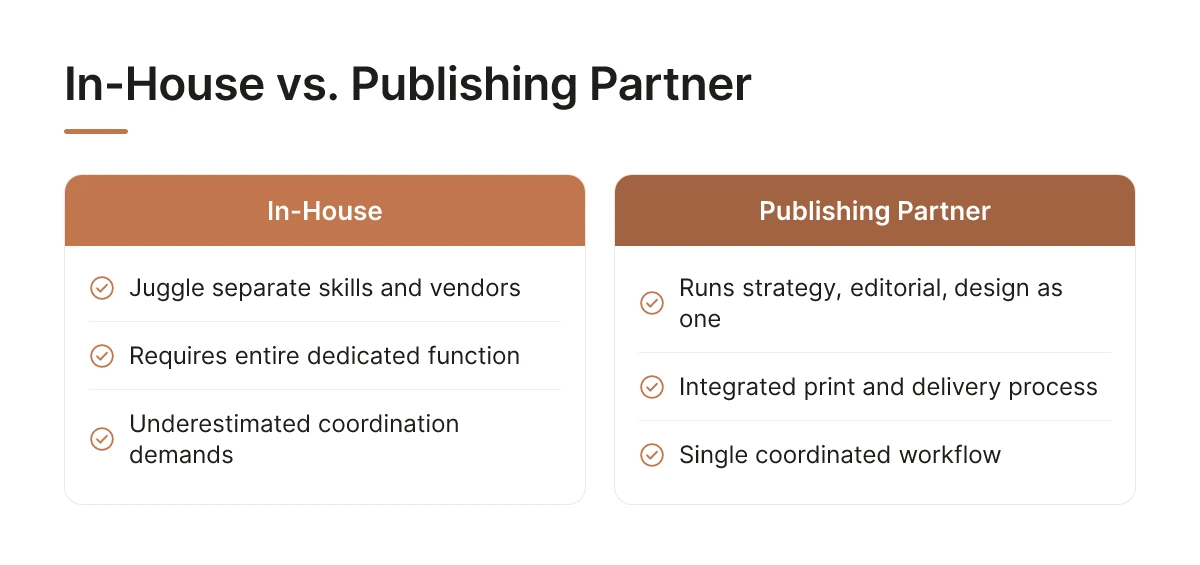
The difference comes down to coordination: in-house teams juggle separate skills and vendors, while a publishing partner runs strategy, editorial, design, print, and delivery as one process.
Most companies evaluating magazine publishing for companies underestimate what running the program internally actually requires. It’s not a single hire, it’s an entire function.
What does running a magazine in-house actually require?
Producing one issue means staffing or contracting editorial talent who can write for a brand voice, a design team who understands print layout (not just web graphics), and someone who can source or commission photography that doesn’t look like stock imagery. Add print production knowledge, paper stock, binding, color proofing, vendor relationships, and a project manager who can hold all of it to a deadline. Few marketing departments have all five capabilities in-house at once, and even fewer have them with print-specific experience.
What does end-to-end publishing support actually include, and why does it matter?
End-to-end support means one team carries the publication from the first strategy conversation through final delivery, rather than a company managing five separate vendors. At Rethink Publishing, that means the same studio defines the editorial spine, writes and designs the issue, sources imagery, manages print production, and handles delivery, with no handoffs between agencies who’ve never spoken to each other.
This matters because fragmented ownership creates inconsistency issue-to-issue. One agency handles design for issue one, a different freelancer handles editorial for issue two, and a new print vendor handles production for issue three, and the magazine’s voice, pacing, and visual identity drift each time. Readers notice when a publication feels assembled rather than authored. A magazine built by one coordinated team reads like it was made by one editorial mind, because it was.
How do you measure whether your magazine is deepening client relationships and strengthening brand perception?
The clearest signals are qualitative, not analytics dashboards. Does a client mention the magazine unprompted in a meeting? Do people ask for extra copies to send to colleagues or family? Does an issue spark a renewed conversation with a dormant account? Does it sit on a reception desk or a conference room table months after it arrived, instead of in a recycling bin within a week?
These signals are harder to track than open rates, but they’re the ones that matter for a physical asset meant to last. A magazine that gets displayed and passed along is doing the job a brochure never could.
Which approach is right for your company?
In-house publishing can work for companies that already run an editorial team, a design department, and print production relationships, media companies, large hospitality groups with in-house content studios. For most CEOs and brand executives outside that narrow group, the honest answer is that the coordination burden is larger than it appears at the outset, and a dedicated publishing partner closes that gap without requiring five new hires.
Frequently Asked Questions
Is print making a comeback, or is this just nostalgia?
It’s a real shift, not nostalgia, the global custom publishing market was valued at roughly $2.8 billion in 2023, and luxury brands are driving a notable share of that growth. The logic is simple: digital feeds are crowded and forgettable, while a physical object sitting on a coffee table has no competing tabs open. Brands are reinvesting in print precisely because scarcity of attention has become valuable.
How often should a company publish its magazine?
Most companies publish one to four issues a year, depending on how much editorial content they can credibly fill. A biannual or annual schedule works well for brands that want each issue to feel like an event rather than a filler piece. Quality and consistency matter more than frequency.
Can a smaller company justify producing a custom magazine?
Yes, if the magazine serves a clear relationship-building purpose rather than mass awareness. A smaller firm with a concentrated list of high-value clients, a boutique law practice or a private wealth advisor, for example, often gets more mileage from one well-made annual issue than a larger company sending generic newsletters. The test isn’t company size; it’s whether the relationships are worth the investment.
Does a company magazine need to be sold, or is it always distributed for free?
Most brand magazines are distributed free, as a relationship tool rather than a revenue product. The return shows up in retention, referrals, and perception, not newsstand sales. A few companies sell copies or use advertising to offset cost, but that’s the exception, not the goal.
Conclusion
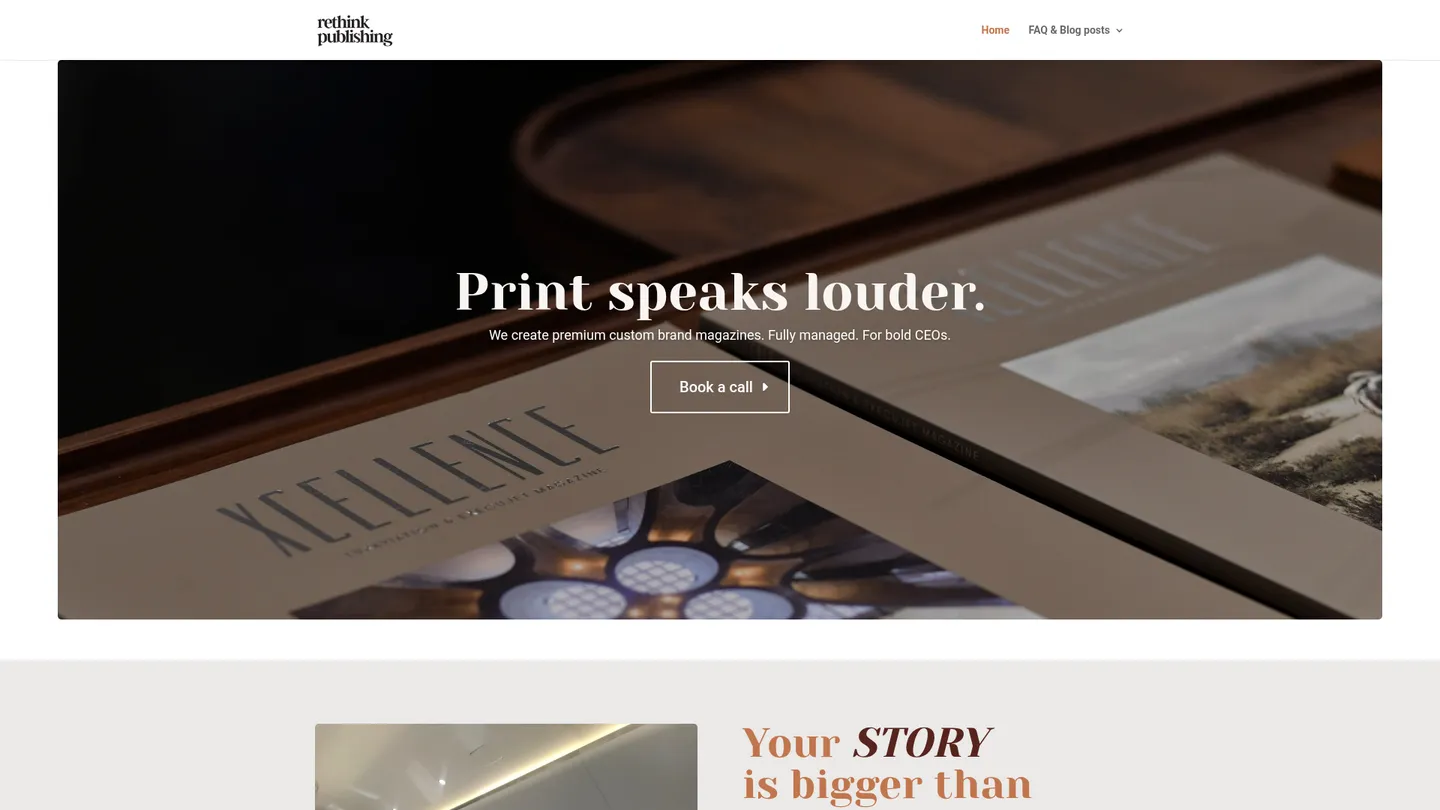
A company magazine earns its place on a coffee table through editorial discipline, not budget alone, the brands that get it right treat it as a long-term asset, not a one-off campaign. Before committing, get clear on your audience, pick a realistic publishing cadence, and decide whether this replaces or complements your existing marketing. If you’re weighing whether your brand has enough editorial substance to sustain a publication, that’s the conversation worth having first. Rethink Publishing, founded by Nathalie Grolimund with over 20 years in the field, has that conversation daily, visit rethink-publishing.com to start it.
Sources & References
- Build Unshakable Brand Loyalty With a Custom Magazine – Yankee Custom Marketing
- Launching Your First Custom Magazine | Tulip Media Group
- 5 luxury print magazine strategies
Recommended Articles
Explore more from our content library: