
Understanding magazine approval process stakeholders is essential. Stakeholder approvals derail magazine timelines when every reviewer gets equal say at every stage, not when you have stakeholders at all. The fix is sequencing: let editorial lock the concept first, bring brand and legal in at defined checkpoints, and treat late-stage feedback as the exception, not the norm. Done well, stakeholder sign-off protects the magazine’s quality and your deadline at the same time, it’s a schedule problem with a structural solution, not a people problem.

Identify Your Magazine Approval Process Stakeholders Before You Start
Most delays trace back to one mistake: nobody wrote down who actually has authority over what before the first draft landed on a desk. Mapping your magazine approval process stakeholders by what they’re qualified to judge, not by title, is the single decision that prevents the most common bottlenecks later.
Editorial, Brand, and Compliance: Different Jobs, Different Sign-Offs
A magazine has three distinct categories of risk, and each needs a different reviewer. Editorial stakeholders protect accuracy, voice, and whether the narrative actually holds together across 60 or 100 pages. Brand stakeholders protect visual identity and messaging alignment, does this look and sound like the company. Compliance stakeholders protect the business from legal exposure, regulatory issues, and factual claims that could come back as liability. This is particularly relevant for magazine approval process stakeholders.
Treating these as one undifferentiated “review” is where most companies lose weeks. A regulated business in particular needs to separate brand-consistency checks from accuracy and compliance checks, since collapsing them into a single pass tends to bury legal issues under stylistic feedback [3]. When one reviewer is asked to judge all three at once, something gets missed, usually the thing that costs the most to fix later.
The fix is a lane system. A brand director should not be rewriting a feature’s lede because the phrasing feels off to them personally, that’s an editorial call. An editor should not be overriding the brand’s typography or color guidelines because they prefer a different look, that’s a brand call. Legal should not be commenting on tone at all; their job is factual and regulatory exposure, full stop. Each stakeholder approves inside their lane and defers outside it.
What to Do When Marketing and Editorial Priorities Collide
Marketing will often want more product promotion; editorial will push back to protect the magazine’s credibility as an actual publication rather than a brochure. Both positions are legitimate, and consensus rarely resolves them cleanly, someone has to own the call. Stakeholder management research is consistent on this point: unclear authority over decisions, not disagreement itself, is what stalls projects and triggers the kind of late-stage surprises that blow timelines [5].
The practical fix is naming a single final approver per issue type before anyone starts writing, in writing, not a committee, not “whoever’s in the room.” At Rethink Publishing, we build this into the editorial spine conversation with clients up front, so the decision-owner for tone, for brand compliance, and for legal sign-off is settled before production begins, not negotiated mid-issue when a deadline is already at risk.
Set Boundaries Between Editorial Vision and Stakeholder Input
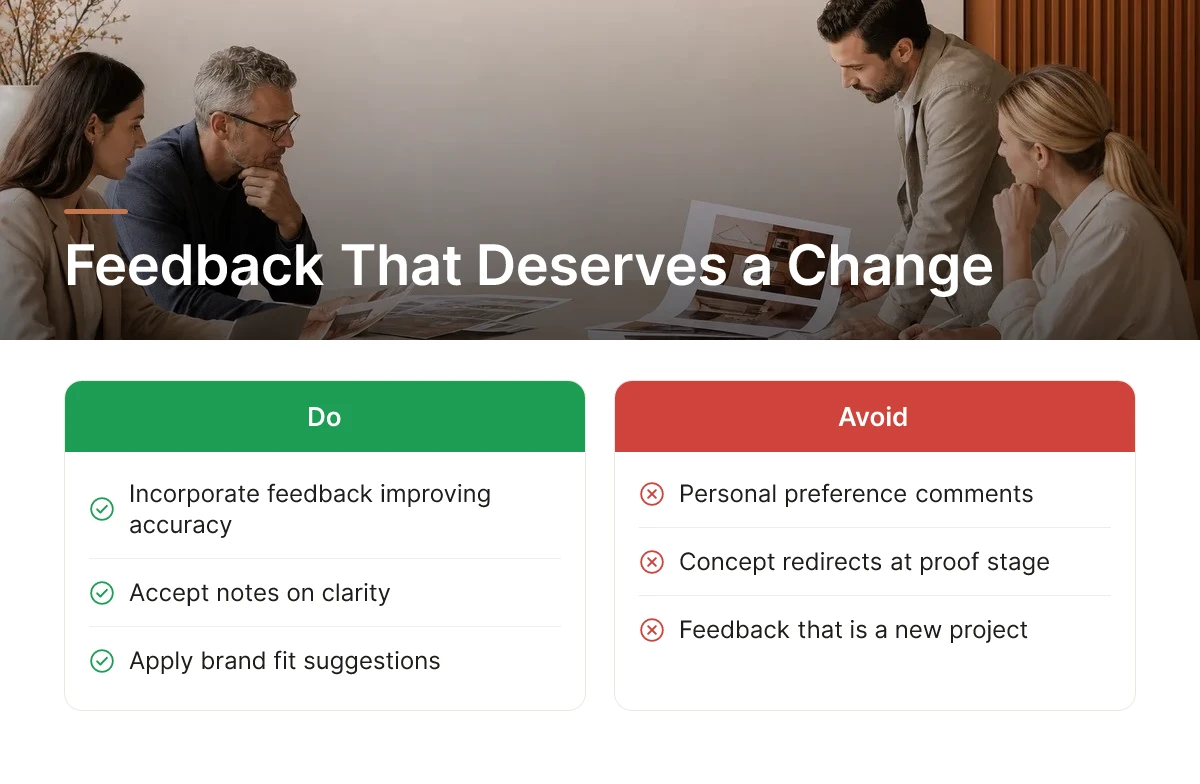
Not every comment deserves a change, the fastest way to protect a magazine’s quality is a simple test applied to every note before it reaches the design file.
Ask one question: does this feedback improve accuracy, clarity, or brand fit? If yes, incorporate it. If the comment is a personal preference, a favorite color, a photo the CEO’s spouse liked better, a headline rewritten in someone’s own voice, it does not meet the bar. The same goes for feedback that arrives at proof stage trying to redirect the entire concept. That is not a review comment. That is a new project, and it should be named as one rather than absorbed quietly into the current timeline.
When to Push Back on Feedback, and When to Fold It In
Train every reviewer to label their own comments before they submit them: factual correction, brand inconsistency, or preference. Most feedback conflict in a magazine approval process stakeholders rely on comes from skipping this step, a preference gets dressed up as a brand concern, and nobody challenges it because challenging feels political.
A useful filter: if two different stakeholders would give opposite notes on the same page, it is probably taste, not accuracy. Hold the line there. If a factual error or a genuine brand misstep is flagged, fix it immediately and thank the reviewer, that is the review process working as intended. When considering magazine approval process stakeholders, this point stands out.
How to Stop Revision Cycles From Multiplying
Scope creep in publishing is mechanical, not accidental. One open-ended review round, “take a look and send thoughts”, invites a second round once new people see the draft, and a third once someone forwards it further down the chain. Each round without a cap or a defined scope compounds the last one. Review research on content workflows confirms what every production team already knows: approval stalls are rarely about the content itself, they’re about handoffs with no defined endpoint [1].
The fix is procedural: cap review rounds at two or three, name who reviews each round, and state in advance what each round is for, concept approval, then design approval, then final proof. No new concept notes once design has started.
That discipline depends on locking the editorial concept and brand guidelines before design work begins. Once the spine of the issue, its themes, tone, and structure, is fixed on paper, later feedback has something concrete to measure against instead of a moving target. A strong editorial lead, whether in-house or an outside publishing partner, absorbs incoming notes and triages them before they ever reach the design team, so layout work isn’t disrupted by unfiltered opinion. At Rethink Publishing, this triage sits with the editorial lead by design, which is part of why a 20+ year production history holds up across 80+ magazines without the concept drifting mid-project.
Build Approval Checkpoints Into the Workflow Before Print
Four checkpoints, concept, first layout, fact-check and legal, final proof, catch problems while they’re still cheap to fix instead of at the printer’s deadline.
A magazine without defined gates doesn’t avoid conflict, it just delays it. Every unresolved disagreement about tone, image choice, or messaging resurfaces later, usually when there’s less time and less budget to fix it. Structured checkpoints exist to force those conversations early, when a sentence can be rewritten in minutes instead of a signature being chased the night before a print run. This is the practical core of managing magazine approval process stakeholders, giving each person a defined moment to weigh in, and a defined moment when their input is no longer open for debate.
- Concept and content plan. The editorial spine, section list, and story angles get approved here. Once this gate closes, the magazine’s direction is locked, no new sections, no pivot in theme.
- First layout draft. Copy and images appear together for the first time, in rough design. Stakeholders confirm the story still serves the brand and the content is accurate in substance. Design polish comes later.
- Fact-check and legal pass. A dedicated review, separate from creative feedback, confirming every claim and credit is defensible.
- Final proof. The last look before the file goes to press. Nothing structural changes here, only typos, misalignments, and last catches.
What Fact-Checking and Legal Review Should Cover
This gate exists to confirm the magazine won’t embarrass the brand or expose it to liability once it’s printed and irreversible. Reviewers should verify every factual claim and statistic against a source, confirm quotes are accurate and attributed correctly, and check that image rights and licensing are documented for each photo used, a gap competitors and brand agencies alike treat as a formality, and shouldn’t. Reviewers should also check advertiser disclosures where sponsored content appears, and confirm any regulatory or industry-specific language, in hospitality, real estate, law, or finance, meets current requirements. Reviews that skip brand consistency or regulatory compliance checks tend to surface costly errors later [3].
How to Keep Design Feedback Useful Instead of Micromanaged
Design review stalls when stakeholders comment on font weight instead of whether the story lands. Give each reviewer a specific lens, content accuracy, brand voice, or clarity, and ask them to flag only what falls inside it. A fresh set of eyes is genuinely useful for catching inconsistencies the team closest to the work has missed [3], but that value disappears once feedback drifts into subjective layout preference. Rethink Publishing builds this boundary into its process by separating editorial sign-off from design execution, so stakeholders approve the story and the brand team executes the visual craft.
The final proof checkpoint exists precisely because sign-off earlier in the process doesn’t catch everything, it’s the last chance to stop an error before the ink is committed and the cost becomes permanent. For those exploring magazine approval process stakeholders, this matters.
Structure Communication So Decisions Keep Moving
Route every draft through one scheduled review session with a deadline and a required format, not an open inbox collecting opinions at random. A magazine approval process involving stakeholders across marketing, legal, and the executive suite stalls the moment feedback arrives through five separate channels instead of one.
Collecting Feedback From Multiple Stakeholders Without Chaos
Scattered emails and hallway comments are the fastest way to lose a week. One stakeholder forwards a PDF with handwritten notes, another replies-all with a paragraph of impressions, a third mentions a concern in a meeting that never gets written down, and now nobody knows which version is current. A single consolidated review, whether a shared document with comment threads or one meeting where every voice is heard at the same time, keeps the draft moving instead of fragmenting across inboxes [3].
Feedback also needs boundaries. “What do you think of the cover?” invites an open-ended reaction that can run in circles for days. Asking reviewers to tie comments to a specific page, flag whether a note is a required fix or a preference, and submit everything by a set time turns vague impressions into decisions someone can actually act on. Research on creative review processes makes the same point: structured, specific feedback is what separates a review that improves the work from one that just delays it [3].
Write down who approved what, and when. A short decision log, even a simple table with the date, the section, the approver, and the outcome, means a disagreement that resurfaces six weeks later gets settled by checking the record, not by re-arguing the point from scratch. Stakeholder research on project delays shows that a single person who feels bypassed, or a decision nobody can verify, is often enough to stall momentum that took weeks to build [5].
Why Print Deadlines Leave Less Room for Delay Than Digital
A web page can be corrected after it publishes. A printed magazine cannot, once it’s at the press, the words, the photo credit, and the approved layout are permanent. That reality should shape how much time gets budgeted for review versus design and production: a realistic schedule gives stakeholders a firm window to respond, not an indefinite one, because every day spent waiting on a comment is a day subtracted from layout, proofing, and print. Rethink Publishing builds this into its production timeline from the start, so the people approving a client’s magazine know exactly when their input is due and what happens if it isn’t delivered on time, because in print, “we’ll fix it later” isn’t an option.
Common Mistakes to Avoid in Stakeholder Sign-Off
Most delays in a magazine approval process come from five repeatable mistakes, and every one of them is avoidable with a decision made before the first draft lands. This directly impacts magazine approval process stakeholders outcomes.
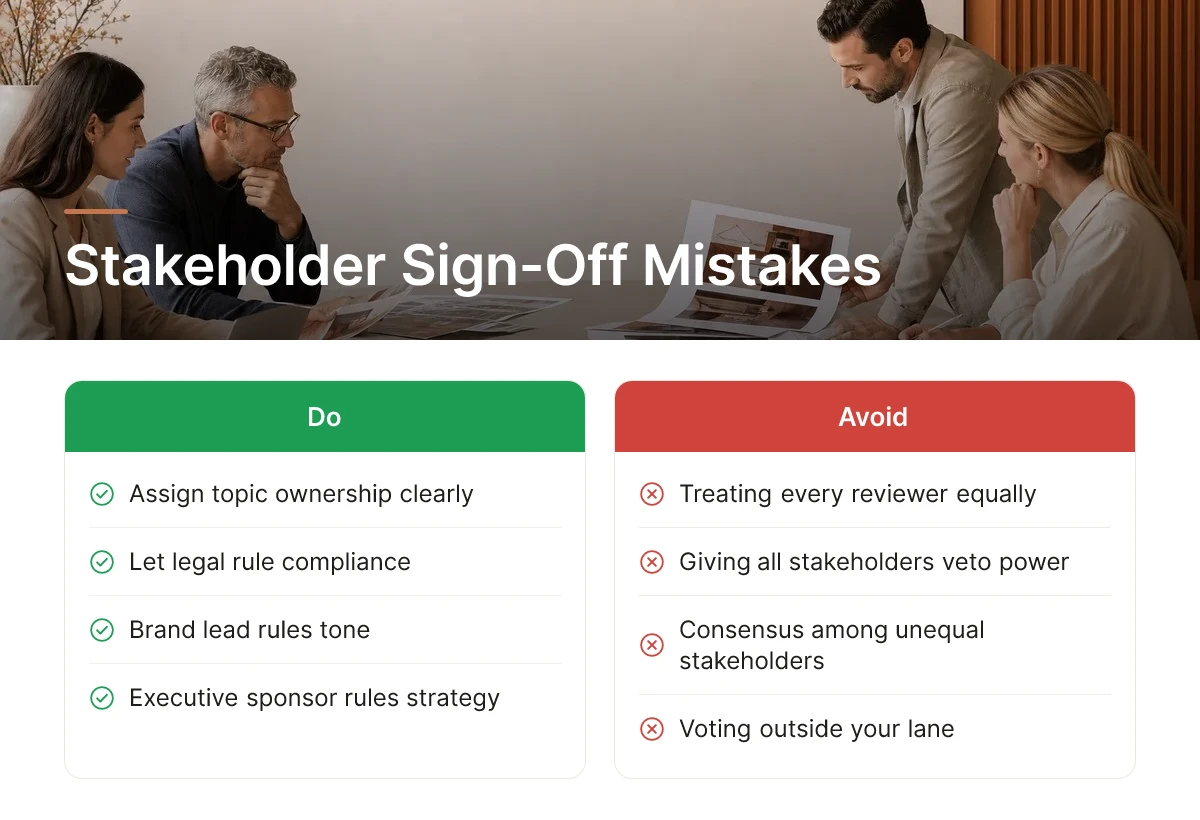
The most common error is treating every reviewer as an equal decision-maker on every topic. When legal, marketing, and the CEO all have veto power over a headline choice or a photo crop, nothing moves, consensus among unequal stakeholders is slower to reach and more fragile once reached. Assign topic ownership instead: legal rules on compliance, the brand lead rules on tone, and the executive sponsor rules on anything that touches strategy. No one should be voting outside their lane.
A second mistake is pushing fact-check and legal review to the final proof. By that stage, layout is locked, images are licensed, and a single factual correction can unravel a two-page spread. Build legal and accuracy checks into an earlier checkpoint, right after the first draft, so corrections happen while text is still flexible.
Open-ended feedback rounds cause the third problem. Without a deadline and a defined scope, “comment on copy accuracy, not layout”, reviewers keep adding notes indefinitely, and scope creep replaces progress. Cap every round with a date and a stated purpose, and hold to it.
The fourth mistake is letting the loudest voice in the room override an editorial concept that was already agreed and locked. A senior executive who dislikes one pull-quote can derail weeks of editorial direction if the team has no agreed process for pushing back. This is exactly where structure among magazine approval process stakeholders matters most: the concept sign-off should be treated as binding, not a draft that stays open to relitigating.
Last, skipping written documentation of decisions guarantees the same arguments resurface late in production, when they’re far more expensive to have [5]. A one-line log, who decided what, and when, settles disputes before they cost a reprint. Rethink Publishing builds each of these checkpoints into its production calendar from the outset, precisely because undocumented decisions are the most common reason an otherwise strong issue slips its schedule.
Frequently Asked Questions
What’s the difference between editorial, brand, and compliance stakeholders in a magazine approval process?
Each group protects a different asset, and conflating them is what causes approval chaos. Editorial stakeholders judge whether the story holds together and reads well. Brand stakeholders check tone, visual identity, and market positioning. Compliance stakeholders (legal, regulatory, or franchise partners) verify claims, image rights, and disclosures. Routing all three through one undifferentiated review round guarantees contradictory feedback and missed deadlines.
How do you prevent scope creep during magazine stakeholder review?
Lock the editorial direction before anyone reviews a single page, then treat that document as the standard against which feedback gets judged. New ideas that surface mid-review get logged for a future issue, not inserted into the current one. Without that boundary, a 60-page magazine can balloon into endless rework. This is particularly relevant for magazine approval process stakeholders.
How much time should you budget for stakeholder review in a magazine production timeline?
Plan for two to three review rounds, each needing five to ten business days for stakeholders to respond, depending on how many departments or executives are involved. Build in buffer time for at least one unplanned revision cycle, since a missed voice in round one often surfaces objections in round two. Print deadlines don’t bend for a late sign-off, so pad the schedule rather than the print date [5].
How do print deadlines change the approval process compared to digital publishing?
Print approval has to be final before the file goes to press, while digital content can be corrected after it’s live. A typo caught after a digital post goes out costs a quick edit; the same typo on a printed page costs the reprint of an entire run. That difference is why print reviews demand earlier, firmer sign-off from every stakeholder group before anything reaches the production floor.

Conclusion
A magazine stalls in review for the same reason most brand projects stall: nobody mapped who needed to say yes, and in what order, before the work began. Fix that by naming your editorial, brand, and compliance stakeholders at the outset, locking the editorial direction before anyone reviews a page, and building real time into the schedule for at least one unplanned revision round. Rethink Publishing manages this process end to end, strategy, writing, design, and print production, so your stakeholders review a finished vision instead of a moving target. Start by listing every person who has sign-off authority on your next issue, and confirm that list before a single page gets designed.
Sources & References
- Content Workflow Management: The Essential Guide for 2026
- 6 ways to improve your creative review process – Perivan
- The Stakeholder Skill That Prevents Project Delays
Recommended Articles
Explore more from our content library: