
A premium custom printed magazine or coffee table book works as a strategic brand asset because it combines editorial credibility with physical permanence, something a digital ad or PDF cannot offer. Unlike disposable marketing collateral, a well-made print publication sits on a desk or coffee table for months, gets picked up repeatedly, and signals that a company invests in quality. Custom book printing services that handle strategy, editorial, design, and production end-to-end are what make this possible at a professional level, turning a one-off print run into a long-term brand touchpoint rather than a glossy brochure.
What Makes Custom Book Printing Services a Strategic Brand Asset?
A printed magazine earns its keep by occupying physical space over time, while a digital asset vanishes the moment someone closes the tab or scrolls past it. That difference is the entire case for treating print as an investment rather than a line-item marketing expense.
Consider where a well-made magazine or coffee-table book ends up: a reception desk, a boardroom table, a client’s living room. It sits there for weeks, sometimes years, getting picked up by whoever walks past, a visiting partner, a houseguest, a prospective client waiting for a meeting. No email newsletter survives that long in anyone’s attention. No LinkedIn post gets revisited by a stranger three months later because it looked good next to the coffee cups.
Attention itself works differently on paper. Someone who chooses to pick up a printed piece a second or third time is giving it a kind of attention that a scrolled feed never earns, unhurried, undistracted, deliberate. That’s not a nostalgic claim about print; it’s a structural one. A PDF competes with forty open browser tabs. A book on a table competes with nothing until someone decides to open it.
Why Do Brands Choose Print Over Digital for Their Most Important Marketing Moments?
Companies reach for print specifically when the moment matters too much to risk looking disposable, client gifts, investor updates, a flagship property launch, a tenth-anniversary milestone. Print marketing in particular is seeing renewed investment from brands because physical media carries a weight that a digital impression doesn’t [4]. A CEO handing a client a glossy brochure at a product launch sends a different signal than handing them a hardbound book with their name on the spine. One reads as promotional. The other reads as a gift worth keeping.
How Does a High-End Printed Publication Stay Relevant in People’s Homes and Offices?
A publication built with real editorial direction keeps earning relevance because it’s designed to be reread, not archived. It gets displayed, shown to visitors, referenced in conversation, the opposite of a digital file buried in a downloads folder. This is also where the line matters between a magazine and a brochure wearing a magazine’s clothes: a brochure is built to pitch, so it gets skimmed once and discarded. A magazine with an actual editorial spine, reporting, narrative, considered photography, gives people a reason to open it again. That distinction is exactly what custom book printing services are supposed to protect, and it’s why Rethink Publishing builds the editorial strategy before a single page gets designed.
How Do You Move From Concept to a Finished, Printed Publication?
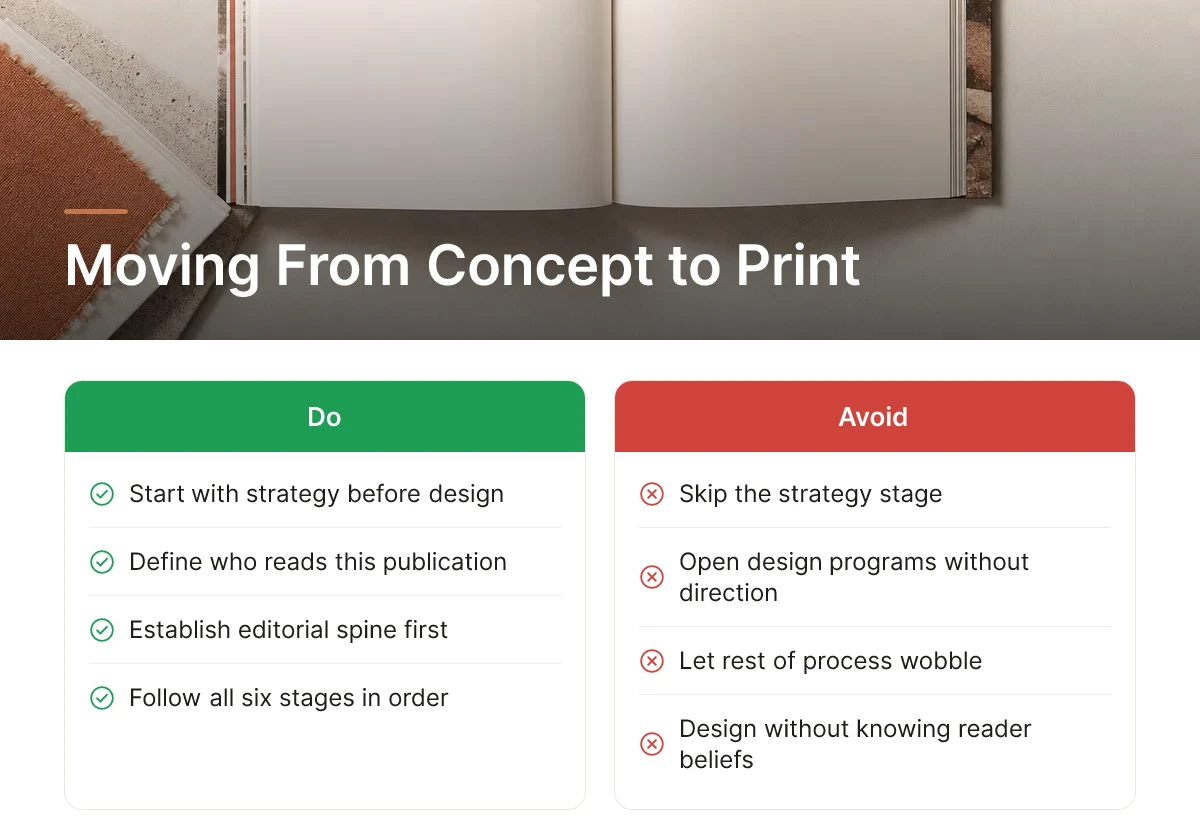
A finished magazine moves through six stages in order: strategy, editorial planning, design, proofing, print production, and delivery, skip the first and the rest wobble.
What Does the End-to-End Process Look Like, From Strategy Through Delivery?
Strategy comes first because design has nothing to anchor to without it. Before anyone opens a layout program, the real questions are: who reads this, what do they already believe about your brand, and what should they feel by the last page? At Rethink Publishing, this stage produces what we call the editorial spine, a defined content strategy that dictates everything downstream, from the sections a magazine carries to the kind of photography worth commissioning.
Editorial planning follows: mapping features, assigning writers, sourcing images or scheduling original photography, and building a table of contents that actually has a point of view. Design comes next, where words and images get paired with intention rather than dropped into a template. Proofing is its own phase, not an afterthought, multiple rounds, multiple eyes, checking facts, flow, and fit. Only then does the file go to print. Delivery and distribution close the loop, covering everything from freight logistics to getting copies into the hands of clients, prospects, or guests at the right moment.
Research on brand publishing echoes this sequencing: TopRank Marketing’s review of brand print magazines points to planning and audience definition as the foundation tips that separate publications readers keep from ones they discard [2]. A magazine without a strategic spine behind it tends to read like a brochure wearing a magazine’s clothing, longer, but no more purposeful.
How Do You Prepare Your Content and Files for Professional Printing?
Preparing content for print is a technical discipline, not a formality tacked on at the end. Images need to be sourced or shot at print resolution, which is considerably higher than what displays acceptably on a screen. Files need the right color profile so the blues in your logo don’t shift on press. Every spread needs bleed and trim allowances built in, or elements near the edge get clipped during binding. None of this is intuitive if your team’s experience is limited to web content and PDFs, which is precisely why custom book printing services built around end-to-end production exist.
A company working with a fully managed studio typically supplies three things: the brand material (logos, guidelines, existing photography), access to subject matter, executives, properties, products, for interviews and shoots, and timely feedback during proofing rounds. Everything else, including file prep, color management, and press checks, sits with the production partner. The realistic shape of a timeline runs through distinct planning, production, and printing phases, each with its own proofing checkpoints, rather than compressing into a single rushed handoff.
What Should You Expect From the Design and Editorial Process?
Expect a process built around an editorial point of view first, with layout and photography serving that point of view, not the reverse.
Good custom book printing services start long before anyone opens a design program. Someone has to decide what the publication is actually about, who it’s for, and what it should feel like on page 40 versus page 4. Skip that step and you get something that looks like a magazine but reads like a brochure with better paper.
How Does Intentional Pairing of Words and Images Shape a Publication’s Impact?
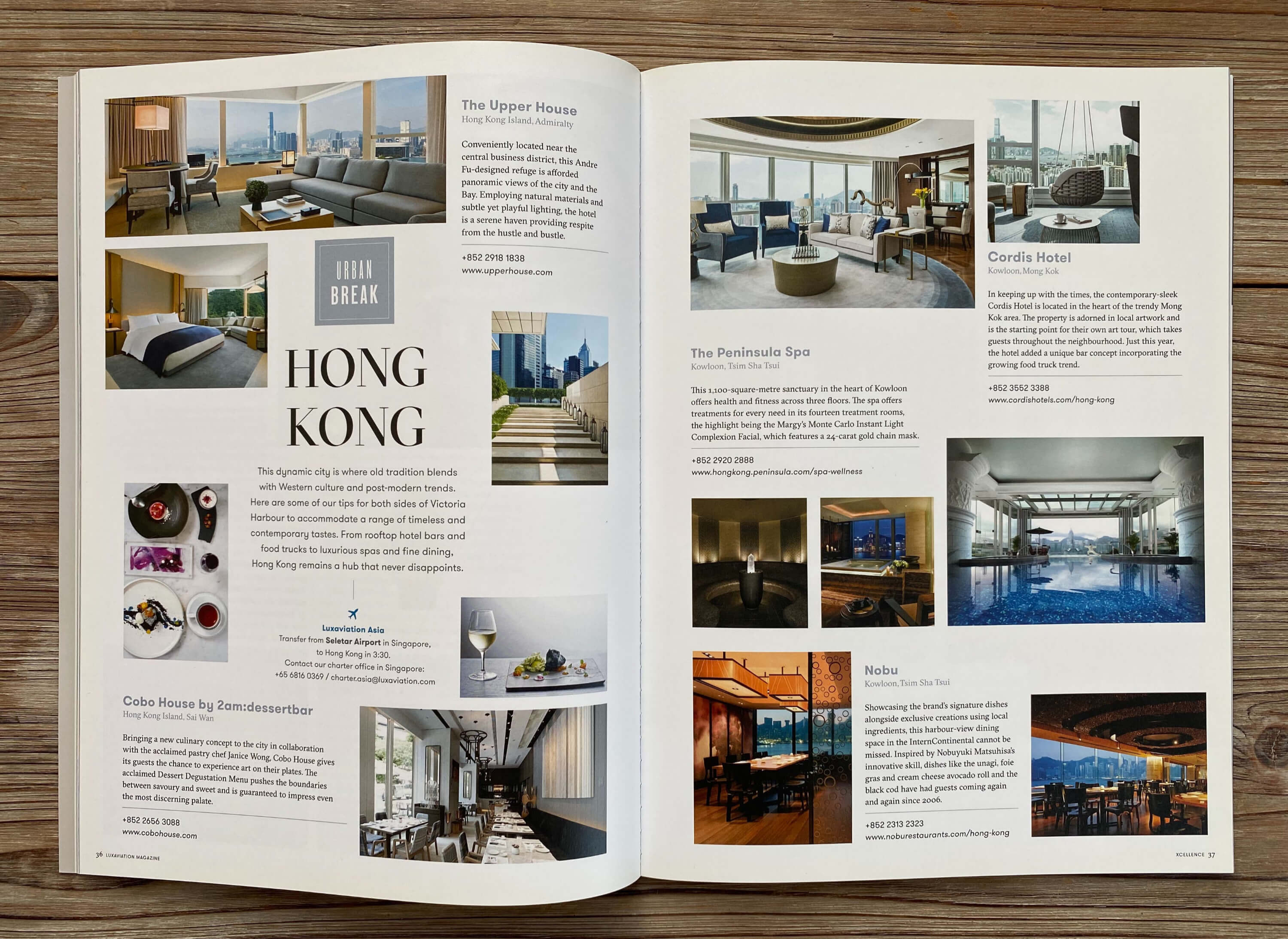
Pairing photography, layout, and copy with intention creates pacing, a rhythm the reader feels page to page, not just a set of pretty pictures around text blocks. A dense, text-heavy spread followed by a single full-bleed photograph gives the reader room to breathe. A quick sequence of short captions moves them forward quickly. That rhythm is a design decision made in service of the story, and it’s the difference between flipping through something and actually reading it.
Brochures don’t have pacing because they don’t need it, every page carries the same density of features and claims. A magazine or coffee-table book earns attention across sixty or a hundred pages by varying it deliberately.
What Role Does Editorial Curation Play in Creating a Keepsake, Not Just a Brochure?
Curation is mostly the discipline of leaving things out, deciding which photo, quote, or feature doesn’t make the cut matters as much as what does. A brochure tends to include everything the company wants to say about itself. A magazine has an editorial spine: a throughline, a point of view, a structure a reader can follow from the opening feature to the close. That spine is what lets someone skip the in-house design team and software templates and instead get a publication with a reason to exist beyond the logo on the cover.
Real editorial judgment shows up first in the cover story. A strong opening feature, one built around a person, a place, or a tension worth resolving rather than a product description, sets the tone for every page that follows. Readers decide within the first spread whether a publication is worth their time; that decision rarely survives a weak opener [2]. Premium print marketing in general works because it holds attention in ways saturated digital channels increasingly can’t [4], but only if the editorial craft underneath the design is doing real work.
How Do Format, Materials, and Production Choices Affect the Final Product?
Binding, paper, trim size, and finishing decide whether a publication feels like a keepsake or like something that gets recycled with the junk mail. Each choice carries a cost and a message, and the right combination depends entirely on how the piece will be used.
What Are the Differences Between Hardcover, Paperback, and Specialty Binding Options?
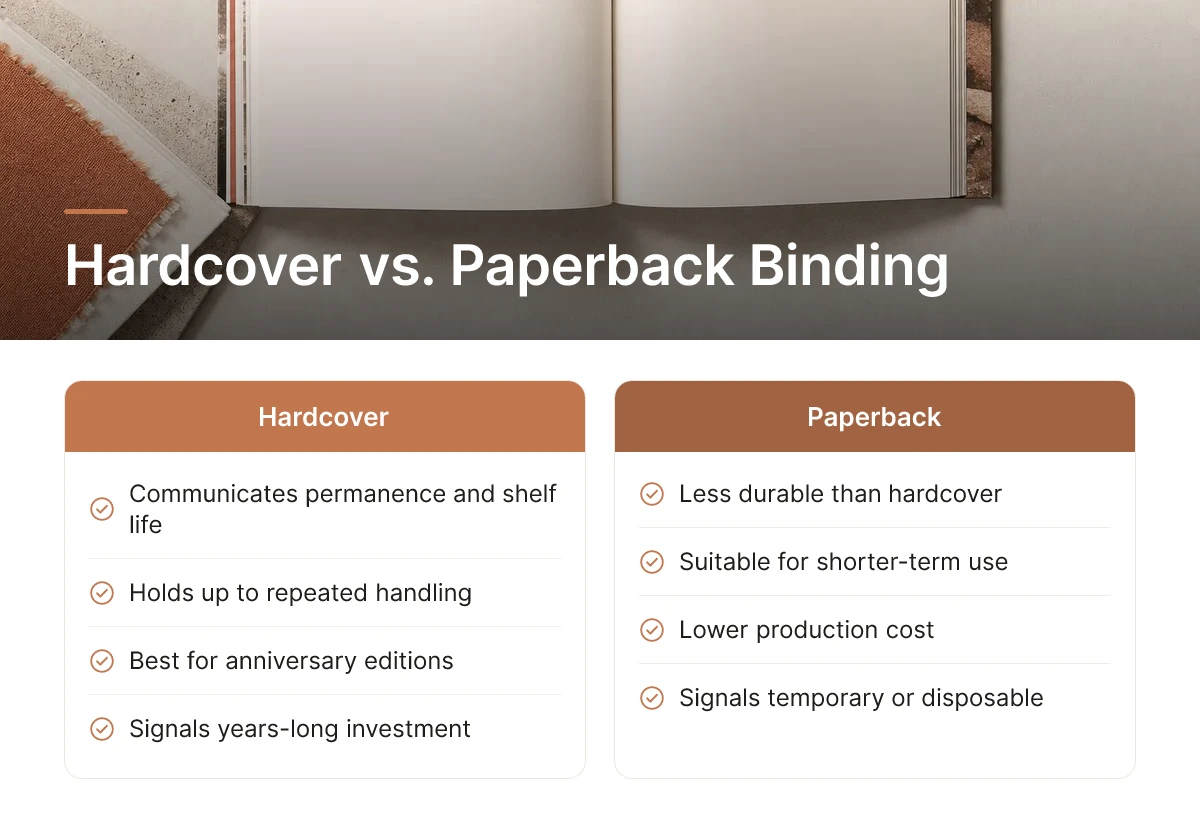
Hardcover communicates permanence. It signals that a brand expects the piece to sit on a shelf or coffee table for years, not weeks, and it holds up to repeated handling far better than softer formats. This is the default choice for anniversary editions, flagship property launches, or anything meant to outlast a single marketing cycle.
Paperback and saddle-stitched formats suit a different job. They work well for seasonal lookbooks, event programs, or quarterly brand magazines where the content has a shorter shelf life and a lower per-unit investment makes more sense across a larger print run.
Specialty binding sits above both. Swiss binding, where the cover is glued only at the spine, letting pages lie flat, adds a tactile, workshop-made quality that readers notice immediately. Slipcases push further, turning the object into something closer to a presentation piece than a magazine, appropriate for a limited run gifted to top clients or investors rather than mailed at scale. Custom book printing services that offer this range let a brand match the binding to the moment rather than defaulting to whatever the printer stocks.
How Do Paper Quality, Finishing Techniques, and Trim Size Influence Perception and Longevity?
Paper stock changes how photography and typography actually read. Coated gloss stock makes color photography pop and suits fashion, architecture, or hospitality imagery where saturation matters. Uncoated or matte stock mutes glare and gives text a quieter, more literary feel, often the better choice for a brand that wants to read as considered rather than flashy.
Finishing techniques carry their own signals. Foil stamping and embossing read as heritage and craft; spot UV coating on a cover reads as modern and deliberate, drawing the eye to a logo or image without shouting. Deckled edges, the rough, untrimmed page edge, borrow a printmaking tradition and suggest something handmade rather than mass-produced.
Trim size matters just as much as material. A large-format book reads as coffee-table-worthy and commands physical space in a lobby or living room; a smaller, more compact trim feels personal and travels well, suited to something a client might carry rather than display. None of these choices need to sit at the premium end by default, budget-friendly, mid-range, and premium tiers all exist within custom book printing services, and the right tier depends on whether the piece needs to circulate widely or make an impression on a handful of decision-makers [5].
When Is Custom Book Printing the Right Investment for Your Brand?
Custom book printing services make sense when a company has a real story, a client base that notices craft, and a long enough horizon to let a physical asset do its work over years, not weeks.
Honestly? Not every company should commission one. If your brand changes positioning every quarter, or your growth depends entirely on performance ads and conversion funnels, a printed magazine will sit on a shelf unread and unjustified. Saying that plainly is more useful to you than pretending every business needs a coffee-table book. The companies that get real value are the ones with something worth saying slowly, a point of view, a body of work, a client relationship that benefits from depth rather than another email.
What Industries and Use Cases Benefit Most From a Custom Printed Publication?
The obvious candidates are hospitality, luxury real estate, and private clubs, industries built on ambiance and trust, where a guest or buyer already expects a tactile, considered experience. Design and architecture firms fit the same pattern: their work is visual, and a printed piece lets it breathe in a way a website gallery can’t.
The less obvious candidates matter just as much. Law firms use custom publications to put complex expertise into a format clients actually read cover to cover, rather than skimming a PDF. Cybersecurity firms, not an industry anyone associates with print, have used it to humanize a technical offering for boards and executives who trust a well-argued print feature more than another slide deck. Professional services and private equity firms use it the same way: as a credibility document that outlives the meeting it was handed out in.
How Do You Measure the Return on a Print Publication as a Long-Term Brand Asset?
Skip invented metrics and watch what actually happens around the piece instead. Does it change the tone of a client retention conversation. Does your sales team request more copies as leave-behinds because prospects respond to it. Does it sit on a coffee table for months instead of getting recycled after one read, the way most printed materials do [2].
Those are qualitative signals, but they’re the ones that matter, print’s return shows up in relationship depth and time spent with the material, not a click-through rate. Treat the investment the way you’d treat brand-building generally: continuous and cumulative rather than campaign-based [3]. A single well-made issue, produced through full-service custom book printing services that cover strategy, writing, design, and production, tends to outperform a rushed one made to hit a quarterly budget line.
Frequently Asked Questions
Is a custom printed magazine just a glorified brochure?
No, a magazine has an editorial spine; a brochure has a sales pitch. A brochure describes a product or service in service of a transaction. A magazine tells stories, about clients, craftsmanship, ideas, that build trust before any pitch happens. That distinction is why readers keep one and bin the other.
How long does it take to produce a custom printed publication from start to finish?
Most fully managed projects take several months from strategy to delivery, not weeks. The timeline covers editorial planning, writing, image sourcing or photography, design, print production, and shipping. Rushing any one stage, especially editorial direction, tends to show up in the finished product.
Can a small or mid-sized company justify a custom printed magazine, or is it only for large brands?
Size matters less than client relationships and brand perception, if those drive revenue, a magazine can justify itself at mid-size too. A boutique hospitality group or a single-location law firm with high-value clients often has more to gain than a large, anonymous brand. The honest question isn’t company size, it’s whether the brand depends on trust and taste to win business.
How often should a brand publish a new issue or edition?
Annually or biennially works for most brands, frequency matters less than consistency and editorial quality each time. A magazine rushed out twice a year with thin content does less for a brand than one well-made issue every 18 months. Treat it like a flagship event, not a newsletter.
What’s the difference between print-on-demand and a true custom publishing project?
Print-on-demand is a production method; custom publishing is an editorial process that happens to end in print. On-demand platforms let anyone upload a file and print a short run [4]. A custom publishing project like the ones Rethink Publishing manages starts with strategy and writing, long before a single page reaches the press.
Conclusion
A custom printed magazine earns its place on a coffee table through editorial discipline, not budget size, the strategy, the writing, and the pairing of words and images matter more than the print run. Treat frequency as a feature, not a constraint: one well-made issue beats four rushed ones. And remember the line that matters most, a magazine is a brand artifact your clients keep, not a brochure they discard.
If you’re weighing whether this fits your brand, start by drafting the editorial spine for a single issue before committing to a production partner.
Sources & References
- Print Magazines for Content Marketing: Pros, Cons, Brand Examples and Best Practices, TopRank® Marketing
- The importance of consistent brand advertising, Fundamental Group
- The Ultimate Print Marketing Guide
- Booklet Printing Communicates Confidently With Consumers
Recommended Articles
Explore more from our content library: