
Understanding private club members magazine is essential. A private club launches a members magazine by treating it as a brand asset, not a newsletter: define an editorial spine tied to club identity, secure buy-in from the board and GM, then partner with a team that handles strategy, editorial, design and print under one roof. Clubs that get this right use the magazine to deepen belonging among existing members and signal quality to prospective ones, something an email digest or noticeboard can’t replicate. The real work is in the editorial plan and production discipline, not the printing itself.

Decide Whether Your Club Needs a Private Club Members Magazine
Honestly? Not every club needs a private club members magazine, and the clubs that benefit most are rarely the ones chasing a trend.
Some clubs are better served by a sharp monthly bulletin and an active events calendar. Others have outgrown that format entirely, and the gap shows up in member surveys, renewal conversations, and a GM who can’t put a finger on why engagement is slipping. Before any discussion of design or print specs, a board needs to answer a plainer question: does this club have enough identity, scale, and ambition to justify a publication, or would that budget do more good elsewhere?
Generic Club Publication vs. a Strategically Designed Magazine
A bulletin reports what happened last month; a magazine builds the reason members stay for the next ten years. The distinction isn’t cosmetic. A newsletter lists the wine dinner date and reminds members about the pro shop sale, useful, disposable, forgotten by the following week. A strategically designed magazine has an editorial spine: recurring sections on the club’s history, member profiles that make the place feel like a community rather than a facility, and a visual identity that matches the quality of the clubhouse itself. One is overhead. The other is a brand asset members keep on a side table and hand to a prospective member considering whether to join.
How a Members Magazine Shapes Retention and Perception
A well-made magazine works because it signals the club invests in its members with the same care it invests in its greens, its dining room, and its service staff. Members notice when a club spends on things they can see and touch. Print has an advantage digital can’t match here, dwell time on a physical piece runs into tens of minutes rather than seconds, and it gets read in a relaxed, undistracted setting a club’s email newsletter never reaches [1]. That sustained attention is where perception shifts: the club stops feeling transactional and starts feeling like something worth belonging to.
Three signs suggest a club is ready. First, a culture distinct enough to be worth articulating, a strong founding story, a design philosophy, a membership with shared values beyond the amenities. Second, a member base large enough that people no longer know each other personally, where a magazine does the social connecting that used to happen organically at the bar. Third, a board that wants a tangible legacy piece, something that outlasts a single GM’s tenure or a single marketing campaign.
On cost, be honest with the board: this is a long-term brand investment, not a line item measured against a single quarter. Budget-friendly approaches exist, but clubs that treat it as premium positioning, closer to how they’d budget a clubhouse renovation than a mailer, tend to get a publication members actually keep.
Define the Editorial Strategy Before You Design Anything
Set the editorial spine, voice, and content mix first, layout decisions made before that are just decoration with no structure to hold them up.
Skip this step and you get what most clubs already have: a newsletter that reads differently every quarter because nobody agreed on what the publication is actually for. A private club members magazine earns its place on the coffee table only when members can recognize it issue after issue, same rhythm, same sections, same editorial personality, different content.
Building an Editorial Spine That Matches Your Club’s Identity
An editorial spine is simply the set of recurring sections and throughline that make issue six feel like the same publication as issue one, even though none of the stories repeat. Think of it as the skeleton: a chairman’s or GM’s letter, a members-in-focus column, a culture or lifestyle feature, a facilities or strategy update. The topics change every quarter; the architecture doesn’t.
Clubs that skip this step tend to produce something closer to an internal bulletin than a magazine, and members notice the difference immediately, even if they can’t name why. The spine is also what makes production sustainable. Editorial committees that start from a blank page every issue burn out fast, which is a documented pattern: most member magazines falter between issue four and six, precisely when the initial launch energy fades and nobody has a repeatable structure to fall back on [2].
Balancing Member Interests With Club Messaging
The content mix should run roughly two-thirds member-driven and one-third club messaging, profiles, achievements, and event recaps carry the issue, while facility updates and strategy notes get placed, not paraded. A magazine that leads every section with the club’s own news reads as a brochure, and members treat brochures the way they treat junk mail: a glance, then the recycling bin [1].
A workable mix for a quarterly issue: two or three member spotlights, one chairman’s or GM’s letter, one longer feature on club history or a notable member achievement, a lifestyle or culture piece unrelated to club operations, and a recap of the past quarter’s signature events. The variety matters because it gives different members a reason to open each issue, the golfer who skips the wine feature still reads the member spotlight on a fellow committee chair.
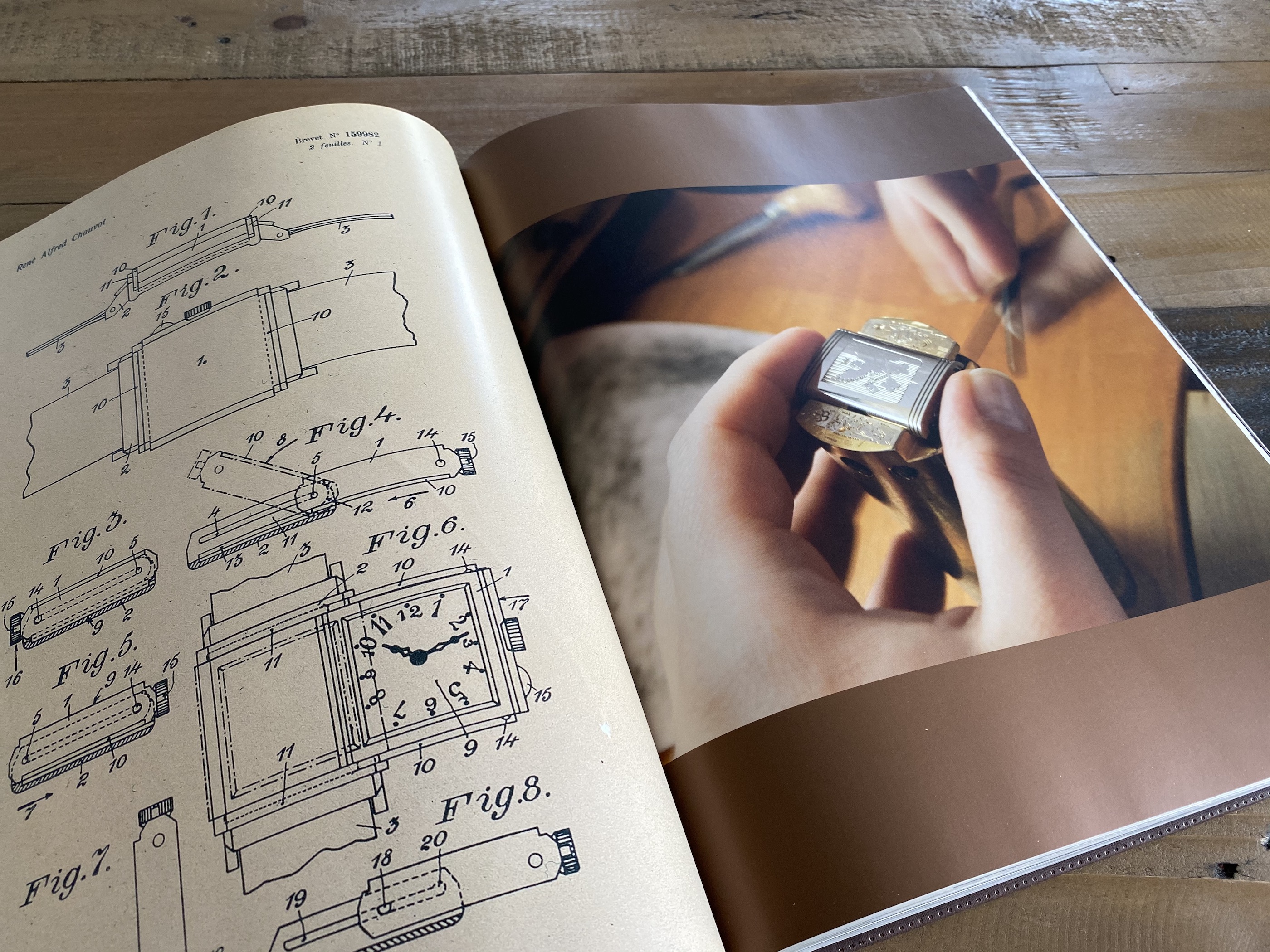
None of this holds together without production quality that matches the editorial ambition. Paper stock, photography, and typesetting are not finishing touches, they’re the signal members use to judge whether the club takes itself seriously. A magazine printed on stock that feels thin, with photography that looks like a phone snapshot, undercuts even strong writing. This is where Rethink Publishing’s end-to-end model, editorial direction paired with design-led layout and production management, keeps the spine and the craft moving together, rather than treating design as an afterthought bolted onto whatever copy came in late.

Design the Magazine to Reflect the Club’s Brand
A member opens the cover before reading a single word, so trim size, paper weight, and page count communicate the club’s standing before the editorial does any work at all.
A heavier stock, a larger trim, a spine thick enough to sit upright on a shelf, these physical details tell a member whether the publication is a quick newsletter or an object worth keeping. Clubs that treat a private club members magazine as a throwaway handout tend to choose the cheapest format available, and members read that choice correctly. The format is a positioning statement, made before the table of contents.
Photograph the club’s own people and spaces
Stock imagery is the fastest way to make a members-only publication feel generic. A photo of the actual clubhouse at golden hour, the actual chef plating in the actual kitchen, the actual members at the actual anniversary dinner, that specificity is what separates an editorial product from a brochure. Commissioned photography costs more up front than a stock subscription, but it is the difference members notice first and complain about if it is missing.
Pace the layout so the magazine gets read, not just flipped
Typography and layout rhythm decide whether a member actually finishes an article or abandons it on page two. A long profile on a founding member deserves generous white space, a slower type size, and few interruptions, the kind of pacing that rewards a reader who has settled in with coffee [1]. A quick-hit page of event photos or committee updates should move fast, dense, and scannable. Mixing those paces deliberately is what keeps a 60-page issue from feeling like a slog or a scroll.
Extend the crest into the printed page
A club’s crest, color palette, and typefaces should not live in one system for the website and another for print, the magazine is where that visual identity gets its fullest expression. Rethink Publishing builds the design direction around a club’s existing identity rather than introducing a separate brand system, so the printed piece reads as an extension of the club, not a vendor’s template.
Produce and Deliver the Magazine End-to-End
A private club members magazine moves through six stages, strategy, commissioning, design, proofing, print, and distribution, and the fewer hands touching those handoffs, the faster and cleaner the issue comes together.
Here’s the realistic sequence a board should expect to see mapped out before a single page is drafted:
- Strategy and planning: confirm the editorial calendar, section lineup, and which member stories or club milestones anchor the issue.
- Content commissioning: assign writers, schedule interviews with members or staff, and gather photography or request new shoots.
- Design and layout: pair copy with images inside a template that reflects the club’s identity, not a generic newsletter grid.
- Proofing rounds: at least two structured passes, one for content accuracy, one for final design and print specs.
- Print production: paper stock selection, color calibration, and a press check to confirm the physical copy matches the proof.
- Distribution logistics: mailing list preparation or clubhouse delivery, timed to arrive before the next event or board meeting references it.
Split that sequence across a freelance writer, a separate graphic designer, and an outside print shop, and the gaps show up fast. The writer delivers copy without knowing the final page count, so the designer cuts or stretches text to fit. The printer flags a color or bleed issue the designer never tested for, pushing the mailing date past the event it was meant to promote. Nobody owns the delay, because no single person owned the whole process, accountability sits in the space between three separate invoices.
Who Should Handle Strategy, Editorial, Design, Print and Distribution
One partner carrying the publication from first concept through mailbox or clubhouse table removes the handoff risk entirely. Rethink Publishing runs it this way: strategy, writing, layout, image rights, printing, quality control, and delivery sit under one team, so a missed deadline has one accountable party, not three pointing at each other. For a club’s marketing director or general manager, that means one point of contact instead of a rotating cast of vendors to chase.
What a Transparent Production Process Looks Like
A board doesn’t need visibility into every design revision, it needs a timeline it can trust. That means a published production calendar with named milestones, a defined proof sign-off stage where the editorial committee reviews and approves before anything goes to press, and a single contact who can answer a status question without “checking with the printer.” Clubs that lose confidence in a members magazine program usually lose it here, at the ambiguous middle, not at the idea stage [2].
Distribution deserves a decision early, not after the files are print-ready. Mailing to members’ homes extends the dwell time the format is built for, read on a couch, not scanned in a lobby [1]. Placing copies in the clubhouse works for visibility and guest impressions but misses members who visit infrequently. Many clubs do both, but the choice changes paper stock, print quantity, and budget, which is exactly why it belongs in the planning stage, not a last-minute scramble after the issue is already at the printer.
Avoid These Common Mistakes When Launching a Members Magazine
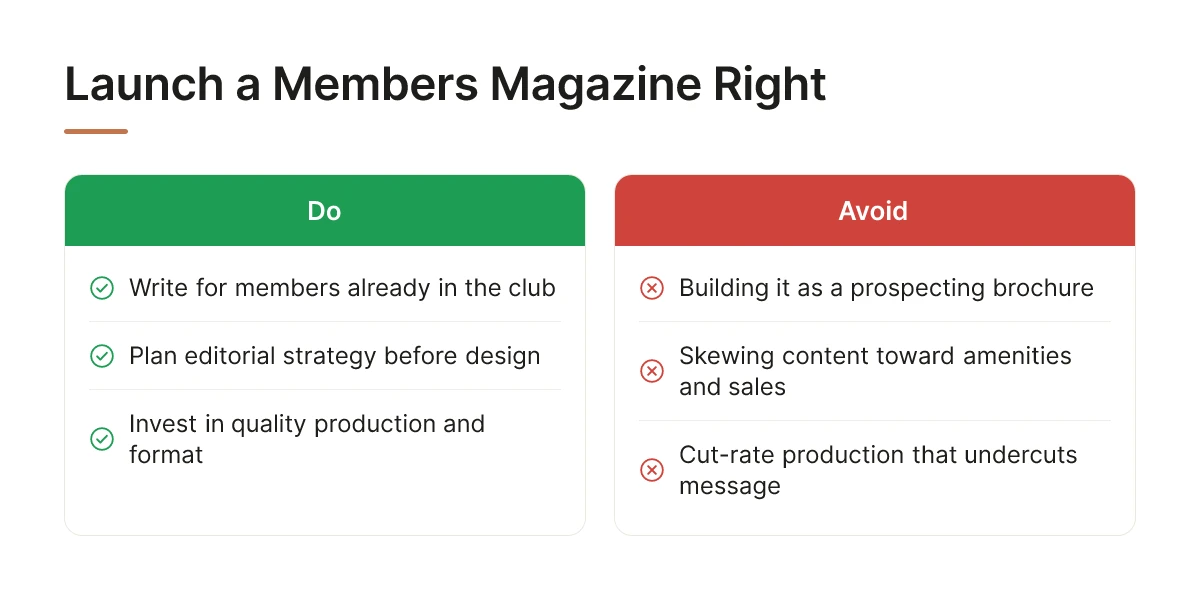
Most launches fail for the same handful of reasons: the wrong audience, no editorial plan, and cut-rate production that undercuts the message. Each one is avoidable if you spot it before issue one goes to print.
The most common error is building a private club members magazine as if it were a prospecting brochure. Boards often want to impress prospective members, so the content skews toward amenities, square footage, and initiation pitches. But the primary reader is already a member. They don’t need to be sold the club, they need to feel seen by it. A magazine that reads like a sales sheet gets skimmed once and shelved; one that profiles the member who restored the 9th hole’s irrigation system or the chef’s family recipe gets read cover to cover.
The second mistake is skipping the editorial plan entirely. Clubs that produce issue-by-issue, scrambling each quarter for enough content to fill the page count, watch the magazine thin out fast, a pattern consistent with what happens industry-wide, where most member magazines falter between issue four and issue six once the launch energy fades and no one owns the pipeline [2]. A defined editorial spine, recurring departments, a content calendar, clear sourcing from committees and staff, is what keeps issue twelve as strong as issue one.
The third mistake is cheaper paper and lighter cover stock to trim the invoice. This is the most self-defeating cut a club can make, because the entire premise of print is that it signals permanence and craft. A magazine that feels flimsy tells the member the club’s standards are negotiable, the opposite of the message the publication exists to send.
Print-Only or Print-Plus-Digital?
Print and digital should coexist, not compete, a digital flipbook or web excerpt extends reach to members who travel or prefer screens, without replacing the physical copy members actually keep. Pairing formats also gives the club a shareable link for recruitment or alumni outreach while the print edition does its real job at home. That job is sustained, undistracted attention a phone notification can’t interrupt [1].
Print endures as a brand asset for one simple reason: it isn’t deleted, archived, or scrolled past the way an email newsletter or social post is. It sits on a coffee table for months, gets picked up again, and gets shown to a guest. Rethink Publishing builds that durability in from the start, editorial direction, design, print production, and delivery handled end-to-end, so the finished magazine holds up exactly as sturdily as the standards it represents.
Frequently Asked Questions
How often should a private club publish its members magazine?
Most clubs do best with two to four issues a year rather than attempting a monthly schedule. A quarterly rhythm gives the editorial team enough lead time to source member profiles, event recaps, and seasonal content without the program collapsing under its own deadlines, a common failure point between issue four and six [2].
Can a small or mid-sized club justify a custom magazine?
Yes, if the club has enough member stories and events to fill an issue without padding. The deciding factor isn’t size, it’s whether the content plan can sustain quality past the launch issue, since that’s where most member magazine programs quietly stop [2].
Should club staff write the content, or should it be commissioned?
Commissioning editorial work almost always produces a stronger result than relying on internal staff alone. Club marketing directors are skilled at member communications, but a magazine needs editorial framing, writing, and design pulled together on a production schedule, exactly the gap a studio like Rethink Publishing, led by Nathalie Grolimund with 20+ years in print publishing, is built to close.
How long does it take to launch a first issue?
Plan on a 90 to 120 day pre-launch sprint before the first issue reaches members [2]. That window covers aligning the board on editorial vision, confirming the content plan, and allowing enough production time for writing, layout, and print, rushing it is what produces a thin, unconvincing debut issue.
Conclusion
A members magazine earns its place in the budget when it’s treated as an editorial product, not a newsletter with a cover. Set a sustainable frequency before launch, commission the editorial work rather than stretching internal staff, and protect the 90-to-120-day runway a strong first issue requires [2]. Clubs that skip these steps tend to lose momentum by issue four. Clubs that don’t are the ones members keep on the coffee table. Start by drafting a one-page editorial brief for your first issue, then review it against your board’s actual goals before committing to a production partner.
Sources & References
- Member Magazine Playbook 2026 | Private Club Marketing
- Launching a Member Magazine | Private Club Marketing
Recommended Articles
Explore more from our content library: