
| Key Insight | Explanation |
|---|---|
| Keepsakes outlast campaigns | A physical brand publication stays in a client’s home or office for months or years, far beyond the lifespan of any digital ad or email. |
| Editorial quality is non-negotiable | A poorly designed keepsake damages brand perception. The physical object must match the brand’s positioning in every detail. |
| Print readership remains strong | 81% of US affluent consumers read print publications, and 74% of millennials still read print magazines, making print a viable premium channel. |
| Strategy precedes design | The most effective keepsake marketing starts with a clear editorial spine — a defined content strategy — before a single layout is created. |
| Keepsakes serve existing relationships | Brand keepsakes are most powerful for deepening trust with current clients, not generating cold leads. They’re retention tools first. |
| Print works best as part of a broader strategy | A brand magazine or coffee table book is most effective as the flagship piece in a wider brand strategy, feeding digital, social, and PR channels. |
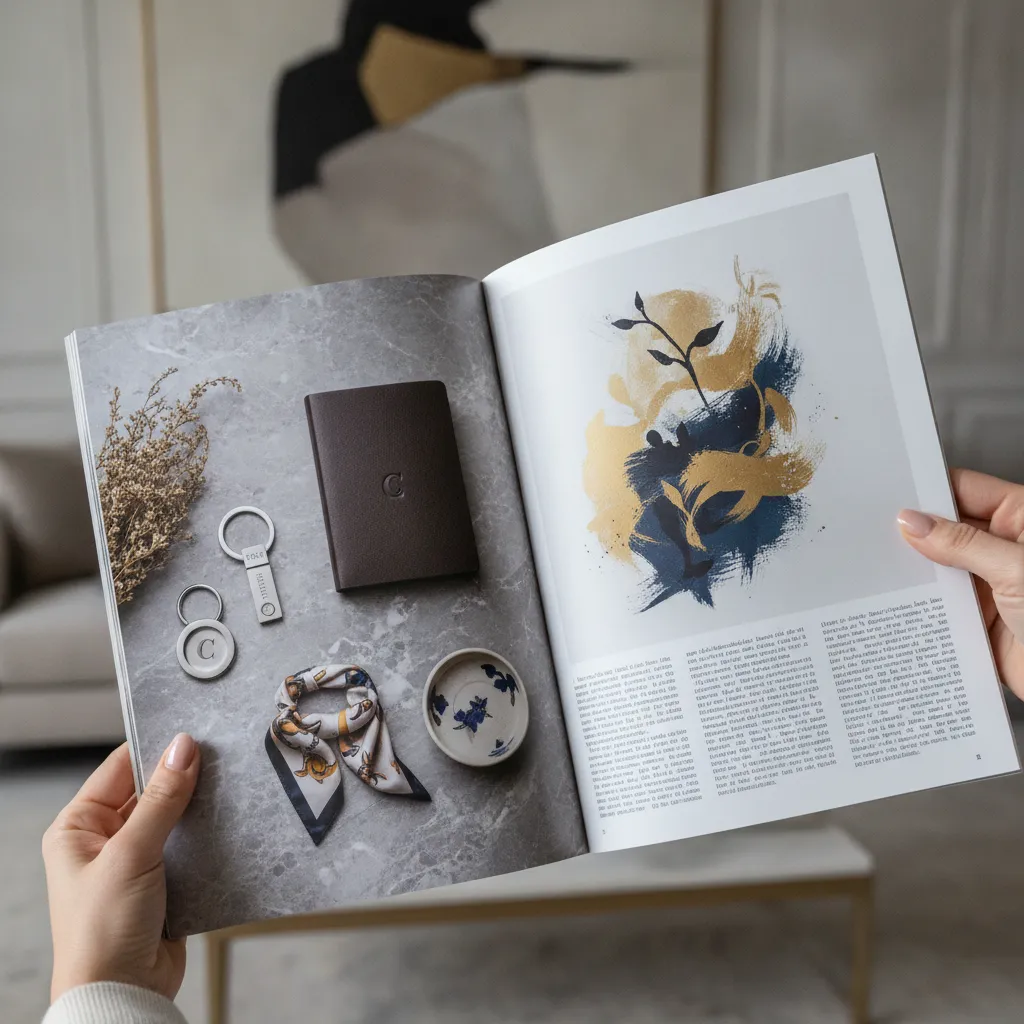
A brand keepsake marketing strategy is the deliberate use of high-quality physical objects — most powerfully, editorially curated print publications — to build lasting brand presence, deepen client relationships, and create emotional connection that digital media simply cannot replicate. The core principle is permanence. Unlike a social post that disappears in 48 hours or an email that gets archived, a keepsake stays. It sits on a coffee table, gets passed between colleagues, and keeps your brand present in someone’s world for months or years after it was first received.
This article covers what a brand keepsake strategy actually involves, how it works in practice, why it delivers outsized returns for premium brands, and what separates the publications people keep from the ones that end up in recycling.

What Is a Brand Keepsake Marketing Strategy?
A brand keepsake marketing strategy is a long-term approach to brand building that centers on creating physical objects of genuine quality — publications, books, or curated print pieces — that clients choose to keep, display, and return to over time.
Defining the Keepsake in a Marketing Context
The word “keepsake” is precise. It describes something kept not out of obligation, but because it has perceived value. In marketing terms, a keepsake is any brand-produced object that earns a place in someone’s home or office on its own merits. It doesn’t get thrown away. It doesn’t get filed. It stays visible.
The American Marketing Association noted in 2026 that tangible marketing works best when it is thoughtful, and that a poorly designed keepsake can undermine brand perception just as quickly as a great one can reinforce it [1]. That’s the standard. The object must be genuinely worth keeping.
For premium brands, the most powerful keepsake format is the custom print magazine or coffee table book. These are editorial products — not brochures, not promotional catalogs — that carry a brand’s voice, values, and stories in a format that reads like a real publication. According to brand communication strategist Jigyasa Laroiya, “brand communication must be for the keepsake. Unlike a timed campaign, it should be for the long run” [2].
Who Uses This Strategy?
Brands that invest in keepsake marketing tend to share certain characteristics:
- They serve affluent, relationship-driven clients who value quality over speed
- They have a strong visual identity and something genuinely worth saying
- They think in years, not quarters, when it comes to brand building
- They operate in sectors where trust and perception are the primary currency
In practice, this includes luxury hospitality groups, real estate developers, private members’ clubs, law firms, architecture studios, and design-forward technology companies. These are businesses where a single client relationship can be worth millions over a decade, and where the quality of every brand touchpoint matters.
The University of Illinois’s enrollment marketing plan explicitly lists keepsake materials — quality printed pieces — as a mechanism for building brand awareness and encouraging meaningful action [3]. Even in higher education, the principle holds: physical quality signals institutional quality.
How Brand Keepsake Marketing Works
Brand keepsake marketing works by replacing disposable brand touchpoints with objects of lasting value, creating a physical presence for your brand in the spaces where your clients actually live and work.
The Editorial Spine: Strategy Before Design
The process begins long before any design work. Effective keepsake marketing starts with what publishing professionals call an editorial spine — a defined content strategy that answers three questions:
- What does this publication stand for? Not what the company sells, but what it believes, observes, and contributes to its industry or world.
- Who is the reader, specifically? Not a demographic, but a real person with particular interests, pressures, and aesthetic sensibilities.
- What will make this person keep it? What content, design, or stories will earn a place on their shelf rather than in the bin?
Once those questions are answered, the editorial plan follows: story selection, interview subjects, photography direction, feature length, tone of voice. Design comes after that. This sequence — strategy, editorial, design, production — is what separates publications that feel like real magazines from ones that feel like expensive brochures.
Production, Distribution, and the Long Game
The physical production of a keepsake publication involves decisions that directly affect perception. Paper weight and texture, binding method, typography, white space, and image quality all communicate something about the brand before a single word is read. Event Marketer’s analysis of the “keepsake long game” in experiential marketing confirms that the post-event keepsake is now “a well-crafted campaign born from the on-site hero moment” [4] — the physical object extends the brand experience far beyond the initial encounter.
Distribution for premium keepsake publications is typically direct and intentional:
- Delivered personally to key clients and prospects
- Placed in waiting areas, hotel rooms, or club lounges where the target audience spends time
- Used as a leave-behind after significant meetings or events
- Sent as a welcome gift to new clients or members
- Presented at industry events as a credibility marker
Experiential marketing firm Sweeter notes that putting something physical in someone’s hands builds “ownership and memory” in a way that digital touchpoints don’t [5]. That’s the mechanism. The keepsake creates a physical anchor for the brand in the client’s environment.
Key Benefits: Why Keepsake Marketing Matters in 2026
The core benefit of a brand keepsake marketing strategy is longevity. A physical publication that earns a place in someone’s home keeps the brand present and visible for far longer than any digital channel can achieve.
Measurable Advantages Over Digital Channels
Digital marketing has a permanence problem. Paid ads stop the moment the budget stops. Social content has an average lifespan measured in hours. Email open rates in most industries sit below 25%, and even opened emails are rarely revisited. A quality print publication operates on a fundamentally different timeline.
Consider the data:
- 81% of US affluent consumers read print publications, making it a direct channel to the highest-value demographic
- Ultra-affluent readers consume 22% more print titles than the average reader
- 74% of millennials read print magazines, challenging the assumption that print is only for older audiences
- Print has a documented “pass-along” effect: a single copy of a publication is typically read by multiple people
The American Marketing Association’s 2026 analysis of brand presence identifies tangible marketing as one of marketing’s most overlooked advantages, noting that physical objects create brand presence in environments where digital simply cannot reach [1].
Trust, Perception, and Retention
There’s a psychological dimension to keepsake marketing that’s worth being direct about. Receiving a beautifully produced publication signals that the brand behind it is serious, established, and willing to invest in quality. It’s a proxy for how the brand treats its work more broadly.
Brands that have turned gifting and physical touchpoints into a core marketing strategy consistently report stronger client retention and higher-quality referrals [6]. The logic is simple: when a client keeps your publication on their coffee table, your brand is present in every conversation that happens in that room.
| Channel | Average Lifespan | Typical Audience Reach | Brand Perception Signal |
|---|---|---|---|
| Social media post | 24–48 hours | Followers (algorithm-dependent) | Low to medium |
| Email newsletter | Minutes to hours | Subscribers (open-rate dependent) | Low to medium |
| Branded brochure | Days (often discarded) | Direct recipients only | Medium |
| Premium brand magazine | Months to years | Recipients + pass-along readers | High |
| Coffee table book | Years (often indefinite) | Recipients + visitors + referrals | Very high |
Pro Tip: Think of a brand magazine as a long-duration media placement, not a one-time production cost. A single issue placed in 500 homes has a media lifespan measured in years, not weeks. Calculate your cost-per-impression over 24 months and the economics look very different.
Common Mistakes That Undermine Keepsake Marketing
The most common failure in keepsake marketing is producing something that looks like a marketing brochure with extra pages — a publication that signals cost rather than value, and gets discarded rather than kept.
Confusing a Keepsake with a Catalog
A catalog is organized around what the company sells. A keepsake is organized around what the reader finds interesting, beautiful, or useful. These are fundamentally different editorial philosophies, and readers feel the difference immediately.
One pitfall to watch for: brands that fill their publication with product descriptions, pricing information, or promotional copy. That’s a catalog. A genuine keepsake publication covers topics the reader cares about — stories, ideas, people, places — with the brand’s perspective woven through naturally. The sell is implicit, not explicit.
Packaging and brand communications consultant research confirms that how a brand presents itself physically has direct impact on perceived quality [7]. A publication that looks and reads like a real magazine communicates something very different from one that looks like an expensive flyer.
Underinvesting in Editorial Quality
A second common mistake is treating the writing and editorial direction as secondary to design. In practice, design without editorial substance produces beautiful objects that have nothing to say. Readers notice. They flip through once and set it aside.
Common editorial mistakes include:
- Writing that sounds like press releases rather than genuine stories
- Featuring only company news, with no external perspective or insight
- Ignoring the reader’s actual interests in favor of what the company wants to communicate
- Inconsistent tone across articles, signaling that multiple uncoordinated hands were involved
- Failing to commission original photography, relying instead on generic stock imagery
At Rethink Publishing, we’ve found that the publications clients keep longest are the ones where the editorial content would be interesting even if you removed the brand name entirely. That’s the test. If the stories only make sense in a promotional context, they won’t earn a place on anyone’s shelf.
Pro Tip: Before finalizing your publication’s content plan, apply the “stranger test.” Would someone who has never heard of your brand find this genuinely interesting to read? If the honest answer is no, revise the editorial approach before touching the design.
Best Practices for a Brand Keepsake Marketing Strategy
The most effective brand keepsake marketing strategy combines a clear editorial purpose, uncompromising production quality, and intentional distribution to the right people at the right moments.
Building the Editorial Foundation
Start with the reader, not the brand. Define exactly who you’re producing this for — not a demographic profile, but a real description of the person’s life, interests, and aesthetic sensibilities. Then build an editorial plan around what that person would genuinely want to read.
A practical framework for editorial planning:
- Define the publication’s point of view. What angle does your brand bring to its industry that no one else can? That’s your editorial voice.
- Map content categories. Typically: a flagship feature, two or three shorter stories, an interview, a visual essay, and one piece that’s purely reader-serving (practical insight, beautiful photography, or cultural reference).
- Commission original content. Assign writers and photographers with genuine craft. Don’t rely on internal teams unless they have real editorial experience.
- Design with intention. Every layout decision — white space, type size, image placement — should serve the reader’s experience, not the brand’s ego.
- Print at a quality level that matches your brand positioning. Paper weight, binding, and finishing details are not optional extras. They’re the product.
Distribution and Timing
A keepsake publication delivered at the wrong moment or to the wrong person is still a missed opportunity. Strategic distribution matters as much as production quality.
- Use new client onboarding as a distribution moment — it sets the tone for the relationship immediately
- Place publications in physical spaces where your audience spends time: club lounges, hotel lobbies, waiting rooms
- Align issue timing with significant brand moments: property launches, anniversaries, major events
- Treat the publication as a conversation starter, not a leave-behind — brief your team on how to introduce it
Fashion brand marketing analysis for 2026 notes that retention-focused strategies — keeping existing clients engaged and loyal — are delivering stronger returns than acquisition-focused campaigns [8]. A keepsake publication is a retention tool first. It deepens existing relationships before it creates new ones.
Pro Tip: Don’t produce a keepsake publication as a standalone project. Build it as the flagship piece of a broader content strategy. Photograph the process, excerpt stories for social media, repurpose interviews for email, and use the publication’s visual identity to elevate every other brand touchpoint.
Our team at Rethink Publishing recommends thinking about the first issue as a proof of concept for a long-term publishing program. One issue demonstrates quality. A consistent series builds authority. The brands that get the most from keepsake marketing are the ones that commit to it as an ongoing discipline, not a one-time project.
Sources & References
- American Marketing Association, “Marketing’s Most Overlooked Advantage: Brand Presence,” 2026
- Jigyasa Laroiya, “Brand communication must be for the keepsake,” LinkedIn, 2026
- University of Illinois Enrollment Management, “2021 Marketing Plan,” 2020
- Event Marketer, “Experiential Marketing Trend of the Week: The Keepsake Long Game”
- Sweeter, “How To Create An Experiential Marketing Strategy in 4 Phases”
- Create Your Meta, “These 3 Brands Turned Gifting into an Effective Marketing Strategy”
- VistaPrint, “What Is Package Marketing?,” 2026
- The Fashion Business Coach, “The Best Fashion Brand Marketing Strategy for 2026,” 2026
Frequently Asked Questions
1. What exactly is a brand keepsake marketing strategy?
A brand keepsake marketing strategy is the deliberate creation and distribution of high-quality physical brand objects — most commonly print magazines or coffee table books — designed to stay in a client’s environment long-term. Unlike campaigns with defined end dates, keepsake marketing builds brand presence over months and years through objects that earn their place in someone’s home or office.
2. How is a brand magazine different from a brochure?
A brochure is organized around what a company sells. A brand magazine is organized around what the reader finds interesting — stories, ideas, interviews, and visuals that would be worth reading regardless of the brand behind them. The brand’s voice and values are present throughout, but they’re expressed editorially rather than promotionally. That’s what makes a magazine a keepsake and a brochure a piece of collateral.
3. Which industries benefit most from keepsake marketing?
Any industry where client relationships are long-term, high-value, and trust-dependent benefits from a brand keepsake marketing strategy. In practice, this includes luxury hospitality, real estate development, private members’ clubs, law firms, architecture and design studios, private aviation, and premium financial services. These are sectors where brand perception is a competitive differentiator and where a single client relationship can justify significant investment in quality touchpoints.
4. How often should a brand publish a keepsake magazine?
Most premium brand publications publish one to four issues per year. Annual or biannual publishing is common for brands that want a flagship presence without the production pressure of a quarterly schedule. The right frequency depends on how much genuinely interesting content the brand can generate, the budget available, and how the publication fits into the broader marketing calendar. Consistency matters more than frequency — one excellent annual issue outperforms three mediocre quarterly ones.
5. What makes a brand publication worth keeping?
Several factors determine whether a publication earns a permanent place in someone’s environment: genuinely interesting editorial content that isn’t purely promotional, photography of real quality, design that creates visual calm rather than visual noise, paper and binding that feel premium to the touch, and a consistent point of view that makes the publication feel like a real editorial product. The American Marketing Association notes that a poorly designed keepsake can undermine brand perception just as quickly as a great one can reinforce it.
6. Is print really still effective in 2026?
Yes, particularly for premium brands targeting affluent audiences. 81% of US affluent consumers read print publications, and 74% of millennials still read print magazines. The global custom publishing market was valued at approximately $2.8 billion in recent years and continues to grow among luxury brands specifically because digital saturation has made physical scarcity a strategic asset. Print isn’t declining for premium brands — it’s becoming more valuable as a differentiator.
7. Can a small or mid-sized company use a brand keepsake marketing strategy?
Yes, with the right scope. A boutique law firm, a single luxury property, or a regional architecture studio can produce a publication that serves 200 to 500 key relationships extremely effectively. The investment scales with the print run and production complexity, not with company size. What matters is whether the brand has something genuinely worth saying and relationships valuable enough to justify the investment in quality. Results may vary depending on industry, audience, and editorial execution.
8. Does a brand need an in-house editorial team to produce a magazine?
No. Most companies that produce premium brand publications work with a specialist publishing studio that manages the entire process end-to-end: editorial strategy, writing, design, photography, production, and delivery. This is the most reliable way to achieve genuine editorial quality, because it brings experienced publishing professionals to the project rather than asking marketing or communications teams to develop skills that take years to build.
Conclusion
A brand keepsake marketing strategy is, at its core, a decision about what kind of presence you want your brand to have in the world. Digital channels are fast, measurable, and necessary. But they don’t stay. They don’t sit on a client’s desk for six months. They don’t get passed to a colleague with a note that says “you should read this.”
The brands that invest in quality print publications understand something that’s easy to miss in a metrics-driven environment: the most valuable brand touchpoints are the ones that earn attention rather than demand it. A beautifully produced magazine does that. It gives your audience a reason to slow down and actually engage with what your brand has to say.
This isn’t the right strategy for every company. If you need fast conversions, there are better tools. But if you’re building a brand for the long term — one that your clients trust, admire, and talk about — a brand keepsake marketing strategy delivers something no digital campaign can: a physical object that keeps your brand present and valued in someone’s world, long after the first impression.
Rethink Publishing has spent over 20 years producing exactly these kinds of publications — 80+ high-end magazines and 30+ coffee table books — for clients across hospitality, real estate, architecture, law, and beyond. The process is managed entirely from strategy to delivery, so the brands we work with get a world-class publication without managing a single production step themselves. If you’re considering what a keepsake publication could do for your brand, visit www.rethink-publishing.com to learn more.
Recommended Articles
Explore more from our content library: