
Understanding magazine design pricing is essential. The investment required for a high-end custom magazine is shaped by five factors: editorial strategy and curation, page count and production complexity, print quality and paper stock, whether you’re designing one issue or an ongoing publication, and the level of end-to-end production support you need. Strategy and editorial planning typically carry as much weight as design execution itself, because a magazine without a clear editorial spine costs more to fix later than to plan properly up front. Print is a long-term brand asset, not a one-off marketing expense, and the investment should be weighed against how long the piece stays in someone’s hands. Building that kind of lasting brand presence is closely tied to the broader concept of brand equity, which is ultimately what magazine design pricing decisions are meant to protect.
What Actually Determines Magazine Design Pricing for a High-End Custom Magazine?
Magazine design pricing moves with four compounding factors, page count, print quality, production complexity, and the depth of editorial work behind the pages, not a single rate card. Treat any of these in isolation and the number you land on will be wrong.
- Page count: more pages mean more material and layout work, but the real cost jump comes from what fills them
- Print quality and paper stock: coated versus uncoated, weight, and finish all shift the production tier
- Production complexity: foil stamping, gatefolds, tipped-in inserts, and specialty binding each add their own setup requirements
- Editorial depth: original reporting, commissioned photography, and a defined narrative arc take more upfront work than filler content
How Do Page Count, Print Quality, and Production Complexity Affect What You’ll Invest?
Page count and print quality don’t add together, they multiply. Doubling your page count on the same budget-friendly stock is a straightforward material cost increase. Doubling the page count and moving to a heavier stock with foil stamping, spot gloss, or a gatefold spread changes the press setup, the binding method, and often the printer you need to run the job at all.
A 48-page magazine on uncoated matte stock with perfect binding is a mid-range production decision. Push that same magazine to 96 pages with a dust jacket, tipped-in inserts, and a Smyth-sewn binding, and you’ve shifted into premium territory, not because the page count tripled, but because each added finish forces a different set of production requirements. This is why two magazines with similar page counts can land in entirely different investment tiers once finishes and binding enter the conversation. For a broader breakdown of where these costs typically originate, this publisher’s budget guide covers the production side in more detail.
Why Do Hospitality, Real Estate, and Luxury Brand Magazines Cost Differently Than Standard Publications?
A hospitality or luxury real estate magazine costs differently because it’s built to sit on a coffee table for years, not to be read once and recycled. That changes the brief before a single page is designed. A standard trade publication is often disposable by design, quarterly, text-heavy, printed to a budget that assumes a short shelf life. A luxury hospitality or real estate magazine is built to be kept, which means the photography has to hold up at full-page bleed, the paper has to feel substantial in hand, and the editorial has to read like a magazine a guest would buy at a newsstand, not a brochure disguised as content. This is the same logic that underpins luxury marketing strategy more broadly, where perceived value is built through consistent craftsmanship rather than volume.
Longer shelf life raises the bar on every input: original photography instead of stock, color-accurate printing, and paper stock that won’t yellow or feel flimsy a year after delivery. None of this shows up as a line item labeled “luxury tax”, it shows up as higher production values driven by a longer intended lifespan.
Design Is One Line Item, Not the Whole Bill
Layout design is the most visible part of a magazine project, which is why it’s often mistaken for the whole cost. In practice, design execution sits alongside editorial strategy, writing, photography sourcing or commissioning, image licensing, and print production coordination. Rethink Publishing structures each project around an editorial spine first, defining what the publication is actually for, because skipping that step tends to cost more in redesign later than it would have cost to plan properly from the start.
How Does Editorial Strategy Shape Magazine Design and Overall Cost?
Editorial strategy is the single biggest lever in magazine design pricing, it determines whether design dollars build something coherent or get spent twice fixing what should have been settled upfront.
What’s the Relationship Between a Clear Editorial Spine and the Design Work That Follows?
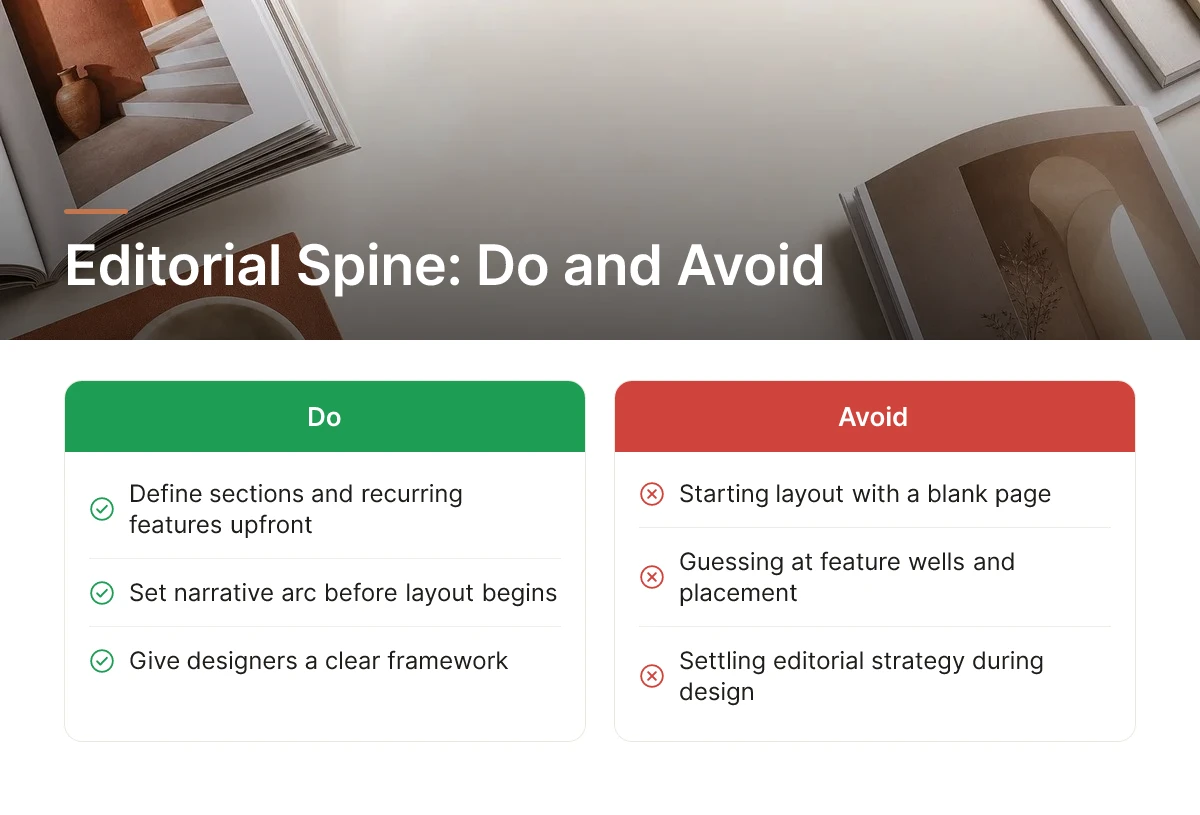
A defined editorial spine, the sections, recurring features, and narrative arc that hold an issue together, gives a design team a framework to work within rather than a blank page to guess at. When the spine is set before layout begins, designers know how many feature wells to build, where profiles sit against shorter departments, and how imagery needs to be sourced to match the story. That structure is what keeps revision cycles short.
Compare two paths. In the first, a client defines the editorial concept, the themes, the voice, the mix of long-form and short-form content, before a single page is laid out. Design moves fast because every decision has a home. In the second, design starts while content direction is still being debated internally. Layouts get built, then rebuilt, once someone decides the magazine actually needs a different structure. That late-stage churn is where budgets quietly balloon, not because design got more expensive, but because it got repeated.
How Much of the Investment Goes Into Strategy and Curation Versus Design Execution?
For a publication done properly, a meaningful share of the investment sits upstream of layout entirely, concept development, content planning, image sourcing and rights clearance, and the editorial judgment calls that decide what a magazine is actually about. Design execution matters, but it works efficiently only when that groundwork is already in place. Treating strategy as a line item to skip, rather than the foundation design sits on, is the most common way companies overspend on the wrong stage.
This is also where the brand distinction matters most. A magazine with real editorial integrity reads like a publication someone chose to keep; a glorified brochure reads like a sales piece with nicer typography, and it rarely earns the read-through, let alone the coffee-table life, that justifies the investment. Rethink Publishing builds the editorial spine first, for exactly this reason, before design or production begins. This approach mirrors how strong global luxury brands are built, where strategy and positioning come before execution, not after.
One-Time Magazine Project or Ongoing Brand Asset: What Changes the Scope?
A single issue and a recurring publication are two different investments, and magazine design pricing should reflect which one you’re actually building. One is a project with a start and end date. The other is infrastructure.
Should You Think of Magazine Design as a Single Expense or a Long-Term Brand Investment?
Treating a magazine as a one-off expense misses where the real value accumulates. The editorial spine, the photography relationships, the design language, all of it takes real work to establish in issue one, and that work doesn’t disappear once the issue ships. It becomes the foundation for issue two, three, and twenty.
A brochure gets read once and recycled. A magazine that readers actually keep gets picked back up, on a coffee table, in a waiting room, on a shelf next to other things the reader values. Each time that happens, the brand impression compounds rather than resets. That’s a fundamentally different return profile than a digital ad that disappears from a feed within a day, and it’s the reason comparing magazine costs against a single social campaign undersells what print actually does over a multi-year relationship with a client or prospect.
How Does Designing for Multiple Issues Change the Scope and Structure of the Work?
Designing one issue and designing a publishing program are different disciplines. A single issue can be built around a bespoke layout chosen for that specific content. An ongoing title needs templates that flex across dozens of future stories, a style guide that keeps voice and visual identity consistent when different writers and photographers touch the work, and a contributor network that can be called on reliably issue after issue rather than assembled from scratch each time.
That systems-building front-loads certain costs into the early issues. Once templates, sourcing relationships, and editorial processes exist, later issues in a program typically draw on that groundwork rather than rebuilding it, which is why per-issue investment tends to shift as a publishing program matures, even though the publication itself keeps getting better. This is the structural reason Rethink Publishing scopes single-issue projects differently from multi-issue programs: the deliverable looks similar on the surface, but the underlying work, and what it sets up for the next issue, is not the same at all.
How Do You Know If a Magazine Will Actually Work as a Marketing Tool?
A magazine works as a marketing tool if someone keeps it after the first read, that’s the entire test, and it’s measurable before you spend a dollar on production.
What Makes a Magazine Feel Like a Keepsake Instead of Something That Gets Recycled?
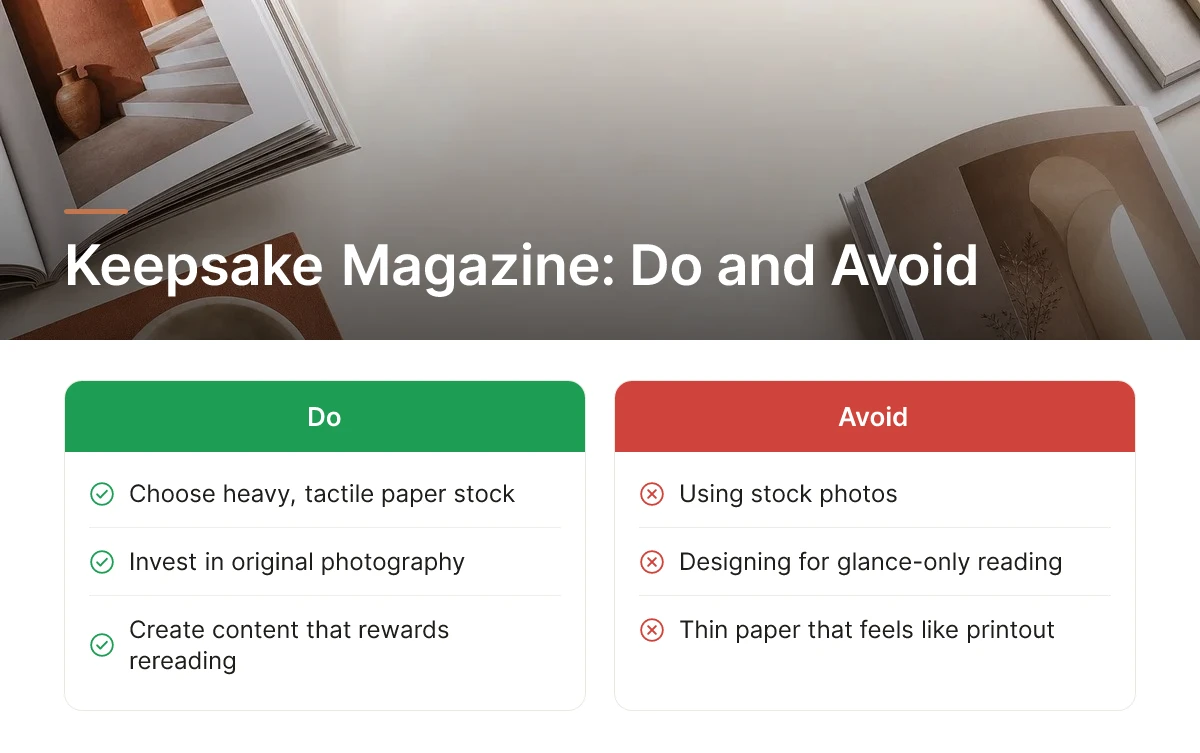
Keepsake quality comes from three decisions made before a single page is laid out: paper stock, photography, and whether the content rewards a second visit. A heavy, tactile paper signals permanence the moment someone picks it up, it feels like an object, not a printout. Photography that holds up under a slower, closer look (not just a glance) gives the reader a reason to flip back. And editorial content with actual substance, a story, not a sales pitch, is what separates a magazine from a brochure with a spine.
This is where magazine design pricing decisions matter most. Cutting corners on stock or commissioning stock photography instead of custom shoots is usually invisible in a proof but obvious on a coffee table. The editorial spine has to be strong enough to survive a second reading, because the first reading is what gets the magazine kept; the second is what gets it remembered.
How Should Brand Perception and Audience Retention Factor Into the Decision?
Attention duration is the practical measure of marketing value here, a scrolled impression lasts seconds, while a printed piece sitting on a desk or table earns minutes, sometimes repeatedly. A prospect who spends unhurried time with a well-made publication forms a different impression of the brand behind it than one who swipes past a sponsored post. That shift in perception is the return on the investment, even though it doesn’t show up as a click-through rate.
A magazine also extends reach in a way most digital assets don’t. A piece that gets displayed in a reception area or passed to a colleague reaches people who were never on the original mailing list, something a PDF buried in an inbox rarely achieves.
None of that justifies the investment for every company. If there’s no distinct audience who’d value receiving it, or no recurring story worth telling issue after issue, a magazine is the wrong tool, save the budget and say so honestly before committing to magazine design pricing conversations at all.
What Should You Budget for When Creating a Premium Magazine?
Magazine design pricing covers only one line item in a much longer list, the real budget has to account for photography, print production, binding, distribution, and revisions before you see a finished copy in hand.
What Costs Beyond Design Should You Account For, Photography, Printing, Distribution, Revisions?
- Photography and image sourcing: original or carefully licensed imagery, since stock photos read as corporate and undercut the premium feel
- Print production and paper selection: stock weight, coating, trim size, and color fidelity, all of which affect how the object feels in hand
- Binding and finishing: perfect binding, saddle stitching, embossed covers, and matte versus gloss finishes, each with different durability outcomes
- Distribution logistics: mailing to a curated client list, stocking a lobby, or shipping to a conference, all of which require fulfillment planning
- Revision rounds: structured editorial and design feedback cycles, where unplanned revisions are where budgets quietly expand
Photography and image sourcing come first. A premium magazine needs original photography or carefully licensed imagery, stock photos read as corporate, and corporate is the opposite of what a coffee-table-worthy publication is supposed to feel like.
Print production and paper selection come next, and the choices compound. Stock weight, coating, trim size, and color fidelity all affect how the final object feels in someone’s hands, and feel is the entire point of a physical brand asset.
Binding and finishing decide whether the magazine survives a year on a coffee table or gets tossed after one read. Perfect binding, saddle stitching, embossed covers, and matte versus gloss finishes each carry different production timelines and different durability outcomes.
Distribution logistics matter more than most executives expect going in, mailing to a curated client list, stocking a lobby, or shipping to a conference requires fulfillment planning most marketing teams have never had to do for a physical product.
Revision rounds round out the list. Editorial and design work both need structured feedback cycles, and unplanned revisions are where budgets quietly expand.
How Do You Work With a Studio That Handles Everything End-to-End Versus Piecing Together Vendors?
Fragmented vendor coordination is where most hidden costs originate. A separate photographer, a separate printer, and a separate distribution partner each hand off work at a different stage, and each handoff is a place where files get mismatched, timelines slip, and someone has to redo work that should have been right the first time.
A single studio managing strategy, editorial, design, print, and delivery removes those handoff gaps by design, not by luck. There’s one point of accountability instead of four vendors pointing at each other when a deadline moves.
The tradeoff is real: assembling freelancers can look cheaper line by line, but it shifts coordination work onto the client’s team. An integrated model trades that coordination overhead for consistency, the same editorial voice and production standard from the first page to the last. This end-to-end approach is also how strong luxury brands maintain consistency across every touchpoint, print included.
Rethink Publishing has run this end-to-end model for 20+ years, producing 80+ magazines and 30+ coffee-table books under one roof. That track record is the practical answer to what you should budget for: not a design fee in isolation, but a single accountable process that covers the full life of the publication.

Frequently Asked Questions
Is a custom magazine worth the investment compared to a digital-only brand publication?
Yes, if the goal is a lasting relationship rather than a fleeting impression, print has a physical presence digital content cannot match. A social post disappears in a feed within hours; a well-made magazine sits on a coffee table for years, gets picked up repeatedly, and gets shown to other people. Physical media’s scarcity is now a strategic asset precisely because audiences are saturated with digital content. Digital still matters for reach, print wins on retention.
How long does a custom magazine project typically take from strategy to delivery?
Most fully managed magazine projects run several months from initial strategy to final delivery, not weeks. Editorial direction comes first, defining the spine, themes, and structure, followed by writing, design, image sourcing, print production, and quality control. Rushing any one of these stages is usually where quality erodes.
Does every company need a branded magazine?
No, not every company needs one, and pretending otherwise does a disservice to the brand. A magazine makes sense when the business has a visual identity worth preserving, a relationship-driven clientele, and a story that goes deeper than a product pitch. If none of that applies, that budget is better spent elsewhere.
What industries commission custom magazines or coffee table books?
Luxury hospitality, real estate, law firms, architecture and design firms, private clubs, and even cybersecurity companies have commissioned custom publications. Rethink Publishing has produced 80+ magazines and 30+ coffee-table books across hospitality and design sectors, proving the format works well beyond obviously “visual” industries.
How do you compare quotes from different studios when evaluating magazine design pricing?
Compare scope, not just the final number. Ask whether editorial strategy, photography, print production, and distribution are included or billed separately, since a lower headline figure often hides gaps your team will have to fill later. The most useful comparison weighs what’s actually included against the publication’s intended shelf life, not just the quoted total.
Conclusion
What a magazine costs matters less than what it’s for. The real decision points are scope, custom editorial versus templated content, ambition, and whether a studio handles the entire process end-to-end or leaves gaps for your team to fill. Treat the investment like brand equity, not a line item, and measure it in years of shelf life rather than weeks of ad impressions.
If you’re weighing whether this is the right year to commission one, start by asking what story your brand hasn’t told yet, then visit www.rethink-publishing.com to talk through whether that story deserves a spine, a cover, and a print run.
Recommended Articles
Explore more from our content library: