
A realistic magazine production timeline runs twelve to sixteen weeks from kickoff to delivery, though the editorial strategy phase before design begins deserves at least two to three of those weeks on its own. The sequence generally moves through editorial planning, content development, design and layout, pre-press, printing, and distribution, with printing and finishing alone needing two to four weeks depending on method and quantity. Rushing any single phase, especially editorial, tends to cost more time later in revisions than it saves upfront.
What Does a Realistic Magazine Production Timeline Look Like from Concept to Delivery?
A realistic magazine production timeline moves through six phases, and each one has a floor below which quality starts to break down visibly on the page.
Those six phases are editorial strategy and content development, design and layout, pre-press and proofing, printing, finishing, and delivery or distribution. None of them run in isolation. A delay in editorial pushes design later, a late design sign-off compresses pre-press, and a compressed pre-press phase is exactly where typos and color errors slip into a print run that can’t be undone once it’s on press. Mapping the full arc before you start is what keeps one slow week from becoming three.
How Much Time Should You Budget for Editorial Strategy and Content Development Before Design Begins?
Budget two to three weeks minimum for editorial strategy alone, and expect content development, the actual writing, interviews, and image sourcing, to run another four to eight weeks depending on scope [1].
This is the phase executives most often try to compress, and it’s the one that punishes compression hardest. Skipping a defined editorial spine means a designer is laying out pages without knowing what the issue is actually about, the throughline, the sequence of stories, the tone. That gets discovered halfway through layout, and fixing it means re-writing copy that’s already been placed, re-sourcing images that no longer fit, and re-approving pages a second time. Rethink Publishing builds the editorial spine before a single layout file opens, specifically because rework at the design stage costs far more time than planning does upfront.
What Are the Actual Lead Times for Print Production, and How Do They Vary by Print Method and Finishing?
Print and finishing typically need two to four weeks, with digital printing running faster and offset printing with specialty finishing running longer [1].
Digital printing suits smaller runs and shorter lead times because there’s no plate-making step. Offset printing produces sharper color and lower per-unit cost at volume, but it requires plates, longer press setup, and more calendar time before a single copy exists. Finishing choices compound this: perfect binding, saddle-stitching, uncoated versus coated stock, spot UV, or foil stamping each add their own production windows, and a print production schedule has to count backward from the print date to lock every one of these deadlines in advance [3].
Total timeline length ultimately depends on three variables working together: page count, print run size, and how many rounds of approval are built into the schedule. A 48-page quarterly with one proofing round moves faster than a 120-page annual with three stakeholder sign-offs, and both are legitimate, as long as the schedule accounts for the difference honestly.
A realistic timeline isn’t a constraint on quality, it’s what protects it. Every shortcut taken to hit an arbitrary date shows up later as a rushed layout, a missed proof correction, or a print run that has to be redone.
How Do Editorial, Design, and Printing Workflows Need to Coordinate to Stay on Schedule?
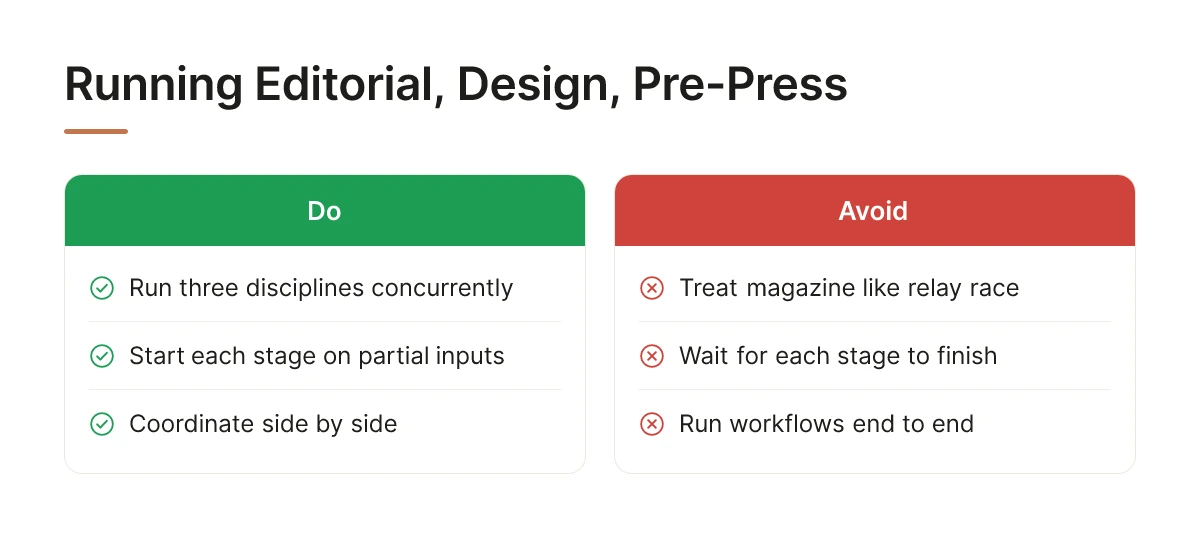
Editorial, design, and pre-press have to run side by side, not end to end, waiting for each stage to fully finish before the next begins is the single biggest reason magazine production timeline estimates blow past their deadlines.
Treating a magazine like a relay race, where the writer hands off to the designer who hands off to the printer, sounds orderly. In practice it adds weeks for no reason. Most experienced studios run these three disciplines concurrently, with each stage starting on partial inputs rather than finished ones.
How Can You Run Editorial, Design, and Pre-Press Work in Parallel Without Creating Bottlenecks?
Layout can begin on a feature’s structure and image placement before the final copy edit is locked, and a printer can confirm paper stock and press dates while proofs are still being reviewed. Content creation alone typically runs four to eight weeks depending on the volume and complexity of the pieces involved [1], so design work that waits for every word to be finalized before starting loses most of that window for nothing.
The two bottlenecks that derail this overlap are predictable. The first is design sitting idle because copy isn’t locked, writers still revising while a layout artist has nothing firm to build against. The second is the printer waiting on unresolved proofs, which is worse, because press time is booked and inflexible once a date is confirmed. A production schedule that counts backward from a fixed print date, with every department’s deadline set against that same anchor, is how publishers avoid both [3].
What Communication Checkpoints Matter Most to Keep a Magazine on Track?
Three checkpoints carry the weight of the entire schedule: content lock, design review, and proof sign-off. Content lock means editorial stops revising and design can commit to final layout. Design review is the moment the client and editorial team confirm the visual direction before it goes further. Proof sign-off is the last checkpoint before files leave for print, skip or rush it, and the next person to catch an error is the printer, which costs both time and money to fix.
A single point of coordination, one person or team who owns the master schedule, is what keeps these checkpoints from slipping past each other unnoticed. Without that owner, editorial assumes design has more time than it does, and design assumes editorial is further along than it is. At Rethink Publishing, this coordination sits with the editorial director managing each issue end to end, so a client never has to chase departments to find out where a piece stands.
Late content changes don’t cost the same at every stage. A rewrite during content creation costs almost nothing. The same rewrite after layout means re-flowing pages. After proofs are signed, it means a reprint.
One-Off Magazine Versus a Repeatable Annual or Quarterly Production Cycle: What Changes?
A standalone issue needs weeks of extra work up front to invent an editorial voice and design system, while a recurring title spends that time once and reuses it indefinitely.
Every magazine production timeline carries a hidden cost on the first issue: nothing exists yet. There’s no grid, no tone of voice, no roster of contributors who already understand the brand. Concept and planning alone can run two weeks to two months on a first issue [1], and that range sits at the high end precisely because a one-off has no prior decisions to borrow from. A brand producing a single anniversary publication or a launch piece has to build the editorial spine, the layout templates, and the approval chain from a blank page, then use them exactly once.
How Do Monthly, Quarterly, and Annual Magazine Schedules Differ in Planning and Execution?
Frequency changes almost everything about how a schedule is built. A monthly title works backward from a fixed print date with little room for drift, ad sales might close 24 days before print, editorial copy a few days after that, and layout starting roughly two weeks before files go to the printer [3]. That cadence only works with tight, repeatable workflows, because there’s no slack to absorb a late draft or a reshoot.
A quarterly schedule loosens that pressure somewhat, giving editorial and design teams more room to refine a feature before deadline. An annual publication, the format most common for a flagship brand magazine or coffee-table book, allows the deepest research, the most ambitious photography, and the most deliberate design choices per issue, because the entire production cycle isn’t competing with the next one already queued behind it.
Can You Build a Template-Based Workflow That Speeds Up Production for Repeat Issues?
Yes, a locked grid, a pre-approved style guide, and a set of recurring sections can cut real weeks off every issue after the first. Once a design system is approved, the layout team isn’t debating typography or column widths again; they’re dropping new content into a structure that already works. The same logic applies to contributor networks, printer specifications, and sign-off chains: a publisher who already knows which photographers, writers, and print partners deliver reliably doesn’t have to vet them again each cycle.
This is the real argument for investing properly in the first issue. A recurring cycle pays back that early effort many times over, which is part of why Rethink Publishing builds the editorial spine and design system before production starts on any client’s first issue, so issue two, three, and twelve move faster, not slower.
How Can You Compress Your Magazine Production Timeline Without Sacrificing Quality?
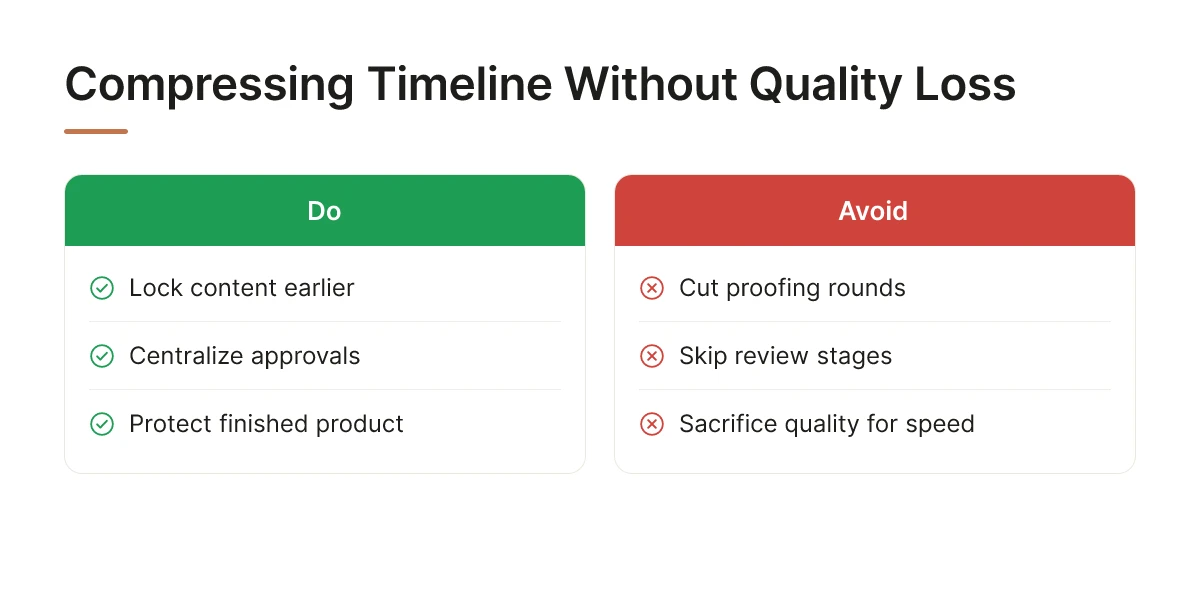
You compress a magazine production timeline by locking content earlier and centralizing approvals, not by cutting proofing or review rounds.
Those are two different moves with two different outcomes. One protects the finished product. The other produces a magazine with typos on the contents page and a cover line that doesn’t match the feature inside.
Where Do Most Magazine Projects Lose Time, and How Do You Protect Against Those Delays?
Four places account for almost every blown deadline we’ve seen in two decades of running these projects. An unclear editorial brief sends writers and designers in different directions, and the rework that follows costs more time than a clear brief would have taken to write in the first place. Late content from contributors, an executive who misses an interview slot, a property manager who can’t find the right photos, pushes every downstream stage back by the same number of days. Excessive revision rounds, often because stakeholders weren’t aligned before the first draft went out, can double a design timeline on their own. And slow client approvals, where a PDF sits in someone’s inbox for a week, are the single most common delay we encounter.
None of these are production problems. They’re coordination problems, and they get solved before design work ever starts, with a locked brief, a firm contributor deadline, and one named approver instead of a committee.
What Modern Tools and Systems Actually Help Reduce Production Time in Practice?
Digital asset management systems and shared online proofing platforms remove the biggest time sink in traditional production: feedback scattered across email threads. When five stakeholders mark up a PDF separately and email their notes, someone has to reconcile conflicting comments before design can even start revising. A shared proofing tool puts every comment on the same page, visible to everyone, with version history attached. A production schedule built around a fixed print date, the model RunMags describes, where every stage counts backward from a printer deadline [3], works precisely because it exposes conflicts early, before they become late-stage fire drills.
Setting a firm content lock date earlier in the process is the other real lever. Once writing, images, and approvals are frozen, design and print have the breathing room they need to do careful work instead of rushed work. This is the difference between a genuinely shorter timeline and a dangerously compressed one, the former moves deadlines earlier, the latter removes safety margin from the end. At Rethink Publishing, that distinction shapes how Nathalie Grolimund’s team structures every schedule: tighten coordination at the front, never the proofing at the back.
When Should You Handle Production In-House Versus Partnering with a Specialized Production Studio?
In-house works when you publish often enough to justify full-time editorial and design staff; a specialized partner works when quality and schedule certainty matter more than keeping every step under your own roof.
Building an in-house magazine operation means hiring or reassigning editorial staff, designers, and someone who understands print production and vendor management, not just one person wearing three hats during crunch weeks. You also need standing relationships with printers, paper suppliers, and possibly a photography network. None of this is cheap in practice, even when the org chart makes it look like a cost-saving move. The real expense shows up as time: internal teams juggling a magazine alongside other marketing work tend to slip deadlines, because the magazine is rarely anyone’s only job.
What Does End-to-End Production Partnership Actually Include, and How Does It Change Your Timeline?
A genuine end-to-end partnership covers strategy, editorial direction, design, print, and delivery under one coordinated schedule, not a relay race between separate vendors who each own one leg. Rethink Publishing, for example, runs strategy, writing, layout, image rights, printing, and quality control through a single accountable team, so a client never has to reconcile a copywriter’s timeline against a printer’s calendar. That structural difference is what actually protects a magazine production timeline: when one party owns every stage, there’s no handoff where a file sits in someone’s inbox for three days waiting for a status update.
Separate vendors create separate failure points. An agency that writes the content has no stake in whether the printer’s proof schedule slips [3]; a designer working independently of the editorial team may not know a content deadline moved until it’s too late to absorb the delay. Each handoff adds a buffer that compounds across a production cycle. A single accountable partner collapses those buffers because one team is tracking the whole schedule, not just their piece of it.
In-house makes sense for frequent, high-volume internal publications, employee newsletters, member bulletins, anything printed monthly where dedicated staff are already in place and the stakes of a late issue are low. A partner makes more sense for high-stakes brand publications: a flagship coffee-table book, an anniversary issue, a magazine meant to sit in a client’s home for years. Print remains a long-term brand investment, and a coordinated partner protects both the calendar and the quality of what eventually lands on that coffee table.
Frequently Asked Questions
How far in advance should a company start planning a custom magazine?
Start four to six months before you need the finished magazine in hand, longer if it’s tied to a launch date that can’t move. Concept and planning alone can take two weeks to two months [1], and that’s before writing, design, image sourcing, and printing begin. Companies that start early get a better editorial product and fewer rushed decisions.
Does a print and digital hybrid magazine take longer to produce than print alone?
Yes, usually by several weeks, because digital formatting and web optimization run as a separate track alongside print layout. The content itself, writing, photography, editorial direction, stays the same either way. The added time comes from adapting layouts for screens, testing digital files, and coordinating two delivery formats instead of one. Companies without a firm reason for a digital edition often skip it to protect the timeline.
What causes the biggest delays in magazine production?
Late or incomplete content from the client’s side causes most delays, followed by slow approval rounds and image rights issues. A production schedule only works if everyone hits the same dates, since each stage is counted backward from a fixed print date [3]. Missed deadlines early in the process push every later stage back.
Can a magazine production timeline be shortened for an urgent event or launch?
Yes, within limits, experienced production teams can compress planning and layout, but printing and proofing have hard floors. Rushing content creation usually shows in the final quality, so the smarter move is locking scope early and keeping approvals fast. A studio handling writing, design, and print under one roof can compress a schedule more safely than juggling separate vendors.
How many rounds of proofing should be built into a magazine schedule?
Build in at least two full proofing rounds before files go to the printer. One worked schedule shows proofs going out a week before print, with final sign-off days later [3], leaving no room for a third round without delaying the print date.
Conclusion
A magazine production timeline holds together when the print date is fixed first and every other deadline counts backward from it. Content delays and slow approvals cause more schedule damage than any production stage itself, so lock your editorial scope and review process before work begins. A hybrid digital edition adds real time, so include it only when it serves a clear purpose.
If you’re planning a flagship issue tied to a launch, anniversary, or fundraise, start the conversation now rather than four weeks before you need it in hand. Rethink Publishing manages the full timeline, strategy, editorial, design, print, and delivery, so the schedule stays yours to approve, not manage.
Sources & References
- Creating a magazine: how long does it take to produce?
- Free Magazine Production Schedule Template | RunMags
Recommended Articles
Explore more from our content library: