
A publication design process stays on time when editorial strategy, design, and production are managed as one connected workflow instead of separate handoffs. The biggest timeline risk isn’t design itself, it’s starting design before the editorial spine (the story, structure, and purpose of the issue) is locked. Projects that build in print-specific checkpoints early, paper stock, binding, color proofing, avoid the late-stage surprises that blow deadlines. A realistic high-end custom magazine timeline runs in clearly connected phases, not a single blurred sprint.
Establish the Editorial Spine Before the Publication Design Process Begins
Open a layout file before the story is locked, and every hour spent on design risks getting thrown out later. The editorial spine has to exist first, everything else in the publication design process builds on it.
Why a Publication Needs an Editorial Spine Before Design Starts
An editorial spine is the narrative thread running through the whole issue: what story it tells, in what order the sections appear, and what job each spread does in service of that story. It’s not a mood board and it’s not a table of contents filled in loosely. It’s a decision about what the magazine is about, made concretely enough that a designer can open a spread and know exactly what that page needs to accomplish.
Skip this step, and the rework shows up fast. A designer builds a 12-page layout around a feature interview, then the editorial team cuts the interview to six pages or swaps the lead subject entirely. The layout doesn’t flex, it breaks. Image crops no longer match copy length, pull-quotes disappear, and the designer rebuilds the spread from scratch. Multiply that across 80 or 100 pages and a two-week design phase quietly becomes four.
Design as a Final Step vs. Design Integrated From Day One
Treating design as something that happens after the writing is “done” assumes content never changes shape. It always does. Word counts shift, images get swapped for rights reasons, and section order gets reshuffled once the full issue is laid out side by side. When design sits downstream of editorial with no overlap, every one of those normal adjustments becomes a fire drill.
Integrating design from day one works differently. The designer sees the spine early, builds templates around the planned section structure, and flags layout constraints, image orientation, copy length limits, spread pacing, while the editorial team can still adjust. This is the model Rethink Publishing runs on: editorial direction comes first, and design decisions get made alongside it rather than handed off cold, which is part of why the studio has produced 80+ custom magazines without the late-stage scramble that blank-layout-first projects tend to hit.
That early coordination only works if the right people are actually in the room, the editorial lead, the designer, and someone from production who understands binding, paper stock, and print constraints. Decisions made in isolation at this stage get revisited, expensively, later.
Pair Editorial Vision and Design Execution Across Every Spread
Every spread moves back and forth between editorial and design until the two fit without compromise on either side. That back-and-forth is the real engine of the publication design process, not a single handoff from writer to designer.
How Words and Images Get Paired With Intention
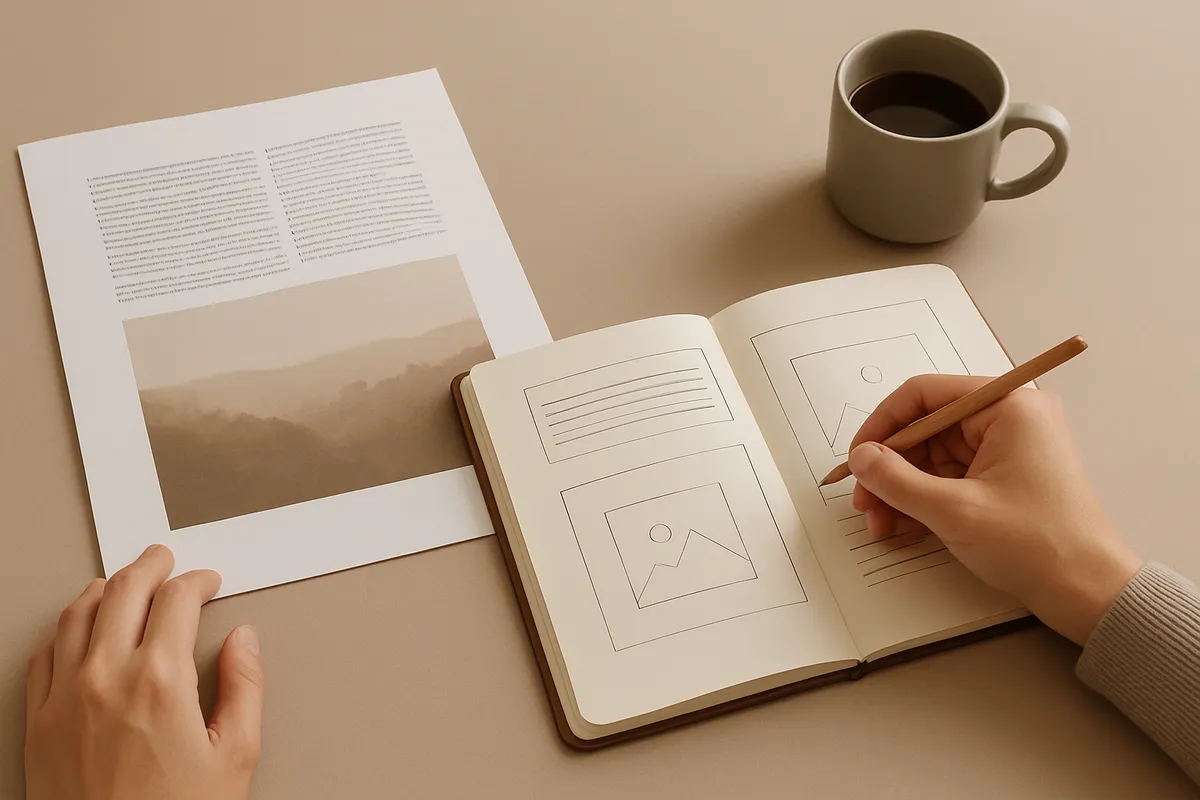
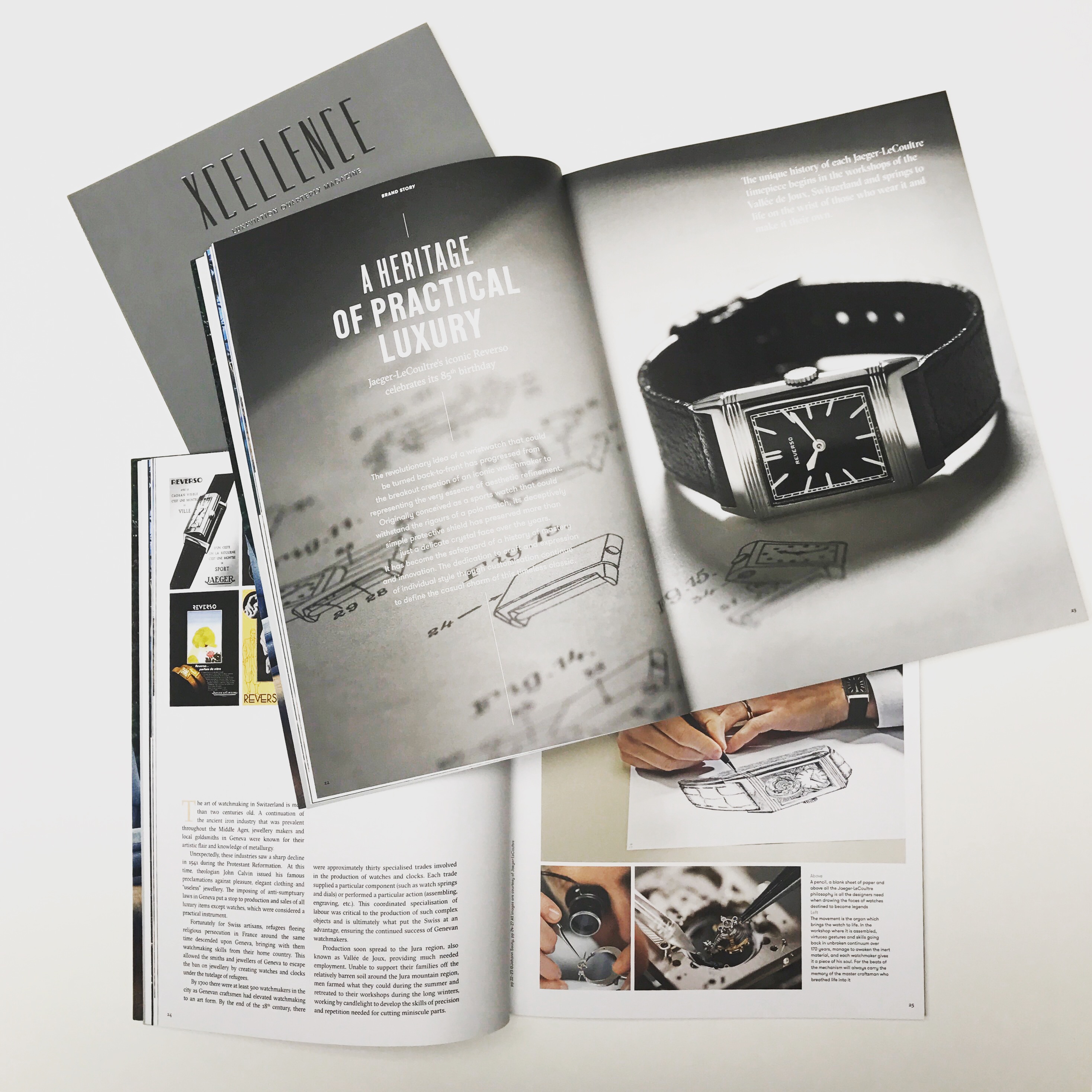
Editorial drafts a spread first: the story, the headline, the length it’s meant to run. Design then tests that draft on an actual page, real margins, real column widths, a real image slotted in rather than a placeholder box. If the story feels cramped or the photo fights the headline for attention, the draft goes back to editorial with specific notes, not vague feedback.
This loop can run two or three times per spread before anything locks. A graphic designer’s workflow typically moves through brief, concept, and revision stages before sign-off [5], and a print magazine spread is no exception, it just adds the constraint of a fixed physical page that can’t be scrolled or resized.
What Happens When Editorial and Design Priorities Conflict
Conflicts are routine, not exceptional. A photographer delivers one striking vertical image for a spread designed as a horizontal two-page layout. A profile piece that reads well at 1,200 words gets filed at 1,800, and the layout grid only has room for 1,400.
Neither problem gets solved by a vote. Someone with authority over both the editorial spine and the visual system makes the call, crop the photo tighter and let white space carry the page, or cut the story to its strongest 1,400 words and hold the rest for a pull quote. Design and editorial teams that rely on committee approval at every spread tend to lose time to exactly this kind of decision point, with revisions and unclear ownership cited among the most common causes of delay in design workflows generally [5]. Rethink Publishing runs this stage under one point of accountability per issue, so a conflict between a photo and a grid gets resolved in a day, not relitigated at the next status call.
Brand voice and visual identity get checked spread by spread, not just on the cover. A law firm’s magazine needs the same restrained tone on page 40 as it has on page 1; a hospitality brand’s visual warmth can’t disappear once the feature well ends. That consistency check is part of what keeps a 60-page issue feeling like one publication instead of a stitched-together collection of articles.
Map the Critical Phases of the Publication Design Process
A sound publication design process runs through six connected phases: strategy and editorial planning, content gathering, design and layout, proofing and print preparation, print production, and delivery. Skip a handoff between any two, and the whole timeline absorbs the damage.
Each phase feeds the next with a specific output, not a vague intention. Strategy produces the editorial spine, the themes, sections, and narrative arc the issue will follow. Content gathering turns that spine into actual interviews, photography, and copy. Design and layout pair those assets with intentional pagination. Proofing catches errors before they’re locked into plates. Print production turns approved files into physical units. Delivery gets the finished magazine into hands, client offices, hotel lobbies, coffee tables.
How a Custom Magazine Workflow Differs From a General Design Project
A general design project usually starts from one static brief; a custom magazine depends on a chain of moving content pieces that arrive on different schedules.
A logo redesign or a brochure layout begins with a brief, some reference material, and a fixed set of deliverables. A magazine issue begins with a brief too, but the content that fills it, executive interviews, on-location photography, contributed essays, sourced images, gets produced in parallel with design work, not before it. Graphic design frameworks tend to treat research and concept development as early, self-contained stages before production begins [3]. Magazine publishing can’t fully separate those stages because content gathering and layout run concurrently and depend on each other. A delayed interview delays the spread built around it. A reshoot pushes back the section it anchors. Editorial workflow systems exist specifically because publishing teams juggle content creation, review, and approval simultaneously rather than in strict sequence [1].
Why Transparency and Process Management Keep a Publication on Track
Regular status check-ins and shared proofing rounds surface content gaps and layout problems early, before they cascade into missed print deadlines.
Content operations research points to the same failure pattern across industries: scattered communication and unclear ownership create the bottlenecks and missed deadlines that erode a content workflow [2]. A magazine project is more vulnerable to this than most, because so many contributors, writers, photographers, designers, printers, touch the same files in sequence. Rethink Publishing manages this with a defined, visible workflow the studio describes internally as Swiss precision: clients see where the issue stands without having to manage any production step themselves.
The two handoff points where timelines most commonly slip are predictable. First, content delays, a missing interview transcript or unapproved photography, stall the design team before layout can start. Second, late approval of print-ready files holds up the press run, since printers work on fixed production windows that don’t flex for a client still reviewing proofs. Naming these risk points early is what keeps a publication design process on schedule rather than in recovery mode.
Account for Print Specifications Before Finalizing Any Layout
Lock color mode, bleed, margins, paper stock, and binding before anyone opens a design file, changing these mid-layout means rebuilding pages, not adjusting them. This is the part of the publication design process that gets skipped under deadline pressure, and it’s the part that costs the most to fix later.
Color Modes, Bleeds, Margins, and Legibility Standards to Plan For
Screens display color in RGB. Printing presses lay down ink in CMYK. A photo that looks rich on a laptop can turn muddy or shift hue entirely once it hits paper, because the two color models don’t translate one-to-one. Every image, background, and brand color needs conversion and proofing in CMYK before layout begins, not as a last step before the print run.
Bleed and margin requirements matter just as much. Anything meant to run to the edge of a page needs extra image or color extending past the trim line, typically a small fixed allowance the printer specifies, so trimming doesn’t leave a thin white sliver. Margins inside that need enough breathing room that body text never reads as cramped or cut off near the fold. Body copy also needs a legibility floor, a type size and leading that holds up in print, where there’s no pinch-to-zoom to rescue a reader’s eye.
How Page Size, Paper Stock, and Binding Shape Design Decisions
Page size sets the outer boundary for every layout grid that follows. Paper stock changes how that layout behaves, a heavier, uncoated stock handles ink differently than a glossy coated sheet, and both affect how photography and color read on the page.
Binding method constrains the gutter. Saddle-stitch binding, common for slimmer magazines, allows spreads to cross the fold with less visual loss. Perfect binding, more common for thicker coffee-table books, swallows more of the inner margin, so a two-page photo spread needs a wider gutter allowance or the image content near the spine disappears into the binding itself.
Deciding these specifications during strategy, not during final design, is what keeps a publication design process from doubling back on itself. A format decided late forces every finished spread to be rebuilt around a different grid, a different gutter, a different bleed. Print is also a durable, tactile object a reader keeps on a shelf or coffee table for years, not a webpage that gets pushed a quiet update. That permanence is exactly why proofing decisions carry more weight here than they would for anything digital-only, there’s no edit button once the run is printed.
Avoid the Timeline Mistakes That Derail a Custom Magazine
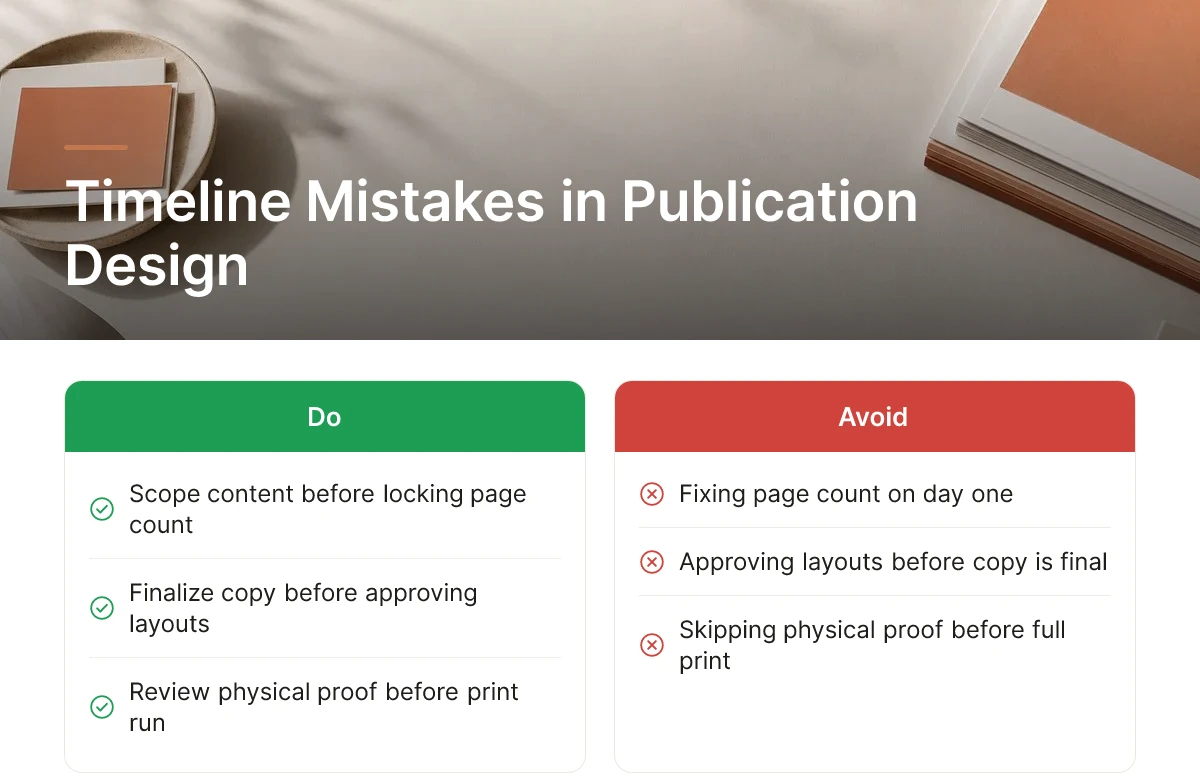
Most schedule blowouts in the publication design process trace back to three decisions made too early or skipped too late: fixing a page count before content is scoped, approving layouts before copy is final, and skipping a physical proof before the full print run.
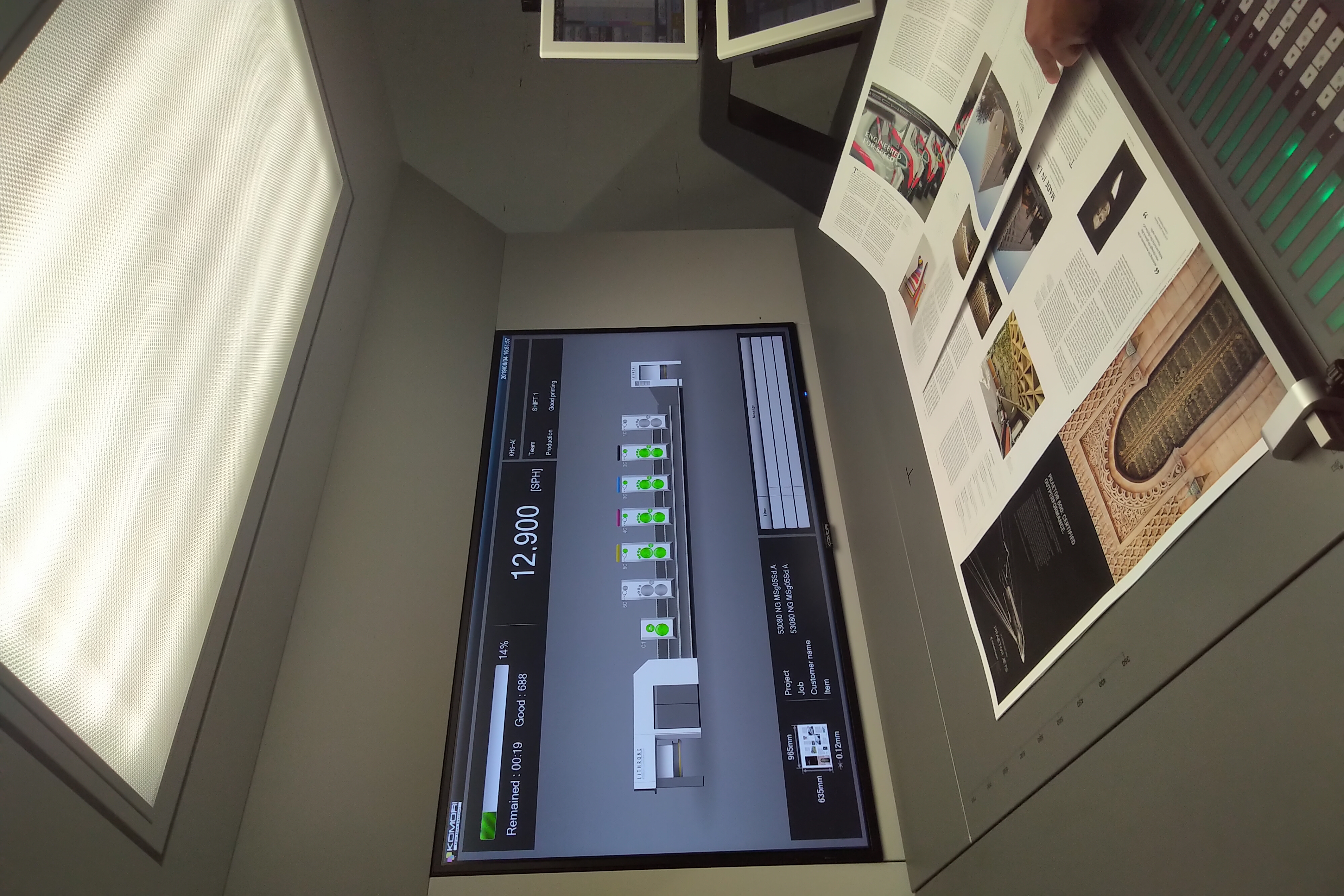
Locking a page count on day one feels efficient, but it forces editorial decisions before anyone knows how much content a story actually needs. A property profile might need four spreads or ten, depending on what the photography and interviews yield. Committing early means either padding weak sections to fill space or cutting strong ones to fit it, both weaken the final product. Similarly, approving a layout before copy is finalized invites rework: text that runs long or short reflows the grid, and design teams end up rebuilding pages they already signed off on. The third mistake, skipping a physical proof, is the costliest. Screen colors and paper colors are not the same thing, and a 5,000-copy run with the wrong stock weight or a color cast nobody caught on screen cannot be undone cheaply.
Why Quality Publications Need More Time Than Generic Design Work
A branded magazine carries more content dependencies than a typical design project because writing, photography, and layout all depend on each other sequentially, not in parallel. A flyer or social template can be designed the moment brand assets exist. A magazine needs interviews completed, images licensed or shot, and copy edited before layout can start in earnest [3]. Physical proofing rounds and print lead times add further fixed time that cannot be compressed by adding more designers, press slots, binding, and shipping run on their own calendars.
How Long Each Phase Realistically Takes and What Determines It
Schedule length depends on variables specific to each phase, not a fixed formula. Content gathering takes longer when interviews span multiple time zones or when original photography is required instead of licensed imagery. Design and layout take longer with more review rounds, and clear approval gates at each stage are what keep revisions from spiraling [3], a pattern consistent with findings on where creative timelines typically break down [5]. Print production scales with run size and finishing complexity: foil stamping, custom binding, and larger quantities all extend lead time.
As a general rule, start the project several months ahead of the date the magazine needs to be in hand, earlier if it is tied to a launch, anniversary, or event with a fixed date. Rethink Publishing manages this timeline end-to-end, from editorial strategy through the physical proof, so clients see the schedule without having to police it themselves.
Frequently Asked Questions
Why does a publication need an editorial spine before design begins?
Without an editorial spine, design has nothing to organize around and layout decisions become guesswork. The spine sets the narrative arc, section order, and story priorities so the designer knows which pages deserve a full spread and which need a single column. Skip it, and you get a beautiful shell with no argument inside, the reason brochures feel hollow and magazines don’t.
What’s the difference between treating design as a final step versus integrating it from the start?
Treating design as a final step means dressing up finished copy; integrating it from the start means copy and layout develop together. When writers know the spread they’re filling, they write to length and rhythm instead of overwriting and forcing a designer to cut. The result reads tighter and looks intentional, not retrofitted.
How does the workflow for a custom magazine differ from other design projects?
A custom magazine workflow runs longer and carries more dependencies than a typical design project, writing, image rights, printing, and binding all have to align before a single page is final [4]. A logo or social post can iterate in hours; a 96-page print run has fixed deadlines once it hits the press, so sign-off gates and lead time matter far more.
What print requirements should be settled before design work starts?
Trim size, paper stock, binding method, and page count should be locked before layout begins, because each one changes how designers build the grid. Color profile and print vendor specifications also need confirming early, reworking a 120-page layout for a different trim size late in the process costs real time and money. These decisions anchor every spread that follows.
How far in advance should a company start planning a custom magazine?
Most companies should start planning three to six months before a target launch or event date. That window covers editorial strategy, writing, design, image sourcing, print production, and shipping, compressing it usually means cutting corners on editorial depth or settling for a rushed layout.
Conclusion
A magazine that ends up on a coffee table instead of in a recycling bin starts with sequence: spine before layout, layout before copy polish, print specs locked before design begins. Rushing that order is the most common reason self-produced print pieces look corporate instead of editorial. Rethink Publishing runs this process end to end, strategy, writing, design, printing, and delivery, so you’re not assembling a production team you don’t have.
If you’re weighing a flagship launch, anniversary, or client-relationship push for next year, start the conversation now. Visit www.rethink-publishing.com and bring your timeline, three to six months out is the right time to begin.
Sources & References
- Top media challenges solved: how editorial workflow software transforms your content game
- B2B Guide to Building a Content Operations Workflow
- Graphic Design Process Steps for 2026: Clear Actions to Finish Fast
- KCC|NMA Chris Gargiulo’s Faculty Site – Design Process for Time-Based Media
- Graphic design process: Tested strategies for preventing delays
Recommended Articles
Explore more from our content library: