
Understanding law firm thought leadership magazine is essential. A law firm builds a thought leadership magazine by treating it as an editorial product, not a marketing brochure: define a clear editorial spine tied to the firm’s practice strengths, commission real reporting and interviews rather than repurposed blog posts, design it to the standard of a publication people keep, and print it so partners can hand it to a client rather than email a PDF. The result works because a physical magazine signals permanence and judgment in a way a webpage cannot, it sits on a desk, gets passed around, and makes the firm’s expertise tangible. Firms that treat it as a one-off brochure instead of an ongoing editorial product rarely see it become a keepsake.

What You’ll Need Before Creating a Law Firm Thought Leadership Magazine
Before the first interview is booked, a firm needs five things in place: a named sponsor, a time commitment, willing experts, a defined audience, and a realistic budget.
Skip any of these and the project stalls somewhere between issue one and issue two, which is where most branded publishing efforts quietly die.
- A named editorial sponsor. Someone on the leadership team, usually a marketing director or a managing partner, has to own the decision and defend it in front of partners who ask why the firm is spending on print. Without a sponsor, every editorial call gets relitigated and the project loses momentum by the second quarter.
- A recurring production rhythm, not a one-off project. A law firm thought leadership magazine only works as an ongoing publication, quarterly or biannual, because a single issue reads as a brochure, while a series builds the recognition that makes clients keep copies on their desks. Budget time accordingly: interviews, editing, design, and print production repeat on a fixed calendar, not when convenient.
- Partners and associates who’ll sit for interviews. Asking a partner to “write an article” usually produces a dense, hedged memo nobody reads past the first paragraph. Asking the same partner to talk through a recent matter for 30 minutes, on the record, produces quotable material a writer can shape into something readers actually finish.
- A clear picture of who picks it up. Existing clients, referral sources, and prospects read differently and expect different depth, the editorial spine and the distribution list both depend on settling this before commissioning a single piece. Harvard Law School’s Center on the Legal Profession notes that brand is often an underused asset in legal marketing, built through consistent signals of expertise and promise to the client rather than one campaign [1].
- An honest cost expectation. Quality print production, real photography, professional design, premium paper, proper binding, sits at a premium tier relative to a blog post or a PDF, and firms that try to minimize that spend usually end up with something that looks like every other firm’s brochure. Treat it as a long-term brand investment with a multi-year payoff, not a marketing line item to shrink.
Define the Editorial Strategy for Your Law Firm Thought Leadership Magazine
Decide what the magazine is actually about before anyone opens a design file, the editorial spine determines whether clients keep it or bin it. A law firm thought leadership magazine without that spine is just a stapled pile of partner updates, and clients can tell the difference in the first thirty seconds.
An editorial spine is a consistent angle, a recognizable voice, and a set of recurring sections that repeat issue after issue, a regulatory outlook column, a client interview, a “case that changed the industry” feature. A loose collection of articles has none of that. It reads like a newsletter stretched to 40 pages, with no reason for a reader to expect the next issue or recall the last one.
Why Print Succeeds Where Blogs and Digital-Only Content Fall Short
A blog post gets read once, maybe skimmed, then disappears into a browser history that nobody revisits. Legal content marketing has leaned hard into digital channels, one playbook for 2026 even frames short-form video and AI-optimized content as the new baseline for visibility [5], but that same race for attention is exactly why a physical magazine stands out. It sits on a desk or a coffee table where someone picks it up a second and third time, long after the original email newsletter has been archived or deleted.
Brand itself is still underused in legal marketing, treated as incidental rather than strategic [1]. A printed magazine forces the opposite: it makes brand and editorial point of view the entire product, not a byproduct of a billable matter.
Choosing an Editorial Spine That Reflects the Firm’s Real Strengths
Pick the two or three practice areas the firm is genuinely known for, not all of them. A firm strong in antitrust and employment litigation should build its spine around those, with every other practice appearing only where it naturally intersects. Trying to give equal column space to twelve practice groups produces the brochure feel firms are trying to escape, since brand similarity is already a known problem across the legal industry [4].
Mix content types deliberately: a long-form analysis of a regulatory shift, an interview with a client about a deal that mattered to their business, an opinion piece carrying a named partner’s byline, and a visual feature, office culture, a courtroom sketch artist, a pro bono project. Thought leadership works best as marketing when it reflects real expertise rather than generic commentary [1].
Map the spine to the audience. A magazine built for clients emphasizes outcomes and relationship stories; one aimed at referral sources leans on technical credibility; one built for recruiting foregrounds culture and people. Rethink Publishing starts every project by defining that editorial spine first, before any layout decision, so the content strategy drives the design rather than the other way around.

Design the Magazine So It Becomes a Keepsake, Not a Shelf Item
A reader decides whether to keep or discard a magazine within seconds of picking it up, based almost entirely on what their hands feel before their eyes read a word.
Paper stock is the first signal. A heavy, uncoated or soft-touch cover communicates permanence; a thin, glossy sheet reads as disposable, no matter how good the writing inside turns out to be. Binding matters just as much, a perfect-bound spine that lies flat and holds up to repeated handling tells a reader this object was made to last, not to be flipped through once and tossed in a recycling bin. Print finish, from foil accents to matte lamination, adds a final layer of restraint or indulgence that either matches a law firm’s brand or quietly contradicts it. None of this is decorative. It’s the physical argument for why a law firm thought leadership magazine deserves a place on a desk instead of a drawer.
Layout carries the same weight once someone opens the cover. Photography, typography, and pacing do work that plain text cannot, they establish rhythm, create visual rest between dense sections, and signal confidence rather than urgency. A page that gives an idea room to breathe reads as authoritative; a page crammed with text and a stock photo reads as a brochure. Harvard Law School’s Center on the Legal Profession has made the case that brand is routinely underused in the legal industry, even though it shapes the promise of quality and expertise clients expect before they ever sign an engagement letter [1]. Design is where that promise becomes visible.
How Editorial Curation and Design Work Together to Build a Lasting Asset
Design should follow the editorial spine, never replace it. A magazine built around better paper and prettier photos but no real point of view still reads as a brochure in disguise, readers notice the difference even if they can’t name it. Consistency across issues does the rest of the work: the same typographic system, color discipline, and layout logic, issue after issue, function the way a firm’s letterhead or office interior does. They build recognition without a single word of copy.
Get all of this right and the object earns its keep, literally. It sits on a coffee table, gets handed to a colleague, stays in view for months instead of one news cycle. That ongoing physical presence is the return on the investment, which is exactly the production discipline Rethink Publishing applies to every issue it builds.
Produce and Distribute the Magazine as an Ongoing Brand Asset
Production runs on five roles working from one editorial spine, and distribution turns finished copies into reasons for partners to reach out to clients. Skip either half and a law firm thought leadership magazine becomes an expensive folder of PDFs nobody opens.
Who Should Be Involved in Producing the Magazine
Five functions need to work together: an editorial strategist who sets the spine and keeps every issue on theme, writers and interviewers who draw out usable quotes from partners who’d rather bill hours than write copy, designers who pair text and image with intent, a print production team that manages paper stock and press runs, and a firm-side liaison who schedules partner availability and approves drafts.
- The editorial strategist decides what each issue is actually about before anyone writes a word, a regulatory shift, a client-facing trend, a practice group milestone.
- Writers interview partners the way a journalist would, not the way a marketing questionnaire would, so the voice on the page sounds like the person, not a press release.
- Designers build the layout around the story, choosing imagery and typography that match a law firm’s visual identity rather than defaulting to a generic template.
- Print production manages the physical details, stock weight, binding, color proofing, that decide whether the final object feels premium or forgettable.
- The firm-side liaison, usually someone in marketing or the managing partner’s office, is the single point of contact who keeps partner interviews on schedule.
Running all five in-house or across separate vendors creates handoff gaps: a freelance writer finishes copy with no sense of the design grid, a designer lays out pages before print specs are confirmed, and nobody owns the final proof check. Rethink Publishing runs strategy, writing, design, image sourcing, print, and delivery under one process specifically to close those gaps, the firm reviews drafts and proofs, but doesn’t manage separate contracts with three or four vendors who’ve never spoken to each other.
How a Magazine Supports Client Retention and Authority Over Time
A finished issue works when it gets into hands, not when it sits in a storeroom. Effective distribution includes copies hand-delivered at client meetings, mailed directly to key referral sources, placed in reception and conference rooms where visiting clients see them, and sent as a follow-up once a matter closes, a moment when most firms go quiet.
That follow-up copy does something a status update can’t: it gives a relationship partner a reason to call that isn’t a sales pitch. “Thought you’d enjoy this piece on the regulation your general counsel mentioned” reopens a conversation without asking for anything. Brand plays a bigger role in client decisions than most firms credit, and it works through exactly these small, low-pressure touches rather than a single pitch meeting [1].
On cadence, most firms do better publishing one or two issues a year than attempting a quarterly schedule they can’t sustain. A thin issue built to hit a deadline undercuts the credibility a magazine is supposed to build.
Common Mistakes to Avoid When Creating a Law Firm Thought Leadership Magazine
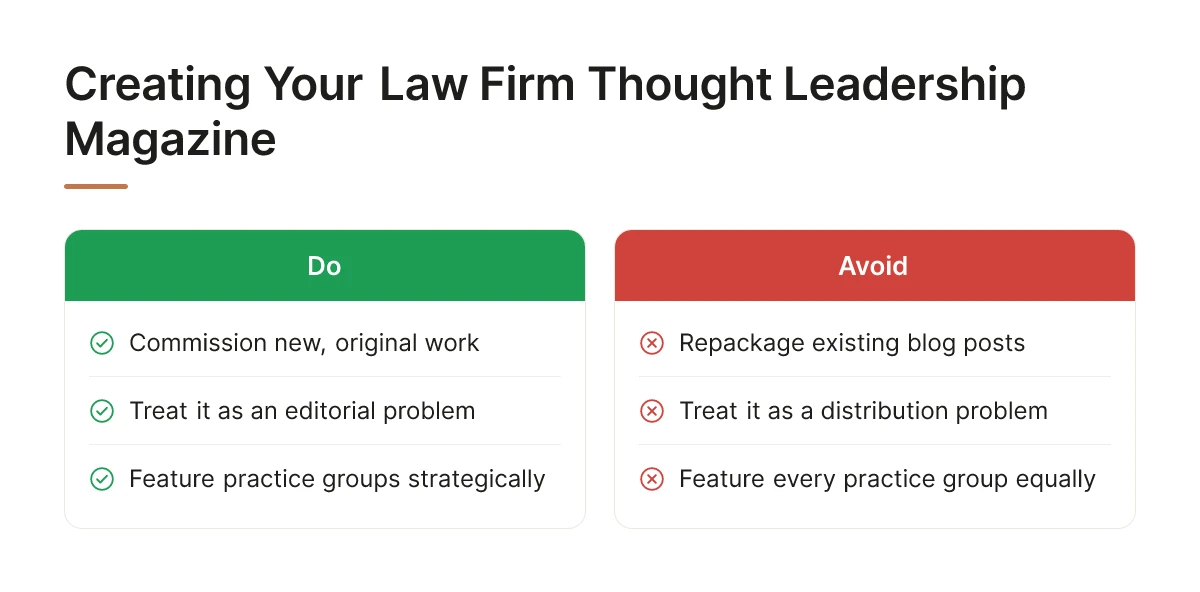
Most failed projects share one root cause: the firm treats the magazine as a distribution problem instead of an editorial one. A law firm thought leadership magazine fails for predictable reasons, and nearly all of them trace back to shortcuts taken early.
- Repackaging existing content instead of commissioning new work. Pulling old blog posts and client alerts into a PDF layout is not a magazine, it is a newsletter wearing a nicer cover. Readers notice the seams, and the firm loses the one advantage original editorial offers: content clients cannot get anywhere else [1].
- Trying to feature every practice group equally. Partners naturally want their group represented, but a magazine built to satisfy every internal stakeholder ends up with no point of view. The firms that build real brand equity through publishing let a clear editorial spine, a theme, a market angle, a specific audience need, decide what makes the issue, and cut what doesn’t fit regardless of whose practice group it represents.
- Underinvesting in design and print quality. A magazine exists to signal the same precision and judgment the firm sells in its legal work. Thin paper stock, generic stock photography, or a cramped layout undercuts that signal before a client reads a single word, the object itself has already told them something false about the firm.
- Publishing once and stopping. A single issue is a brochure with better production values. Recognition and anticipation, the qualities that turn a magazine into something clients watch for and keep, only build across a consistent run, issue after issue, year after year.
- Skipping the distribution plan. Firms spend months on content and design, then ship boxes to the office and let reception staff hand out copies at will. Without a deliberate plan, mailed to top clients, placed at pitch meetings, handed out at events, even a well-made magazine ends up stacked in a storage closet instead of on a client’s coffee table.
Brand in the legal industry is frequently underused as a strategic asset [1], and a magazine amplifies whatever discipline, or lack of it, a firm already brings to its brand decisions. Rethink Publishing exists specifically to prevent these failure points: the studio sets the editorial spine before any design work begins and manages production end to end, so firms don’t have to discover these mistakes the expensive way.
Frequently Asked Questions
Why do law firms choose print magazines over blogs and digital-only content strategies?
A blog post competes with hundreds of open tabs; a magazine sits on a desk until someone reads it. Brand in the legal industry is often underused as a strategic asset [1], and most firms already publish digital content that looks identical to every competitor’s. A printed magazine signals permanence and investment, it doesn’t vanish in a social feed after 48 hours.
How does a physical magazine differentiate a law firm from competitors in a crowded market?
Legal brands suffer from real sameness, similar websites, similar bios, similar case study PDFs [4]. A well-designed magazine built around a clear editorial spine looks nothing like a brochure, which is exactly the point. It gives clients a reason to notice the firm before they ever need legal counsel.
What role does a high-quality magazine play in client retention?
It keeps the firm visible in a client’s life between billable matters, which is when relationships usually go quiet. A magazine that lands in a boardroom or a home office reinforces the promise of expertise and quality a brand is meant to deliver [1]. That ongoing presence builds the loyalty a one-time email never will.
How often should a law firm publish its thought leadership magazine?
Most firms do well with one or two issues a year rather than a rushed quarterly schedule. Legal thought leadership works best as a long-term marketing asset, not a reactive content push [1]. Quality and editorial consistency matter more than frequency, a thin, rushed issue undermines the authority the firm is trying to build.
Should junior lawyers be involved in the firm’s magazine content?
Yes, selectively, junior associates often surface sharper, more current insights than partners pulled in a dozen directions. Involving them signals bench strength to clients evaluating the firm’s long-term capability, not just its name partners. An editorial team can shape their contributions so the final piece still reads with authority.



Conclusion
A law firm magazine works when it behaves like a magazine, not a brochure with a letterhead. That means a defined editorial spine, design that earns attention on its own, and a publishing rhythm the firm can actually sustain, one or two considered issues a year beats four rushed ones. Brand remains an underused asset in the legal industry [1], and a well-made print publication is one of the few tools left that clients keep rather than discard. Start by drafting the editorial spine for a single issue: three article topics, one client story, one firm perspective. That outline will tell you fast whether the concept has enough substance to become a magazine worth printing.
Sources & References
- Building a Brand to Create Competitive Advantage – Harvard Law School Center on the Legal Profession
- Boost your law firm’s brand | Branding + Design | Moiré Marketing Partners
- Content Marketing for Law Firms in 2026: Seven Essential Tips
Recommended Articles
Explore more from our content library: