
Understanding law firm print publication is essential. A custom print magazine works for a law firm because it does something digital marketing structurally can’t: it sits on a desk or coffee table for months, gets picked up repeatedly, and signals credibility through physical craft rather than a scrollable ad unit. Where a LinkedIn post or email gets seconds of attention before disappearing, a well-made print publication keeps a firm’s expertise in front of clients and referral sources long after it arrives. Used this way, print isn’t a legal-directory ad buy, it’s a standalone brand asset that builds trust through quality and consistency.

Why Should a Law Firm Invest in a Custom Law Firm Print Publication Instead of Relying on Digital Marketing Alone?
A law firm print publication earns attention over months in a way no feed-based channel can, because it occupies physical space rather than competing for a swipe.
Every firm already spends on digital marketing, and most of it works the way it’s supposed to, for the few seconds it’s visible. The problem isn’t quality. It’s structure. A social post lives in a feed designed to bury it within a day. An email sits in an inbox until it’s archived or deleted. A printed piece, by contrast, sits where someone put it, a reception desk, a boardroom table, a client’s home office, and stays there until someone decides to move it.
What Makes Print a Different Kind of Marketing Asset Than Email, Social Media, or a Law Firm Website?
Digital channels are rented attention; print is an owned, physical artifact the firm fully controls. A LinkedIn post depends on an algorithm’s mood that day. A website depends on someone searching the right term at the right moment. A law firm print publication depends on nothing but gravity, it stays on the table until a person picks it up [1]. That’s a structural advantage, not a stylistic preference. The firm isn’t leasing visibility from a platform; it owns the object, the message, and the moment someone encounters it.
This matters more in a trust-based profession than almost any other industry. Clients hiring legal counsel are making high-stakes, long-considered decisions, often during a stressful or high-value transition [2]. A well-made printed piece signals permanence and seriousness, qualities a scrollable ad unit structurally cannot convey, no matter how well it’s designed.
How Long Does a Print Magazine Stay in a Client’s Hands Compared to a Digital Ad?
A digital ad or post typically holds attention for seconds before being scrolled past; a printed magazine left on a desk gets picked up repeatedly over weeks or months. Each pickup reinforces the firm’s name and expertise without the firm spending another dollar on media placement. That repeated, no-cost exposure is the mechanism print marketing for lawyers relies on, and traditional channels still play a measurable role when paired with digital efforts rather than treated as a relic [1].
None of this argues for abandoning digital. A firm’s website, email newsletter, and search presence still do the job of capturing someone actively looking for help right now. Print does the other job: staying visible to people who aren’t searching yet, but will be.
How Does a Custom Print Publication Build Brand Authority and Client Trust?
A law firm print publication builds authority when readers can tell, within two pages, that it was made to inform them rather than sell to them.
That distinction is the whole game. Clients and referral partners have seen enough brochures dressed up as magazines to spot the difference instantly, and once they spot it, they discount everything else on the page.
What Editorial Approach Makes a Law Firm Magazine Feel Like a Trusted Resource Rather Than an Advertisement?
A publication reads as trustworthy when it has an actual point of view, not just a list of case wins dressed up in paragraph form. Legal marketers already understand this instinct, thought leadership content works precisely because it shows a firm’s thinking rather than announcing its accomplishments [3]. A guide on legal thought leadership makes the point directly: the goal is demonstrating that a firm understands the law, not merely stating that it practices it [5].
The same logic applies to print. A partner’s analysis of a regulatory shift, a client’s account of navigating a complicated transaction, a considered essay on where an industry is heading, these read as editorial content because they could exist independently of any sales motive. A paragraph that pivots every third sentence back to “contact our team” reads as an ad no matter how well it’s designed. Readers are quick studies; they skim past self-promotion and remember the piece that told them something they didn’t already know.
How Does Design and Production Quality Signal a Firm’s Professionalism and Values?
Paper stock, typography, and print finish communicate standards before a single word gets read. A heavy, matte page and a carefully set typeface tell a reader that someone sweated the details, the same quality a client hopes for in a contract review or a courtroom filing.
That signal cuts both ways. A law firm print publication with cramped layouts, inconsistent type, or flimsy paper undercuts the exact professionalism the firm spends every other client interaction trying to project. Clients notice the gap between a polished pitch meeting and a publication that looks like it was assembled in an afternoon. This is also where thinner “DIY” attempts tend to fail, not for lack of good writing, but because design and production require a different discipline entirely.
Consistency compounds the effect. A magazine that holds the same editorial voice and visual standard across multiple issues builds trust cumulatively, rather than forcing readers to re-evaluate credibility from zero each time. Rethink Publishing’s model exists around that compounding effect, editorial direction set up front, then carried through design, print production, and delivery, so a firm’s third issue reads as confidently as its first.

What Goes Into Creating a Law Firm Print Magazine That Actually Gets Read and Kept?
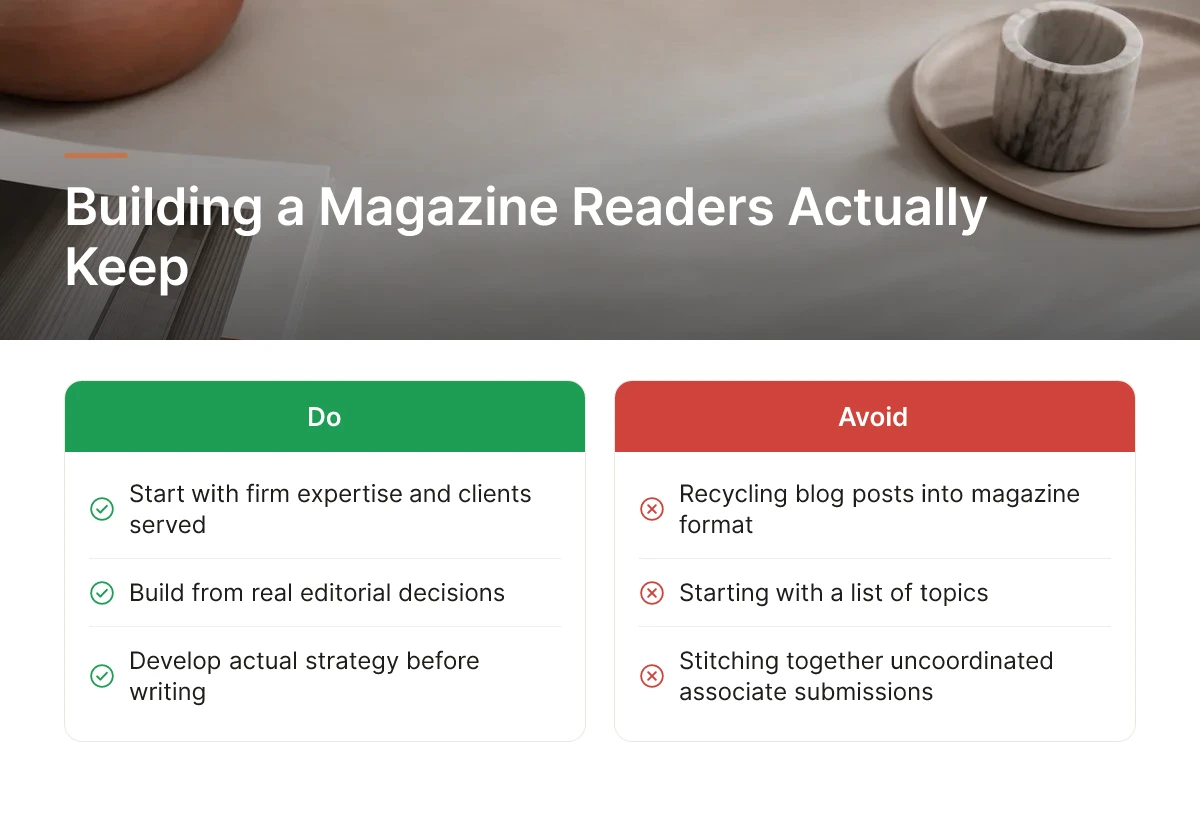
A magazine survives on a client’s coffee table when it’s built from real editorial decisions, not populated with recycled blog posts bound in a cover.
Most firms that attempt this in-house start with a list of topics instead of a strategy, five associates each submit an article, someone stitches them together, and the result reads like a newsletter that outgrew its format. The firms whose publications actually get read start somewhere else entirely: with the firm’s real expertise and the clients it actually serves.
How Do You Develop an Editorial Strategy and Voice That Reflects a Firm’s Expertise and Personality?
An editorial strategy for a law firm print publication has to begin with what the firm genuinely knows and who it genuinely serves, not a generic template borrowed from another industry. A real estate litigation practice and a private wealth group have almost nothing in common editorially, and a publication that treats them the same way will feel generic to both audiences. The strategy question comes first: what does this firm’s expertise look like when it’s not wrapped in legal disclaimers, and which clients will actually recognize themselves in these pages?
Voice matters just as much as topic selection. A legal publication that reads like a compliance memo won’t hold anyone’s attention past the first page, but one that oversells itself reads as marketing rather than insight, and readers in this audience, mostly other executives and general counsel, notice the difference immediately. The tone that works sits in between: informed enough to demonstrate real command of the subject, relaxed enough that a managing partner’s personality comes through. That distinct voice is what separates thought leadership that gets cited from thought leadership that gets skimmed [3].
What Role Does Professional Design and Photography Play in Making a Magazine a Keepsake?
Design and photography decide whether the finished piece feels like an object worth keeping or collateral worth discarding. Stock photography and template layouts signal, instantly, that a publication was produced quickly and cheaply, no matter how good the writing is underneath. Original photography and a layout built around pacing, where text breathes, where an image carries the page alone, are what make a reader slow down instead of flipping through.
The content mix matters too. A publication built entirely from firm-authored articles reads like an internal newsletter stretched to magazine length. One that weaves in client perspectives, practical firm insight, and broader industry context reads like an actual publication with a point of view. Strip out the editorial discipline, and what remains is a brochure with more pages, readers can tell within thirty seconds, and that judgment sticks to the firm’s brand.
How Can a Law Firm Measure Whether a Print Publication Is Delivering Real Business Results?
Track whether people mention it, keep it, redistribute it, or ask for more copies, those behaviors matter more than any digital dashboard. A law firm print publication doesn’t produce a click-through rate, and trying to force one onto it misreads what the format is for.
What Metrics and Outcomes Should a Law Firm Track to Understand the ROI of a Custom Print Magazine?
Start with conversations, not spreadsheets. If a client references a specific article during a renewal discussion, or a referral source brings up the magazine unprompted when introducing a new contact, that’s a signal worth logging.
Other practical indicators include:
- Requests for extra copies. A partner asking for five more issues before a client dinner means the piece is earning a place at the table, not sitting in a drawer.
- Use in business development meetings. Track how often associates or partners bring a copy to pitches, client visits, or industry events rather than a generic capabilities deck.
- Unprompted feedback. Note when a client or prospect brings up the publication themselves, in an email, a call, or a hallway conversation, rather than in response to a survey.
- Internal circulation. Watch whether other departments or offices request copies for their own relationship-building, which suggests the content holds up beyond its original audience.
None of these require new software. A shared log, who received a copy, what meeting it supported, what response came back, gives a firm more useful signal than a vanity metric borrowed from digital marketing.
How Do You Connect a Print Publication to Client Acquisition, Retention, and Brand Perception?
Connect it by watching behavior, not by assigning it a conversion rate. Thought leadership research in the legal sector consistently frames credibility and trust as the actual currency being built, content that demonstrates expertise rather than self-promotion is what moves a prospect toward a decision [4]. A print publication works the same way, just on a longer timeline and in a physical form that sits on a desk rather than disappearing in a feed.
Retention shows up as redistribution: an existing client passing the magazine to a colleague, or referencing it when explaining why they stayed with the firm. Acquisition shows up less directly, a prospect mentions they recognized the firm’s name from something a friend showed them, or a referral partner cites a specific feature when making an introduction.
Brand perception is measurable too, just not numerically. It shows up in what people say without being asked, whether clients describe the firm as “the one with the excellent magazine” or reference a specific story months after publication. That kind of qualitative feedback, gathered consistently over several issues, tells a firm more about positioning than any single campaign report. The honest comparison here isn’t to a digital ad’s weekly report, it’s to how a firm’s reputation builds over years of consistent, credible presence in front of the right people.
What Is the Right Process for a Law Firm to Commission and Launch a Custom Print Publication?
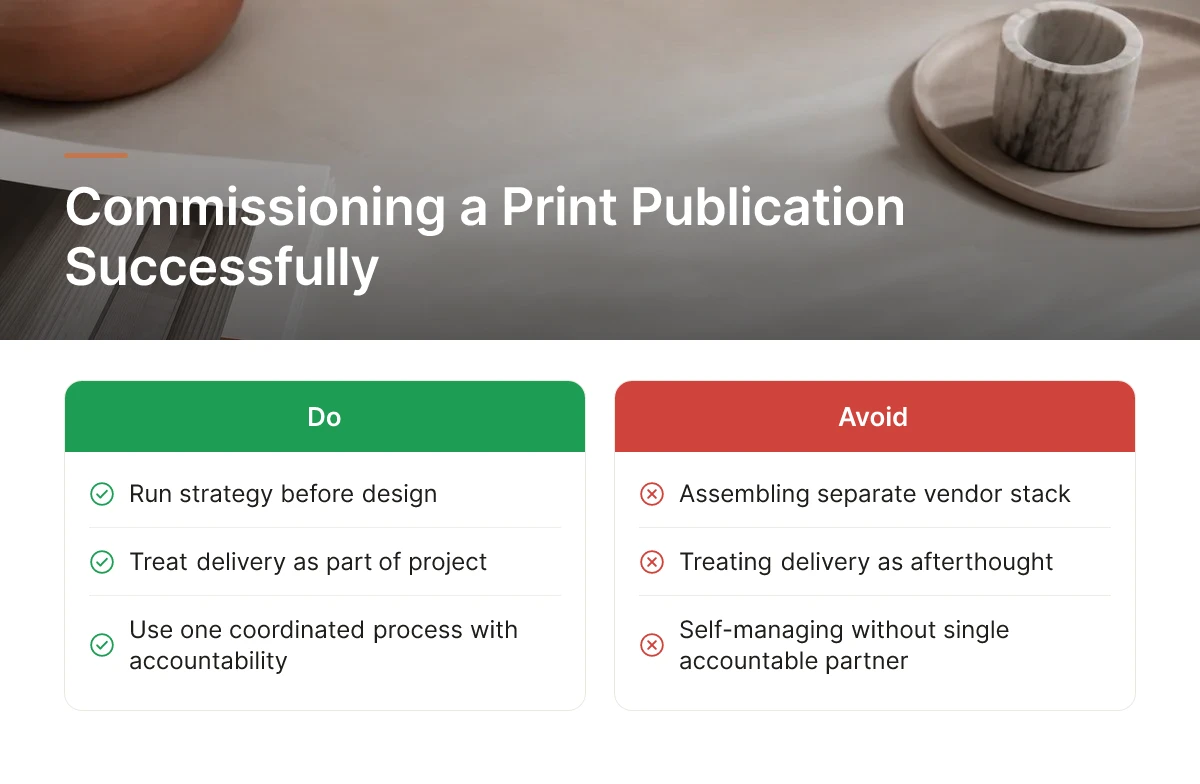
The right process runs strategy before design, design before print, and treats delivery as part of the project, not an afterthought once files are sent to a printer.
A law firm commissioning a print publication for the first time is usually assembling a stack of vendors in its head: a writer, a designer, a printer, maybe a photographer. That instinct is reasonable, and it’s also the reason most self-managed attempts stall or look disjointed. A single coordinated process, run by one accountable partner, is what separates a law firm print publication that reads like a real magazine from one that reads like a stitched-together brochure.
What Should a Law Firm Expect From a Publishing Partner in Terms of Strategy, Design, Production, and Delivery?
Expect five phases handled as one process: strategy, editorial direction, design, print production, and delivery, not five separate vendors you manage yourself.
Strategy comes first because it answers the questions that determine everything after it: who reads this, what topics earn their attention, and how often the firm can credibly produce it. Editorial direction follows, building what Rethink Publishing calls the editorial spine, the throughline of content that gives each issue a reason to exist beyond “here’s what our firm did this quarter.” Only then does design enter, pairing copy and imagery with intentional layout. Print production and delivery close the loop: sourcing paper stock, managing the print run, and getting finished copies into the hands of clients and referral sources rather than a warehouse. A firm that hires a design agency without this sequence often ends up with something polished but hollow, beautiful pages built around content that was never structured to hold a reader’s attention.
How Long Does It Take to Go From Concept to a Finished, Printed Magazine in Clients’ Hands?
Concept to delivery spans a defined project cycle measured in months, not weeks, rushing any phase usually shows up in the finished product.
Strategy and editorial planning take real time because they involve interviewing stakeholders, defining the audience, and deciding what the firm is actually willing to say in print. Writing, design, and image sourcing follow, then print production itself, proofing, color correction, binding, before distribution. Firms that treat this like a quarterly newsletter deadline tend to compress the strategy phase, which is precisely the phase that can’t be shortened without damaging the result.
A useful early signal of a serious partner is the questions they ask before design ever starts: Who is this for, existing clients, referral sources, or prospective hires? What should someone feel after finishing it? How often can this realistically be produced without diluting quality? Firms that can’t answer those questions yet aren’t ready to brief a designer.
Cost should be framed the same way the firm frames its own fee structure, as an investment tied to long-term relationship value, not a line item measured against a single campaign’s return. A well-made publication gets kept, reread, and passed to a colleague; that compounding effect is the return, even though it doesn’t show up in a weekly analytics dashboard.
Frequently Asked Questions
Does a print magazine make sense for a small or mid-sized law firm, not just large ones?
Yes, firm size matters less than clarity of audience and willingness to commit to the investment. A 15-partner boutique with a defined niche often has a sharper editorial story than a 200-lawyer generalist firm. What matters is a distinct point of view and clients worth staying memorable to.
Should a law firm’s print publication include client-facing content or stay internal to the firm’s own work?
It should lead with client-facing content, not internal firm news. Profiles of client industries, market trends, and perspective pieces earn a place on a coffee table; “Partner John Smith Named Super Lawyer” items belong in a newsletter, not a magazine meant to build lasting brand connection.
How often should a law firm publish a print magazine to maintain the brand benefit?
Most firms do best with one or two issues a year rather than a quarterly schedule. Annual or biannual publishing keeps editorial quality high and gives the firm real stories to tell, instead of padding pages to hit a deadline, frequency should never come at the cost of substance.
Can a print publication work alongside a firm’s existing content marketing and thought leadership efforts?
It should complement, not replace, digital thought leadership, the two serve different jobs [1]. Blog posts and alerts build search visibility and timely authority; a print magazine builds a slower, physical relationship with the firm’s best clients and referral sources, repurposing the firm’s sharpest digital content into something kept, not scrolled past.

Conclusion
A law firm print publication earns its place on a client’s desk by doing what a newsletter or blog post cannot: lasting. The firms getting this right treat it as an editorial product with a real point of view, publish on a sustainable annual or biannual schedule, and let digital thought leadership feed the magazine rather than compete with it [3][4]. The decision that matters most is whether the firm can commit to that editorial standard consistently.
If that question is still open, start smaller: audit the last year of thought leadership content your firm already produced, and ask which three pieces would still be worth reading in print. Rethink Publishing can take that audit and build the editorial spine around it.
Sources & References
- How to Integrate Digital and Traditional Media for Law Firms
- How Local Law Firms Can Reach Clients at the Right Time: The Marketing Playbook for Growing Your Practice
- A Guide to Thought Leadership for Law Firms, Sonali Badul, Charlotte Knight, Samuel Page
- How to improve Your Law Firm’s Visibility Via Thought Leadership – The Game-Changing Marketing Catalyst You Start Today
- Thought Leadership & White Papers –
Recommended Articles
Explore more from our content library: