
A custom law firm magazine works because it pairs the credibility of print with the editorial depth digital marketing can’t sustain, long-form thought leadership, client stories, and market insight delivered in a format people keep instead of scroll past. Where a website competes for seconds of attention, a well-made print magazine sits on a desk or coffee table for months, repeatedly reinforcing a firm’s expertise to the people who matter most: existing clients, referral partners, and prospects already evaluating who to trust with high-stakes work.

Why Should a Law Firm Create a Custom Magazine Instead of Relying on Digital Marketing Alone?
A law firm magazine survives in the physical world for months, while a webpage or LinkedIn post survives in someone’s attention for seconds before the next scroll replaces it.
That gap in lifespan is the whole argument. An email newsletter gets opened, skimmed, and archived or deleted within a minute. A social post has a shelf life measured in hours before the algorithm buries it. A printed magazine, by contrast, sits on a managing partner’s desk, a general counsel’s coffee table, or a reception area for weeks at a time, and every time someone picks it up, the firm’s name and expertise get reinforced again, at no additional cost per impression.
- Email newsletter: opened, skimmed, and deleted within a minute.
- Social post: a shelf life of hours before the algorithm buries it.
- Website page: competes for seconds of attention against every other open tab.
- Printed magazine: sits on a desk or coffee table for weeks, reinforcing the firm’s name with every pickup.
How Does Print Differentiate a Law Firm in a Crowded Legal Market?
Print signals permanence and seriousness in a profession built entirely on trust, qualities a scrollable feed cannot convey.
Clients hire law firms to manage risk, not to be entertained. Harvard Law School’s Center on the Legal Profession notes that brand functions in legal services as a promise, of quality, specialized expertise, and a consistent way of working [1]. A digital ad or a quick post can’t carry that promise; it disappears too fast to feel substantial. A bound, designed, physically weighty object does the opposite. It says the firm invested real resources in how it presents itself, which is itself a signal of how it will invest in a client’s matter.
What Makes a Custom Magazine More Effective Than Industry Publications Lawyers Already Read?
A custom magazine carries the firm’s own voice and client stories, not aggregated industry news the firm has no control over.
Subscribing to or appearing in an existing legal trade publication puts a firm’s name next to competitors’ names, inside someone else’s editorial agenda. A custom law firm magazine is the opposite: every article, case story, and interview exists to build that one firm’s authority. Attorney at Work points out that firms competing on price alone erode perceived value over time, while firms that invest in distinct branding create strategic separation from competitors [2]. A proprietary publication is one of the clearest ways to make that separation tangible. Research on law firm marketing and branding strategies points to the same conclusion: firms that control their own narrative outperform those that rely solely on third-party visibility.
None of this replaces a website, email program, or social presence, a magazine does a different job. Digital tools handle speed, search visibility, and daily touchpoints. Print handles depth, memory, and the quiet signal that a firm is established enough to produce something this considered. Rethink Publishing builds that print layer end-to-end, so the firm’s digital strategy and its printed one reinforce each other instead of competing for the same five minutes of attention.
How Does a Custom Magazine Help a Law Firm Build Brand Authority and Client Trust?
A custom magazine lets a firm control what clients read about it, rather than leaving perception to whatever legal news happens to surface that week.
Brand in the legal industry tends to be underused. Most firms compete on credentials that look identical from the outside, top-tier law school names, years in practice, a list of practice areas, while the brand itself, the thing that actually shapes a client’s buying decision, gets left on the table [1]. A law firm magazine fixes that gap by giving the firm a platform it fully controls: its own practice area expertise, its own client wins, its own culture, told on its own schedule. Reacting to the next regulatory headline is not a strategy. Deciding what the firm wants to be known for, and saying it consistently, is.
How Should a Law Firm Position Itself Editorially to Stand Out From Competitors?
Editorial positioning means choosing one distinct angle and committing to it, instead of producing another roundup of generic legal updates. A firm known for explaining complex regulatory change in plain language occupies a different space than a firm that just summarizes case law. That distinction matters more as price pressure increases across the industry, branding research shows that cutting fees to compete erodes perceived value rather than protecting it, and that a stronger market position is a better defense than a lower rate [2]. An editorial spine, a defined angle the firm returns to issue after issue, does the same work a strong brand does elsewhere: it gives clients a reason to choose the firm that has nothing to do with price.
What Role Does Design and Production Quality Play in Client Perception?
Design quality signals competence before a client reads a single word, which means sloppy production actively undermines the trust a firm is trying to build. Thin paper stock, cramped layouts, stock photography, and a saddle-stitched binding that curls at the corners read as an afterthought, something assembled in an afternoon and forgotten. A firm that handles eight-figure transactions but hands a client a brochure that looks like it was built in PowerPoint has created a mismatch clients notice, even if they never say so out loud. A considered piece, proper stock, deliberate layout, commissioned photography, a binding that holds up on a coffee table, reads instead as an extension of the firm’s own standards. That is the entire premise behind Rethink Publishing’s approach: editorial direction and production discipline applied with the same rigor a firm already expects of its legal work, so the printed object matches the standing it is meant to represent.

What Should Go Into a Law Firm Magazine to Make It a Real Marketing Asset?
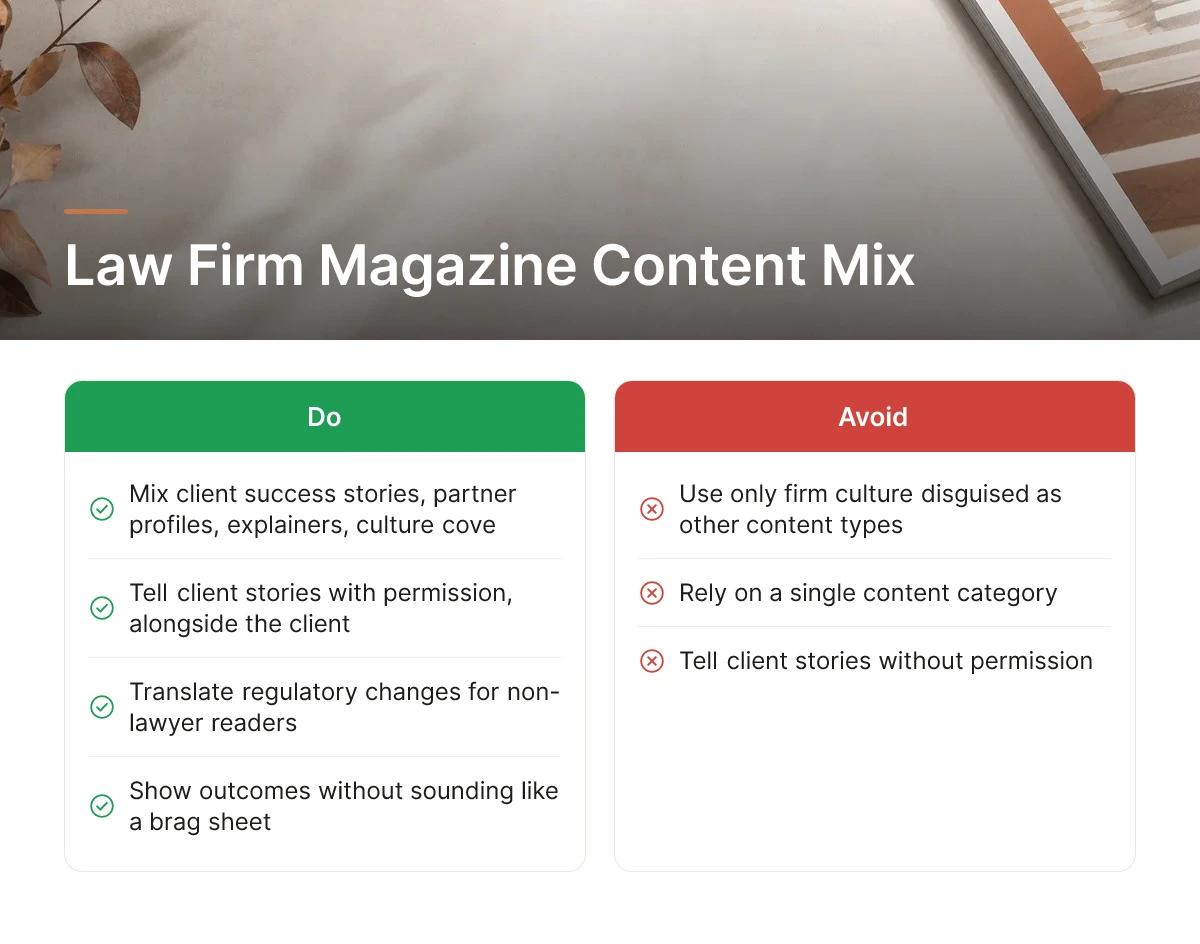
A law firm magazine earns its keep when it mixes four content types, never only the last category disguised as the other three:
- Client success stories: told with permission, often alongside the client rather than about them, showing outcomes without sounding like a brag sheet.
- Partner profiles: humanizing people whose bios otherwise read like court filings.
- Plain-English explainers: translating a regulatory change or case ruling for a reader who isn’t a lawyer, where thought leadership actually lands instead of sitting in a PDF nobody opens [5].
- Firm culture and community involvement: pro bono work, local sponsorships, hiring philosophy, showing the firm as an institution, not just a service provider.
How Do You Develop an Editorial Strategy That Serves Both Clients and Prospects?
Split the content by what each reader already knows and what they need to trust you.
Existing clients want depth: the reasoning behind a case strategy, a partner’s view on where a practice area is heading, specifics that signal the firm understands their business at a granular level. Prospects need something different, accessibility and trust signals, not density. A prospect reading an explainer on a new compliance rule doesn’t need footnotes; they need to finish the page understanding the issue and believing the firm that explained it. Brand research on the legal industry backs this split: firm brand and individual practitioner brand work together to signal quality, expertise, and a certain way of working, which is exactly what a magazine can demonstrate across different reader segments [1]. A single issue can carry both registers if the editorial plan assigns sections deliberately rather than defaulting every page to one voice.
What’s the Difference Between a Magazine That Sits on a Shelf and One That Stays in People’s Hands?
The one that stays has genuine editorial value; the one that gets binned is thinly-veiled self-promotion with a cover.
Firms face real pressure to justify their fees rather than compete on price, and branding is the stronger play, but branding only works if the content behind it is credible, not just polished [2]. Turn every page into a service pitch and the reader notices by page three. People keep what informs or entertains them. They discard what sells to them. The irony is that editorial independence, real stories, real opinions, writing that could run in a general-interest magazine, is what makes the occasional self-promotional page credible when it does appear. A law firm magazine built that way reads less like a brochure and more like something worth leaving on the coffee table in the first place.
How Do You Measure Whether a Law Firm Magazine Is Actually Working for Your Business?
A law firm magazine is measured in retained clients, referral conversations, and relationship depth, not click-through rates or cost-per-lead. That mismatch trips up marketing executives who default to digital dashboards for every initiative.
Print doesn’t generate a conversion event you can trace in an analytics tool. Nobody clicks a magazine. But a managing partner who receives a beautifully produced piece every quarter and keeps it on the credenza, then mentions a specific article the next time you’re in the room with them, is giving you a signal that matters more than a digital impression ever could. Harvard Law School’s Center on the Legal Profession has made the case that brand in the legal industry is routinely underused as a strategic asset, in part because its returns don’t fit the metrics firms are used to tracking [1].
What Outcomes Should a Law Firm Expect From a Custom Magazine Investment?
Expect qualitative signals, not conversion data. Clients bringing it up unprompted in meetings. Referral partners asking for extra copies to pass along to their own network. Business development teams including it in pitch leave-behinds because it does more to convey credibility than a one-page capability statement ever could. Firms building out these capabilities often look to resources like strategies for empowering a law firm’s marketing team as business development consultants, since the same relationship-first thinking applies to how a magazine gets used in pitches and client meetings.
Track where it gets used, not just where it gets sent. Which partners ask for stacks before a conference. Which practice groups request copies for client dinners. Which events it gets handed out at, and whether follow-up conversations reference a specific feature rather than the firm generically. Those touchpoints are the real proxies for impact, they tell you the magazine is doing the relationship-building work it was built for, which echoes the broader point that brand and personal reputation combine to shape every buying decision a client makes [2].
How Long Does It Take for a Print Magazine to Show ROI as a Brand-Building Tool?
Honestly? Longer than a quarter, and that’s by design. A law firm magazine is a cumulative asset, its value compounds across issues as clients come to expect it, keep it, and associate it with the firm’s standing, not a campaign with a fast payback window.
Judge it the way you’d judge sponsoring a flagship event or building out a thought leadership program, not the way you’d judge a paid search campaign [5]. Firms that treat branding as a strategic, patient investment rather than a price-driven expense tend to be the ones who see it pay off in client loyalty over years, not weeks [2].
What’s the Process for Creating a High-Quality Law Firm Magazine From Strategy to Print?
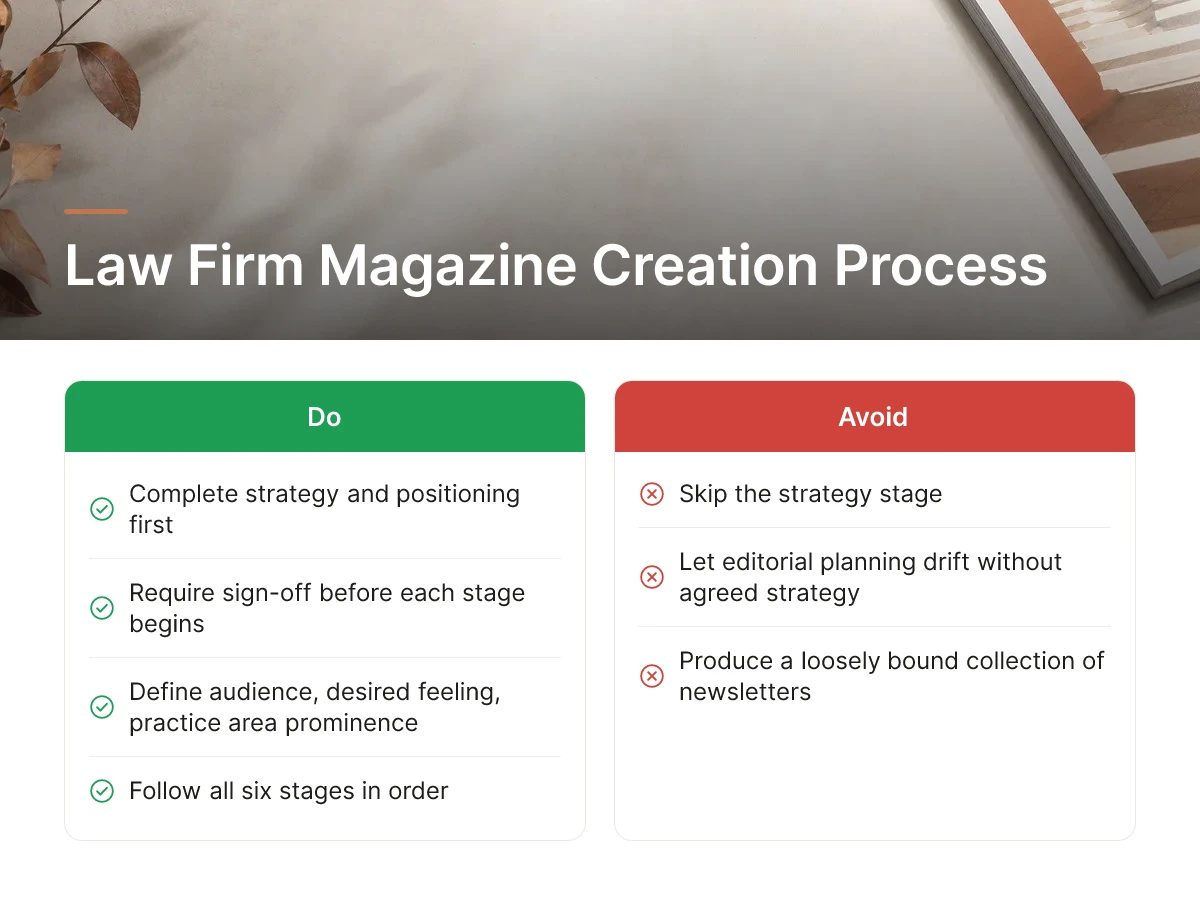
A law firm magazine moves through six stages, each requiring sign-off before the next begins:
- Strategy and positioning: agreeing who the magazine is for, what it should make clients feel, and which practice areas get prominence.
- Editorial planning: turning those themes into an actual table of contents, feature topics, interview subjects, and recurring columns.
- Content development: writing, interviews, and photography.
- Design: pairing copy with imagery and typography that reflects the firm’s visual identity, not a template.
- Print production: paper stock, binding, and quality control.
- Distribution: mailed to top clients, handed out at events, placed in reception areas, where the investment starts paying back.
Skipping the first stage is the most common mistake firms make. Without an agreed strategy, editorial planning drifts and the finished product reads like a loosely bound collection of newsletters. Harvard Law School’s Center on the Legal Profession has made the case that brand is “an underutilized and neglected asset” in the legal industry [1], and a magazine built without strategic grounding wastes the one chance to change that.
Who Should Be Involved in Planning and Executing a Law Firm Magazine?
Three roles need to be in the room: a managing partner or marketing lead who sets direction, an editorial and design partner who executes, and a small group of attorneys who supply subject expertise without running the project.
The managing partner or CMO owns the strategic brief, audience, tone, practice areas to spotlight. The editorial and design partner translates that brief into actual pages, managing writers, photographers, and printers. Attorneys contribute expertise on request: a quote here, a case insight there, a fact check before print. Firms that let attorneys drive editorial decisions usually end up with a magazine that reads like an internal memo rather than something a client wants to keep.
How Do You Balance Editorial Independence With Business Objectives in a Custom Publication?
Set strategic themes upfront, then let the editorial team decide how to make each story genuinely worth reading, don’t dictate sentence by sentence.
Friction shows up in two predictable ways: attorneys pushing for dense legal jargon that signals expertise to them but alienates readers, and partners pushing for promotional copy that turns every feature into a pitch. An experienced editorial partner holds that line, translating expertise into plain language, trading self-promotion for genuinely interesting stories that happen to reinforce the firm’s positioning. This is the tension a specialist end-to-end partner is built to manage. Rethink Publishing develops the editorial spine before a single page is designed, then handles writing, layout, image sourcing, printing, and delivery, so an already-stretched marketing team isn’t also trying to run a production schedule.
Frequently Asked Questions
Does a law firm magazine replace the need for a website or digital content?
No, a magazine doesn’t replace a website, it works alongside it, serving a different purpose entirely. A website answers questions and ranks for searches; a magazine builds emotional recall with clients and referral sources who already know the firm. Digital channels cast a wide net, while print deepens relationships already in motion.
How often should a law firm publish a custom magazine?
Most firms publish once or twice a year, treating each issue as a milestone rather than a routine update. An annual issue tied to a firm anniversary, major case outcome, or industry event tends to carry more weight than a quarterly cadence that strains the editorial team and dilutes content quality over time.
Can a smaller law firm justify a custom print magazine, or is it only for large firms?
Size matters less than the firm’s client relationships and referral economics, boutique firms with high-value clients often benefit more than large ones. A firm with 20 partners and a concentrated base of institutional clients or referral sources can justify a magazine faster than a larger firm with diffuse, transactional relationships [2].
Should a law firm magazine be distributed only in print, or also digitally?
Print should lead, but a digital companion extends reach without diluting the physical object’s value. Mail the printed issue to top clients and referral partners, then share a digital version through email or LinkedIn for broader visibility. The print copy stays the centerpiece, the one that sits on a desk, not a browser tab that closes in seconds.
Who typically owns the budget and decision-making for a law firm magazine?
Usually the chief marketing officer or a managing partner with marketing oversight, often in consultation with practice group leaders. Because a magazine touches brand positioning, client relationships, and firm reputation simultaneously, it tends to require sign-off at a level above a single practice group, even when individual attorneys contribute content.

Conclusion
A law firm magazine works when it’s treated as a brand asset, not a newsletter, edited with a clear point of view, built around client relationships rather than firm announcements, and produced with enough craft that people keep it instead of recycling it [1]. The firms getting this right are investing in long-term perception, not quarterly lead counts [2]. If a competitor’s branded magazine has already landed on a client’s desk before yours has, that’s the signal to stop treating print as optional. Start by identifying the 50 to 100 relationships your firm can’t afford to lose touch with, that list is your first print run.
Sources & References
- Building a Brand to Create Competitive Advantage – Harvard Law School Center on the Legal Profession
- Law Firm Branding: A Winning Strategy to Combat Pricing Pressure
- Thought Leadership as Marketing – Harvard Law School Center on the Legal Profession
Recommended Articles
Explore more from our content library: