
An architectural monograph is a high-end, editorially rigorous print publication that documents a design practice or project with the same seriousness as a design document, not a decorative object. It differs from a coffee table book in intent: a coffee table book is built to look good on a surface, while a monograph is built to carry a point of view, with structured narrative, considered sequencing, and a clear editorial spine. Companies commission them as long-term brand assets, not seasonal marketing collateral.
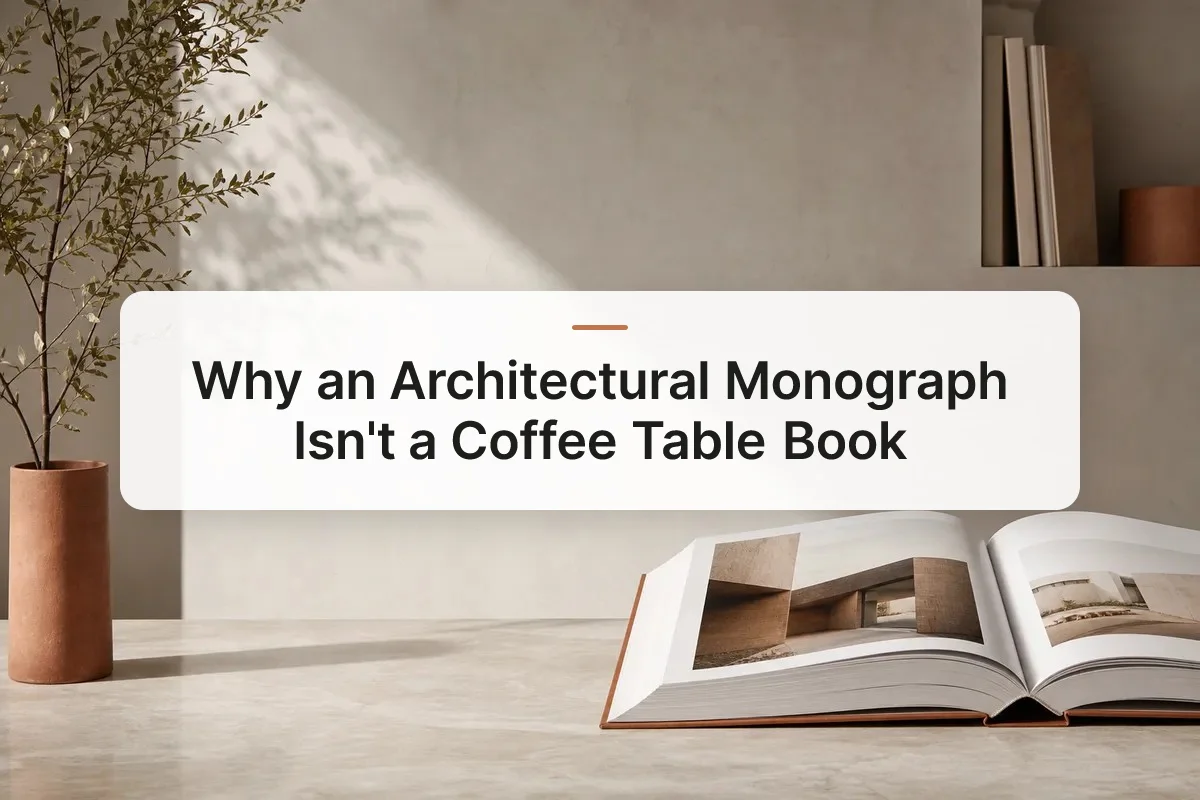
What Is an Architectural Monograph and How Does It Differ From a Coffee Table Book?
A monograph is built around one argument, told in sequence, with every image and caption working toward that argument, not a pile of pretty pictures bound together.
That distinction matters more than it sounds. An architectural monograph is an editorially driven document with a spine: a thesis about a practice, a project, or a design philosophy, supported by text, drawings, and photography arranged to build a case. Pull one spread out of order and the argument breaks. Pull a spread out of a coffee table book and nothing breaks at all, that’s the point of a coffee table book, and it’s not a flaw, just a different job.
What Is the History and Evolution of the Architectural Monograph as a Publishing Format?
The format started as an academic and institutional tool, used by universities and archives to record a single architect’s body of work for scholars and students to study, cite, and return to [5]. Leiden University’s own published scholarship treats the architect’s monograph as a text to be read critically, not merely looked at, evidence that the format was always meant to carry an argument, not just document a career [5]. Firms publishing commemorative books today trace a direct line from that academic tradition, describing their own books as a way to capture a design story and professional standard for the firm’s own history [2].
Over the past two decades, that same documentary seriousness has moved from the academy into the corporate world. Design-minded companies, architecture firms, real estate developers, hospitality groups, now commission monograph-style publications not for a university library, but for a boardroom table and a client’s shelf.
How Does an Architectural Monograph Function as a Brand Document Versus a Decorative Coffee Table Book?
A coffee table book is designed for ambient browsing, open to any page, enjoy the imagery, set it down. Design writers describe this browsability as the format’s whole appeal: the large spread as “an invitation to lean in,” with no obligation to read start to finish [4]. A monograph asks for the opposite. It has an opening thesis, a sequence that develops it, and a close that resolves it, which is why serious coffee table book publishers warn that without “a clear point of view,” even beautiful images and premium materials become “a costly object with no authority” [1].
That line, authority versus surface appeal, is the one a company deciding between formats needs to draw first. Rethink Publishing builds that editorial spine before a single layout decision gets made, because a document meant to be cited and referenced inside an industry has to earn that status structurally, not just visually.
Why Do Architecture Firms and Design Brands Invest in Monographs as Marketing Assets?
An architectural monograph earns trust a PDF never will, it sits on a desk, gets picked up mid-meeting, and signals permanence a link in an email cannot match.
Walk into a pitch meeting with a laptop open to a website and you’re one tab away from being forgotten. Hand a prospective client a weighted, well-bound architectural monograph and the conversation changes. They hold it. They flip back a few pages on their own, without being asked. That tactile moment does something a case study page on a website structurally cannot do, it makes the firm’s body of work feel substantial before a single word gets said.
What Business Outcomes Can a Well-Crafted Architectural Monograph Deliver for a Design Practice or Real Estate Brand?
A monograph converts firm reputation into something a prospective client keeps, references, and passes along, extending the sales conversation long after the meeting ends. The mechanism is simple: a book that’s genuinely well made doesn’t get filed away, it gets left on a shelf or a reception table, where it keeps working without anyone having to resend it. A firm’s single best project, shown once on Instagram, has a lifespan measured in hours. The same project, placed inside a monograph alongside eight or ten others, becomes evidence of range and consistency, the thing a potential client actually wants proof of before signing a seven-figure engagement.
This is also a positioning tool in a crowded field. Architecture and design firms compete on portfolio depth as much as on any single building, and a monograph is built to show that depth deliberately, sequencing projects, typologies, and years of practice into one coherent argument about who the firm is, rather than scattering it across a feed where each post competes with everything else in the scroll.
How Does Print Positioning in an Architectural Monograph Compare to Digital Formats for Long-Term Brand Impact?
Digital content decays by design, a feed algorithm buries a post within days, and attention online is finite and contested by every other brand competing for the same scroll. Print doesn’t compete for attention the same way; once it’s on a coffee table or a bookshelf, it has already won the placement. That’s the asymmetry firms are paying for: not reach, but retention.
None of this is inexpensive, and it shouldn’t be treated as a single campaign line item. A monograph is a long-term brand investment, evaluated properly across years of client meetings, referrals, and shelf life, not against the cost-per-click math of a digital ad. Rethink Publishing builds each monograph around that premise, managing editorial direction, design, and print production end to end so the finished object holds up to that multi-year standard.
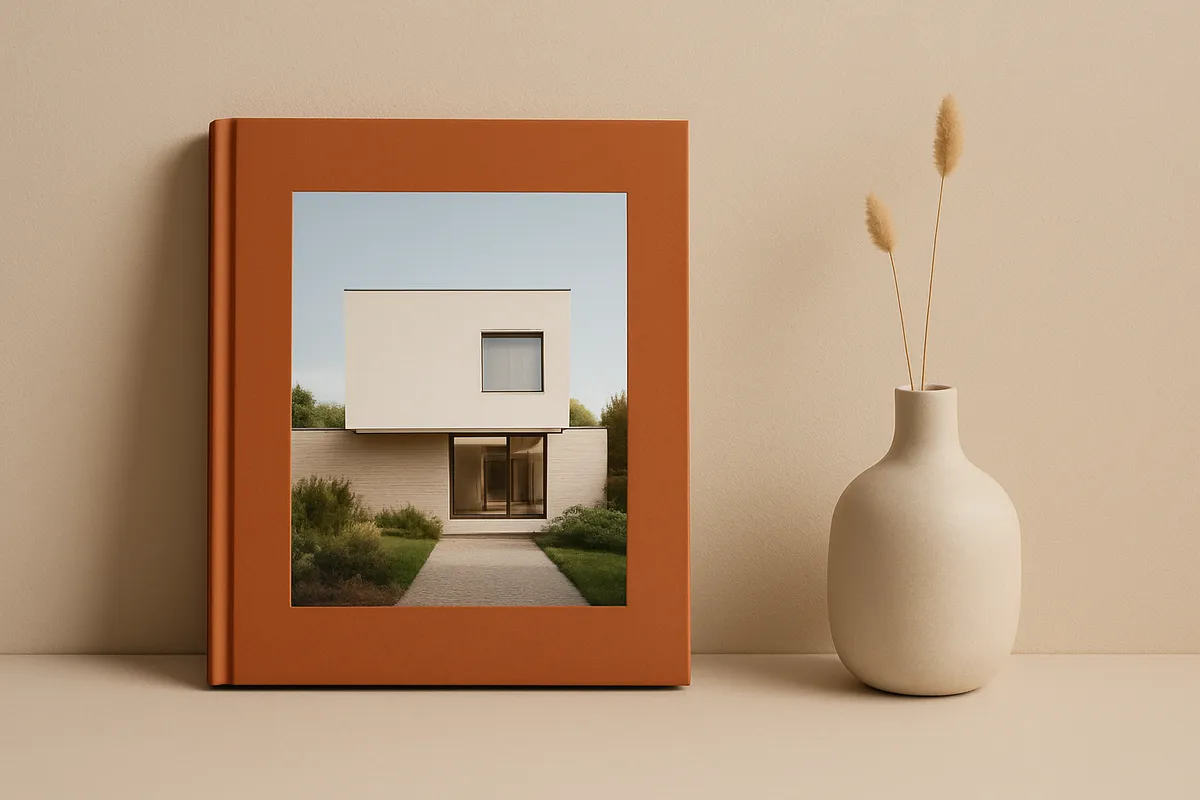
What Makes an Architectural Monograph Editorially Rigorous and Strategically Effective?
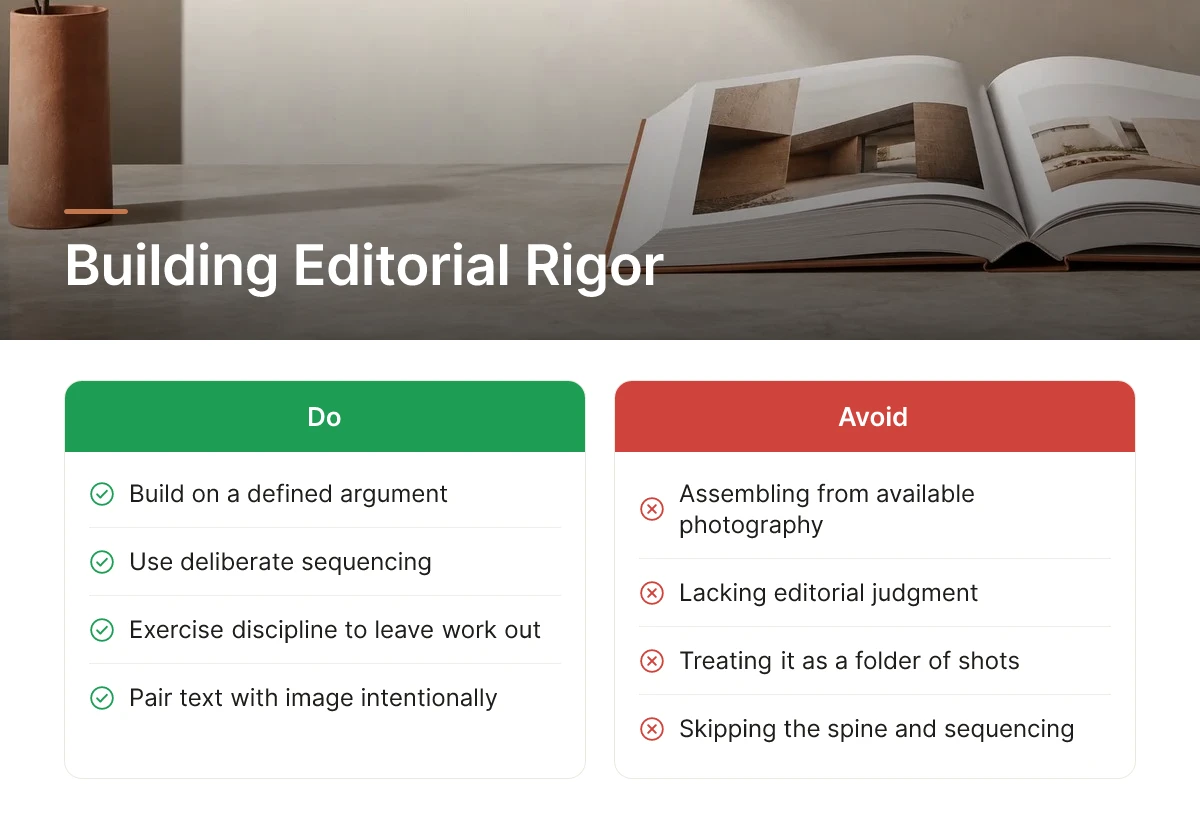
An editorially rigorous architectural monograph is built on a defined argument, a deliberate sequence, and the discipline to leave work out, not just assembled from available photography.
Most firms already have the photography. What they lack is the editorial judgment to turn a folder of project shots into a document someone keeps for a decade. That judgment shows up in three places: the spine, the sequencing, and the pairing of text with image.
What Are the Key Editorial Principles and Design Decisions That Separate Premium Architectural Monographs From Standard Publications?
The first decision is the editorial spine, a defined argument or theme that every chapter, project, and image choice has to support. Without it, a monograph becomes a portfolio with page numbers: projects in whatever order they were completed, captions that just name the building and the year. With a spine, every inclusion answers a question, how does this project demonstrate the firm’s thinking about material, context, or program?
Sequencing matters as much as selection. A monograph organized by theme, material experimentation, urban versus landscape work, public versus private commissions, tells a reader something a chronological list can’t: how a design philosophy formed and where it’s heading. Pacing a monograph this way, rather than defaulting to a timeline, is what separates a strategic brand document from a chronological archive.
How Do You Pair Words and Images Intentionally to Create a Cohesive Design Narrative in a Monograph?
Captions, essays, and project narratives have to work with the photography, not decorate it. A caption that restates what’s visible in the image wastes the page; a caption that explains the decision behind a cantilever or a material choice adds something the photo alone can’t say. This is the same discipline Rethink Publishing applies across every custom print project, pairing copy and imagery with intentional design direction rather than treating text as filler around pictures.
Essays earn their place the same way. A short introduction from a principal, framed around the firm’s point of view rather than a project list, does more work than three extra spreads of unremarkable interiors.
The standard to hold this against is simple: would the document still make sense as a reference in ten years, after the trends in the photography have dated? That means curation as a strength, not every project deserves inclusion, and a monograph that tries to include everything ends up arguing for nothing.
How Do You Develop and Produce an Architectural Monograph From Concept to Print?
An architectural monograph moves through seven stages, strategy, editorial direction, photography and writing, design, proofing, print production, and delivery, each one dependent on the last.
Skip a stage, or hand it to a different vendor than the one before it, and the gaps show up on the page. The firms that get this right treat production as one continuous process, not a series of handoffs.
What Does the End-to-End Process Look Like for Creating an Architectural Monograph From Strategy Through Delivery?
It starts with a content audit: what projects, images, drawings, and documentation already exist, and what gaps need filling before anything gets designed. This is the part firms underestimate. A monograph pulling from fifteen years of project archives needs someone deciding which five projects earn a feature treatment and which get a single spread, before a single page gets laid out.
That decision is the editorial spine. Strategy has to come before design because layout has nothing to serve without it, a designer can make any page look polished, but polish without a point of view is just decoration. Once the narrative is set, writing and photography get commissioned or sourced against that spine, design and layout follow, and the manuscript goes through proofing rounds before it ever touches a press. Rethink Publishing structures its process this way deliberately: strategy and editorial direction happen before any design work starts, which is part of why the studio manages both stages under one roof rather than passing a brief between separate teams.
What Role Does Editorial Curation and Precision Play in the Production of a High-End Architectural Monograph?
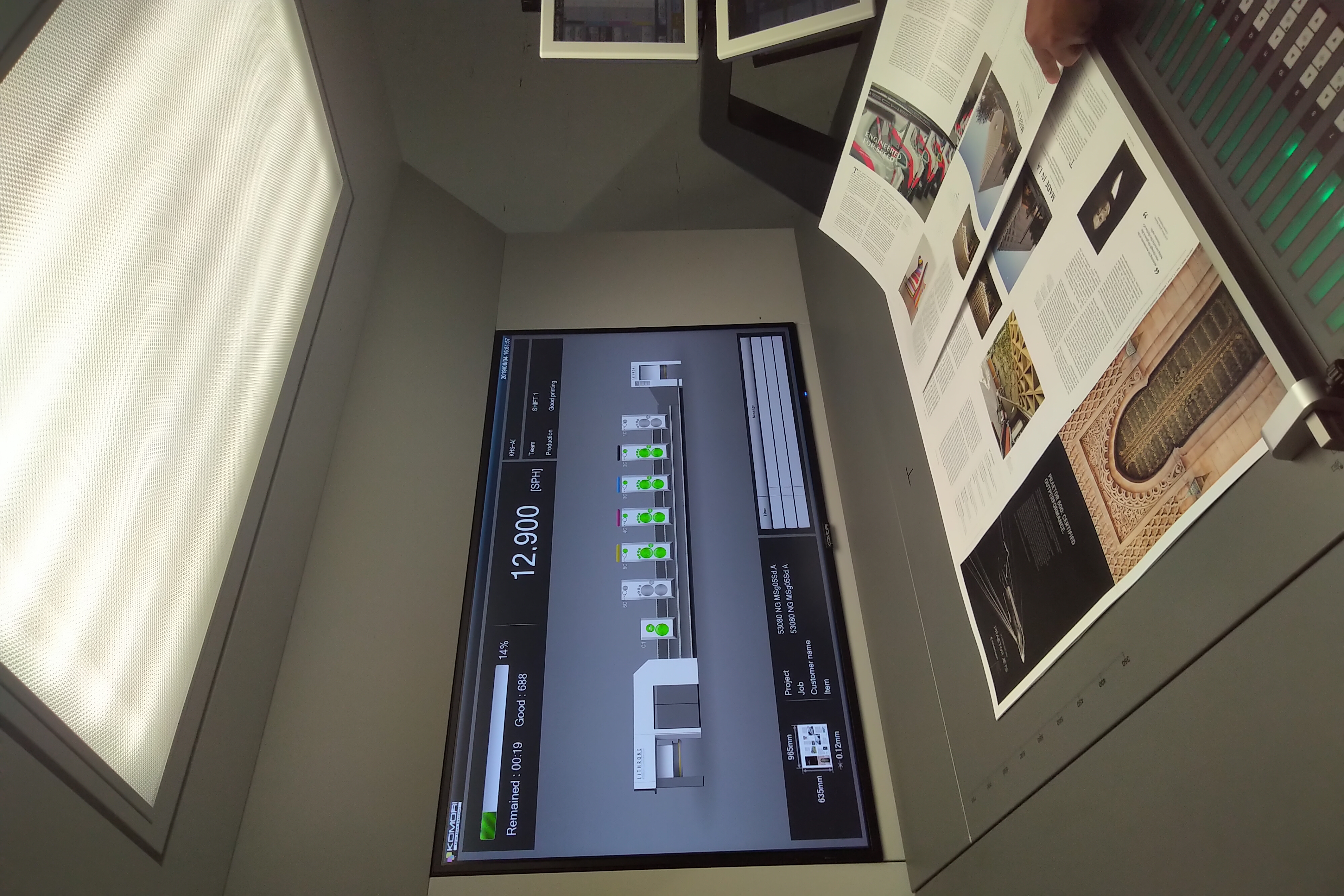
Precision in production is what makes the editorial rigor visible once the words are done, paper stock, print color accuracy, and binding all either confirm or undercut the seriousness of the content. A monograph printed on flat, thin stock with inconsistent color reads as a brochure, no matter how sharp the writing is. Paper weight, finish, and binding method are judgment calls that need the same discipline as the manuscript edit, not an afterthought handled by whichever printer quotes fastest.
This is why separating strategy, editorial, design, and print across different vendors creates risk: each handoff is a chance for the narrative thread to thin out. An end-to-end studio carries the same point of view from the first content audit to the final quality-control check on press.
Cost follows the same logic. An architectural monograph is a premium undertaking priced against editorial depth and production quality, not a commodity print run, and that cost reflects the work of building a narrative worth binding permanently.

Frequently Asked Questions
How is an architectural monograph different from a portfolio or brochure?
A monograph argues a point of view; a portfolio or brochure just displays work. A brochure lists services and projects to win new business, while a monograph builds a narrative around a body of work, a property, or a design philosophy, closer to a serious design document than a sales tool. That editorial rigor, not the page count or paper stock, is what separates the two.
Who typically commissions an architectural monograph?
Architecture and design firms, real estate developers, hospitality groups, and private clients marking a flagship project or firm milestone commission these publications. The common thread is a decision-maker, a principal, CEO, or head of brand, who wants a permanent record of design intent, not a seasonal marketing piece.
How long does it take to produce an architectural monograph?
Most projects run several months from editorial planning through final print, depending on how much photography and writing already exist. The timeline stretches if image rights need clearing or new photography has to be commissioned; it compresses when a firm already has a strong archive. Rushing the editorial spine to hit a deadline usually shows on the page.
Does a small or young design practice need a monograph, or is it only for established firms?
Honestly? Not every young practice needs one yet. A monograph works best once a firm has a body of work substantial enough to support a real narrative, a handful of signature projects, a clear point of view, a story beyond “we’re new and talented.” A firm two years in with three projects is often better served waiting, building the portfolio, and revisiting the idea once there’s enough substance to justify the investment.
Conclusion
An architectural monograph earns its place on a coffee table, and in a client’s memory, because it reads as a design document, not a sales pitch. The firms that get this right start with an editorial spine before anyone touches layout, commit to real photography and writing rather than recycled marketing assets, and treat the project as a long-term brand investment rather than a one-off deliverable. If you’re weighing whether your firm has enough of a body of work to justify one, start by auditing your last five years of projects for a throughline, a genuine point of view is the real prerequisite, not firm size or tenure.
Sources & References
- Custom Coffee Table Book Publishing For Brands & Legacy Projects | Izzard Ink
- Architecture Portfolio Books | Jenkins Group | Custom Design Firm History & Portfolio Books | Architecture Coffee Table Books
- Why Coffee Table Books Still Matter In Interiors
- Reading the architect’s monograph
Recommended Articles
Explore more from our content library: