
A private members club magazine is a custom-designed print publication a luxury brand or club commissions for its members, part brand asset, part retention tool. It works because print carries weight digital channels don’t: a well-made magazine sits on a coffee table, gets picked up again, and signals the quality of the club itself. Leading clubs commission one to reinforce exclusivity, deepen member loyalty, and tell the brand’s story in a format members actually keep, rather than scroll past.
Why Should a Luxury Brand or Private Club Invest in a Member Magazine?
A member magazine earns its budget by doing what digital can’t: it occupies physical space in a member’s home for months, not seconds. An email gets deleted. A social post gets scrolled past in under two seconds. A well-made magazine sits on a coffee table, gets picked up during a slow weekend, shown to a guest, and read again before anyone throws it away.
What role does print play in member retention and brand perception for luxury clubs?
Members read production quality as a direct signal of how seriously the club takes itself. Paper stock, binding, photography, and layout aren’t cosmetic choices, they’re information. A thin, glossy pamphlet printed on cheap stock tells a member the club is cutting corners; a weighty, well-bound publication tells them the opposite.
This matters because luxury purchasing decisions are driven heavily by perceived exclusivity and status signaling [1]. A private members club magazine functions as one more data point in that perception, arriving at a moment when the member isn’t being sold anything, just handed something well made.
On retention specifically, the mechanics are straightforward. Most club communication is transactional: renewal notices, event logistics, dues reminders. A magazine is the rare touchpoint members actually want to receive, which keeps the brand present in a positive context rather than an administrative one, publications built around real editorial programming, not just announcements, tend to be the most-read piece a club produces [5].
How does a member magazine strengthen community and exclusivity?
A magazine reinforces exclusivity simply by being something only members get. A website is open to anyone with a link. A social feed is open to anyone with an account. A printed publication that arrives at a member’s address, and nowhere else, is a tangible marker of belonging that can’t be replicated by a public channel.
That distinction compounds over time. Private clubs already differentiate themselves through amenities, access, and community identity [4]; a magazine extends that same logic into the mailbox, giving members a physical artifact that says they’re inside something, not just subscribed to it.
None of this is a cheap tactic, and it shouldn’t be treated like one. A custom print magazine is a long-term brand investment, the kind that compounds in member perception over years, not a campaign measured in a single quarter. For clubs that already care about how members experience every other touchpoint, that trade-off is the entire point.
What Makes a Private Club Magazine an Effective Marketing Asset?
An effective private members club magazine works because it has a point of view before it has a layout, editorial strategy comes first, design second. Most clubs get this backward, briefing a designer before anyone has decided what the publication is actually for.
A collection of club announcements dressed up with good typography is not a magazine. It’s a bulletin with a better font. Members notice the difference immediately, and so does anyone receiving it as an introduction to the club.
How should editorial strategy and design work together to reflect club values?
Design should express what the club already is, not what a template says luxury should look like. A club built on quiet, old-money restraint needs different typography, pacing, and photography than a club built on energy and social buzz, yet both are routinely handed the same serif-heavy, marble-textured layout because it reads as “premium” on a mood board.
The editorial spine comes first: a defined set of recurring sections, a consistent voice, a reason each issue exists. Design decisions, type choice, image style, white space, how long a feature is allowed to run, follow from that spine rather than from a generic aesthetic borrowed from unrelated industries. This is the same principle that separates a custom print magazine from a brochure with a nicer cover.
What content keeps members engaged across seasons and years?
Content that earns a second read tends to fall into a few repeatable categories rather than one-off features invented from scratch each issue. Clubs that produce engaging member publications over multiple years lean on formats members come to expect:
- Member profiles, not donor recognition, but genuine stories about who belongs to the club and why
- Behind-the-scenes access, the kitchen before a big event, the grounds crew prepping the course, the process members never see
- Seasonal features tied to the club calendar, anchoring content to the rhythm members already live by, rather than generic seasonal filler
- Founder or GM perspective pieces, leadership voice that builds trust and signals where the club is headed
Industry data on club publishing supports this: a member magazine is often the most-read piece a club produces, precisely when it offers unhurried, undistracted attention rather than another sales pitch, and the same source notes a poorly executed one goes straight to recycling [5]. Recurring editorial categories, built and sustained issue after issue, are what separate a publication members anticipate from one they skim once and discard [5].
Consistency does the rest. A recognizable voice, a predictable structure, sections members look for by name, that’s what builds anticipation for the next issue. A single beautiful one-off cannot do that, no matter how well designed; anticipation is built through repetition, not through a single impressive object.
How Do You Create a Private Members Club Magazine People Keep and Share?
Shelf life comes down to three decisions made before a single word is written: paper stock, binding, and photography quality, get those wrong and no amount of good editorial saves the piece from the recycling bin.
What’s the relationship between design quality and how long a magazine stays in a member’s home?
A member decides whether to keep a publication within seconds of picking it up, and that decision is physical before it’s editorial. Thin, glossy stock that curls at the corners reads as disposable. A heavier matte or uncoated paper, a binding that lies flat, and photography shot and reproduced at a quality that rewards a close look, these are what signal “this stays on the table” rather than “this goes in the recycling bin.” Private club marketing specialists note that a member magazine arriving in the mail is one of the few moments a club gets a member’s unhurried, undistracted attention, and that done poorly, it goes straight to recycling [5]. That observation cuts both ways: the same undivided attention that makes print valuable also makes production shortcuts more visible, not less.
How do you balance member stories, club news, and brand narrative in one publication?
The mix has to read as a magazine, not an internal bulletin with a cover redesign. Club news and operational updates matter to members, but a publication built entirely around them feels like a newsletter wearing a magazine’s clothes. The stronger model treats member profiles, a club’s design history, chef or pro-shop features, and seasonal lifestyle content as the spine, with brand and programming news woven in as one department among several, private club publishers typically structure these around six or more recurring editorial categories rather than a single news feed [5]. Photography and layout pacing do real work here too: full-bleed spreads, varied image sizes, and deliberate white space slow a reader down, while a dense, text-heavy page invites flipping rather than reading.
This is also where the sharing case gets made. A private members club magazine built to this standard becomes something a membership director hands to a prospective member, or leaves in a guest suite, reach no app notification or email newsletter can replicate, because it travels physically into rooms a digital channel never enters. It’s a reach multiplier that clubs frequently leave on the table. Many still treat the magazine budget as a line item to shrink rather than an asset whose value compounds with every year a member keeps an issue on a shelf. Rethink Publishing builds its editorial spine and design direction around exactly this calculation, pairing photography and layout with the goal of a kept object, not a quick read, from the first issue onward.
How Does a Member Magazine Differ From Other Club Communications?
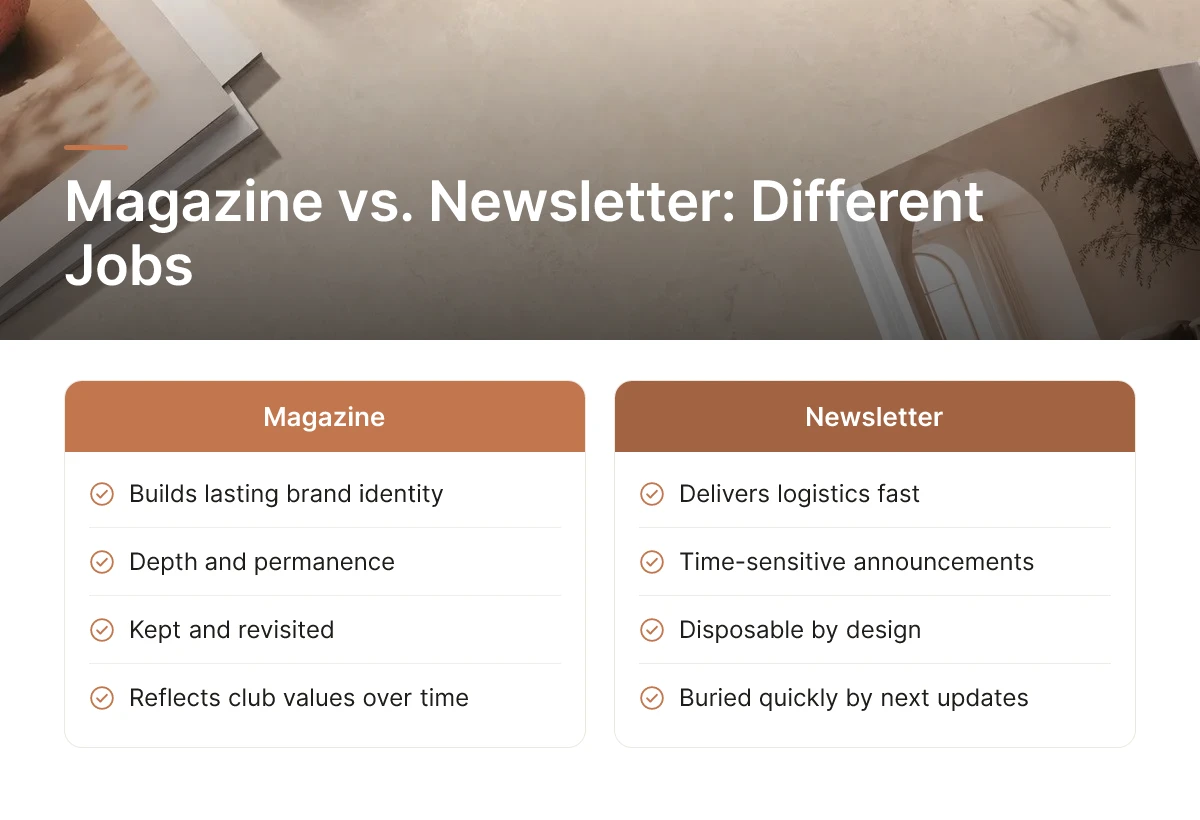
A magazine and a newsletter do different jobs: one builds lasting brand identity through depth and permanence, the other delivers logistics fast and gets discarded. Confusing the two wastes budget on the wrong format.
Email newsletters are built for frequency. They announce the new chef, the tee-time changes, the holiday closure schedule, useful, time-sensitive, and disposable by design. A social feed works the same way, just faster and noisier: a post about last weekend’s member event is gone from attention within a day, buried by the next twenty things competing for a thumb’s worth of scroll. Neither format is wrong. They’re simply not built to carry weight. A member magazine, printed and placed on a coffee table or a desk, doesn’t compete for attention in the same five-second window, it sits, gets picked up again, and gets shown to a guest weeks later.
When should a club choose print over digital for member engagement?
Print earns its place when the moment is about identity, not logistics. Anniversary issues, a flagship property’s history, the founding story told properly, an annual retrospective of the club’s season, these are the moments that justify the cost and lead time of a printed piece. A newsletter can tell members the pool hours changed; it can’t make a seventy-fifth anniversary feel like one. A private members club magazine exists for exactly that gap: the content too significant, too visual, or too permanent to live inside an inbox.
How does a curated magazine differ from newsletters, websites, or social media?
The difference isn’t length, it’s structure. A newsletter is a list of updates; a magazine has an editorial spine, a point of view, features built around sourced reporting and commissioned photography rather than recycled marketing copy [5]. Private club newsletter programs typically run on far shorter production cycles and page counts than a flagship annual publication [5], which is the right trade-off for their job. A magazine reads more like something a member chooses to spend twenty minutes with, not something skimmed in transit. The two can run in parallel without duplicating effort, one keeps members informed, the other keeps the brand remembered.
How Do You Plan and Execute a Private Club Magazine From Strategy to Print?
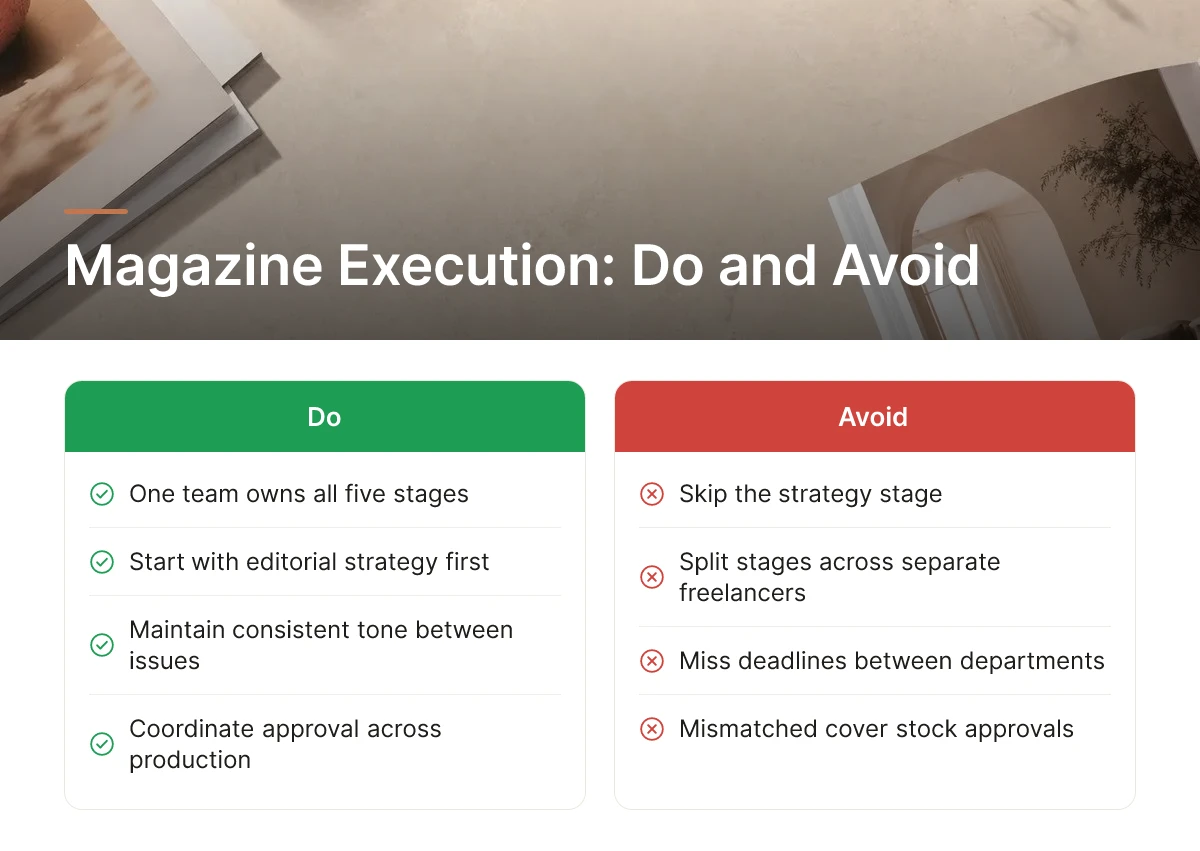
A private members club magazine moves through five stages, editorial strategy, content gathering, design, print production, and distribution, and the work holds together only when one team owns all five.
Skip the strategy stage and you get a magazine that looks like a brochure with a masthead. Split the stages across a design freelancer, a copywriter, and a separate print shop, and you get the real failure mode: missed deadlines, inconsistent tone between issues, and a cover stock that doesn’t match what the club approved three weeks earlier.
What does the end-to-end process look like, from editorial vision to delivery?
It starts with an editorial spine, the recurring departments, the member profiles, the seasonal features that give each issue a shape before anyone writes a word. From there, the process moves into content gathering: interviews with members and staff, photography direction, and sourcing images that match the club’s visual register rather than generic stock. Design and layout come next, pairing copy and imagery with intention rather than dropping text into a template. Then print production, stock selection, proofing, quality control, followed by distribution timed to the club’s actual calendar, not a generic quarterly default.
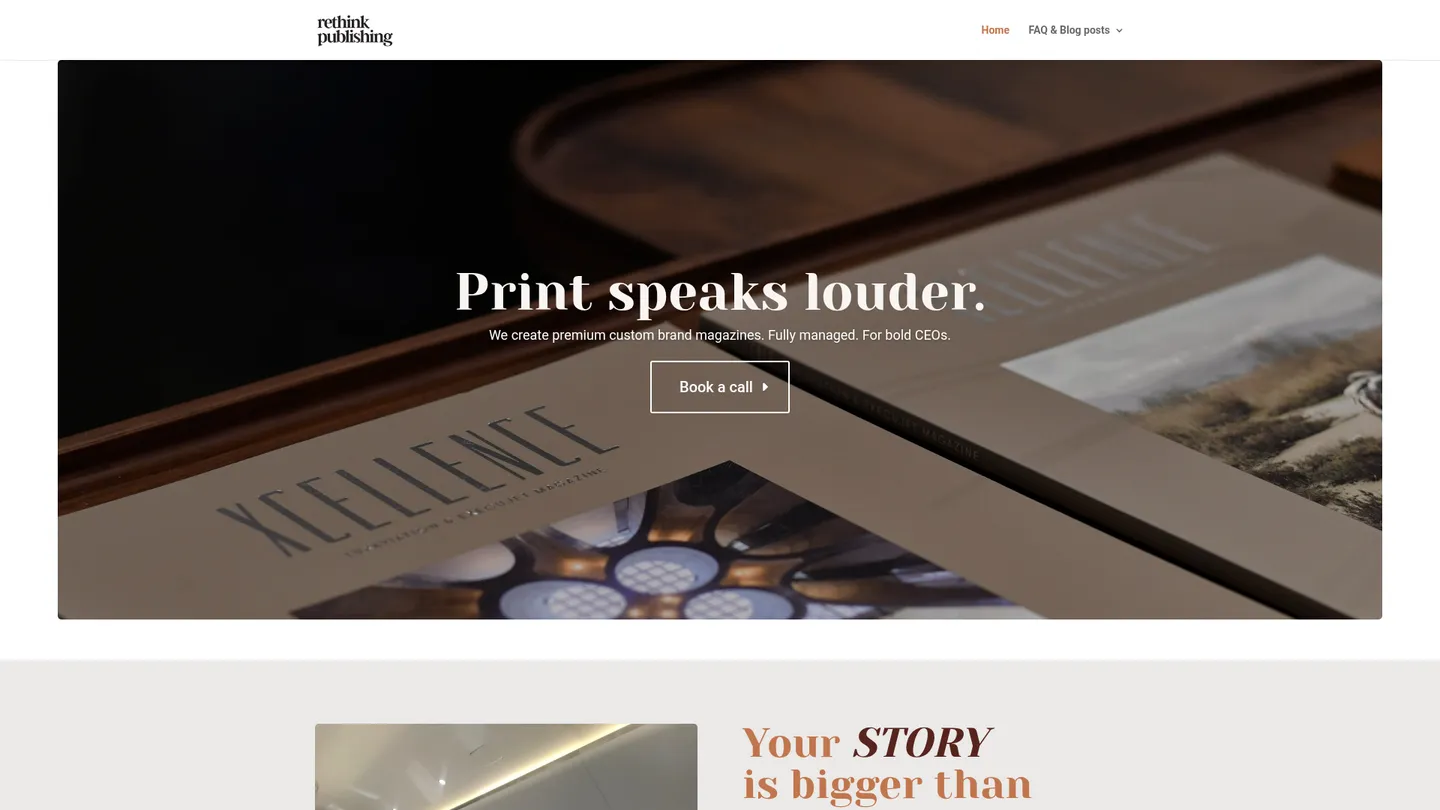
Rethink Publishing runs this as one managed process rather than a series of handoffs, which is the same discipline behind its 80-plus magazines and 30-plus coffee-table books produced for hospitality, design, and private-club clients. One team carrying the work from brief to delivery means no gap where a design file disappears over a holiday or a printer substitutes paper stock without approval.
Cost scales with the decisions clubs make here, not a flat rate. Page count, paper stock, print run size, and publishing frequency all move a project between budget-friendly and premium tiers, a thinner seasonal newsletter costs less to produce than a thick annual flagship issue printed on heavier stock for every member household. The right tier depends on what the magazine needs to do, not on finding the cheapest vendor.
How do you measure whether a member magazine is working as a brand investment?
Look for it showing up in conversations you didn’t orchestrate. Renewal calls where members mention a feature from the last issue. Requests for extra copies to hand to a prospective member or a guest. Prospective members citing the magazine, unprompted, as part of why the club felt different from others they toured. And the simplest signal of all, a member magazine still sitting on a coffee table months after it arrived, rather than in a recycling bin the week it landed.
None of that happens on a generic publishing calendar bolted onto the club’s operations. Plan around the membership cycle you actually have, renewal season, flagship events, the rhythm of the clubhouse year, and the magazine starts working as a retention tool instead of a line item.
Frequently Asked Questions
How often should a private club publish its member magazine?
Most clubs publish quarterly, with some running a biannual flagship issue supplemented by shorter seasonal newsletters. The right cadence depends on your editorial calendar and programming cycle, a club with a packed event schedule has more to report on than one with a quieter social calendar. What matters more than frequency is consistency: members should know when to expect it.
Can a small or boutique club justify a custom member magazine?
Yes, if the club has a strong identity and a membership that values permanence over another email. Size matters less than intent, a 200-member club with a distinct culture often has more to say than a 2,000-member club with generic programming. The investment should match the goal: retention and perceived prestige, not volume of pages. Scope the publication to the story you actually have.
Does a member magazine replace the need for a club website?
No, a magazine and a website serve different jobs and neither replaces the other. The website handles transactions, bookings, schedules, account access. The magazine handles the emotional case for membership: the stories, the people, the culture that justifies the dues. Clubs that treat them as competing channels usually end up weakening both.
Who should be involved from the club’s side when producing a magazine?
Typically the general manager or head of membership, plus whoever owns brand or marketing decisions. One person should hold final editorial sign-off to keep the publication coherent rather than committee-written. Input from board members or committee chairs is useful for story ideas, but too many editorial voices tends to flatten the magazine into something generic. A fully managed studio handles the rest, writing, design, production, so the club’s team isn’t pulled into day-to-day execution.

Conclusion
A private club magazine earns its place only when it’s treated as an editorial product, not a newsletter with better paper stock. Get the cadence right, protect editorial sign-off with one decision-maker, and resist the urge to make it do a website’s job. The clubs that get this right end up with something members keep rather than recycle, and that’s the entire point of the investment.
If you’re weighing whether your club has the story to support one, start by auditing a year of member touchpoints and asking what’s actually worth keeping. Rethink Publishing can help you answer that question before a single page is designed.
Sources & References
- Luxury Marketing: A Deep Dive into High-End Branding | Sotheby’s Institute of Art
- Private Club Marketing Guide & Strategy Insights
- Newsletter & Magazine Design | Private Club Marketing
Recommended Articles
Explore more from our content library: