
Understanding pilot issue brand magazine is essential. Yes, launching your brand magazine with a pilot issue first is almost always the smarter move. A pilot issue is a single, fully realized trial edition you produce before committing to an ongoing publishing schedule, letting you test editorial direction, format, and audience response with real feedback instead of assumptions. It costs less than a full launch, but it still needs to look and feel like the real thing, because a rough draft won’t tell you anything true about how your audience responds to the finished product.

Should You Launch Your Brand Magazine With a Pilot Issue First?
Most companies considering a pilot issue brand magazine should run the pilot, but only if they treat it as a real publication, not a rehearsal.
What Is a Pilot Issue in the Context of Brand Publishing?
A pilot issue is one complete, finished edition of your magazine, full length, fully designed, fully printed, produced before you commit to a quarterly or biannual schedule. It is not a mock-up, a watered-down sample, or a few sketched-out pages for an internal meeting. If it doesn’t read like something a client would pick up off a coffee table, it isn’t doing its job.
That distinction matters because a pilot issue brand magazine still needs an editorial spine, a defined point of view, a mix of features and departments, a reason someone keeps reading past page two. A brochure with your logo on the cover and testimonials inside is not a pilot issue. It’s brand messaging wearing a magazine’s clothes, and readers notice the difference within the first spread [1]. The whole value of piloting comes from testing something real. Test a diluted version and you learn nothing true about how your audience actually responds.
When Does a Pilot Issue Make Sense Versus Going Straight to a Full Launch?
Skipping the pilot can be the right call in specific, narrow circumstances. If your brand already runs a proven editorial format elsewhere, a newsletter with strong open rates, a video series with real audience retention, you’ve already validated the content’s appeal; you’re just changing the format it lives in. The same goes for leadership teams with genuine in-house publishing experience, where the internal appetite and editorial judgment are already established.
For everyone else, a pilot is the smarter starting point. New editorial territory, a brand that’s never told stories this way before, carries real risk if you commit to four issues a year before you know the format works. Unproven internal appetite is another signal: if you’re not certain your leadership team, sales staff, or clients will actually engage with a print magazine, one issue answers that question for a fraction of a full annual commitment. And the first time working with an outside publishing partner, a pilot lets both sides calibrate, on tone, on pace, on what “done” looks like, before locking into a long-term cadence.
None of this applies if your company shouldn’t have a magazine at all. A pilot issue brand magazine only makes sense if you have a genuine editorial story to tell and an audience who’ll value holding it. If neither is true, piloting won’t fix that, it will just prove it faster.
What Strategic Advantages Does a Pilot Issue Brand Magazine Offer?
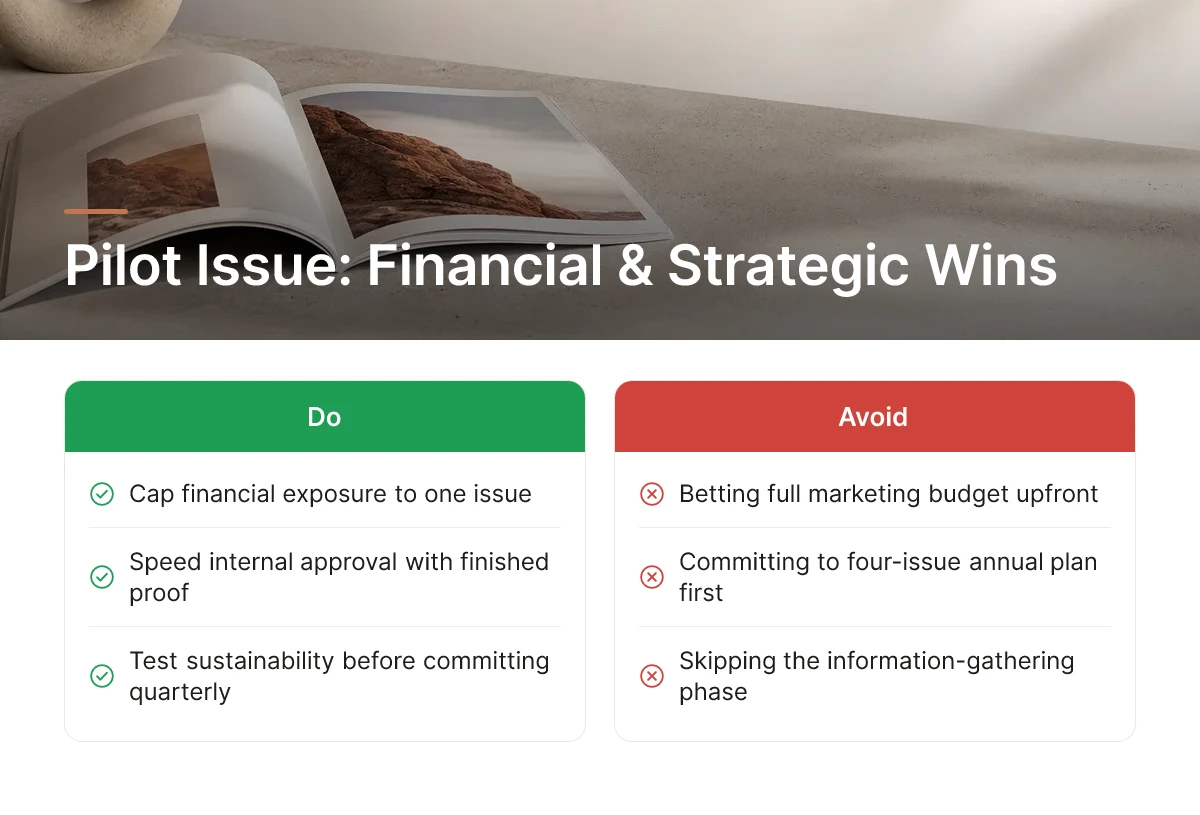
A pilot issue brand magazine caps your financial exposure, speeds internal approval, and tells you whether your company can actually sustain a publishing program before you promise one.
Those four benefits compound. A CEO who greenlights a single issue isn’t betting the marketing budget on an unproven format, they’re buying information. And that information costs far less than a year-long editorial calendar committed before anyone has seen a finished page.
How Does a Pilot Issue Reduce Risk in Magazine Publishing?
Committing to one issue means committing to one production run and one print bill, not a four-issue annual plan, a distribution strategy, and a staffing model built on assumptions. That’s the financial case in plain terms: you pay to find out if this works before you pay to scale it.
The internal politics matter just as much as the budget math. A finished, bound magazine sitting on a boardroom table does something a strategy deck never does, it gives stakeholders something to react to. Marketing executives can point to a real object when asking for next year’s budget. Founders can hand a physical issue to a skeptical board member instead of describing a vision. A pilot converts an abstract pitch into a tangible asset people can pick up, flip through, and judge on sight.
A single issue also exposes production problems while the cost of failure is still small. Editorial turnaround times, the reliability of a print vendor, and whether your internal teams can supply content on deadline, all of this surfaces during a pilot, not after you’ve announced a quarterly publication to clients. Better to discover a bottleneck in month one of a single project than month three of a four-issue commitment.
What Can You Learn About Your Audience From a Pilot Issue?
The real audience research happens after delivery, not before: which sections get read, which stories get shared or kept, and what readers say when you ask them directly. A brand magazine built around lifestyle storytelling rather than overt sales messaging works because readers see themselves in the content [1], but you only confirm that by watching what a specific group of real readers actually does with a specific issue.
This is different from a focus group or a survey. You’re watching behavior: Did the client keep it on their desk for a month, or recycle it? Did the feature on your flagship property get forwarded internally, while the founder profile got ignored? That’s the kind of signal a pilot issue brand magazine generates, concrete, specific, and tied to real content decisions you can adjust before issue two.
A pilot also answers a quieter question: can your company actually resource this on an ongoing basis? Running one issue through editorial, design, and print reveals whether you have the internal content supply, the approval speed, and the budget discipline to repeat it, before you’ve told customers or staff to expect a regular publication. Rethink Publishing manages that full production cycle end to end, so the pilot tests your organization’s readiness, not your ability to run a print project yourself.
How Do You Structure and Execute a Pilot Issue?
A pilot issue brand magazine runs on four decisions: timeline, budget, print run, and distribution, all managed as one coordinated process, not four separate vendor relationships.
What Should Your Pilot Issue Budget and Timeline Look Like?
Most companies underestimate editorial lead time, not design or print time. Interviewing sources, drafting features, and getting internal sign-off on copy routinely takes longer than the layout and production stages combined, a realistic pilot runs several months from concept to a printed, mailable object, with editorial development claiming the largest single share of that window.
The budget conversation is simpler than it looks. A pilot issue should be a smaller, contained investment compared to what a full annual or quarterly program would require, proof of concept before commitment, not a scaled-down version of the real thing done cheaply. Treat it as a bounded test with a defined end point, not an open-ended first step into ongoing publishing.
Companies that skip this framing tend to either overspend trying to make the pilot look like issue twelve of an established magazine, or underspend and produce something that reads as a brochure rather than an editorial product [1]. Neither outcome tells you anything useful about whether the format works for your audience.
How Many Copies Should You Print for a Pilot Issue?
Print enough copies to reach a real, external sample of your actual target audience, not just the executive team and a few favored clients. A run limited to internal stakeholders tells you whether your CEO likes the cover. It tells you nothing about whether a prospective client, tenant, or member finds the content worth keeping.
Sizing the run means identifying a meaningful slice of the audience you’d eventually mail the full program to, enough names that response and engagement data mean something, small enough that the cost stays contained. There’s no universal number; it depends on the size of your actual client list or prospect base.
Distribution matters as much as volume. If the real magazine will be mailed to top-tier clients alongside a handwritten note, test it that way, not as a PDF emailed to a distribution list. A pilot tested under different conditions than the eventual rollout produces a result you can’t trust [5].
This is where fragmented vendor relationships usually cause pilots to stall, one firm handling editorial, another design, a separate printer, no one accountable for the whole arc. Rethink Publishing manages strategy, editorial, design, print production, and delivery as a single process, which is what keeps a pilot issue brand magazine moving on schedule instead of stuck between handoffs.
What Editorial Decisions Should Guide Your Pilot Issue?
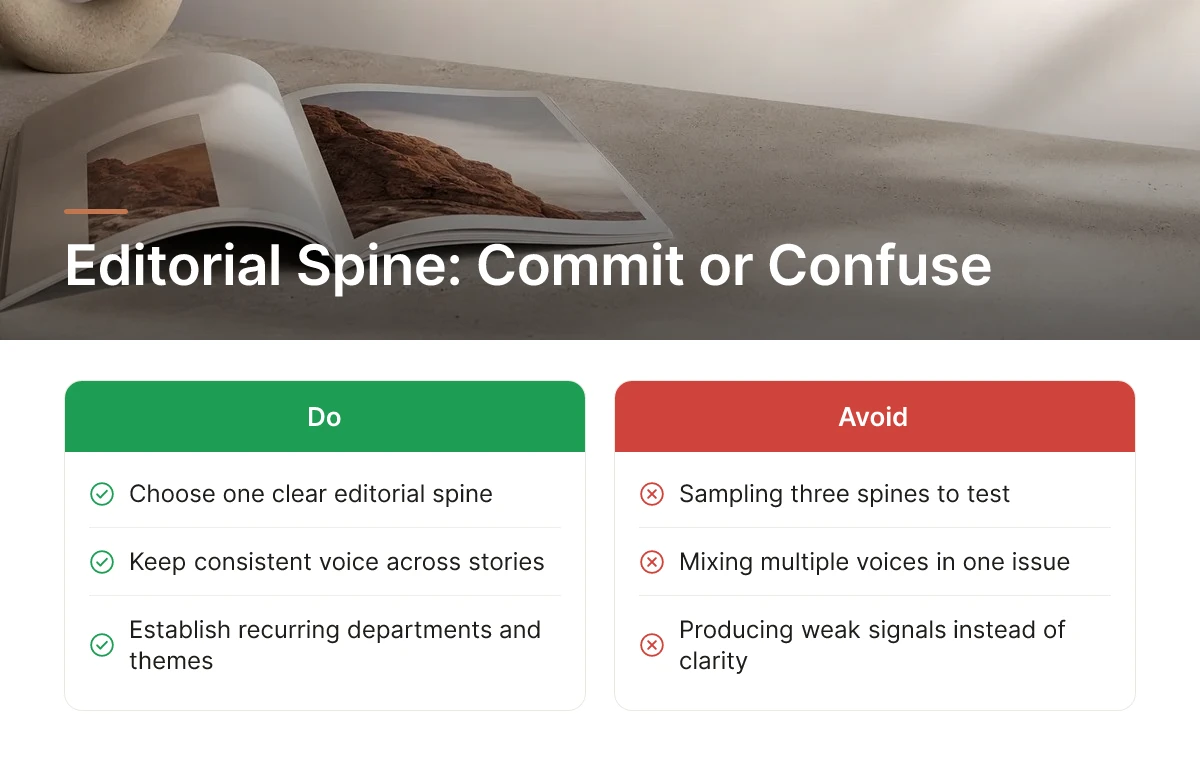
A pilot issue brand magazine earns a trustworthy test only when it commits to one editorial spine, one voice, and one production standard, not a sampler of options.
How Do You Choose Your Editorial Spine and Voice in a Pilot?
The editorial spine is the throughline that makes a magazine recognizable issue after issue, the recurring departments, the themes the brand keeps returning to, the voice that stays consistent whether the story is about a hotel opening or a design partner profile. A pilot that tries to sample three different spines to see “what sticks” doesn’t produce a test. It produces three weak signals instead of one clear one.
Pick a spine before you write a single page, then build the whole pilot issue brand magazine around it. If the spine includes a profile department, a design feature, and a short-form opinion column, the pilot needs all three executed at full strength, not two done well and one dropped for time.
Voice is where internal teams most often get it wrong. Marketing departments tend to default to the tone they already use in sales decks, polished, promotional, safe. Readers of an editorial product expect something closer to a magazine they’d actually subscribe to: opinionated, specific, willing to name a flaw. The test question isn’t “does this sound like us,” it’s “would our reader finish this article if our logo weren’t on it.” If the answer is no, the voice needs work before the pilot goes to print.
Should Your Pilot Issue Look and Feel Like the Final Magazine?
Yes, a pilot built on thinner paper stock, a tighter budget, or a rushed design pass tests the wrong thing entirely. Readers don’t grade on a curve for “it’s just the pilot.” They hold the object in their hands and judge it the way they’d judge any finished magazine on their coffee table [5]. A cheaper trial run produces cheaper feedback: readers react to the compromises, not the editorial premise you actually wanted to test.
This is also where scope discipline matters. A pilot issue isn’t the place to prove every idea the brand has ever had for the publication. Pick the one or two departments that carry the strongest editorial case, execute them at full production quality, and leave the rest for issue two. A focused 40-page pilot that reads like a real magazine will tell you more than a 90-page pilot padded with half-finished sections.
How Does a Pilot Issue Inform Your Full Magazine Launch?
A pilot issue brand magazine earns its cost only if someone reads the results closely and uses them to decide frequency, format, and whether to proceed at all.
What Metrics and Feedback Should You Gather From Your Pilot?
Look past vanity reactions and track what actually happened to the physical copies you sent out. Did a client mention a specific story in a follow-up call? Did your sales team start handing it out unprompted, or did it sit in a box in the supply closet?
Four signals matter most. Direct reader feedback, a short survey, or better, a few real conversations with clients who received it. Sales and relationship conversations where the issue comes up unprompted, which tells you it created a reason to talk. Internal reactions from your own team, who often spot tonal problems before any outsider does. And the hardest but most honest signal: pass-along and retention. Does it get kept on a desk or a coffee table, or does it end up in the recycling bin within a week? That last one is difficult to fake and difficult to game, which is exactly why it matters.
How Do You Use Pilot Issue Results to Refine Your Magazine Strategy?
Separate feedback about the editorial concept from feedback about execution, one requires a rethink, the other just needs a fix. If three people say a particular section felt flat, that’s a design or writing issue you correct in issue two. If nobody mentions the magazine again after receiving it, that’s a concept problem worth taking seriously.
Pilot results should shape decisions on frequency, section mix, and length, not function as a simple pass or fail verdict. Maybe quarterly makes more sense than the biannual schedule you planned. Maybe the profile section landed harder than the trend roundup, so it gets more pages next time. This is also the point where a pilot can justify changing direction entirely: reworking the concept, shifting the audience, or honestly, concluding a print magazine isn’t the right investment for this audience right now. That’s a legitimate outcome, not a failure.
Either way, the pilot’s job ends here. Once it has told you what to build, print, or scrap, its purpose is done, the real publication is what gets attention from that point forward. Studios that manage the full cycle, including Rethink Publishing, tend to build this review step directly into the process so pilot feedback has somewhere concrete to go before the next issue goes to print.
Frequently Asked Questions
How long should a pilot issue take to produce?
A well-run pilot issue typically takes three to five months from strategy to delivery. That window covers editorial planning, writing, image sourcing, design, and print production, the same disciplines a full launch requires, just applied to a smaller page count. Rushing the timeline is the fastest way to end up with something that reads like a brochure instead of a magazine.
Can a pilot issue be distributed digitally instead of in print?
You can test a pilot digitally, but it won’t tell you what you actually need to know. The entire case for a brand magazine rests on physical permanence, something that sits on a coffee table and doesn’t disappear into a feed [5]. A digital-only pilot measures clicks, not the weight-in-hand reaction that print is built to deliver.
What happens if the pilot issue doesn’t perform well?
A pilot that underperforms is still useful, it tells you what to fix before a bigger investment is on the line. Weak performance usually traces back to an unclear editorial spine, content that reads as advertising rather than storytelling [1], or distribution to the wrong list. The fix is rarely “abandon print.” It’s revisiting the brief, the audience, and the story before issue two.
Does a pilot issue need its own name or branding separate from the planned magazine title?
No, the pilot should carry the final magazine’s intended name and design identity from the start. Testing under a throwaway title defeats the purpose, since you want honest reactions to the actual brand asset you plan to keep producing, not to a placeholder.
Conclusion
A pilot issue works because it turns an expensive assumption into a tested decision. Before committing to a recurring print magazine, you get real evidence: whether the editorial spine holds, whether clients keep the issue instead of recycling it, whether the format earns a place at the next budget review. Treat the pilot with the same editorial rigor as issue twelve, same title, same design discipline, same production standard, because a diluted test produces a diluted answer. If you’re weighing whether your brand has enough story to sustain a magazine, the next step is a strategy conversation, not a design mockup. Start that conversation at www.rethink-publishing.com.
Sources & References
- How a brand magazine can be the missing link in your content marketing
- Smart Brands Are Returning to Print, PRINT Magazine
Recommended Articles
Explore more from our content library: