
A corporate anniversary book is a premium, custom-designed publication that marks a company’s milestone, often a 25th, 50th, or 100th year, by turning its history into a lasting print artifact. Unlike a brochure or internal report, it functions as a strategic brand asset: something clients, employees, and partners actually keep on a shelf or coffee table. Companies typically commission one around major milestone years, when there’s enough institutional history to tell a real story and enough brand equity worth reinforcing. Done well, it strengthens relationships with the people who already matter to the business, not strangers who’ve never heard of it.
What Is a Corporate Anniversary Book and Why Does It Matter for Your Brand?
A corporate anniversary book is a custom print publication built around a milestone year, structured like a magazine or history volume rather than a sales document. It has an editorial spine, chapters, chronology, voice, photography selected to support a narrative, not a list of services or a pitch for next quarter’s budget. That distinction matters because it changes how the reader approaches the object. A brochure gets skimmed and recycled; an edited, well-designed book gets read.
Annual reports exist to satisfy a reporting obligation. Marketing brochures exist to move a prospect toward a decision. A corporate anniversary book exists to do neither, it exists to tell the truth about where a company came from and why that history still matters to the people reading it now. That’s a different writing problem, and it requires different craft: real reporting, real photo research, real editorial judgment about what to cut.
How does an anniversary book function as a strategic marketing asset, not just a keepsake?
It earns its place on a desk or coffee table instead of a recycling bin, which is the entire point, longevity in the room is the asset. Bookhouse Group, which has produced commemorative histories for decades, frames milestone anniversaries as rare events worth capturing before institutional memory fades, the stories “could be lost forever” if nobody commits them to print [1]. That permanence is also what makes the book useful long after the anniversary year ends. A brochure gets updated annually and discarded; a well-made anniversary book stays relevant because it’s documenting a fixed point in history, not a current price list.
What business outcomes can a well-executed anniversary book deliver?
Done right, it deepens relationships with clients and partners who already matter, gives leadership a credible artifact for key accounts, and reinforces brand positioning at a moment when trust is already improved. One custom publisher notes that an anniversary book acts as “a tactile—and memorable—invitation” for clients, associates, donors, or students to learn more about an institution [3]. Another points to its value as an authoritative internal reference, “a handy reference guide for employees, investors, customers and other stakeholders” [4]. Those are concrete, usable outcomes: a sales leader handing a bound book to a 20-year client, a new hire understanding the company’s founding story in a way no onboarding deck achieves.
None of this applies to every business turning a round number. It applies to companies with a real history, founders worth naming, decisions worth explaining, a client base worth thanking, and the budget to treat that history with the production quality it deserves. At Rethink Publishing, that qualifying conversation happens before any design work starts, because a thin history forced into 80 pages reads as padding, not legacy.
What Should You Include in a Corporate Anniversary Book to Tell Your Story Authentically?
The content that makes a corporate anniversary book worth keeping is a mix of founder history, cultural texture, and a forward-looking chapter, not a list of achievements with a cover on it.
Most companies start planning one of these books by pulling old press releases, employee photos, and a founder bio, then handing it to a designer to arrange. That produces a document, not a story. The companies that get it right treat content selection as an editorial decision, not an archival one, deciding what the book is about before deciding what goes on each page.
How do you balance company history with forward-looking vision in your narrative?
Balance the past with a genuine forward-looking section so the book reads as a living brand story rather than a retirement speech. A 25-year or 50-year milestone is a natural moment to look backward, but a book that only looks backward reads like a eulogy for a company that’s still operating. The strongest anniversary books devote real space, not a token closing page, to where the company is headed: new markets, the next generation of leadership, the problems it’s still trying to solve.
The other trap is structural. A strict year-by-year timeline, founded in this year, opened this office in that year, hit this revenue milestone, reads like a résumé stretched across 100 pages. Bookhouse Group, which has produced commemorative histories for milestone anniversaries, frames the goal as capturing stories that risk being lost rather than cataloging dates [1]. The fix is an editorial narrative with a point of view: pick three or four threads, a founding risk that almost failed, a cultural value that shaped hiring, a client relationship that redefined the business, and let chronology serve the story instead of dictating it.
What role do photography, design, and editorial curation play in making content resonate?
Original photography and considered layout do more to establish credibility than any amount of text, because stock imagery and dense paragraphs signal a brochure, not a brand artifact. A page of generic handshake photos and three columns of copy reads like every other corporate PDF a client has already ignored. Custom photography of real people, real offices, and real moments, paired with layout that gives images room to breathe, is what makes someone stop flipping and start reading.
This is where editorial curation matters as much as design. Every photo and paragraph should earn its place by advancing the narrative, not filling a page count. At Rethink Publishing, this curation happens before layout begins, through an editorial spine that determines what the book is actually saying, the design decisions follow from that, rather than the other way around.
Finally, credibility comes from whose voices appear on the page. A book built entirely from leadership quotes reads as self-congratulatory. Including employees, long-term clients, and community partners, people with no obligation to flatter the company, gives the story the texture outside readers actually trust.

How Does a Professionally Designed Anniversary Book Differ from a DIY Approach?
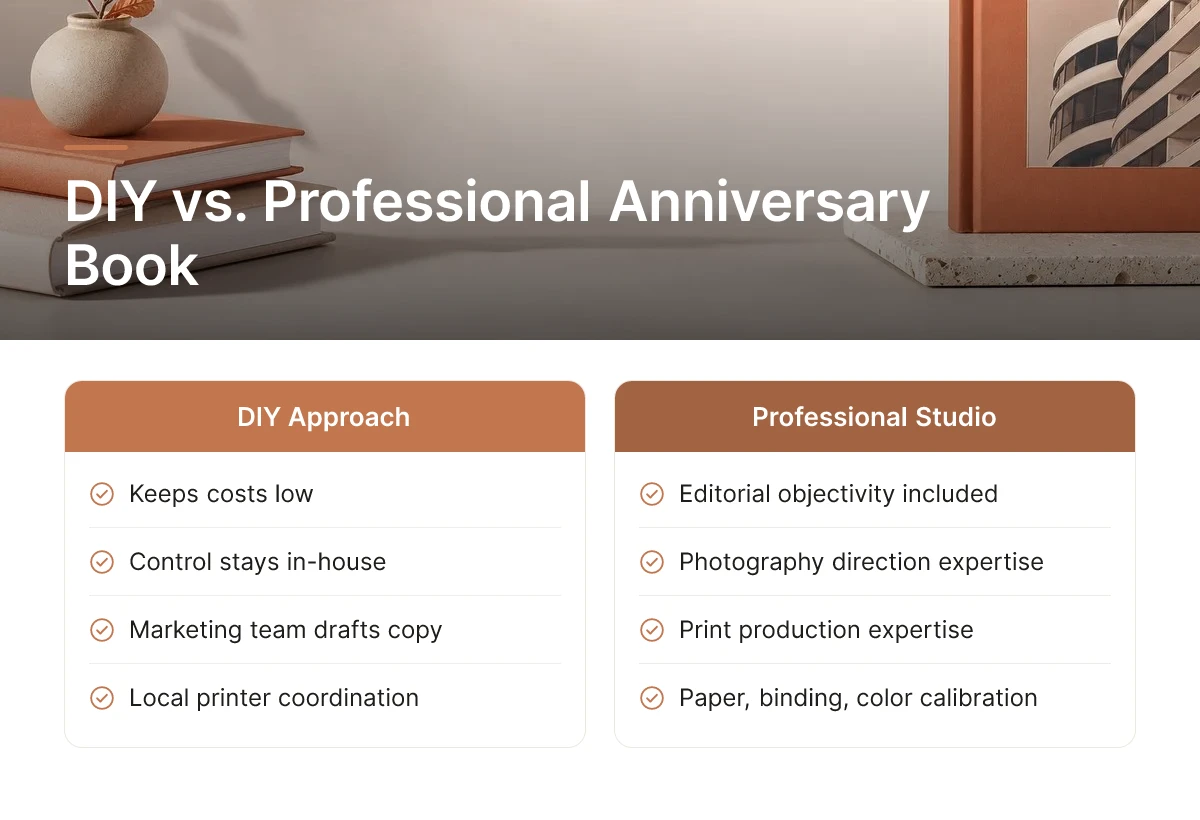
A DIY corporate anniversary book keeps costs low and control in-house, but it usually lacks the editorial objectivity, photography direction, and print expertise a specialized studio brings to the same project. The gap shows up less in the writing and more in the production decisions nobody on a marketing team makes every day: paper stock, color calibration, binding, image licensing, page pacing.
An in-house approach typically means the marketing team drafts copy, a designer builds layout in whatever software is on hand, and someone coordinates with a local printer. That can work for a simple internal keepsake. It struggles the moment the project needs to double as a client-facing brand asset, because writing, design, and print become three disconnected handoffs instead of one directed process.
When does professional design and editorial strategy justify the investment?
The investment earns its keep when the milestone is significant, the intended audience is large or influential, and the book will actually get used in relationship-building, handed to clients, displayed in a boardroom, mailed to partners [4]. A 10-year milestone for an internal team might call for a budget-friendly, modest keepsake. A 25th, 40th, or 100th anniversary meant for clients, investors, and the board is a different undertaking entirely, closer to the premium tier, because the stakes for how the brand is perceived are higher [5].
Company size matters too. Nonprofits, universities, and Fortune 500 companies all use anniversary publishing to strengthen brand and reputation [3], but the scale of distribution and the sophistication of the intended readership should guide how much editorial and design investment the project deserves.
What are the trade-offs between in-house production and working with a specialized publishing studio?
In-house production trades quality and speed for lower upfront cost and more direct control over the process. Marketing teams rarely have in-house staff who do this kind of editorial work daily, and that inexperience tends to surface as inconsistent tone, uneven image quality, or printing problems discovered after the run is already ordered.
A specialized studio runs strategy, editorial, design, and print as one coordinated process rather than three separate vendors stitched together. At Rethink Publishing, that means the editorial spine gets defined before a single layout is built, and the same team that writes the story also manages image sourcing, print production, and quality control through delivery, so nothing gets lost in translation between departments.
None of this means every company needs one. If the anniversary is modest, the audience small, and the book won’t do much relationship work beyond sitting in a drawer, a simpler in-house version may be the honest answer. Save the full investment for the milestone that actually deserves it.
What’s the Right Timeline and Process for Creating a Corporate Anniversary Book?
Start planning 9 to 12 months before the milestone date, and treat the process as six sequential stages, strategy, research, writing, design, print, and delivery, each of which depends on the one before it being done properly.
How does complexity scale with milestone size, 50-year versus 100-year anniversaries?
A 50-year anniversary usually means founders or early employees are still alive and reachable, which shortens the research phase considerably. Interviews fill in what archives can’t, and there are fewer generational gaps to stitch together into one coherent narrative.
A 100-year anniversary is a different undertaking. Multiple generations of leadership have come and gone, archival material may be scattered across old filing systems or lost entirely, and the narrative has to connect founding decisions to decisions made decades later by people who never met each other [4]. Orange Frazer Press notes that anniversary books commissioned by universities, foundations, and Fortune 500 companies alike face this same timeline pressure regardless of institution type [3]. The research effort for a century of history is rarely double that of a 50-year project, it’s often closer to triple, because the gaps themselves take time to locate and verify.
What does an end-to-end publishing process look like, from strategy through delivery?
The work breaks into stages that build on each other:
- Strategy and discovery: defining what the book needs to accomplish, client retention, employee pride, an investor-facing artifact, before a single page is designed.
- Archival and interview research: pulling photographs, records, and firsthand accounts from founders, retirees, and long-tenured staff while they’re still available.
- Editorial writing: shaping raw material into a narrative with a clear through-line, not a chronological list of facts.
- Design and layout: pairing text and imagery with intention, so the book reads as a magazine or coffee-table piece rather than a printed report.
- Print production: paper selection, binding, and quality control, where corners cut show up permanently.
- Delivery and distribution planning: deciding who receives a copy, clients, board members, employees, and when, often timed to a launch event.
Rethink Publishing runs every corporate anniversary book through this same sequence, managing each stage so the client never has to coordinate writers, designers, or printers directly. Rushing the archival or interview phase is the most common way projects lose quality, a founder’s story told under deadline pressure reads thinner than one given room to unfold. Starting early protects access to aging founders, seasonal photography, and the kind of unhurried interviews that make a history worth keeping.
How Do You Measure the Impact of an Anniversary Book After It’s Published?
You measure impact the way you measure any relationship-building asset: through conversations started, copies requested, and how long the book stays visible on a client’s desk. There’s no click-through rate for a printed page, so the signals are qualitative, and for a corporate anniversary book, that’s not a weakness, it’s the point.
What distribution strategies maximize engagement with your audience?
How the book reaches people matters as much as what’s inside it. A mass mailing treats the book like a brochure; a hand delivery treats it like what it actually is, a gift that signals the relationship matters.
The strongest distribution patterns we see favor intention over volume:
- Hand-delivering to key clients during an existing meeting or site visit, rather than shipping it cold
- Seeding copies at leadership events, board dinners, partner summits, anniversary galas, where the book becomes part of the room’s atmosphere, not an afterthought in a goodie bag
- Including it in new-hire and new-partner welcome packages, so the company’s history becomes part of how people are onboarded into the relationship
Each of these puts the book in front of someone at a moment they’re already paying attention. That context does more for perception than print volume ever could.
How do you track whether an anniversary book strengthens client relationships and brand perception?
Track it through what people do with the book after they receive it, not through a dashboard. Three signals tend to recur among companies that take distribution seriously:
- Conversations it sparks. Account managers report clients referencing specific stories or milestones from the book in follow-up meetings, a sign it was actually read, not shelved.
- Requests for extra copies. When a client asks for a second or third copy to give to their own partners, that’s a stronger signal than any open rate.
- How often it surfaces in sales and relationship meetings. A book left visibly on a coffee table or referenced during a pitch is doing brand work long after the anniversary date has passed.
That last point separates print from most marketing investments. A digital anniversary campaign has a shelf life measured in days. A well-made book keeps signaling longevity and craft to clients who are still deciding, months or years later, whether this is a company worth trusting with a long-term relationship, which is the actual job the book was hired to do.

Frequently Asked Questions
How far in advance should a company start planning a corporate anniversary book?
Start 9 to 12 months before the anniversary date. Research, interviews, archival photo sourcing, writing, design, and print production all take real time, and institutions unfamiliar with publishing timelines often underestimate this [3]. Working backward from a fixed celebration date, rather than starting once the date is close, gives editorial and design teams room to do the history justice [3].
Does a corporate anniversary book only make sense for large, established companies?
No. Milestone years matter more than company size, books are made for 10, 25, 40, or 100-year anniversaries, founder retirements, and even listing days [5]. A family business marking a decade can have as much reason to commemorate its story as a Fortune 500 company marking a century [3].
Can a corporate anniversary book be used for client gifting as well as internal celebration?
Yes, the same book typically serves both audiences at once. Publishers in this space describe the finished product as a tactile, memorable piece meant for clients, associates, donors, and employees alike [3], and Rethink Publishing designs each project around that dual purpose from the start, so the book works at a client dinner and in a boardroom.
What’s the difference between a corporate anniversary book and an annual report?
An annual report documents a single fiscal year’s performance; an anniversary book tells a company’s story across its full history. One serves compliance and investor communication, the other serves brand, legacy, and relationship-building, and a well-made history book doubles as an authoritative internal reference for employees and stakeholders for years after publication [4].

Conclusion
A corporate anniversary book only works when three things line up: a timeline that starts months ahead of the actual date, a story built around a real editorial spine rather than a chronology of facts, and a production partner who treats the project as a brand asset, not a keepsake afterthought. Skip any one of those and you get a pamphlet that gets skimmed once and shelved. Get them right, and you get something clients keep on their coffee table for years. If your milestone year is within 12 months, the next step is simple: map the date backward on a calendar and start the conversation with a publisher now, before the timeline makes the decision for you.
Sources & References
- Commemorative and Company Anniversary Books produced by Bookhouse Group of Atlanta, Georgia
- When to start planning for company anniversary books, Orange Frazer Press
- Four Reasons to Consider Writing a Corporate History Book
- Company Anniversary and Founders’ Story Books | KONPOLI
Recommended Articles
Explore more from our content library: