
A brand monograph is a premium, design-led print publication that companies commission to deepen client relationships and improve brand perception beyond what digital channels can do alone. Unlike a brochure or catalogue, it has an editorial spine, a narrative built around craft, history, or point of view, rather than a sales pitch. Luxury and high-end companies use it as a physical, lasting touchpoint: something a client keeps on a shelf or coffee table rather than deletes or recycles. It works as a strategic asset precisely because it behaves like a real publication, not marketing collateral in disguise.
What Is a Brand Monograph and How Does It Differ From Other Brand Publications?
A brochure closes a sale; a brand monograph builds a relationship that outlasts the sale by years, which is the functional line separating the two formats.
A brochure exists to move a transaction forward, here’s the product, here’s the price, here’s the call to action. A brand monograph has no such urgency. It’s built around a point of view: the craft behind a hospitality group’s design philosophy, the history of a law firm’s founding partners, the architectural reasoning behind a real estate developer’s flagship property. That difference in purpose changes everything downstream, the writing, the pacing, the image selection, even the paper stock.
What Makes a Monograph a Strategic Brand Asset Rather Than Just a Beautiful Magazine?
Good design is table stakes. What makes a publication a brand monograph is intention, a reason for the piece to exist beyond the fact that it looks impressive on a desk.
That reason usually comes from what we’d call an editorial spine: a guiding theme or narrative thread that holds every page together, instead of a loose stack of marketing copy dressed up with nice photography. A monograph built around “the history of a hotel’s founding families,” for instance, gives every article, caption, and image a reason to be there. Without that spine, you get a glossy document with no center, expensive to produce, forgettable to read. We’ve seen firms commission stunning layouts that function as nothing more than long brochures, because nobody defined the editorial point of view before the design process started. Strategic purpose has to come first; design serves the idea, not the other way around.
How Is a Brand Monograph Positioned in Luxury and High-End Industries?
Luxury and high-end companies use the brand monograph because their buyers make decisions on perception and trust built over time, not on price comparison, a dynamic Sotheby’s Institute of Art identifies as central to how luxury brands maintain desirability through storytelling and exclusivity rather than conventional sales messaging [1]. A private club, a boutique architecture firm, or a luxury real estate developer sells confidence as much as it sells a service. A tactile, well-made object signals the same taste and permanence the brand wants associated with it.
Adjacent formats fall short for different reasons. A corporate brochure is transactional by design. An annual report serves compliance and investors, not relationship-building with clients. A lookbook showcases products in sequence but carries no narrative thread connecting them. Each has a job, none of them is built to make someone keep it on a coffee table for years, which is precisely the test a brand monograph is designed to pass.
Why Do Luxury Brands Invest in Printed Monographs as Marketing Assets?
A brand monograph earns a kind of attention a screen cannot: sustained, undistracted, and repeatable, which is exactly what high-trust client relationships require.
Luxury buyers already judge a company on craft before they judge it on price. A printed piece either confirms that judgment or quietly contradicts it. This is why the decision to commission a brand monograph belongs in the same conversation as a flagship property launch or a rebrand, it is a positioning move, not a marketing tactic.
What Role Does Print Play in Deepening Client Relationships Compared to Digital-Only Strategies?
Print holds a reader’s attention in a way email and social feeds are not built to do, because a printed page has no notification competing for the same five seconds. Luxury marketing increasingly leans on storytelling and personalization to earn attention from audiences who move fluidly between digital and physical touchpoints [2]. A brand monograph sitting on a desk gets picked up again, during a slow afternoon, before a meeting, while a client waits for a call. A webpage gets a scroll and a tab close.
That repeat exposure compounds. A magazine left on a coffee table or a reception desk works passively, generating impressions for months without a media budget behind it. No email campaign or social post replicates that; both are built to expire within days [2].
How Does a Physical Monograph improve Brand Perception and Stay Relevant in a Digital World?
A physical monograph signals permanence precisely because the medium itself refuses to be disposable, paper, binding, and print finish carry weight that a PDF cannot fake. Digital-only strategies struggle here by design: a feed is built for turnover, not permanence, and that disposability undercuts a brand trying to signal craft and longevity. Luxury marketing depends on signals of rarity and excellence [1], and a brochure printed on flimsy stock with a stapled spine sends the opposite signal, no matter how good the writing is.
The paper stock, the binding method, the matte or gloss finish, these aren’t decoration layered onto the content. They are part of the message. A reader registers quality in their hands before they register a single sentence.
This is a long-term investment in brand perception, not a cheap tactic, and it isn’t the right call for every company. A business still proving its market fit, or one without a distinct point of view to put on the page, should hold off, a brand monograph rewards companies that already have a story worth binding.

What Goes Into Creating a Brand Monograph From Strategy to Print?
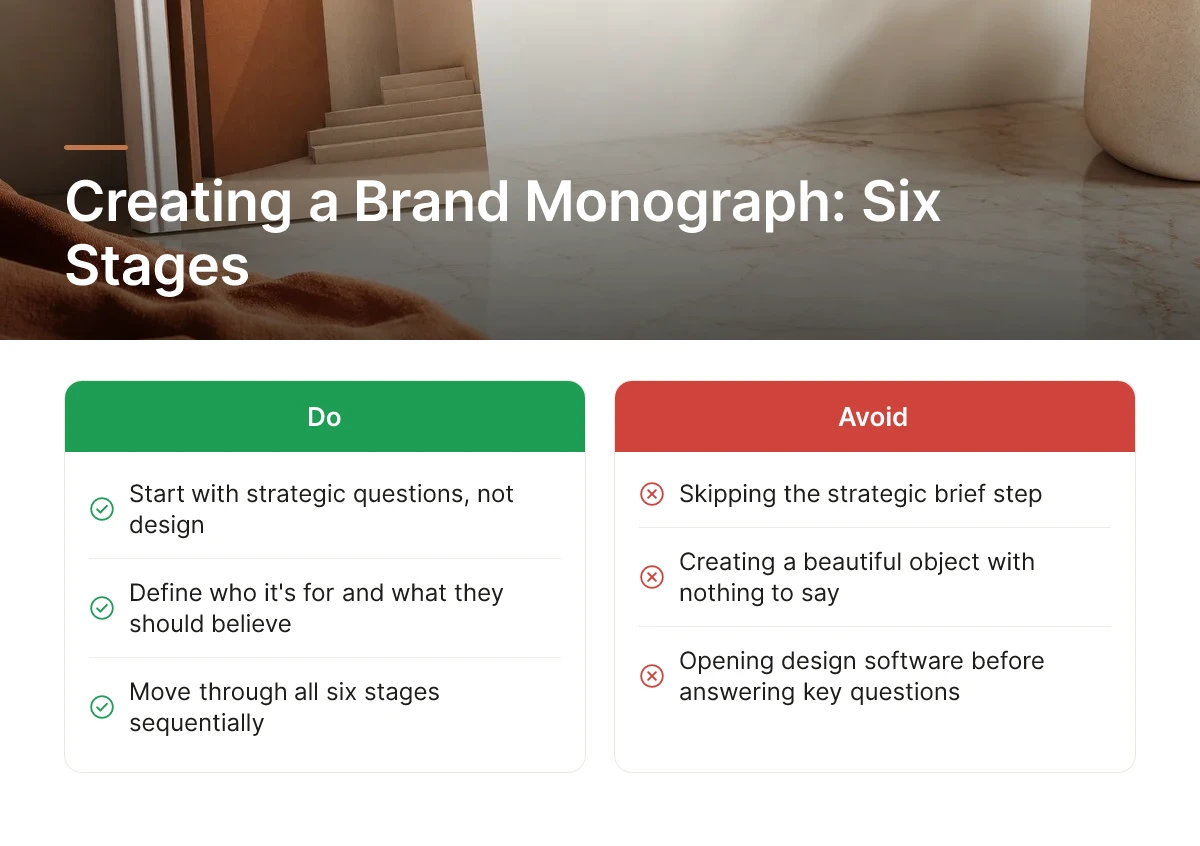
A brand monograph moves through six stages, strategic brief, editorial planning, content and photography, design and layout, print production, and delivery, and skipping any one of them shows up in the final object.
It starts with questions, not design software. Who is this for? What should they believe about the company after they put it down? What’s the one thing this publication needs to say that a website or sales deck never could? Those answers become the brief, and the brief shapes every decision that follows. Skip this step and you get a beautiful object with nothing to say, which happens more often than most brand leaders expect.
How Do You Develop an Editorial Spine and Pair Words and Images With Intention?
An editorial spine is the narrative decision made before a single page gets designed, it determines what’s in, what’s cut, and in what order the story unfolds. Without it, a team is just filling pages. With it, every photograph and paragraph earns its place because it serves a specific argument about the brand.
This is where a brand monograph separates from a brochure. A brochure starts with a template and drops content into it. A real publication starts with a story and builds structure around that story, a hotel group’s history of place, a law firm’s decades of client trust, an architecture firm’s philosophy of restraint. Once that spine exists, writing and image sourcing happen together, not sequentially. Photography gets commissioned or sourced to serve specific narrative beats, rather than images getting chosen afterward to fill gaps around finished copy. That pairing, word and image built for the same moment in the story, is what makes a page feel inevitable instead of assembled.
What Does an End-to-End Monograph Production Process Look Like, From Concept to Delivery?
End-to-end means one team carries the project through strategy, editorial, design, print, and delivery, the client isn’t stitching together a copywriter, a freelance designer, and a print broker and hoping the handoffs hold. Rethink Publishing runs this way deliberately: the same studio that develops the editorial spine also manages image rights, oversees layout, handles print production and quality control, and delivers the finished object.
Internally, the client side still needs the right people at the table early, usually brand or marketing leadership, and often the CEO or founder, since they’re the ones who ultimately judge whether the publication reads true. Getting these stakeholders aligned on the brief and spine before design begins prevents the expensive scenario: a finished layout that leadership rejects because nobody confirmed the narrative direction up front. Alignment is cheap in week one. It’s expensive in week ten, after a designer has built 80 pages around the wrong story.
How Should a Brand Monograph Be Designed and Distributed to Maximize Impact?
A brand monograph earns its place on a coffee table through physical weight, restrained design, and a print run sized to the people who will actually receive it, not through volume.
What Design Principles Make a Monograph Feel Like a Keepsake Rather Than Disposable Marketing?
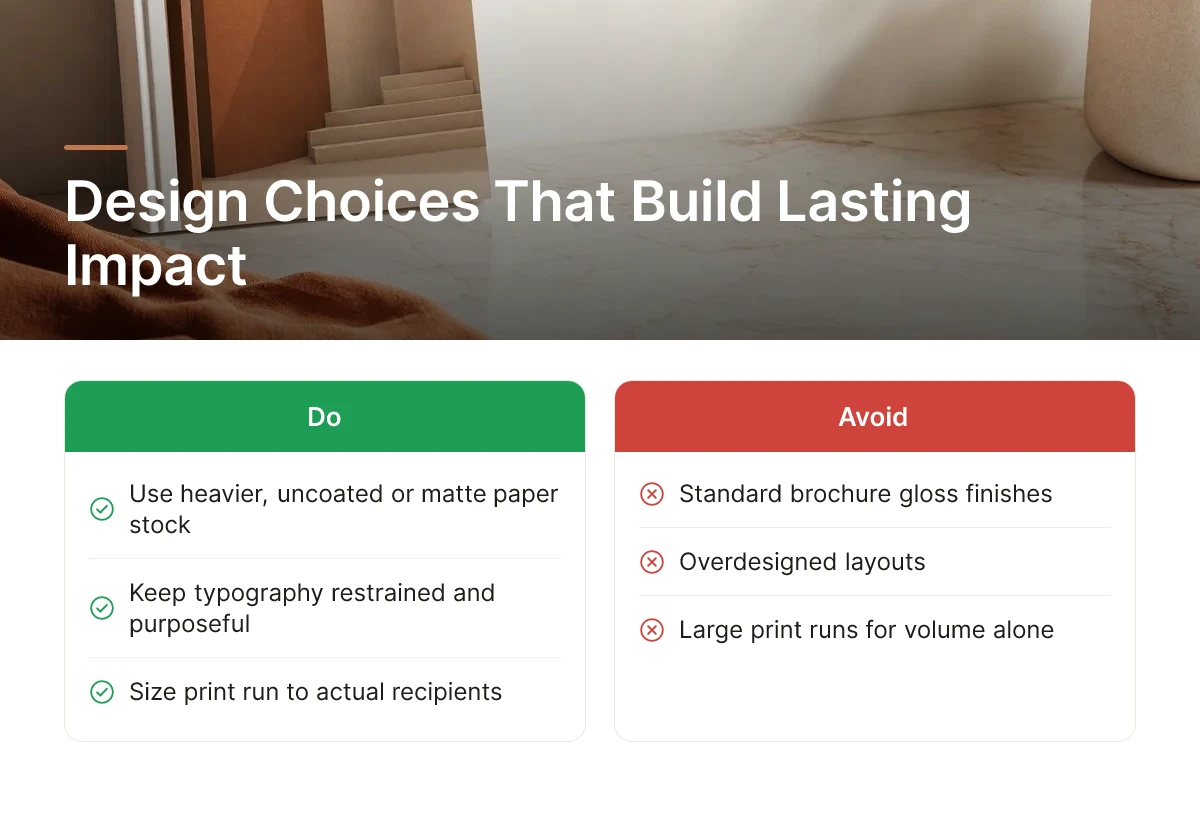
Paper stock is the first signal a reader’s hands notice before they read a single word. A heavier, uncoated or matte sheet communicates permanence in a way that standard brochure gloss never will, it’s the difference between something that feels like mail and something that feels like a possession.
Typography should stay restrained. Overdesigned layouts with competing fonts and crowded columns read as sales material; a confident, editorial grid with generous white space reads as considered. Pacing matters just as much, a monograph that alternates full-bleed photography with quiet text pages gives the reader room to breathe, the same rhythm a well-edited lifestyle magazine uses to hold attention across 80 or 100 pages.
Binding is the detail most companies underestimate. A saddle-stitched booklet signals a newsletter; a case-bound or Swiss-bound volume signals a book meant to last on a shelf. At Rethink Publishing, every coffee-table book and print magazine is built on that editorial spine first, strategy, writing, and image sourcing before a single layout decision, because the physical craft only pays off if the content underneath deserves to be kept.
The contrast with disposable print marketing is direct. A flyer or a tri-fold brochure is built to be glanced at once and binned; a brand monograph is built to be picked up again. That difference in intent should show up in every material choice, not just the cover.
Where and How Should a Brand Distribute Monographs to Reach the Right Audience?
Mass distribution defeats the purpose. A brand monograph works as a targeted gift, handed to a key client at a renewal meeting, placed in a boardroom before a pitch, mailed directly to a short list of top accounts, or given out at a flagship property launch or anniversary event. Luxury brand storytelling increasingly treats print as one deliberate touchpoint within a broader relationship strategy rather than a channel competing for reach [2].
Print runs should match that precision. A thousand copies sent everywhere dilutes the object into another piece of collateral; three hundred copies placed with the right executives, partners, and prospects keeps it scarce enough to matter. Sizing the run against the audience, not against a marketing budget line, is what keeps the per-copy value high.
How the handover happens shapes perception as much as the design does. A monograph presented in person, at a milestone, or as a considered gift carries weight that the same object dropped in a mailbox with other junk mail never will.
Can a Brand Monograph Work Alongside Digital Channels, or Does It Stand Alone?
A brand monograph works best paired with digital channels, print builds depth and retention while digital handles reach and frequency, and a serious brand strategy needs both.
Treating this as an either-or choice misreads what each medium is good at. Social posts disappear in a scroll within seconds. Email newsletters compete with forty other unread subjects in an inbox. A monograph sits on a coffee table or a boardroom shelf for years, available every time someone walks past it. Those aren’t competing strategies, they’re different jobs.
How Does a Printed Monograph Complement a Brand’s Broader Marketing and Digital Strategy?
The content inside a monograph has a second life online, without undercutting why the printed piece feels exclusive. An excerpt from a feature story can run as a LinkedIn post. Behind-the-scenes photography from the shoot, the kind that never made the final print layout, fills out an Instagram grid or a newsletter. A short video of the printing process, the binding, the paper selection, gives a marketing team months of content from a single production cycle.
None of that dilutes the physical object. The printed piece stays the complete, premium version; the digital excerpts function as previews that point people back to the thing worth holding. A company running both channels gets frequency from digital and gravity from print, rather than having to choose one.
What Makes Print a Long-Term Brand Investment Worth the Commitment?
Print isn’t dead, it’s being rethinkd by companies that care how their brand feels in someone’s hands, not just how it performs in an ad auction. The resurgence is real: the broader custom publishing market was valued at roughly $2.8 billion in 2023, and luxury brands are reinvesting in print specifically because digital saturation has made physical scarcity valuable again [1]. That’s not nostalgia. That’s a response to a crowded channel.
A brand monograph also behaves differently from a campaign. A paid ad stops working the day the budget runs out. A monograph keeps working, on a shelf, in a waiting room, passed between colleagues, long after the project that produced it has wrapped. That’s the return on a print investment: it compounds quietly instead of spiking and decaying.
This isn’t for every company, and it shouldn’t be. A business chasing short-term lead volume or testing a new market on a tight budget has better tools than a bound print publication. A brand monograph is for companies with an established identity, a relationship-driven client base, and patience for an asset that pays off over years rather than weeks. Rethink Publishing builds these for exactly that kind of client, handling strategy, editorial, design, and print production end-to-end, so the only decision left is whether the brand is ready to be taken that seriously.
Frequently Asked Questions
Is a brand monograph the same thing as a corporate brochure?
No, and the difference matters: a brochure sells a product, a brand monograph builds a relationship through editorial storytelling. A brochure gets skimmed and tossed. A well-made publication has a point of view, real writing, and image direction strong enough that people keep it on a coffee table instead of filing it away.
How long does it typically take to produce a brand monograph?
Most projects run several months from strategy to delivery, depending on scope and how much original content needs sourcing. Editorial direction and research take the longest upfront; once the spine is set, design, print production, and quality control follow a more predictable schedule.
Who should be involved from the company’s side during production?
One decision-maker who can approve direction quickly, plus access to subject-matter voices for interviews. That’s usually enough, a CEO, CMO, or head of brand who signs off on the editorial spine, and whoever can connect the studio to the people and places worth photographing. Heavy internal committees slow the process without improving the result.
Does a brand monograph work for industries outside luxury and fashion?
Yes, the approach has worked for law firms, architecture practices, and even cybersecurity companies. Any business with a sophisticated clientele and a story worth telling in depth can use the format; Rethink Publishing has produced titles across hospitality, design, and less expected sectors where clients wanted to feel the brand rather than just read about it [5].
How does a company know if it’s ready to commission one?
Readiness means a clear brand point of view and a client relationship worth deepening beyond digital touchpoints. If leadership can’t yet articulate what the brand stands for, that work comes first, a magazine amplifies a strong identity, it doesn’t invent one.
Conclusion
A brand monograph earns its place on a coffee table by doing what a PDF or Instagram post can’t: it slows a client down and lets the brand’s substance show. The companies getting the most from this format treat it as a long-term asset, not a campaign, and they bring in editorial expertise rather than asking an in-house design team to improvise. If your brand has a real story and a clientele worth deepening ties with, the next step is a conversation about what that editorial spine would look like. Start that conversation at www.rethink-publishing.com.
Sources & References
- Luxury Marketing: A Deep Dive into High-End Branding | Sotheby’s Institute of Art
- 5 luxury brand storytelling strategies to engage HNW audiences
- Two Monographs Showcase Design that Does Good [Metropolis] | David Baker Architects
Recommended Articles
Explore more from our content library: