
Understanding what is a bookazine is essential. A bookazine is a hybrid print format, part magazine, part coffee table book, that a luxury brand commissions as a premium marketing asset and client keepsake rather than a disposable publication. It borrows the editorial pacing and glossy production of a magazine but the durable binding, heavier stock, and long shelf life of a book, so it sits on a coffee table for years instead of a rack for a week. For brands focused on perception, it works because it signals permanence: clients keep it, display it, and associate that quality with the brand itself.

What Is a Bookazine and Why Should a Luxury Brand Consider Commissioning One?
The short version: a bookazine borrows a magazine’s editorial structure and a book’s physical weight, built specifically so clients keep it instead of recycling it. Anyone researching what is a bookazine for the first time is usually trying to solve one problem, how to make a brand feel permanent in a market where most marketing is designed to be scrolled past and forgotten.
What Makes a Bookazine Different From a Standard Magazine or Coffee Table Book?
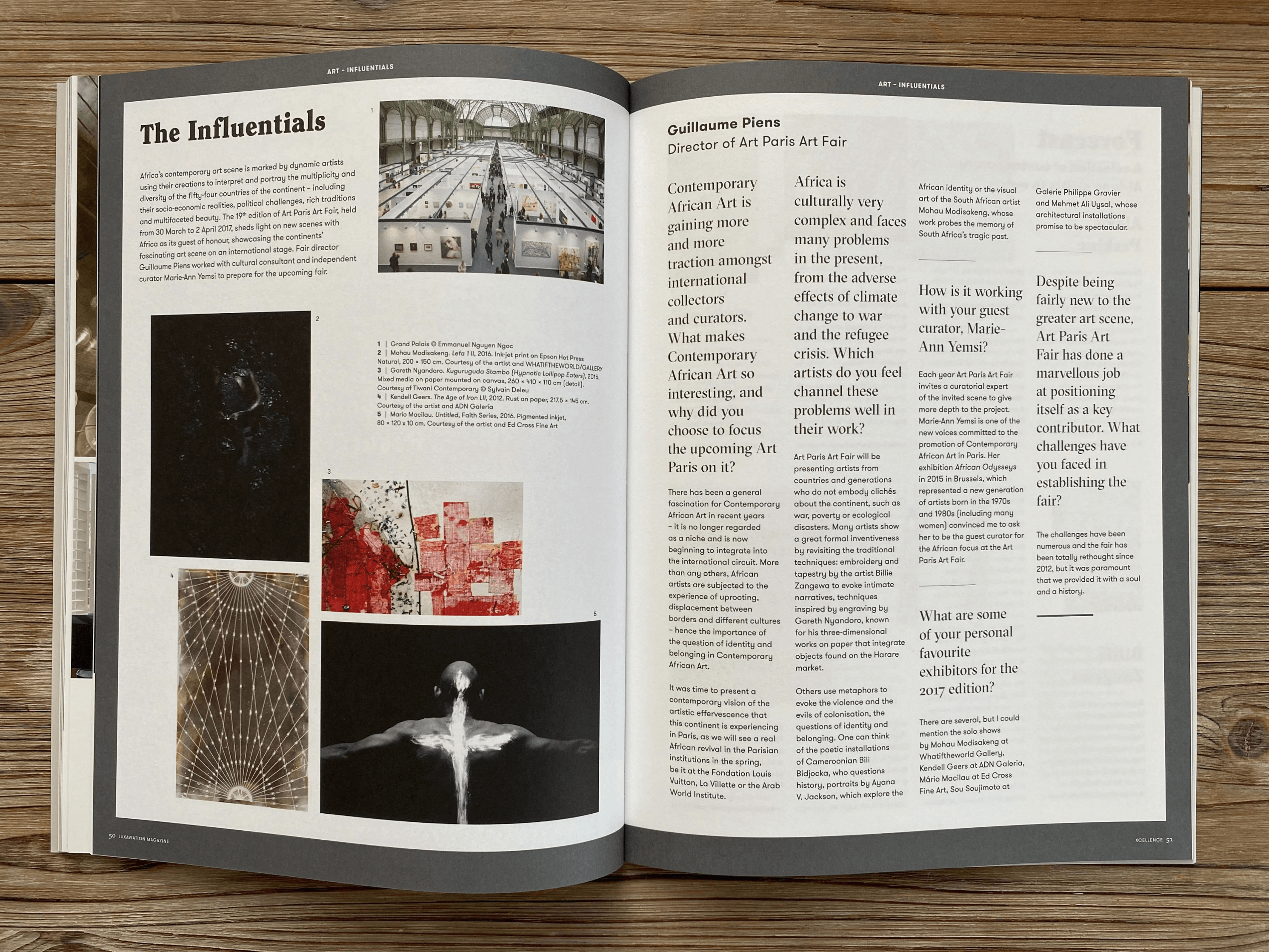
A standard magazine is built for turnover, thin paper stock, a cover that creases, a shelf life measured in weeks. A coffee table book is built for permanence but often lacks the pacing of editorial content: features, profiles, visual storytelling that moves a reader through a narrative rather than a static collection of images. A bookazine sits deliberately between the two. It keeps the section structure, photo essays, and visual rhythm of a magazine, but pairs that with the binding, heavier paper, and cover durability of a book meant to survive years of handling.
That hybrid construction is the entire point. A brand gets the storytelling flexibility of a magazine format without sacrificing the object quality that makes someone want to leave it out rather than file it away.
Why Do Premium Brands Choose Bookazines Over Other Print Formats?
A brochure sells. It has a call to action, a price list, a shelf life that ends the moment the reader’s decision gets made, and then it gets thrown away. A bookazine doesn’t sell anything directly; it has an editorial spine, meaning real stories, real reporting, real photography that give a reader a reason to keep reading past the first page. That distinction is why one earns a place on a client’s coffee table and the other ends up in a recycling bin within a week [3].
Luxury brands reach for this format because perceived permanence communicates quality in a way no folded pamphlet or seasonal issue can. Print is seeing a deliberate return among luxury marketers precisely because physical scarcity now reads as a strategic signal rather than an old-fashioned channel [5]. A heavy, well-bound object that sits in a client’s home for years does something a digital impression or disposable flyer cannot: it keeps reminding someone of the brand long after the original touchpoint is gone [2].
None of this means every company should commission one. Honestly? If a brand doesn’t have enough substance, real stories, a real point of view, enough material to fill an editorial narrative rather than a product catalog, a bookazine will feel hollow, and readers notice hollow faster than almost anything else in print. This format rewards brands with something to actually say.
How Does a Bookazine Work as a Marketing Asset and Brand Keepsake?
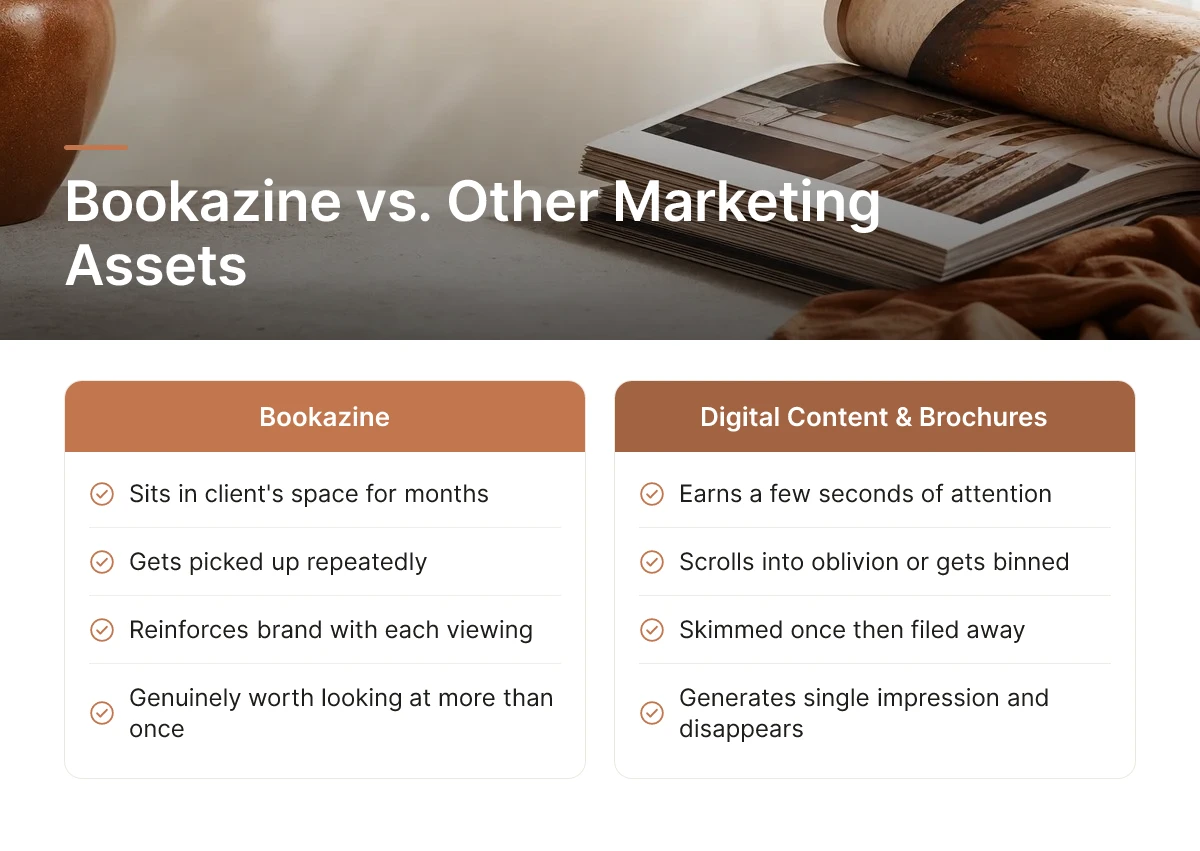
A bookazine works by sitting in a client’s physical space for months, getting picked up repeatedly, and reinforcing brand association each time, not by generating a single impression and disappearing.
That’s the mechanism worth understanding before you commission one. Digital content earns a few seconds of attention, then scrolls into oblivion. A brochure gets skimmed once and filed, or binned. A well-made bookazine behaves differently: it lands on a coffee table or a reception desk and stays there, because it’s genuinely worth looking at more than once.
How Long Does a Bookazine Stay in a Client’s Hands and Home Compared to Other Marketing Materials?
A bookazine’s shelf life is measured in months and years, not the seconds of a social post or the single read of a PDF brochure. Print marketing carries a tactile, sensory quality that digital formats cannot replicate, which is part of why luxury brands keep returning to it as a differentiator [2]. The same source notes that print communicates permanence and intention, qualities a client registers on a subconscious level every time the object reappears on their table [2].
Luxury executives are increasingly questioning whether digital precision was ever the right trade for the erosion of memorability that comes with rising costs and platform fragmentation [5]. A bookazine doesn’t compete on reach. It competes on recurrence, the same object, seen again and again, in a context the brand doesn’t have to pay to occupy twice.
What Role Does Editorial Curation Play in Making a Bookazine Feel Like a Premium Keepsake?
Editorial curation is what separates an object a client keeps from one they throw away, real stories, real photography, and a narrative arc give it a reason to be reopened. This is the central distinction in understanding what is a bookazine: it isn’t a product catalog with better paper stock. It’s an editorial product, built around a spine of stories that happen to feature the brand, rather than a sales pitch dressed up as content.
A revenue model for owned print should feel curated rather than transactional, and the reader experience has to lead the design decisions, not follow them [1]. That’s precisely the discipline Rethink Publishing applies: we build the editorial spine first, the stories, the sourcing, the sequencing, then let design and production serve that structure. The difference shows up in whether a client reopens the object six months later or forgets it by Friday.
What Goes Into Producing a High-End Bookazine From Strategy to Print?
Producing a bookazine properly means moving through five disciplined stages, strategy, editorial, design, print production, and delivery, each one building on the last rather than happening in isolation.
Answering what is a bookazine from a production standpoint means looking at the sequence, not just the finished object on a coffee table. Skip a stage, or rush one, and the final piece reads like a brochure wearing a magazine’s clothes. Clients notice the difference even when they can’t name it.
How Do You Develop the Editorial Spine and Visual Strategy for a Bookazine?
Every credible bookazine starts with an editorial spine, a defined narrative thread and set of content pillars established before anyone opens a design file. This is the step most in-house teams skip, which is why self-produced print pieces tend to feel like a stack of marketing slides bound together rather than one coherent story.
The spine answers basic questions first: what is this publication actually about, who is it speaking to, and what thread connects issue one to issue four. At Rethink Publishing, this editorial direction work happens before a single layout is touched, strategy sets the content pillars, then writing and design follow the spine rather than inventing structure page by page.
Visual strategy comes next, and it’s not decoration. Photography direction, the layout grid, typography choices, each one needs to reinforce the brand’s identity rather than borrow the look of whatever template shipped with a design tool. A private members’ club and a boutique architecture firm should never end up with the same grid, the same crop style, or the same stock-photo gloss. Luxury print succeeds partly because it signals restraint and intention in how a reader experiences the page, not just in what the page says [1].
What Does End-to-End Bookazine Production Actually Involve?
End-to-end production means strategy, editorial writing, design, print production, and delivery are managed as one continuous process rather than five separate vendor handoffs.
Paper stock and binding sit inside the production stage, and they’re functional decisions as much as aesthetic ones. A coffee-table book that gets handled daily, passed around a boardroom, left out for clients, shipped to a second office, needs stock and a binding method built to survive that handling, not just look good under studio lighting. Print materials carry a tactile, sensory quality that digital formats cannot replicate, which is precisely why the physical choices behind the object matter as much as its content [2].
None of this moves quickly. A properly produced bookazine runs on a long production timeline, editorial development, image rights and sourcing, design rounds, press checks, and distribution logistics all take real time, measured in months rather than weeks. Brands considering this as a one-off rush project for a launch date two weeks out are solving the wrong problem. Craft-driven production and short turnarounds don’t coexist, and any partner promising both is cutting a corner somewhere in the five stages above.
How Do You Know if a Bookazine Is the Right Investment for Your Brand?
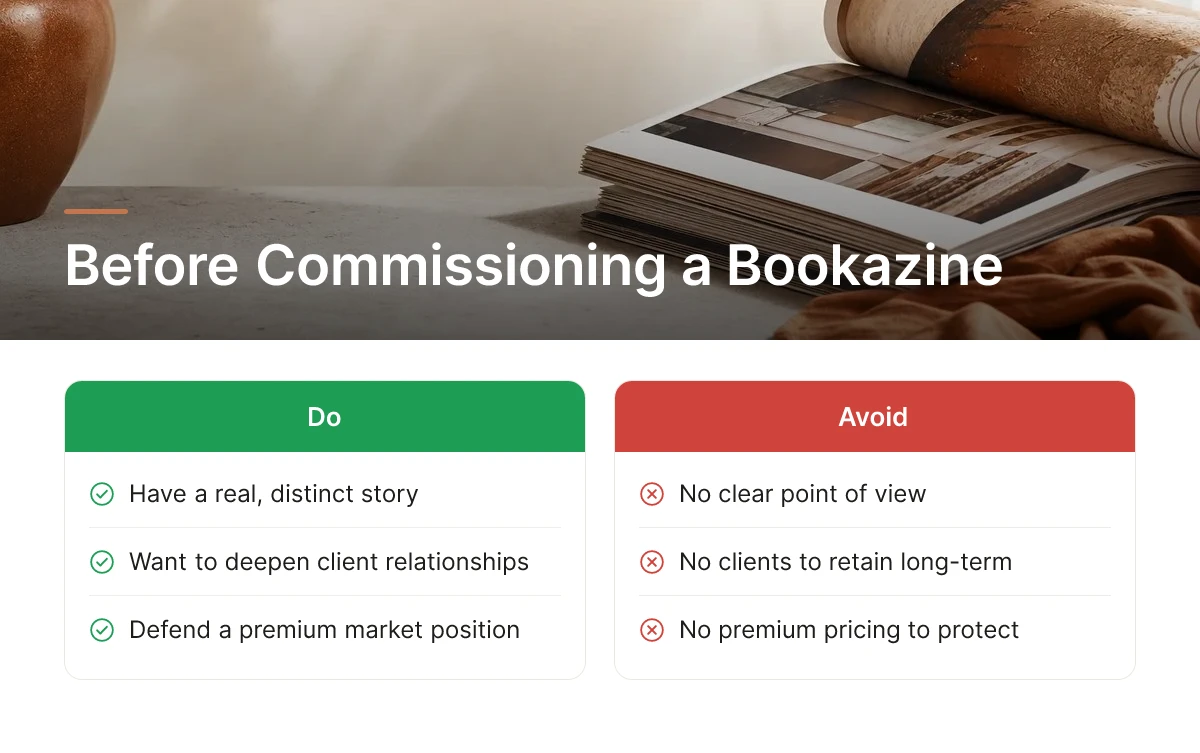
A bookazine is right for you if you have a real story, relationships worth deepening, and a premium position worth protecting, otherwise, save your money.
That is not a sales line. It is the honest qualifying test we put to every prospective client before discussing scope or production. If your company has no distinct point of view, no clients it wants to hold onto for decades, and no premium pricing to defend, a glossy publication will not fix that. It will just be an expensive brochure with better paper stock. The question “what is a bookazine” only matters once you’ve answered a harder one: does your brand have something worth putting in print at all?
What Industries and Brand Types Benefit Most From Commissioning a Bookazine?
Hospitality groups, luxury goods houses, real estate developers, private clubs, and architecture firms benefit most because their business already runs on trust, taste, and long client relationships. A hotel group with a flagship property launch, a developer selling multi-year residences, a law firm advising clients through decade-long relationships, these are businesses where a client’s perception compounds over years, not weeks.
Less obvious candidates benefit just as much, sometimes more. We’ve worked with cybersecurity firms, yes, cybersecurity, because trust and authority are exactly what that industry sells, even though nobody expects a security vendor to hand over a beautifully bound publication. Professional services firms face the same opportunity: when every competitor sends the same PDF deck, a print artifact signals something no email attachment can. Luxury brands are already leaning back into print precisely because digital saturation has made consumer attention scarce and expensive [5]. The brands capitalizing on that shift aren’t always the ones you’d expect.
How Should Companies Think About Print as a Long-Term Brand Investment?
Treat a bookazine as a premium, long-cycle brand investment, not a one-off marketing expense measured against a single campaign’s return.
Digital campaigns carry a marginal cost every time you run them: another round of ad spend, another email send, another social push that disappears from a feed within 48 hours and leaves nothing behind. A bookazine is different. The production cost is front-loaded, but the asset keeps working, sitting on a coffee table, a reception desk, a boardroom shelf, long after a digital campaign has stopped delivering impressions. Rising costs and shrinking precision in digital media are pushing even the most digitally sophisticated luxury brands to reconsider what channels actually earn attention over time [5]. Rethink Publishing positions every project this way with clients: not as a marketing line item to justify quarter over quarter, but as a brand asset built to last years, produced end to end, strategy, writing, design, print, delivery, so the investment compounds rather than resets with every new campaign cycle.
Run one simple self-check before committing: if your brand has no story yet worth an editorial narrative, it is not the right time. Build the story first. The publication comes after.
Frequently Asked Questions
Can a bookazine work for a smaller or newer brand, not just an established luxury name?
Yes, if the brand has a genuine story and a clientele worth deepening a relationship with. Scale matters less than substance, a boutique architecture firm with three years of standout projects can justify a bookazine faster than a large but undifferentiated company. The real question isn’t size, it’s whether you have something worth putting in print.
Does a bookazine replace a brand’s regular magazine or marketing materials?
No, a bookazine sits above everyday marketing collateral rather than replacing it. Brochures, email newsletters, and digital content still handle routine updates and lead generation. A bookazine serves a narrower purpose: a lasting artifact for top clients, partners, and prospects who warrant more than a PDF attachment.
How often should a brand produce a new bookazine?
Most brands produce one every one to three years, tied to a milestone rather than a fixed calendar. A flagship launch, anniversary, or major expansion gives the publication a reason to exist. Producing one too frequently cheapens its weight; producing one too rarely wastes the relationship-building momentum it creates.
What size print run makes sense for a bookazine aimed at top clients?
Most client-focused bookazines run in the low hundreds to a few thousand copies, prioritizing the right recipients over broad distribution. The goal is a boardroom or coffee table, not a newsstand, so brands typically reserve copies for top clients, prospects, referral partners, and press rather than mass mailing lists. Quality of placement matters more than volume.
Conclusion
A bookazine earns its place when a brand has a real story, a client relationship worth deepening, and a milestone that justifies the investment, not as a routine marketing line item. Treat it as a long-term asset: one tied to a launch or anniversary, placed deliberately with top clients rather than mass-mailed, and built with genuine editorial direction rather than repurposed brochure copy. Nathalie Grolimund and the Rethink Publishing team have guided brands through that exact process for over 20 years, producing 80+ magazines and 30+ coffee-table books along the way. If you’re weighing whether your brand has a story worth binding in print, start that conversation at rethink-publishing.com.
Sources & References
- The commercial print strategy luxury brands often overlook
- How Luxury Brands Market Themselves Using Print
- Marketing Magazines: Why They’re a Secret Weapon – Smartpress Blog
- Why Luxury Brands Are Returning to Print | PRINT Journal
Recommended Articles
Explore more from our content library: