
Understanding bespoke publishing vs template is essential. Bespoke publishing builds every element of your book or publication from scratch, design, layout, editorial structure, to fit your specific goals. Template-based publishing uses pre-built frameworks you populate with your content. Bespoke costs more and takes longer (typically 3–6 months versus weeks), but produces a distinctly professional result. Templates are faster and cheaper but impose hard limits on how far you can differentiate your work from thousands of other titles using the same system.

Bespoke Publishing vs Template: What Actually Separates the Two
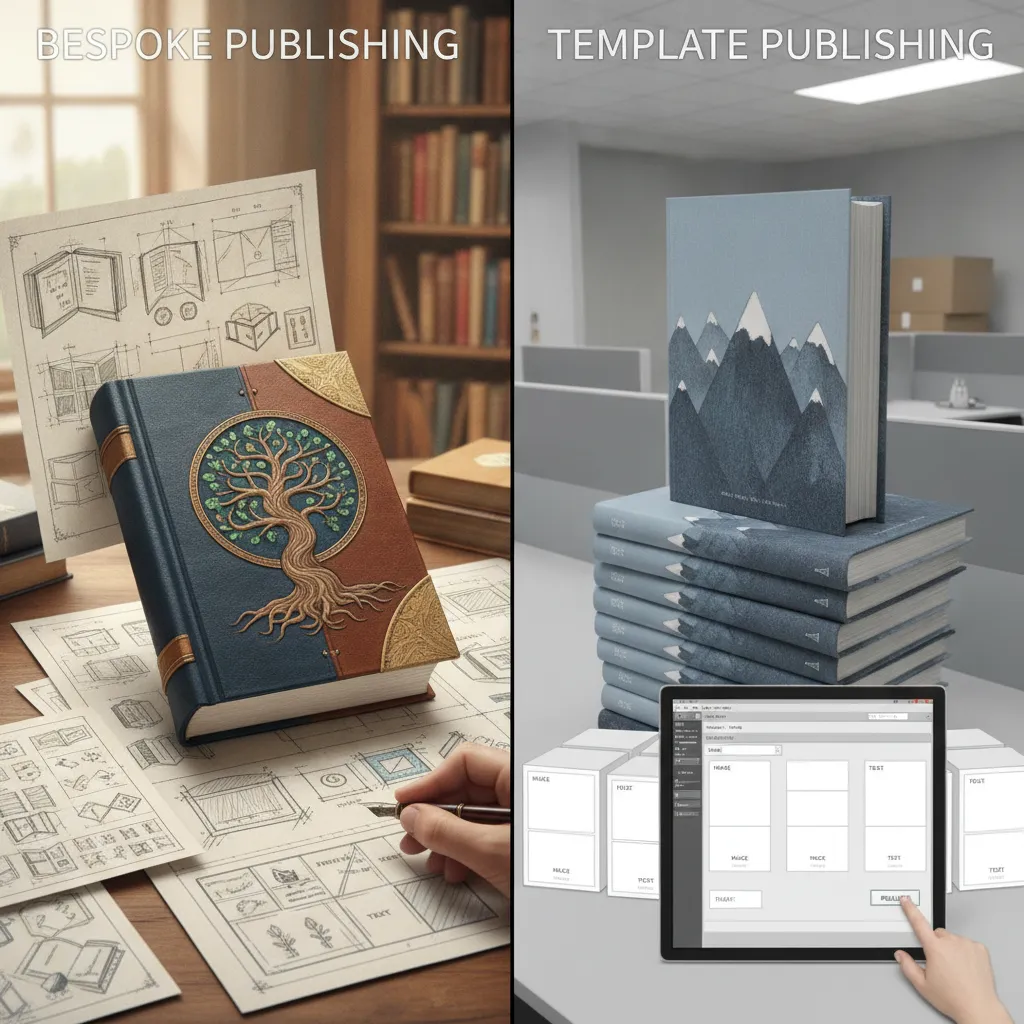
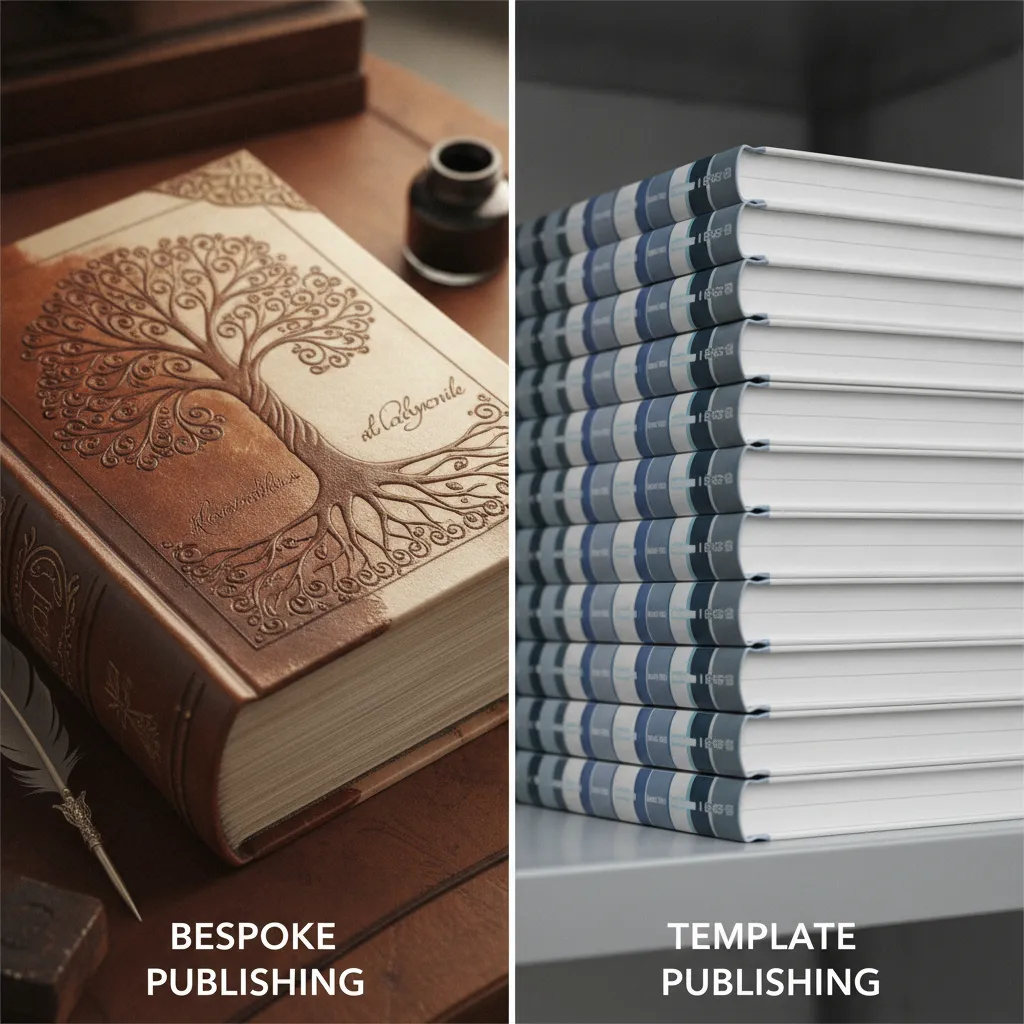
Bespoke publishing builds every design, typesetting, and editorial decision around one specific title, nothing is borrowed from a shared framework used by other clients.
A bespoke publication starts with a blank brief. The cover art, interior grid, typeface selection, chapter architecture, and image treatment are all designed from scratch for that title alone. No other publication shares the same structural DNA. That’s the defining characteristic, not just that it looks good, but that it was built to fit one specific piece of work and no other.
Template publishing works differently. The layout, typography, and design elements are pre-built. The author or publisher populates those fixed structures with content. The system renders the result automatically or semi-automatically, and the structural constraints, column widths, font sizes, margin ratios, don’t move regardless of what the content requires.
What is a bespoke template and how does it differ from standard templates?
A bespoke template sits between the two: it’s a custom-designed layout system built once for a specific client or publication series, then used consistently across multiple issues or editions. A law firm’s quarterly magazine, for example, might run on a bespoke template, one designed exclusively for that firm, not shared with thousands of other users on a self-publishing platform. Off-the-shelf templates on platforms like Amazon KDP or Canva are used by a large number of authors simultaneously, which is precisely why titles produced on them tend to look interchangeable.
How do bespoke and template publishing compare in terms of professional output quality?
The output quality gap in the bespoke publishing vs template debate comes down to human review at every production stage. In bespoke work, a designer checks and corrects typographic problems, widows, orphans, awkward image bleed, mismatched font pairing, as they appear. Templates rely on automated rendering that has no mechanism to catch those edge cases.
Bespoke publishing is standard in luxury brand magazines, corporate publications, high-end non-fiction, and professional services, sectors where a single design flaw signals a lack of care. Templates dominate self-publishing platforms and low-cost ebook production, where speed and unit economics matter more than visual distinction. Rethink Publishing, for instance, operates entirely within the bespoke model: every magazine and coffee-table book is built from an original editorial and design brief, with a human designer involved at each stage of production.
Timeline: How Long Each Publishing Approach Actually Takes
Template publishing runs 2–6 weeks from manuscript to publication; bespoke publishing runs 3–6 months, and knowing where each loses time changes your planning entirely.
What is the typical timeline from manuscript to publication for each method?
With a template-based approach, an author who handles their own formatting can move from finished manuscript to a published book or document in as little as two weeks. The ceiling sits around six weeks when a service provider applies the template on the author’s behalf and a round of corrections is needed.
The delays in template publishing rarely come from the template itself. They come from the author, formatting errors that trigger platform upload rejections, inconsistent heading styles, or image resolution failures that send the file back to square one.
Bespoke publishing operates on a different calendar. A single publication, covering design briefing, layout, proofing rounds, print-ready file preparation, and press checks, typically runs 3–6 months from manuscript delivery to finished product. That timeline compresses only when the manuscript is locked before the project starts and the client turns approvals around fast.
Rush bespoke projects do exist, but they carry a cost premium of 20–40% above standard rates and still require 6–8 weeks minimum. No amount of budget eliminates the physical time needed for print production.
The bespoke publishing vs template gap narrows considerably for repeat corporate publications. Once Rethink Publishing establishes a design system after a client’s first issue, grid, typography, image treatment, editorial structure, subsequent issues of a custom magazine typically run on an 8–12 week production cycle per issue. The first issue is the investment; every issue after moves faster.
Bespoke stalls most often at revision rounds and client approval delays, not at the studio’s end. Building internal sign-off processes before production begins is the single most effective way to protect the timeline.
The Real Cost Difference Between Bespoke and Template Publishing
Template publishing costs almost nothing to start; bespoke publishing runs thousands, but the gap narrows sharply once you account for hidden fees and your own time.
How do pricing models compare between bespoke custom publishing and template-based platforms?
Platforms like KDP, IngramSpark, and Reedsy charge near-zero setup fees, IngramSpark’s title setup fee sits at $49. A basic interior and cover design through a template-based service typically runs $250–$1,000, depending on complexity and the designer’s experience level.
Bespoke publishing sits in a different bracket entirely. Full design and layout for a non-fiction book in the UK market typically runs £2,000–£6,000. A corporate magazine built from scratch, including the creation of a design system, typographic hierarchy, and grid structure, runs £5,000–£15,000 for the first issue. Subsequent issues cost less because the design framework already exists.
The template route carries costs that don’t appear on the platform’s pricing page. Premium templates run £30–£150 each. Hiring a formatter to fix template errors after a platform rejection adds another layer of spend. Factor in the hours a CEO or marketing director spends wrestling with InDesign or Canva, and the “cheap” option starts to look expensive.
Bespoke pricing models vary by studio. Per-project fees give budget certainty upfront. Per-page or per-hour models can work out cheaper for short publications but introduce unpredictability on longer ones. Ask for a fixed-scope quote before committing to any engagement.
The ROI question cuts through the bespoke publishing vs template debate cleanly. If a book is the lead-generation asset for a $15,000 consulting engagement, a $5,000 design investment is a rounding error. If the goal is 200 copies for friends and family, it isn’t, and no studio worth its reputation will tell you otherwise. At Rethink Publishing, the first conversation is always about what the publication needs to do commercially, not just how it needs to look.
Which Publishing Approach Suits Your Author Type and Goals
Your author category and publishing goal, not budget alone, determine whether bespoke publishing or a template is the right call.
Should indie authors, small presses, or enterprises choose bespoke or template publishing?
Indie authors publishing fiction or genre non-fiction with a sales target under 1,000 copies should use a template. The cost savings are real, the quality gap is negligible for that audience, and the margin math simply doesn’t support a custom design investment.
The calculation shifts when a book functions as a business tool. Consultants, executives, and professional service firms use books to represent their brand in a room, in front of clients, at speaking engagements, during pitches. In that context, the bespoke publishing vs template decision is straightforward: bespoke is the defensible choice because the book’s primary job is brand perception, not unit sales.
Small presses publishing 5–20 titles per year have a third option worth considering. A bespoke design system built once and applied across titles delivers professional consistency without paying bespoke rates on every new title.
The 5,000-copy benchmark deserves a frank look. Selling 5,000 copies is a strong result for most non-fiction authors, but whether it justifies bespoke spend depends entirely on margin per copy and the book’s secondary purpose: speaking fees, consulting mandates, or licensing deals can make the investment rational even at modest print runs.
Enterprise clients, companies producing branded magazines, annual reports, or thought-leadership publications, almost always require bespoke. Brand standards, legal review, and multi-stakeholder sign-off make template workflows unworkable at that level. Studios like Rethink Publishing are built precisely for this use case, managing editorial direction, design, and production end-to-end so internal teams aren’t coordinating across disconnected vendors.
Quality and Customization Trade-Offs You Need to Understand Before Deciding
Template platforms cap what your publication can look like; bespoke publishing removes that ceiling entirely, and the gap matters most to the people who matter most to your brand.
What Customization Limitations Exist with Template-Based Publishing Platforms?
Most template platforms operate on fixed grid structures. You can adjust content within the grid, but you cannot break it, meaning complex layouts like pull quotes spanning two columns, multi-column footnotes, or custom chapter openers are simply not supported.
Typeface choice is another hard limit. Template libraries typically offer between 20 and 50 fonts. A bespoke publication faces no such restriction, a studio can license or commission any typeface that fits the brand’s visual argument. That distinction sounds minor until you see two publications side by side.
Print quality compounds the problem. Template output frequently produces inconsistent line spacing across chapters and poor hyphenation in justified text, both visible to any careful reader. Cover templates carry a sharper risk: a reverse image search can surface the same layout on dozens of other titles, which undermines the exclusivity a premium brand depends on.
Bespoke publishing addresses these structurally, not cosmetically. Custom illustration, hand-lettered elements, and paper and binding specifications chosen for the specific publication, these are decisions a template platform cannot make because they fall entirely outside its architecture. The design itself can visually argue the book’s thesis before a word is read. That is what the bespoke publishing vs template comparison ultimately comes down to at the production level.
What Is the 90/10 Rule for Authors and How Does It Apply to Publishing Choices?
The 90/10 rule is straightforward: 90% of readers will never notice the difference between a well-executed template and a bespoke design. The 10% who do, however, are disproportionately the gatekeepers, buyers, media contacts, senior partners, or institutional clients whose opinion shapes the publication’s commercial reach.
For a brand publishing a coffee-table book to place in client boardrooms or a magazine distributed to a private membership, that 10% is the entire audience that matters. Rethink Publishing’s editorial-first model, 20+ years of production across 80+ high-end magazines, is built precisely around that reality.
The practical test is direct: if you would hesitate to hand the finished publication to your most important professional contact, the template is not serving you. That hesitation is the honest signal that the format has outgrown the tool.
Frequently Asked Questions
Can you use a bespoke template to get custom results at a lower cost?
A customized template can improve visual consistency, but it won’t deliver the same result as a fully bespoke publication. Templates set structural constraints, grid systems, type hierarchies, image placement rules, that were designed for a general audience, not your brand. A designer can modify colors and fonts within those constraints, but the underlying architecture remains generic. For brands where the physical publication is a primary client-facing asset, that compromise shows in the finished product.
Is selling 5,000 copies of a book considered successful?
For a branded coffee-table book, sales volume is the wrong metric entirely. A book produced for a luxury hospitality group or architecture firm isn’t sold, it’s placed: in client hands, in reception areas, on boardroom tables. Fifty copies delivered to the right fifty people can generate more business than 5,000 units sold through retail. Reach matters less than precision of placement when the goal is client retention and brand perception.
What are the biggest mistakes authors make when choosing a template-based publishing platform?
The most common mistake is treating the template as a neutral container and assuming strong content will carry the publication. It won’t, layout shapes how content is read and remembered. Authors also underestimate how quickly a template signals its origins to a trained eye: a hospitality client or architecture firm will recognize a stock layout immediately. A third mistake is choosing a platform based on price without accounting for the production time required to work around the template’s limitations.
Do professional publishers ever use templates, or is bespoke always the standard?
Professional publishers use both, but they use them differently. High-volume consumer magazines rely on modular design systems, structured templates that experienced art directors adapt issue by issue. That’s not the same as a retail template. For branded publications where the design itself carries brand meaning, bespoke is the standard. At Rethink Publishing, every publication starts from an editorial spine built around the client’s specific brand identity, no pre-built framework determines the structure before strategy does.

Conclusion
The choice between bespoke publishing and a template comes down to what the publication is actually for. If it needs to function as a brand artifact, something a client keeps, shares, and associates with quality, a template will underdeliver, regardless of how well the content is written. The design, the editorial structure, and the production quality are the message.
Three things worth acting on: define the publication’s job before choosing a format; audit whether your current collateral would survive a side-by-side comparison with a competitor’s best print piece; and speak to a specialist before committing to a production path. If you’re ready to explore what a fully managed, editorially directed publication could look like for your brand, start at rethink-publishing.com.
Recommended Articles
Explore more from our content library: