
| Key Insight | Explanation |
|---|---|
| Print works across industries | Custom magazines build brand authority in hospitality, law, real estate, cybersecurity, and more — any sector where trust and perception matter. |
| Editorial spine comes first | A strong editorial strategy, not design, is what separates a keepsake publication from a glossy brochure that gets thrown away. |
| Physical media earns longer attention | Research consistently shows print readers spend significantly more time with content than digital audiences scrolling a feed or inbox. |
| The brand owns every page | Unlike media placements or sponsored content, a custom magazine gives the brand complete editorial control with no competing advertisers. |
| Print is a long-term investment | A well-made magazine stays on desks and coffee tables for months. That sustained visibility is something no digital campaign can replicate. |
| End-to-end production matters | Quality at this level requires specialist expertise across strategy, editorial, design, print, and delivery — not a patchwork of freelancers. |
Cross-industry magazine publishing is the practice of producing high-end, brand-owned print magazines across multiple sectors — hospitality, real estate, law, technology, architecture, and beyond — using the same editorial and design discipline found in world-class consumer titles. It is not a niche tactic. It is a proven brand-building strategy that works wherever a company needs to build trust, deepen relationships, and stay present in its clients’ lives over time.
The honest question behind this topic is simple: can a company in any industry benefit from a custom print magazine? The answer, based on 20+ years of producing publications across wildly different sectors, is yes — with one condition. The company has to care about how it is perceived. If it does, cross-industry magazine publishing delivers something no digital channel currently can: a physical object that earns real attention, stays in people’s hands, and makes the brand feel serious and considered.
This article covers what cross-industry magazine publishing actually means, how the process works, where it delivers the most value, and what separates publications that become keepsakes from those that end up in a recycling bin.
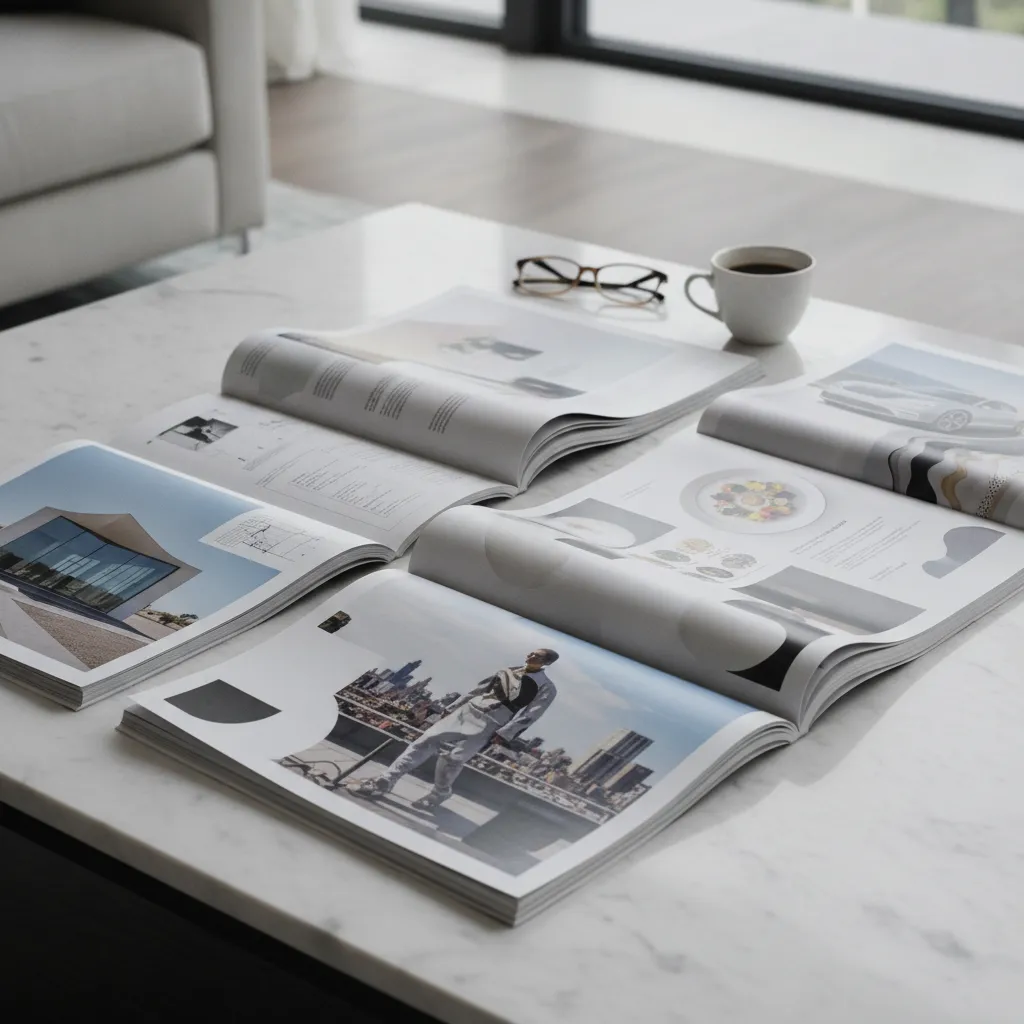
What Is Cross-Industry Magazine Publishing?
Cross-industry magazine publishing means applying the craft and discipline of professional editorial publishing to branded magazines across any sector — not just media or consumer lifestyle. A law firm, a cybersecurity company, a luxury hotel group, and a real estate developer can all produce publications that read and feel like world-class editorial titles, because the underlying process is the same regardless of industry.
The Difference Between a Magazine and a Brochure
This distinction matters more than most marketing teams realize. A brochure is transactional. It describes services, lists credentials, and gets discarded. A magazine is editorial. It has a point of view, a clear editorial spine (the central idea or narrative thread that runs through every page), and content that earns a reader’s time rather than just filling space.
Research published in the journal Futures examined the evolution of magazine publishing and found that the most resilient publications are those that move beyond simple information delivery toward genuine value creation for their audiences [1]. That finding holds whether the publisher is a media company or a law firm producing its own quarterly title.
The key characteristics that define a true cross-industry brand magazine include:
- A defined editorial strategy developed before a single word is written or image selected
- Content that serves the reader’s interests, not just the brand’s promotional agenda
- Design-led layouts where words and images are paired with intention, not assembled from templates
- Production quality — paper stock, print finish, binding — that signals the brand’s seriousness
- Consistent publishing cadence that builds anticipation and brand recall over time
Which Industries Use Custom Magazine Publishing?
The range is broader than most people expect. In practice, any industry where client relationships are long-term, where trust is a competitive differentiator, and where the brand wants to be perceived as authoritative and considered is a strong candidate. The Community of Literary Magazines and Presses maintains a directory that illustrates just how wide the publishing landscape is [2].
Industries actively using cross-industry magazine publishing include:
- Hospitality and private clubs: Guest-facing titles that extend the brand experience beyond the property itself
- Luxury real estate: Development magazines that build desire and trust before a single unit is sold
- Architecture and design firms: Portfolio-led publications that demonstrate thinking, not just finished projects
- Law firms and professional services: Quarterly titles that establish intellectual authority in a crowded market
- Cybersecurity and enterprise technology: Publications that humanize complex technical brands for C-suite audiences
- Private aviation and luxury goods: Lifestyle titles that reinforce the brand’s world and values
Pro Tip: Before deciding whether a magazine fits your brand, ask one question: do your clients have a relationship with your company that lasts longer than a single transaction? If yes, a magazine has a place in your marketing. If the relationship is purely transactional, invest elsewhere.
How Cross-Industry Magazine Publishing Works
The process behind a high-quality cross-industry brand magazine follows a structured sequence that takes roughly 17 weeks from brief to delivery — and the quality of the output is determined almost entirely by how rigorously each stage is executed.
The Editorial-First Process
Every serious brand magazine starts with an editorial spine, not a design brief. The editorial spine defines what the publication stands for, what stories it will tell, and why a reader would choose to spend time with it. Without this, even beautifully designed magazines feel hollow.
The production sequence, from experience working across 80+ high-end publications, looks like this:
- Brand and audience brief: Understanding the company’s positioning, its target reader, and what the magazine needs to accomplish over time
- Editorial spine development: Defining the central narrative idea, tone of voice, recurring sections, and content pillars
- Content proposal and flatplan: Mapping every article, image spread, and feature across the full issue before any writing begins
- Editorial production: Commissioning and writing content, conducting interviews, sourcing visuals, and clearing image rights
- Design and layout: Building spreads that pair words and images with deliberate intention, refined across multiple review rounds
- Colour and photo craft: Retouching, softproofing, and applying proper print colour profiles so the final printed piece matches the intended visual quality exactly
- Proofing and fact-checking: Multiple full review passes before anything goes to print
- Pre-press, print, and delivery: Full preflight, paper and finish selection, print proofs, production, and worldwide shipping
The Diffusion Research Institute notes that cross-industry knowledge transfer — applying proven methodologies from one sector to another — consistently produces stronger outcomes than siloed approaches [3]. That principle applies directly to publishing: the editorial discipline that makes a great consumer lifestyle magazine is exactly what makes a great brand magazine for a cybersecurity firm.
What Makes the Process Different Across Industries
The mechanics are consistent. What changes is the content strategy and the audience lens. A hospitality brand needs its magazine to evoke feeling and aspiration. A law firm needs its publication to project intellectual authority and calm confidence. A real estate developer needs to build desire and trust simultaneously, often before a project is even complete.
| Industry | Primary Magazine Goal | Typical Content Approach | Key Design Consideration |
|---|---|---|---|
| Hospitality | Extend the brand experience | Destination, culture, chef profiles, guest stories | Warm, immersive photography; generous white space |
| Real Estate | Build desire and trust pre-sale | Architecture, lifestyle, community, vision | Architectural photography; aspirational editorial tone |
| Law and Professional Services | Establish intellectual authority | Thought leadership, sector analysis, case perspectives | Clean, typographic layouts; restrained color palette |
| Cybersecurity and Technology | Humanize a complex brand | Leadership profiles, industry insight, cultural pieces | Modern, precise design; accessible visual language |
| Architecture and Design | Demonstrate thinking, not just output | Process stories, material culture, collaborator profiles | Detail-oriented photography; strong editorial grid |
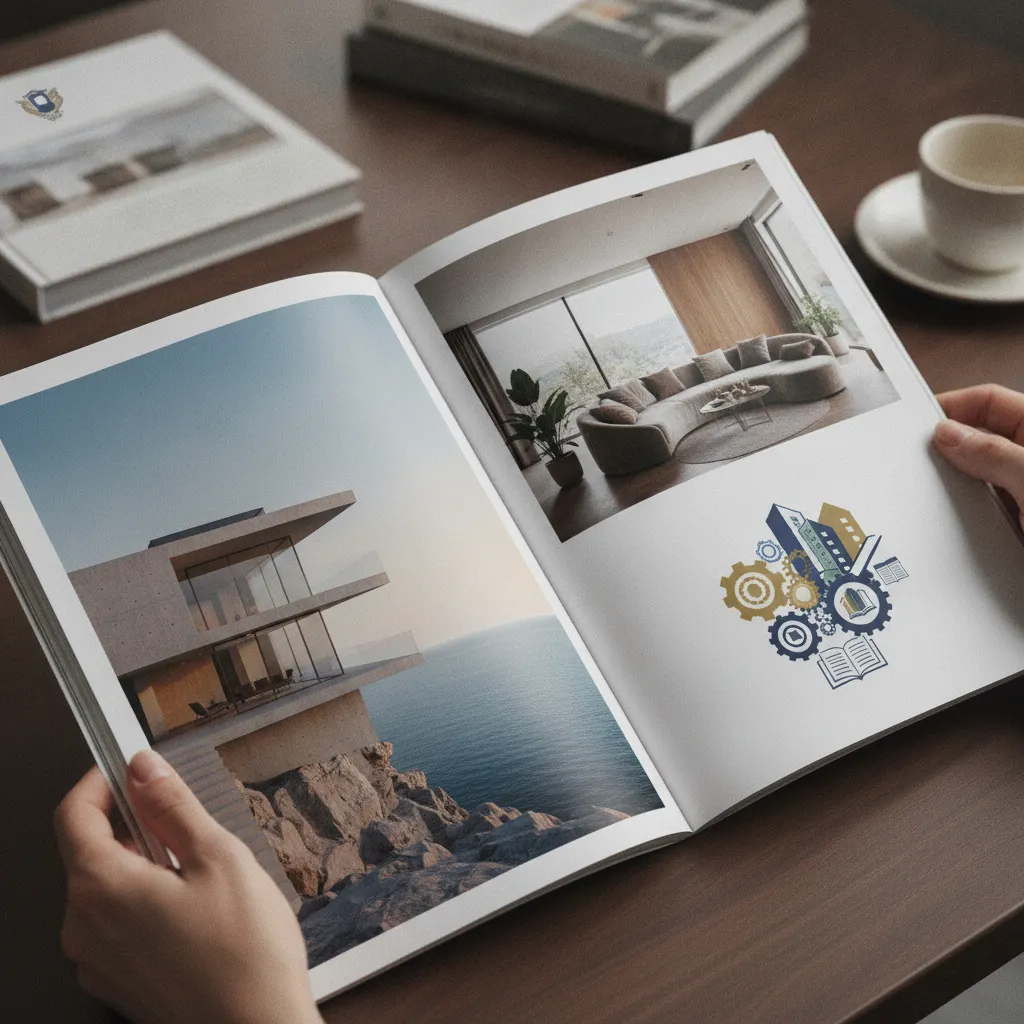
Key Benefits of Publishing Across Industries
Cross-industry magazine publishing delivers sustained brand value that most digital channels cannot replicate — because a physical publication earns undivided attention, stays visible for months, and signals quality the moment someone picks it up.
Why Print Works When Digital Feels Noisy
As of 2026, the average professional receives hundreds of digital marketing messages daily. Email open rates have declined. Social media reach is increasingly pay-to-play. The feed is saturated. A well-made print magazine arrives in a completely different mental space — it asks for time, and it rewards that time with something worth keeping.
Research from the journal Futures on the evolution of magazine publishing found that publications which co-create genuine value with their audiences build far stronger loyalty than those that treat readers as passive recipients of brand messaging [1]. This is precisely why the editorial-first model works across industries.
The practical benefits of cross-industry magazine publishing include:
- Top-of-mind awareness: A magazine sitting on a client’s desk or coffee table keeps the brand present without paying for every impression again
- Trust through quality: A beautifully produced physical object signals that the company is serious, confident, and invested in its relationships
- Owned channel: No algorithm, no ad auction, no platform deciding who sees the content — the brand controls the story entirely
- Sustained attention: Print readers engage with content for minutes, not seconds. That depth of engagement is not available in a digital format at scale
- Differentiation: Almost no company in any given sector does this well. A great magazine immediately separates a brand from its category
- Brand DNA made tangible: It turns what a company stands for into something people can hold, read, and feel — not just a website they visit once
The Longevity Advantage
A digital post has a lifespan measured in hours. A well-made magazine has a lifespan measured in months, sometimes years. In practice, publications produced for hospitality clients end up in guest rooms, waiting areas, and reception desks long after the issue date. A magazine produced for a law firm gets passed between partners and left on meeting room tables. That sustained visibility is a compounding asset, not a one-time campaign.
Industry analysts note that luxury and premium brands in particular are reinvesting in print as of 2024-2026, precisely because digital saturation has made physical media scarce and therefore more valuable. The global custom publishing market was estimated at approximately $2.8 billion in recent years, with growth driven by brand-funded publications rather than traditional advertising-supported media.
Pro Tip: Don’t measure a brand magazine against the same metrics you use for a digital campaign. The right question isn’t “how many clicks did it generate?” It’s “how did this change how our best clients perceive us?” Those are different questions with very different answers.
Common Challenges and Mistakes
The most common failure in cross-industry magazine publishing isn’t poor design or weak writing — it’s starting with the wrong intention, treating a magazine as a brochure with more pages rather than as a genuine editorial product.
The Brochure Trap
A common mistake is letting the sales or marketing team drive the content agenda without an editorial counterweight. The result is a publication full of product descriptions, executive quotes that read like press releases, and photography that looks like it came from a corporate stock library. People can feel the difference between a magazine made with genuine editorial intent and one assembled to fill a format. The former gets kept. The latter gets recycled.
Other frequent pitfalls in cross-industry magazine publishing include:
- Skipping the editorial spine: Jumping straight to design without defining what the publication stands for produces beautiful-looking content that says nothing memorable
- Inconsistent publishing cadence: Producing one issue and then going quiet for 18 months undermines the brand-building effect entirely — consistency is what builds anticipation and recall
- Underestimating production complexity: Print production involves pre-press, colour management, paper selection, print proofing, and logistics that require specialist expertise to execute well
- Treating it as a one-person job: High-quality cross-industry magazine publishing requires a coordinated team covering editorial direction, writing, photography, design, and production management simultaneously
- Measuring it like a digital campaign: Expecting immediate lead generation from a brand magazine sets up a false failure. The value is brand equity, not click-through rates
The In-House Illusion
Many companies attempt to produce a magazine using internal marketing teams or a combination of freelancers. In practice, this rarely produces a result that matches the brand’s ambitions. The problem isn’t talent — it’s coordination and specialist depth. Editorial direction, design-led layout, colour craft, and print production are four distinct disciplines that need to work in tight sequence. Without an experienced production studio holding the process together, the timeline expands, quality suffers, and the final product looks exactly like what it is: assembled rather than made.
The Commonwealth Beacon’s analysis of regional publishing illustrates how even well-resourced organizations struggle to sustain print publishing quality without dedicated specialist infrastructure [4]. That challenge is amplified when publishing is not the company’s core business.
Best Practices for Cross-Industry Magazine Publishing in 2026
The brands getting the most out of cross-industry magazine publishing in 2026 share a few consistent habits: they invest in editorial strategy before design, they publish consistently, and they treat the magazine as a long-term brand asset rather than a one-off project.
Build the Editorial Strategy First
At Rethink Publishing, we’ve found that the single biggest predictor of a magazine’s success is how clearly the editorial spine is defined before production begins. A strong editorial spine answers three questions:
- What does this publication stand for, independent of the brand’s products or services?
- What would a reader choose to read this over — what genuine value does it deliver?
- What is the consistent thread that makes every issue feel like part of the same publication?
Once those questions are answered clearly, every subsequent decision — content commissioning, photography direction, design language, paper stock — becomes much easier to make well.
Practical Guidelines for Any Industry
These principles apply whether the brand is a private members’ club, an enterprise software company, or a luxury real estate developer:
- Define your reader before your content: A magazine for a brand’s top 200 clients should read very differently from one distributed at industry events. Know exactly who you’re making it for
- Commission original content: Repurposed blog posts and recycled press releases are immediately detectable. Original editorial — interviews, commissioned essays, reported features — is what makes a publication feel serious
- Invest in photography: Images are not decorative. They carry the emotional weight of the publication. Weak photography undermines strong editorial every time
- Choose paper and finish deliberately: The physical experience of a magazine — how it feels in the hand, how it opens, how the ink sits on the page — is part of the brand message
- Plan for multiple issues from the start: A single issue is an introduction. Two or three issues is a publishing program. The brand equity compounds with each issue
- Work with specialists, not generalists: Cross-industry magazine publishing at a high level requires people who have done it before, across multiple sectors, at scale
Pro Tip: The best test of whether your magazine is working is simple: are your clients keeping it? If you visit a client six months after delivery and the magazine is still on their desk or bookshelf, the investment is working. If it went in the recycling bin the week it arrived, something in the editorial or production process needs to change.
Sources and References
- Futures Journal, “The futures of magazine publishing: Servitization and co-creation of value,” 2014
- Community of Literary Magazines and Presses, “Directory of Publishers,” 2026
- Diffusion Research Institute, “Publications and Cross-Industry Perspectives,” 2026
- Commonwealth Beacon, “Boston tries to keep a token presence in the magazine publishing industry,” 2023
Frequently Asked Questions
1. What is the future of magazine publishing?
The future of magazine publishing is bifurcated. Mass-market, advertising-supported print titles will continue to consolidate or migrate to digital formats. But brand-owned, custom print magazines are growing, particularly among premium and luxury brands who recognize that physical media’s scarcity is now a strategic advantage. As of 2026, the most durable model is the brand-funded publication with a clear editorial spine, produced for a specific audience rather than sold on newsstands. Cross-industry magazine publishing is central to this shift, as companies across sectors discover that a well-made print publication builds the kind of trust and brand recall that no digital channel currently delivers.
2. What are the 9 types of magazines?
Magazines broadly divide into consumer titles (general interest, lifestyle, fashion, food, health, sport, culture, and entertainment) and trade or professional publications (industry-specific titles targeting practitioners in a given field). A more useful framework for brand decision-makers adds a third category: custom or brand magazines, which are funded and owned by a company rather than sold to subscribers. This third category is where cross-industry magazine publishing sits. It includes hospitality titles, real estate publications, professional services journals, and enterprise brand magazines — all produced with the same editorial discipline as consumer magazines but serving a specific, defined audience rather than the general public.
3. How long does it take to produce a brand magazine?
A high-quality brand magazine produced end-to-end by a specialist studio typically takes around 17 weeks from initial brief to delivery. This covers editorial strategy, content commissioning and writing, photography, design and layout, review rounds, pre-press, print production, and shipping. Attempting to compress this timeline significantly tends to compromise quality at one or more stages. The editorial and design phases in particular require time to do well — rushed layouts and underdeveloped content are immediately visible in the final product.
4. Which industries benefit most from custom magazine publishing?
Any industry where client relationships are long-term, where trust is a competitive differentiator, and where brand perception drives purchasing decisions is a strong candidate for cross-industry magazine publishing. In practice, this includes hospitality, luxury real estate, architecture and design, private clubs, law and professional services, private aviation, and enterprise technology including cybersecurity. The common thread is not the sector itself but the nature of the client relationship: high-value, relationship-driven, and reputation-sensitive.
5. Can a company manage magazine production in-house?
Technically, yes. In practice, the results rarely match the brand’s ambitions. High-quality magazine production requires simultaneous expertise in editorial direction, commissioned writing, photography, design-led layout, colour management, print pre-press, and logistics. Internal marketing teams typically have strong skills in one or two of these areas, not all of them. The coordination overhead alone tends to stretch timelines and dilute quality. Most companies that attempt in-house production either produce something that looks assembled rather than made, or they quietly outsource most of the work anyway — without the benefit of a studio that has done it 80+ times before.
6. Is print magazine publishing worth the investment for a B2B brand?
For the right B2B brand, a custom print magazine is one of the highest-return brand investments available — precisely because so few B2B companies do it. A well-produced publication sent to a firm’s top 200 clients or prospects delivers sustained visibility, signals seriousness, and creates a physical touchpoint that no email campaign or LinkedIn post can replicate. The investment is real, and it is not a short-term lead generation tool. But for companies focused on long-term client relationships, brand authority, and differentiation in a crowded market, the return compounds over time in ways that are genuinely difficult to replicate through digital channels alone.
Cross-industry magazine publishing, done with genuine editorial discipline and specialist production craft, is one of the few marketing investments that actually gets better over time. Each issue builds on the last. The brand’s presence compounds. And the publication itself becomes an artifact that clients associate with quality, care, and confidence.
Rethink Publishing has spent more than 20 years producing high-end magazines and coffee-table books across hospitality, real estate, law, cybersecurity, architecture, and design. The process is fully managed, editorially led, and built on the belief that a great publication is worth making properly. If your brand is ready to invest in something with real weight, visit rethink-publishing.com to start a conversation.
Recommended Articles
Explore more from our content library: