
Understanding print magazine marketing benefits is essential. A custom print magazine delivers measurable marketing benefits by converting brand spend into a physical asset that extends dwell time, builds credibility through tactile quality, and keeps working long after a digital ad disappears. Unlike a campaign that ends when budget runs out, a well-made magazine sits on a desk or coffee table for months, gets reread, passed along, and associated with the quality of the brand behind it. For leadership, the case for print magazine marketing benefits rests on longevity, trust-building, and brand perception, not impressions or click-through rates.
Below is a quick summary of the core print magazine marketing benefits covered in this article:
- Long-term brand asset value that keeps working after the budget is spent
- Credibility and trust built through a tactile, intentional format
- Measurable business impact leadership can track over time
- Editorial strategy and design quality that drive real results
- Seamless integration with existing digital and marketing channels
- Stronger returns in trust-dependent, relationship-driven industries
- End-to-end production that protects quality from strategy to delivery
- Physical keepsake value that earns a place in people’s hands and homes
1. Long-Term Brand Asset Value, The Core Print Magazine Marketing Benefit
A custom magazine keeps working on a coffee table for months after a digital ad has already disappeared from someone’s scroll. That difference in lifespan is the foundation of every print magazine marketing benefit that follows.
A digital ad earns a few seconds of attention, if that, before the next post pushes it off screen. A well-made magazine sits in a reception area, a living room, or a waiting room for weeks, gets picked up more than once, and gets handed to someone else entirely. No new spend is required for that second or third read, the object simply stays where it was placed and keeps doing its job.
This is not a case for print advertising in general. Buying ad space inside someone else’s publication is still a rented slot with someone else’s editorial around it. A custom magazine is owned content, built entirely around your brand’s point of view, with no expiration date tied to a media budget.
This distinction matters most to leadership teams who think about marketing as capital investment rather than a recurring line item that resets to zero every quarter, and it’s one of the print magazine marketing benefits that’s easiest to explain in financial terms.
2. Credibility and Trust Built Through Tactile, Intentional Format
A printed magazine signals that a brand invested real time and money before asking for anyone’s attention, and that signal transfers directly to perceived credibility. This is one of the print magazine marketing benefits that’s harder to quantify but easy for any reader to feel.
Why Do Consumers Respond Differently to Print Than Digital Content?
Digital content costs almost nothing to produce and even less to ignore. A social post can be thrown together in an afternoon and forgotten by the next one. Printing, binding, and mailing a magazine takes real commitment, paper, production time, a print run that can’t be quietly deleted if it underperforms. Readers register that effort, even if they never think about it consciously, and read it as sincerity rather than a sales pitch.
How Does the Tactile, Intentional Nature of Print Shape Brand Perception?
Holding a magazine means nothing else is competing for that moment. There’s no autoplay video, no next-post temptation, no notification pulling attention sideways. That singular focus is rare, and brands that can command it stand out simply by not competing for the same five seconds everyone else is fighting over.
This benefit compounds for brands in trust-dependent sectors, professional services firms, real estate groups, hospitality brands, and law firms, where clients are making high-stakes decisions and look for signals of permanence before they commit. Brands in these sectors tend to see the print magazine marketing benefits compound fastest, since every reread reinforces the same impression of stability.
3. Measurable Business Impact Leadership Can Track Over Time
Print results show up in referrals, retention, and sales conversations rather than click-through rates, and leadership can track all three with simple, consistent habits.
What ROI Metrics and Attribution Methods Work Best for Print Magazine Campaigns?
Dedicated landing pages, QR codes, and unique promo codes printed inside the magazine give an immediate response signal, how many people acted on what they read. Those numbers matter, but they’re only half the picture. The other half shows up in how often a prospect mentions the magazine unprompted during a sales call, or how a long-standing client describes why they stayed.
Immediate response metrics, inquiries, referrals, redeemed codes, tell you the magazine is being read. Longer-term brand equity signals, client retention rates, the ability to hold premium pricing, how a brand gets described by people who’ve never bought anything yet, tell you it’s changing how the business is perceived. Both belong in the same report, not just the one that’s easier to pull from a dashboard. Understanding brand equity is useful context here, and the Harvard Business School explainer on brand equity is a solid primer on how these longer-term signals get built and measured.
Print attribution is slower and relationship-driven rather than click-driven, which is why it gets dismissed by teams used to measuring everything in real time [3]. A magazine someone received in March might come up in a conversation in September. That’s not a failure of measurement, it’s how a physical asset with a longer lifespan behaves, and it’s one of the print magazine marketing benefits that resists easy dashboards.
The practical habit worth building now: ask every new client or lead where they heard about you, and log the answer the same way every time. After a year of consistent logging, the pattern of how a magazine influences the pipeline becomes obvious without needing a complicated attribution model.
4. Editorial Strategy and Design Quality That Drive Results
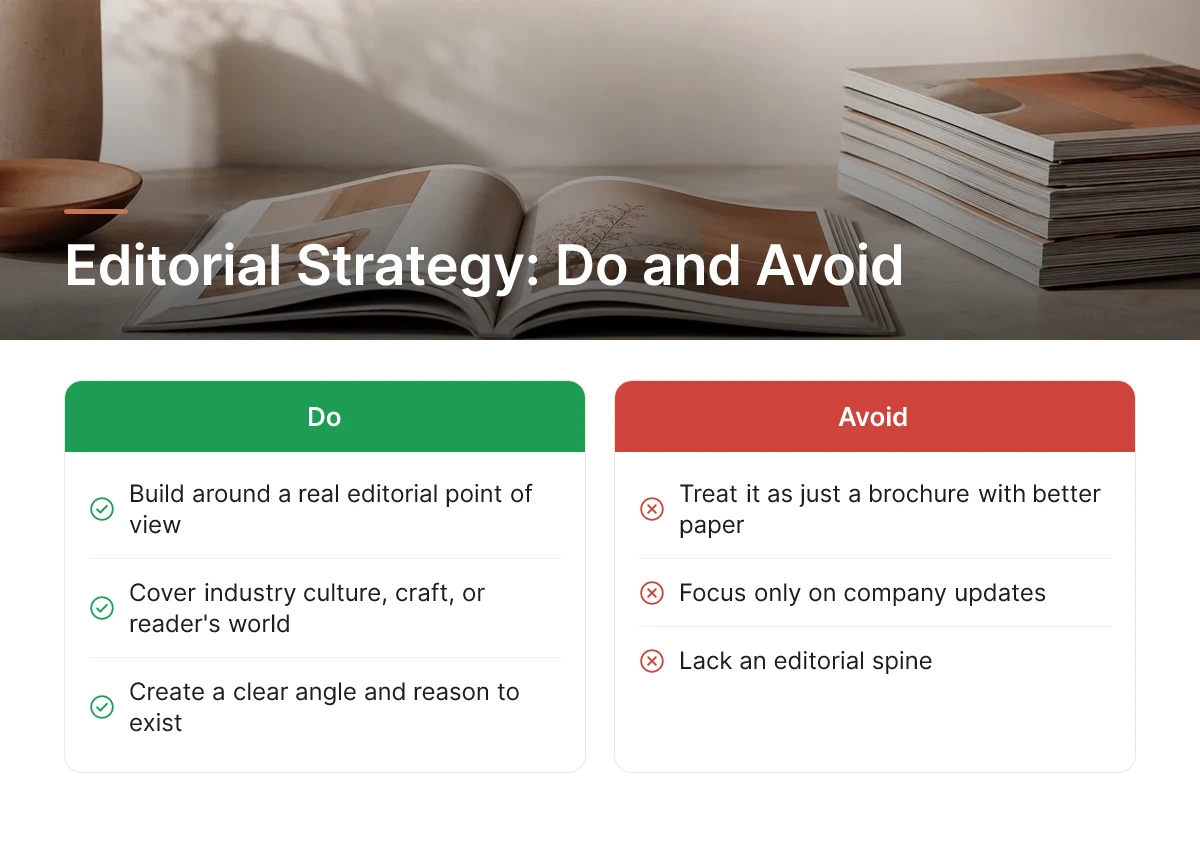
A magazine only delivers print magazine marketing benefits if it’s built around a real editorial point of view, the printing itself does nothing on its own.
An editorial spine means the magazine has a clear angle and a reason to exist beyond company updates. It might cover an industry’s culture, the craft behind a product, or the world a client lives in, something a reader would want even if your logo weren’t on it. Without that spine, a magazine is just a brochure with better paper, and readers can tell within the first two pages [1].
How Does the Editorial Spine and Design Approach Determine Whether a Magazine Becomes a Keepsake?
Layout, paper stock, typography, and pacing decide whether someone reads an issue once and recycles it or keeps it on a shelf. A magazine that paces itself like a real publication, features, breathing room, a rhythm between image and text, asks to be revisited. One that crams every page with company news asks to be thrown away.
Restraint signals quality more reliably than volume. Adding more pages or more photos doesn’t make a magazine feel more premium; a curated, deliberately edited issue does. That discipline, knowing what to leave out, is exactly what separates an editorially credible magazine from a stack of marketing collateral bound together, which is the standard Rethink Publishing builds every issue around, starting with the editorial spine before a single layout decision gets made.
5. Seamless Integration With Your Digital and Marketing Channels
A print magazine performs best when it reinforces existing digital marketing rather than competing with it for a separate budget line.
How Do You Build a Cohesive Strategy Using Print and Digital Together?
The practical connection points are straightforward: mail the magazine to warm email leads who’ve already shown interest, post individual spreads as social content, hand a copy to a prospect as a leave-behind after a sales meeting. None of that requires new infrastructure, it just requires treating the magazine as part of the same campaign as everything else already running.
Think of it as a retargeting mechanism in physical form. It’s not built for cold outreach, it’s built to re-engage people already somewhere in the funnel, giving them a reason to spend fifteen minutes with the brand instead of three seconds.
The common mistake is budgeting print and digital as if they’re unrelated line items reporting to different goals. They’re not. Digital builds initial awareness at scale; the magazine deepens trust once a prospect reaches the consideration stage and is deciding whether this brand is worth a longer relationship. Sequenced that way, each channel does the job the other one can’t.
6. Industries and Business Types That See the Strongest Returns
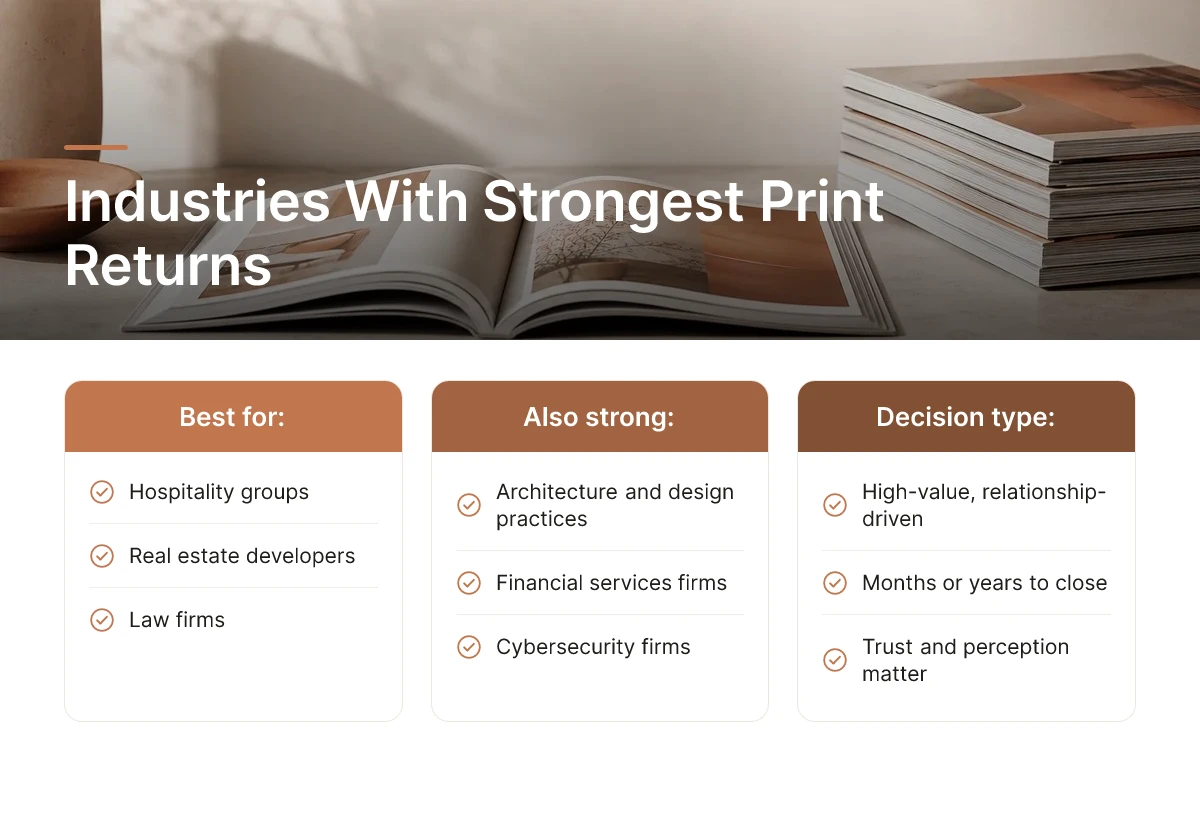
The strongest print magazine marketing benefits show up in industries where trust, taste, and perception drive high-value decisions, not transactional, price-driven purchases.
Hospitality groups, real estate developers, law firms, architecture and design practices, and financial services firms all sell through relationships that take months or years to close. A magazine fits naturally into that timeline because it does the same job a good relationship does: it stays present without pushing. Less obvious fits earn a place too, cybersecurity firms selling into boardrooms, for instance, use a magazine to translate technical credibility into something a non-technical decision-maker can feel confident about.
Long sales cycles reward slow-burn trust-building. A LinkedIn post disappears in a day; a well-made magazine sits on a reception table or a coffee table for a year, doing quiet work every time a prospect picks it up.
Industries that typically see the strongest print magazine marketing benefits share a few common traits:
- Long, relationship-driven sales cycles rather than impulse purchases
- High-value transactions where trust and taste influence the decision
- A need to translate complex or technical credibility into something tangible
- Repeat client relationships where retention matters as much as acquisition
What Size Company or Budget Level Makes Sense for a Custom Print Magazine?
Company stage matters more than company size. This works for established companies with a brand worth reinforcing, not early-stage startups still finding product-market fit and still changing their story every quarter. Budget tier matters more than headcount: a law firm with a premium positioning and a modest headcount is a better fit than a larger company still competing on price.
7. End-to-End Production: Strategy, Editorial, Design, Print, Delivery
End-to-end production means one team manages strategy, editorial, design, printing, and delivery, so nothing gets lost in the handoff between vendors.
What Does End-to-End Magazine Production Include?
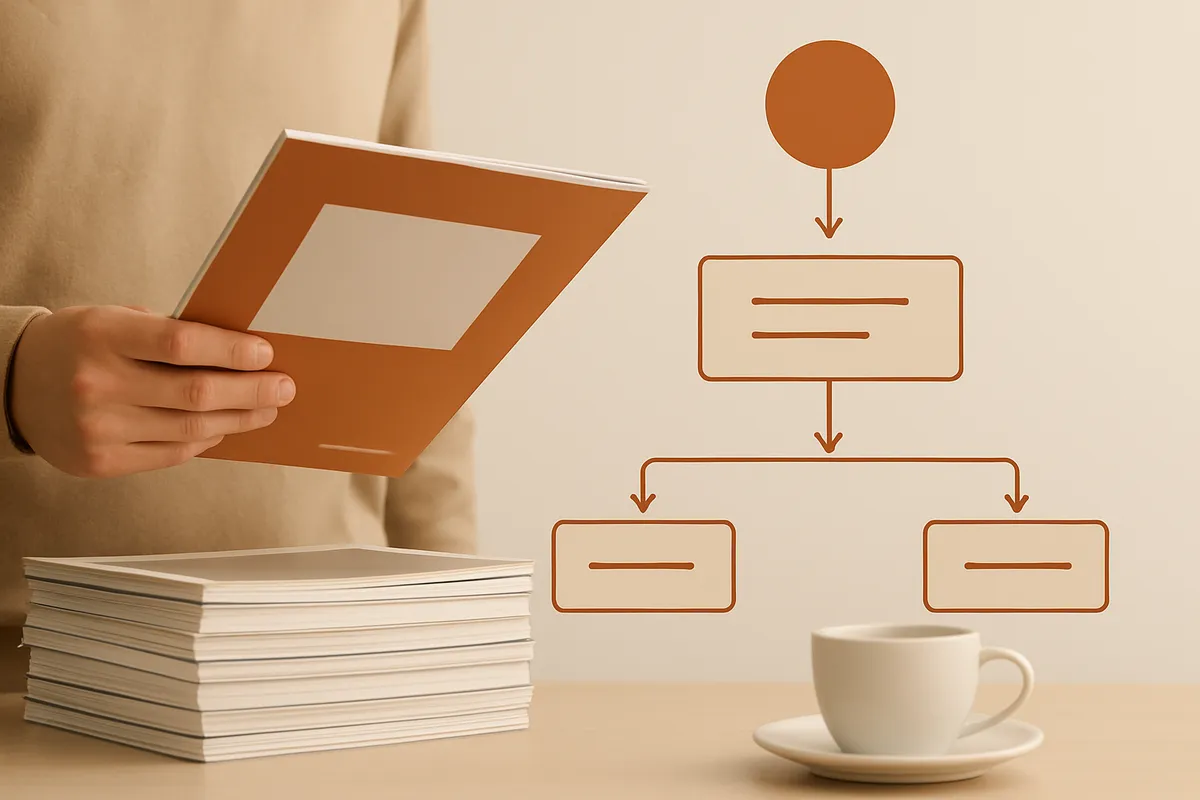
The sequence runs in order: strategy and positioning first, deciding what the magazine needs to say and to whom, then editorial planning, where that strategy becomes a table of contents with a real spine. Content and design production follows: writing, image sourcing, and layout happen together, not as separate departments passing files back and forth. Print production and finishing come next, and distribution and delivery close the cycle.
Rethink Publishing runs all five stages under one roof, which matters because the usual failure point in branded publishing isn’t any single stage, it’s the gap between stages. A strategy firm hands off a brief to a copywriter who’s never spoken to the brand, who hands a draft to a designer with no context, who hands files to a printer with no oversight. Each handoff loses intent.
Paper stock, binding method, and finishing decide whether the result feels like a premium object or a flimsy handout, matte versus gloss, perfect binding versus saddle-stitch, spot varnish on a cover. These choices are small individually and decisive together.
Treat the timeline as a considered production cycle, not a rush job. Editorial work and print quality both suffer when compressed.
8. A Physical Keepsake That Earns a Place in People’s Hands and Homes
A magazine kept on a coffee table or office shelf gets seen repeatedly by people who never engaged with the brand’s digital marketing at all.
That’s the mechanism behind this particular print magazine marketing benefit: objects placed in a home or office become passive, repeated exposure. A client’s business partner, dinner guest, or colleague sees the cover on a table and absorbs the brand without a single ad impression being bought. Digital content can’t replicate that, a social post reaches whoever scrolls past it once, then it’s gone.
What Separates a Magazine That Gets Kept From One That Gets Thrown Away?
Paper weight, cover design, and content depth decide whether a magazine gets displayed or recycled after one skim. A thin, glossy pamphlet with stock photography reads as marketing and gets treated like marketing, filed in the recycling bin within a week.
Here’s the uncomfortable part: not every piece of print earns keepsake status. Mediocre execution gets thrown away regardless of being physical, paper doesn’t fix weak editorial content or a forgettable cover. What drives display-worthiness is specific: strong cover photography that could stand alone as art, restrained layout that doesn’t crowd the page, and content people actually want to revisit, not just skim once for the brand logo.
How to Choose the Right Print Magazine Investment for Your Company
Choose a custom magazine only if your brand has a real story, a trust-dependent sales cycle, and the budget to commit beyond a single issue.
What Questions Should Leadership Ask Before Committing to a Print Magazine Project?
Three questions separate the right fit from a mistake. Does the brand have something distinctive to say, a point of view, a history, a craft, or just a service to describe? Does the sales process depend on trust built over months, not a single transaction? And can the company commit to sustained production, issue after issue, rather than a one-off vanity project that nobody follows up on?
If the honest answer to the first question is no, wait. A brand with nothing distinctive to say yet will produce a magazine that reads like a brochure with better paper, and readers notice the difference immediately.
Weigh this against other premium brand-building spend the same way: not by unit cost, but by how long the asset keeps working after the money’s spent. A sponsorship fades at the end of the event; a well-made magazine sits on a desk for a year. This is ultimately how the print magazine marketing benefits should be judged, against the full lifespan of the asset, not a single moment of exposure.
The reasonable next step isn’t a full production commitment. It’s a strategy conversation, the kind Rethink Publishing starts every engagement with, to find out honestly whether a magazine fits the brand before anyone commits budget to finding out the hard way.
Frequently Asked Questions
Is print advertising still effective in a digital-first world?
Yes, print is seeing renewed investment from premium brands precisely because digital attention has become commoditized. Luxury brands are reinvesting in print as a differentiator, treating physical media’s scarcity as a strategic asset rather than a relic [1]. A custom magazine isn’t competing with a banner ad; it’s competing for a few unhurried minutes on someone’s coffee table, which digital rarely earns anymore.
What tangible advantages does a custom magazine have over standard digital marketing channels?
A magazine stays in a client’s home or office for months, while a social post disappears in days. Digital content gets scrolled past; a printed piece gets picked up, shared with peers, and re-read. Custom magazines build emotional connection and loyalty in a way that’s harder to ignore than another email or feed post [4], because the reader chose to engage with it rather than having it interrupt them.
What is the difference between a custom brand magazine and buying an ad in an existing publication?
An ad buy rents someone else’s audience for a page; a custom magazine builds your own publication around your brand, your story, and your clients. You control the editorial spine, the design, and who receives it, there’s no competing advertiser on the facing page. It’s an owned media asset, not a rented placement, which is why it compounds in value over multiple issues rather than expiring after one print run [1].
How do you evaluate whether print magazine marketing aligns with your brand and business goals?
Start by asking if your brand depends on trust, taste, and long-term relationships rather than impulse purchases. If your clients are high-value and relationship-driven, real estate, hospitality, law, private clubs, a magazine reinforces the credibility and consistency that build brand equity over time [5]. If you’re chasing quick conversions, a magazine is the wrong tool; it’s built for a slower sales cycle, and understanding the full range of print magazine marketing benefits upfront will help set the right expectations.
Why does Swiss-level precision and intentional curation matter in custom magazine production?
Because a magazine with sloppy production or thin editorial direction reads as corporate collateral, not a brand artifact worth keeping. Creative standards function as business standards, the quality of the paper, layout, and writing signals the quality of the brand itself [1]. Rethink Publishing builds every issue around a defined editorial spine before design begins, which is what separates a magazine people keep from one they recycle.

Conclusion
A custom magazine earns its place in your marketing budget when it does three things a digital campaign can’t: it survives in a client’s home for months, it signals the taste and authority of your brand through production quality, and it builds the kind of brand equity that compounds across issues rather than expiring with an ad spend [5]. The brands reinvesting in print right now aren’t nostalgic, they’re responding to digital saturation with scarcity [1]. If you’re weighing whether this fits your brand, start by auditing what physical touchpoints your top clients currently receive from you. If the answer is none, that’s your opening move, and a conversation with Rethink Publishing is the next one.
Sources & References
- The commercial print strategy luxury brands often overlook
- Why Investing in Brand is Essential for Long-Term B2B Success
- Should B2C Brands Invest in a Magazine? | Tulip Media Group
- Brand Equity Explained: How to Build and Measure Success
Recommended Articles
Explore more from our content library: